
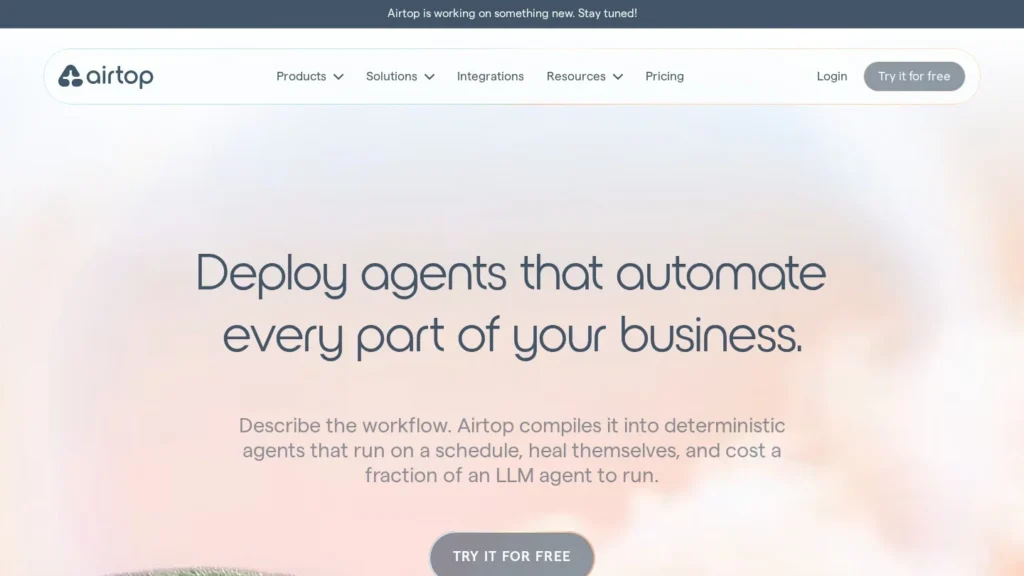
Airtop is a no-code builder for browser agents. You describe a web task in plain English, such as signing in to a portal, downloading invoices and reconciling them, and Airtop compiles it into an agent that runs in its cloud browsers on a schedule, by webhook or on demand. In Airtop’s own test, a compiled agent finished a task in 1 minute 21 seconds for $0.063, while Claude Code took nearly 8 minutes and $6.26. It suits operations, sales and marketing teams that repeat the same web chores every week.
There is a free plan, and paid plans start at $29 a month. The pricing page sells credits without listing how many a typical run uses, so real costs depend on testing your own workflows; a per-run credit guide would help buyers plan. This review is based on Airtop’s published product pages, pricing and a LangChain customer story; we have not tested the product hands-on.
Free Credits, Paid Tiers and Compiled Browser Agents
- Starting price: free plan with 1,000 credits a month; paid plans from $29, $189 and $558 a month, 10% off annually.
- Compiled, not improvised: agents become reusable code, and Airtop measured one at $0.063 per run against $6.26 for Claude Code on the same task.
- Self-repair with approval: failed runs get an automatic diagnosis and a repair draft that only goes live when a person deploys it.
- Security: SOC 2 Type 2 and HIPAA, isolated encrypted sessions and no training on customer data, per Airtop.
- Our score: 8.8/10, strong on setup, autonomy and published pricing, with room to grow through clearer credit use and public ratings.
Airtop’s Published Speed and Cost Test Results
Airtop publishes more concrete numbers on its product pages than most no-code automation startups. Each figure below was checked on the source page.
| Fact | Detail | Source and date |
|---|---|---|
| Compiled agent test | A compiled agent took 1 minute 21 seconds and cost $0.063; Claude Code (Opus 4.7) took 7 minutes 58 seconds and cost $6.26 on the same task | Airtop Agent Builder page, accessed October 2026 |
| Claimed savings | Compiled agents described as up to 100x cheaper and up to 6x faster than prompt-based agents | Airtop Agent Builder page, accessed October 2026 |
| Concurrency | Up to 100 simultaneous browser sessions, with logs, session replay and batch runs across URL lists | Airtop Agent Builder page, accessed October 2026 |
| Templates | More than 85 precompiled templates | Airtop Agent Builder page, accessed October 2026 |
| Free plan | $0 with 1,000 credits a month, a one-time 10,000 credit bonus, 3 sessions and 1 deployed agent | Airtop pricing page, accessed October 2026 |
| Top published plan | Enterprise from $558 a month with up to 1.5 million credits, unlimited agents and 100 sessions | Airtop pricing page, accessed October 2026 |
| Compliance | HIPAA and SOC 2 Type 2; customer data never used for AI training; each session in its own encrypted environment | Airtop pricing page, accessed October 2026 |
| Engineering stack | Each browser automation built as a LangGraph subgraph, with LangSmith used for debugging and testing across GPT-4 series, Claude, Fireworks and Gemini models | LangChain customer story, November 26, 2024 |
| Named customer | Cared.io’s chief product officer says automated invoice reconciliation saves her hours each week | Airtop Agent Builder page, accessed October 2026 |
| Second product | Mark, described as the first AI employee built on Airtop, plans, builds and runs a go-to-market loop from chat | Airtop about page, accessed October 2026 |
For a buyer, the cost comparison is the most important line. Our arithmetic on Airtop’s figures puts the compiled run at roughly 99 times cheaper and about 5.9 times faster than the Claude Code run. That matches the “up to 100x” and “up to 6x” claims, but it is one task chosen by the vendor. The logic still holds broadly: an agent that calls a large model at every step pays for every click, while a compiled agent pays mostly for browser time.
The LangChain story matters for a different reason. It shows Airtop built its automations on widely used open frameworks and can switch between model providers, which reduces the risk of being tied to one model vendor’s pricing or outages.
Agent Builder, Web Automation and the Shared Browser Layer
Airtop has three product lines on the same browser infrastructure: Agent Builder for no-code agents, Web Automation for developers who want to give their own AI agents access to the web, and Mark, an AI go-to-market employee. Most buyers will start with Agent Builder.
From Plain-Language Task to Compiled Agent
- Describe the task: write in plain language what the agent should do, or start from one of more than 85 templates.
- Compile: Airtop turns the description into an agent backed by reusable code rather than a prompt that a model re-reads on every run.
- Add credentials: logins are stored in a secure vault so the agent can sign in to sites that require an account.
- Choose a trigger: run on a schedule, from a webhook or on demand, and use batch mode to process a list of URLs.
- Watch and review: logs and session replay show each run, and up to 100 sessions can run at once on the top plans.
What Happens When a Site Changes
Browser automations usually break when a site moves a button or renames a field. Airtop diagnoses failed runs and writes a repair draft. The draft does not go live until a person deploys it, which keeps a human in charge of changes to production agents while sparing them the debugging work.
LangGraph Subgraphs and LangSmith Tracing
According to LangChain’s November 2024 customer story, Airtop built each browser automation as a subgraph in LangGraph, so new capabilities can be added without redesigning the control flow. It used LangSmith to debug issues raised in support tickets, test prompts and compare models. At the time it offered an Extract API for pulling structured data from pages, including sites behind a login, and an Act API for typing queries and clicking interface elements. Its CTO, Daniel Shteremberg, credited the framework with letting the team switch models easily.
Features for Teams
The platform lists shared authentication, an embedded live view, audio support and web scraping. It connects to n8n, Zapier and Make, so an Airtop agent can become one step in a larger automation, and to Claude Code and Codex for developers who want coding agents to use real browsers.
Choosing the Right Plan
Plan limits are set mostly by concurrency and the number of deployed agents rather than by features. Free and Starter both allow three simultaneous sessions, which suits agents that run one at a time overnight. Professional jumps to 30 sessions and 30 agents, the level a team needs when several people build agents or a batch job must work through hundreds of URLs quickly. Enterprise adds 100 sessions, unlimited agents and the SOC 2 Type 2 report that procurement teams often ask for. Custom plans exist for volume buyers who need more sessions or credits than Enterprise provides.
Credentials and Repair Approvals Need a Person
People decide which workflows to automate, supply credentials, approve repair drafts and check results. Airtop handles the clicking, typing and data collection. For anything that moves money or changes records, a review step in your own process is still sensible.
Four Plans With Credit Tiers From $0 to $558
Airtop publishes its plans. Each paid plan has several credit tiers, and the prices below are the starting points.
| Plan | Price | Billing | What’s Included | Limits |
|---|---|---|---|---|
| Free | $0 | Monthly | 1,000 credits a month plus a one-time 10,000 credit bonus; Mark trial | 3 simultaneous sessions, 1 deployed agent |
| Starter | From $29 a month | Monthly or annual (10% off) | Credit tiers from 30,000 to 150,000, integrated proxy, Airtop support | 3 sessions, 10 deployed agents |
| Professional | From $189 a month | Monthly or annual (10% off) | 225,000 to 500,000 credits, custom proxy, Mark included, dedicated support | 30 sessions, 30 deployed agents |
| Enterprise | From $558 a month | Monthly or annual (10% off) | 775,000 to 1.5 million credits, SOC 2 Type 2 report, Mark included | 100 sessions, unlimited agents |
| Custom | Quote | Custom | Volume pricing and custom credits, Mark included | Custom sessions |
Free Testing, Then Starter at $29 for One Operator
Solo operator automating a few reports. The free plan covers testing. Moving to Starter at $29 a month costs $348 a year, or $313.20 with the 10% annual discount. Three simultaneous sessions are enough for a handful of scheduled agents that run one after another.
Sales or operations team running agents in parallel. Professional at $189 a month comes to $2,268 a year, or $2,041.20 billed annually. It lifts the limits to 30 deployed agents and 30 simultaneous sessions and includes Mark.
Company that needs a SOC 2 report for vendor review. Enterprise starts at $558 a month, $6,696 a year, or $6,026.40 annually. It is the only published plan that lists the SOC 2 Type 2 report, 100 sessions and unlimited agents.
Variable costs. Credit use is the main thing to measure. The pricing page does not yet say how many credits a run, a minute of browser time or a page of extraction uses, so run your real workflows on the free plan and watch the meter. Annual plans require paying for all credits upfront, so measuring first helps you pick the right tier.
Airtop Compared With Browser Use, Skyvern and Amazon Nova Act
These agents all drive real browsers, but they target different buyers. Airtop and Skyvern give non-developers a workflow builder, Browser Use is primarily an open-source library with a hosted cloud, and Amazon Nova Act is an AWS service for developers.
| Tool | Starting Price | Free Plan | Main Strength | Main Trade-Off | Best For |
|---|---|---|---|---|---|
| Airtop | Free; from $29 a month | Yes | No-code agents compiled into reusable code | Credit use per run not published | Business teams automating recurring web tasks |
| Browser Use | Free open source; cloud pay as you go | Limited | Popular open-source library plus hosted cloud | Developers write and maintain the code | Engineering teams building their own agents |
| Skyvern | $29 a month (Hobby) | No | Vision-based workflows with CAPTCHA, 2FA and password manager support | Credits tied to actions can climb | Form-heavy back-office workflows |
| Amazon Nova Act | $4.75 per agent hour | Pay as you go | AWS-native fleets with monitoring and human escalation | Python and AWS skills needed | Companies already on AWS |
Pick Airtop if business staff will build and own the agents and you want predictable published plans. Pick Browser Use if your engineers want full control of open-source code. Skyvern is the closest rival for form-heavy work such as insurance and procurement portals. Nova Act makes sense when your stack already lives on AWS. Developers comparing infrastructure layers should also look at Anchor Browser, and our browser automation agents page lists the full field.
Ops and Sales Teams With Weekly Portal Chores
- Operations teams with weekly portal chores: downloading invoices, updating supplier records or checking order status across logged-in sites fits the compiled-agent model.
- Sales and marketing teams: research, list building and data extraction can run on a schedule, and Mark targets go-to-market work directly.
- No-code automation users: teams already on n8n, Zapier or Make can add browser steps where an app has no API; see our workflow automation page.
- Healthcare-adjacent businesses: stated HIPAA compliance and isolated sessions suit teams that handle sensitive records, subject to their own review.
- Developers using coding agents: connections to Claude Code and Codex let those agents use real browsers.
Self-Hosters and Fixed-Budget Buyers May Prefer Other Options
- Teams that require self-hosting: Airtop runs in its own cloud; an open-source option such as Browser Use fits better.
- Buyers who need fixed costs: credit metering means spend varies with usage, and per-run credit costs are not yet published.
- One-off tasks: a general-purpose agent such as Comet by Perplexity can handle a single errand without building a reusable agent.
- Teams automating sites that forbid bots: if a site’s terms ban automated access, no tool solves that.
Credit Use and Airtop’s Own Benchmarks
- Credit burn: test real workflows on the free plan before committing, especially to an annual plan paid upfront.
- Vendor benchmarks: the 100x cost and 6x speed figures come from Airtop’s own comparison on a task it chose.
- Compliance paperwork: the SOC 2 Type 2 report is listed only on the Enterprise plan, so smaller customers may need to ask for it separately through the Trust Center.
- Site terms and stored credentials: agents sign in with real accounts, so confirm each target site allows automation and limit the access those accounts have.
- Repair approvals: repair drafts protect you from silent changes, but someone has to review and deploy them or agents stay broken.
Weekly Web Chores Are Where Airtop Pays Back
For business teams that repeat the same web tasks every week, yes. Airtop scores 8.8/10 on our scale. The compiled-agent design addresses the two biggest problems with browser agents, cost per run and fragility, and the free plan plus published prices make it cheap to find out whether it works on your sites. Human approval for repairs is a sensible default.
Clearer guidance on how credits map to real workloads, independent benchmarks and public ratings would lift the score. Start with the free plan, automate one recurring workflow end to end, track the credits it uses for a month, and then pick a paid tier.
Airtop’s Monthly Plans From Free to $558
How Much Does Airtop Cost Per Month?
Airtop has a free plan with 1,000 credits a month. Paid plans start at $29 (Starter), $189 (Professional) and $558 (Enterprise) a month, with higher credit tiers costing more and a 10% discount for annual billing.
What Is a Compiled Agent in Airtop?
It is an agent Airtop generates from your plain-language description and stores as reusable code. Later runs follow that code instead of asking a language model what to do at each step, which Airtop says makes them far cheaper and faster.
Does Airtop Train AI Models on My Data?
Airtop says it never uses customer data for AI training and runs each session in its own encrypted environment. It also states SOC 2 Type 2 and HIPAA compliance.
Can Airtop Work With Zapier, Make or N8n?
Yes. Airtop lists connections to n8n, Zapier and Make, so a browser agent can be one step in a larger workflow. It also connects to Claude Code and Codex.
What Is Mark by Airtop?
Mark is an AI go-to-market employee built on Airtop that plans, builds and runs a company’s go-to-market loop from a chat. It is included on Professional and higher plans and available as a trial on Free and Starter.
User Reviews
Nobody has rated it here yet. Be the first AI Agents Choice user to rate Airtop.