
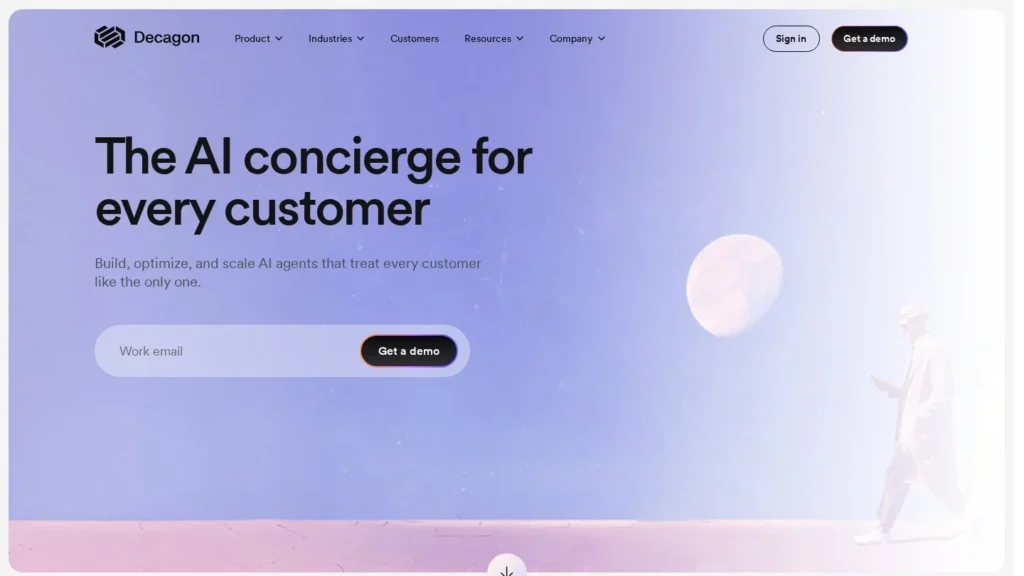
Investors valued Decagon at $4.5 billion in January 2026, less than three years after Jesse Zhang and Ashwin Sreenivas founded it in San Francisco. Its AI agents handle customer service conversations over chat, email, voice and SMS, and they do more than answer questions: they process refunds, cancel subscriptions and replace credit cards.
Customers named by the company and by analysts include Avis Budget Group, Block, Deutsche Telekom, Mercado Libre, Notion, Duolingo and Chime. Annualized revenue reached an estimated $100 million in July 2026, according to a third-party estimate.
How It Works
Decagon’s central idea is the Agent Operating Procedure, or AOP. Support teams write the steps for a workflow in natural language, much like a standard operating procedure for a human agent, and Decagon turns that into agent behavior connected to the company’s backend systems. A unified knowledge graph feeds the same answers to every channel and supports multilingual service.
Voice arrived in February 2025 through a partnership with ElevenLabs, and a second version followed that September. Proactive Agents add outbound voice calls that draw on what the system remembers about each user. For the teams running the agents, Agent Workbench helps debug conversations, Simulations test agents before they go live, and AOP Copilot manages deployments. When the agent cannot finish a task, it hands the customer to a human.
Pricing
Decagon does not publish prices. Buyers reportedly choose between two models. The more popular one charges a fixed rate for every incoming conversation, with discounts at higher volumes. The alternative charges a higher rate only when the AI resolves a conversation without human help, so escalations cost nothing, and larger resolution commitments lower the rate. Contracts are sold through a sales process, and there is no self-serve plan or free tier.
What to Watch Out For
Decagon is built for companies with large support volumes, and its sales-led model shows it. Smaller teams will find simpler, cheaper tools. The quality of the agent depends on the procedures a team writes and the systems it connects, so plan for setup and ongoing tuning. If you pick per-resolution pricing, agree in writing on what counts as a resolution. Large savings figures, such as Chime’s report of more than 60% lower contact center costs, come from customer case studies rather than independent testing.
Recent News
On January 28, 2026, Decagon closed a $250 million Series D at a $4.5 billion valuation, led by Coatue Management and Index Ventures. The round roughly tripled its valuation in under six months.
User Reviews
No reviews yet. Be the first to rate Decagon.