
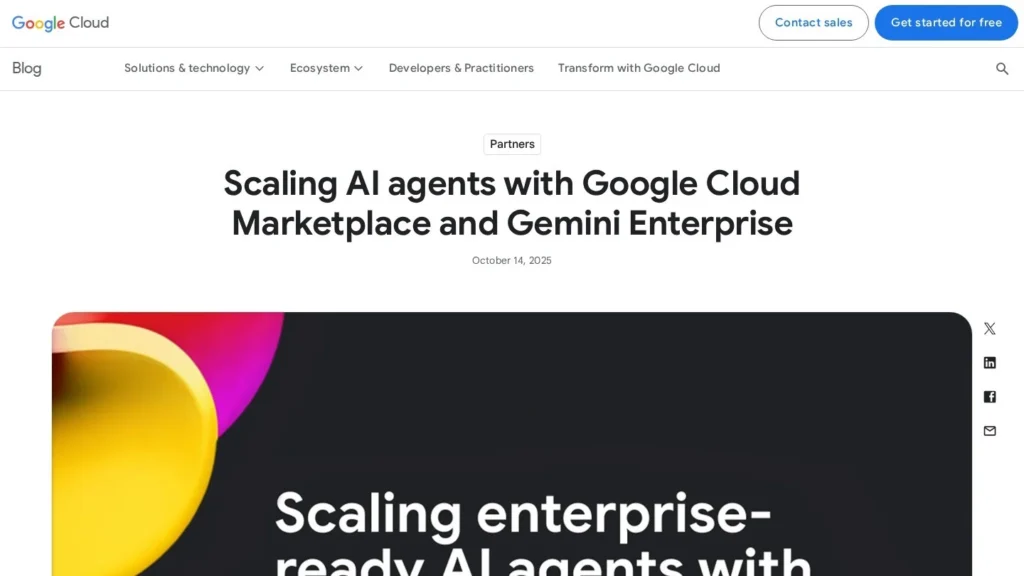
Google Cloud Marketplace’s AI agents section suits companies already on Google Cloud and Gemini Enterprise that want to add third-party agents without a new procurement process. Browsing is free, purchases land on the existing Google Cloud bill, and each agent’s price is set by its seller.
Google said in October 2025 that thousands of pre-vetted agents were listed, from partners including Box, HubSpot, UiPath and S&P Global. Buyers outside Google’s ecosystem will get less from it, and registration takes several admin roles. It scores 8.4/10 on our scale.
Google Cloud’s Agent Marketplace for Gemini Enterprise Customers
- Google Cloud Marketplace’s AI agents section sells partner agents validated for Gemini Enterprise and A2A.
- Google said in October 2025 that thousands of pre-vetted agents were available, from partners such as Box, HubSpot and UiPath.
- Buyers pay on their Google Cloud billing account; each seller sets subscription, usage, private offer or outcome-based pricing.
- A Gemini-powered agent finder supports natural-language search and multi-turn AI Mode.
- Since July 2026, developers can publish Agent-as-a-Service products through a dedicated Producer Portal type.
Google Cloud Marketplace AI Agents by the Numbers
Google’s October 2025 announcement, its Marketplace documentation and July 2026 coverage of the publishing process supply these figures.
| Fact | Detail | Source and Date |
|---|---|---|
| Agents available | Thousands of pre-vetted AI agents | Google Cloud blog, October 14, 2025 |
| Named partners | 22, including Amplitude, Box, HubSpot, Pegasystems, S&P Global, UiPath | Google Cloud blog, October 2025 |
| Seller pricing models | Subscription, usage-based, private offers, SaaS entitlements, outcome-based | Google Cloud blog, October 2025 |
| Deal size for Marketplace sellers | 112% larger, per a Futurum Research study Google cites | Google Cloud blog, October 2025 |
| Quality designation | Google Cloud Ready – Gemini Enterprise | Google Cloud blog, October 2025 |
| Search filters | Category, industry, business function, A2A and Gemini Enterprise compatibility | Google Cloud docs, 2026 |
| Publishing path | Agent-as-a-Service product type in the Producer Portal | IT Brief, July 7, 2026 |
| Example agents | Lovable Agent, Atlassian Rovo | IT Brief, July 2026 |
| Admin roles | Billing Administrator, Discovery Engine Administrator, Discovery Engine User | IT Brief, July 2026 |
The partner list shows what kinds of agents to expect. It mixes data providers such as S&P Global and Dun & Bradstreet, software vendors such as Box, HubSpot and Optimizely, automation companies such as UiPath and Pegasystems, and consultancies such as HCLTech and Quantiphi.
The 112% deal-size figure comes from a study Google cites for sellers, not buyers. For a buyer, it signals that vendors have reason to list here, which should keep the catalog growing.
The July 2026 publishing process adds a formal product type and a Google review of function, security and pricing. For buyers, that review is the main difference from a public directory where anyone can list.
The two example agents in the July 2026 coverage show the range. Lovable builds apps from prompts. Atlassian Rovo works across Jira and Confluence. Both are products with their own customer base, now sold through Google’s channel as well.
How Buying an Agent on Google Cloud Marketplace Works
The process has three stages: find, buy and deploy. Each is handled by a different person in most companies.
Searching the AI Agents Page
Employees or IT staff search by task, for example forecasting demand or summarizing contracts. A Gemini-powered AI agent finder returns an AI Overview with suggested agents. Logged-in users can open AI Mode for a back-and-forth that narrows the list. Product cards show the provider and a short description, and each details page lists features, pricing and deployment options.
Filtering by Fit
Filters cover category, industry such as healthcare, finance or retail, business function such as customer support, sales, marketing or HR, and compatibility with A2A and Gemini Enterprise. Filters apply to both standard results and AI Overviews.
Purchasing
Employees follow their company’s process to ask IT to buy an agent. A Billing Administrator subscribes through Marketplace or accepts a private offer from the seller. This sends a Pub/Sub notification, the seller approves the entitlement in its procurement system, and a unique order ID is recorded.
Registering in Gemini Enterprise
A Discovery Engine Administrator registers the agent in the company’s Gemini Enterprise environment. Gemini Enterprise can register itself with the seller’s sign-in server through OAuth Dynamic Client Registration. The Google Cloud project must use the same billing account as the purchase, and the seller checks the order ID before allowing registration.
Using the Agent
Once access is granted, Discovery Engine Users find the agent in Gemini Enterprise’s Agent Gallery and work with it there. Admins decide which agents can be deployed and who can use them, through IAM and Private Marketplace.
Keeping an Approved List
Large companies rarely want every employee buying agents. Private Marketplace lets IT show staff a curated set of approved listings. IAM decides who can buy and who can register. Together they give IT a gate before any agent touches company data.
How Sellers Get Listed
Sellers enroll in Marketplace and the AI agent ecosystem program, then provide a link to an A2A Agent Card, a JSON file describing skills, sign-in methods and endpoints. Marketplace reads the card’s metadata automatically. Google reviews each agent’s function, security and pricing, and agents that meet its top standard can earn the Google Cloud Ready – Gemini Enterprise designation.
A Finance Team Adding a Contract Agent, Step by Step
A finance analyst finds a contract-review agent through the agent finder and asks IT to buy it. The Billing Administrator accepts the seller’s private offer, the Discovery Engine Administrator registers the agent in Gemini Enterprise and grants the finance group access, and the analyst opens it from the Agent Gallery. The charge appears on the company’s Google Cloud invoice.
Google Cloud Marketplace Agent Pricing and Billing
Google does not charge to browse. Sellers pick from five pricing models.
| Pricing Model | Price | Billing | What Buyers Get | Limits |
|---|---|---|---|---|
| Standard subscription | Set by seller | Google Cloud billing account | Ongoing access at a listed rate | Per seller terms |
| Usage-based | Set by seller | Google Cloud billing account | Pay for what the agent does | Costs move with use |
| Private offer | Negotiated | Google Cloud billing account | Custom terms for one buyer | Needs seller contact |
| SaaS extension with entitlements | Set by seller | Google Cloud billing account | Access tied to entitlements | Per seller terms |
| Outcome-based | Set by seller | Google Cloud billing account | Pay per result, such as tickets resolved | Results must be defined |
What Buying Through Marketplace Changes for a Budget
The agent’s price is the same question as with any vendor. What changes is where the bill lands. Charges go on the Google Cloud account the company already pays, and Google describes the models as predictable operating expense. Companies should ask their Google account team whether agent purchases count toward existing Google Cloud commitments, since that can change the real cost.
Gemini Enterprise itself is a separate subscription. A company that buys a partner agent also needs Gemini Enterprise seats for the employees who will use it, starting at $21 per user per month on the Business edition according to our Gemini Enterprise listing.
- Small pilot: 20 employees on Gemini Enterprise Business cost $420 a month in seats before any partner agent fee.
- Department rollout: 200 employees cost $4,200 a month in seats, plus the agent’s own price.
Outcome-Based Pricing in Practice
Outcome-based pricing ties the bill to results. Google’s examples are anomalies detected and support tickets resolved. A buyer should agree in writing how a result is counted, who checks it and what happens with disputed cases. Without that, an outcome price is hard to forecast.
Questions to Ask Each Seller
- Is the agent sold at a listed price or only through a private offer?
- Does it carry the Google Cloud Ready – Gemini Enterprise designation?
- What company data does it read, and where is that data processed?
- Is there a trial period before the subscription starts?
- How are usage or outcomes counted on the invoice?
Google Cloud Marketplace Compared With AWS Marketplace, AgentExchange and Microsoft Agent Store
| Marketplace | Starting Price | Free to Browse | Main Strength | Main Weakness | Best For |
|---|---|---|---|---|---|
| Google Cloud Marketplace AI agents | Seller-set | Yes | A2A-validated agents for Gemini Enterprise | Built around Google Cloud | Google Cloud and Gemini Enterprise customers |
| AWS Marketplace AI Agents | Seller-set | Yes | Buy on AWS contracts | Built around AWS | AWS customers |
| Salesforce AgentExchange | Vendor-set | Yes | Security-reviewed agents for Agentforce | Built around Salesforce | Salesforce and Slack teams |
| Microsoft 365 Agent Store | Included with Microsoft 365; Copilot $30/user/month | Yes | Agents inside Microsoft 365 apps | Built around Microsoft 365 | Microsoft 365 organizations |
Each marketplace serves its own platform’s customers. The choice usually follows where a company already pays for cloud or workplace software. Google’s version stands apart for its use of the open A2A protocol, which other agent platforms can also support. Browse more on our AI agent marketplaces page, and see Gemini Enterprise for the workspace where these agents run.
Price comparisons across these stores are rough. All four leave agent prices to sellers or bundle agents into a platform subscription. The cost that differs most is the platform seat each one assumes: Gemini Enterprise, AWS, Salesforce or Microsoft 365. Count that seat cost before comparing agent prices.
Google Cloud Customers Adding Partner Agents
- Companies on Gemini Enterprise: bought agents appear in the Agent Gallery employees already use.
- Procurement teams with Google Cloud agreements: purchases go on existing billing, which avoids setting up a new vendor account.
- IT teams that need control: IAM and Private Marketplace limit which agents can be bought and used.
- Agent vendors selling to enterprises: the A2A Agent Card onboarding and procurement API give a defined path to list and bill.
- Teams that use several AI vendors: A2A lets agents from different companies work together inside Gemini Enterprise.
- Regulated firms: Google’s review of each agent’s security adds a check before purchase.
Companies Without Gemini Enterprise
- Microsoft 365 or Salesforce shops: the agent stores inside those platforms fit existing tools.
- Small businesses without a cloud contract: the purchase and registration flow assumes Google Cloud admin roles.
- Buyers who want public reviews before buying: listings show provider details and pricing, so reviews may need to come from elsewhere.
Admin Roles, Billing Match and Seller Terms
Three roles are involved. A Billing Administrator controls purchasing, a Discovery Engine Administrator registers agents and manages access, and Discovery Engine Users work with the agents. Small IT teams should map who holds each role before buying.
Registration checks that the Google Cloud project uses the same billing account as the purchase. Companies with several billing accounts should decide which one owns agent spending.
Prices and terms belong to each seller. Usage-based and outcome-based models can move month to month, so set alerts and review invoices for the first few cycles.
Agents work on company data once registered. Review each seller’s data handling terms, and use IAM to limit access to the groups that need the agent.
Start small. Buy one agent for one team, track its cost and results for a month, and then widen access. Once roles are set, a Billing Administrator can subscribe directly in Marketplace, so a light approval process keeps spending in check.
Google Cloud Agent Marketplace Milestones
- October 14, 2025: Google Cloud introduced its AI agent marketplace with thousands of pre-vetted agents, an AI agent finder and A2A-based onboarding for partners.
- July 7, 2026: IT Brief reported a formal publishing path for Agent-as-a-Service products in Gemini Enterprise and Google Cloud Marketplace, with Lovable Agent and Atlassian Rovo as examples.
Google Cloud Marketplace Suits Gemini Enterprise Buyers
Google Cloud Marketplace’s AI agents section earns 8.4/10 on our scale. Agents validated for A2A and Gemini Enterprise, a Google review of function and security, IAM controls and billing on an existing Google Cloud account count in its favor. It could publish a running count of listed agents, and buyers outside Google’s ecosystem will find less value in it.
For a company already running Gemini Enterprise, the marketplace is the natural place to add partner agents. Companies on other platforms should start with their own platform’s store. Vendors that already sell on Google Cloud can add their agents with an A2A Agent Card and reach buyers who pay through bills they already have. The section works best when IT treats it as a curated catalog with clear owners for buying, registering and reviewing each agent.
Vendors deciding where to list should weigh the same facts from the other side. The A2A Agent Card and procurement API are a defined path, and Google’s review adds a step before approval. In return, buyers can pay on bills they already have.
IT Buyers’ Questions About Google Cloud’s Agent Marketplace
Is Google Cloud Marketplace Free to Browse for AI Agents?
Yes. Searching and browsing is free. Each agent is priced by its seller, and charges go on your Google Cloud billing account.
Do I Need Gemini Enterprise to Use Marketplace Agents?
Agents in this section are validated for Gemini Enterprise, and bought agents are registered in Gemini Enterprise, where employees find them in the Agent Gallery.
What Is the A2A Agent Card?
It is a JSON file based on the Agent2Agent protocol that describes an agent’s skills, sign-in methods and endpoints. Sellers supply a link to it, and Marketplace reads the details automatically.
Who Can Buy and Register an Agent?
A Billing Administrator subscribes or accepts a private offer, and a Discovery Engine Administrator registers the agent and grants access to users.
How Is It Different From the AWS Marketplace Agents Category?
Both let customers buy third-party agents on their cloud bill. Google’s section is built around Gemini Enterprise and A2A validation, while AWS’s serves AWS customers and contracts.
Can Developers Sell Their Own Agents Here?
Yes. Developers enroll in Marketplace, follow the A2A protocol, set up sign-in and billing, and register the agent in Gemini Enterprise. Since July 2026 there is a dedicated Agent-as-a-Service product type in the Producer Portal. Google reviews each agent’s function, security and pricing before approval.
User Reviews
Nobody has rated it here yet. Be the first AI Agents Choice user to rate Google Cloud Marketplace AI Agents.