
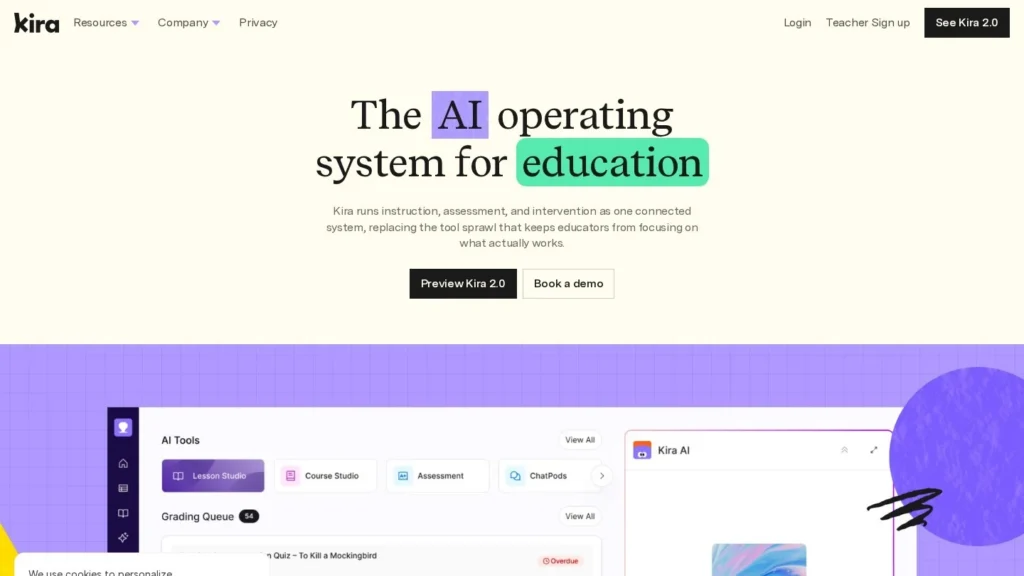
Kira is an AI platform for schools that generates complete courses, then creates, assigns and grades the assessments and uses every answer to update a skills profile and trigger extra help. In March 2026 it announced that Anthropic’s Claude powers course generation and skills mapping, and it is chaired by Andrew Ng. It suits districts, colleges and workforce programs that want one AI-native system for instruction and assessment.
Teachers can sign up for free; district pricing is by quote. Points to weigh are pricing shared by quote, a short public track record and Common Sense Education reviewers’ view that its AI tutor was uneven in places. This review is based on Kira’s website, its announcements and independent coverage; we have not tested it hands-on.
Kira’s Free Teacher Sign-Up and Claude-Built Courses
- Price: Free teacher sign-up; paid options and district, higher ed and workforce plans by quote.
- What it does on its own: Generates standards-aligned courses, then generates, assigns and grades assessments and recommends or delivers interventions.
- Built on Claude: A March 2026 integration with Anthropic powers course generation and competency mapping in Kira 2.0.
- Privacy: Designed to meet FERPA and COPPA by default, with Common Sense Privacy Verified status.
- Our score: 8.2/10, strong on autonomy and privacy design; published pricing and more public results would lift it further.
Partners and Backers Behind Kira’s Early Growth
Kira is young and publishes few usage statistics, but its partnerships and backers say a lot about where it is heading. Each item below was checked on the source page, and the claims about what the product does are Kira’s own descriptions.
| Fact | Detail | Source and Date |
|---|---|---|
| Anthropic integration | Claude generates complete courses, such as 9th Grade Biology and AP US History, and maps student work to competencies | Kira and Anthropic announcement, March 6, 2026 |
| Kira 2.0 | Available to K-12 districts, higher education institutions and workforce organizations | Business Wire, March 6, 2026 |
| Standards coverage | Aligns content to state standards, NGSS, Common Core and AP frameworks, and to industry skill taxonomies for workforce programs | Business Wire, March 6, 2026 |
| Founders | Andrea Pasinetti (CEO) and Jagriti Agrawal; Andrew Ng is board chair | Business Wire, March 6, 2026 |
| Public launch | Launched as an AI-native K-12 platform with agents for lesson planning, tutoring, grading and early intervention | THE Journal, April 30, 2025 |
| Statewide use | Adopted in Putnam County, Tennessee, as part of a statewide rollout | THE Journal, April 30, 2025 |
| Backers and offices | Backed by investors including Andrew Ng and Rick Yang; offices in San Francisco and New York City | Kira About page, viewed November 2026 |
| Privacy design | Designed to meet FERPA and COPPA requirements by default, with student data under district control | Kira homepage, viewed November 2026 |
| Independent review | Common Sense Education lists it as free to try with paid options and Common Sense Privacy Verified | Common Sense Education review, viewed November 2026 |
For a buyer, the Anthropic announcement is the most telling item. It describes Kira’s core loop in concrete terms: generate the course, generate and grade the assessments, map every response to a skill, then act on the gaps. That is agent work, not a lesson-plan generator, and it explains why Kira positions itself against the LMS rather than against teacher chat tools.
The Tennessee rollout and the Common Sense privacy status matter for procurement. A statewide program and an independent privacy review give district technology teams something to check before a pilot. What Kira does not yet publish is outcome data, so ask any vendor reference for its own before and after numbers.
Curriculum, Assessment and Intervention in One Kira Loop
Kira combines curriculum, assessment and intervention in one system. The steps below follow the workflow Kira and its Anthropic announcement describe.
From Course Request to Graded Work
- Request a course. A teacher or curriculum lead names a subject and level. Kira generates a course that is scaffolded, scoped, sequenced and aligned to the relevant standards.
- Review and adjust. Teachers review the lessons, rubrics and adaptations, which Kira says are visible and explainable, and change what they want.
- Assess. Kira generates diagnostic, formative and summative assessments, assigns them and grades the responses.
- Measure skills. Every response updates a mastery model and a skills profile for each learner.
- Intervene. When gaps appear, Kira recommends or delivers targeted support inside instruction, including support for MTSS processes.
Differentiation and Pathways
Kira adapts instruction for students with IEPs, English language learners and multilingual learners without teachers recreating materials. It also supports computer science and AI literacy courses, career and technical education, credit recovery, virtual programs and classes affected by staffing gaps. Its roots are in computer science: Common Sense Education describes full courses from Computational Thinking to AP Computer Science with lesson plans, worksheets, unplugged activities and a collaborative code editor.
Where It Sits in a District
Kira can operate alongside existing LMSs, curriculum and district infrastructure, or serve as the LMS. Common Sense notes single sign-on and LMS integration. Administrators get real-time views of engagement, learning outcomes and instructional effectiveness across classes and schools.
What an Independent Review Found
Common Sense Education reviewed Kira’s computer science courses for grades 6 to 12 and called them solid courses for middle and high schools. Reviewers liked that courses can be aligned to state standards with print and digital materials, that teachers can monitor progress, give feedback and return work for revision, and that a collaborative editor lets students write code together. They also found plenty of teacher resources, including a chatbot for generating lesson materials, and extensive professional development.
The same review noted areas to improve. Built-in student supports such as hints and the AI tutor were inconsistent, the tutor did not work in the middle school code editor and capped out at 10 questions on certain problems, and creative responses took time to grade. The review predates parts of Kira 2.0, so ask Kira which of these points have changed.
Running a Pilot
- Pick one course and a few teachers. Start with a subject where standards are clear, such as a computer science or science course.
- Generate and review. Have teachers edit the generated course and rubrics before students see them, and log the time spent.
- Run the assessment loop. Let Kira assign and grade diagnostics and quizzes, then spot-check a sample of grades against teacher judgment.
- Track interventions. Record which gaps Kira flags, what support it assigns and whether those students improve.
- Decide on scope. Use the results to choose between running Kira alongside your LMS or replacing it.
What Still Needs a Teacher
Teachers still own what students see. They approve generated courses, review grades on open-ended and creative work, which Common Sense notes takes time, and decide how to act on intervention flags. Andrew Ng has framed the goal as taking repetitive tasks off overloaded teachers so they can give students more personal help.
No Kira Price List Beyond the Free Teacher Account
Kira publishes no price list. Based on its site and Common Sense Education’s listing, this is how buying works.
| Plan | Price | Billing | What’s Included | Limits |
|---|---|---|---|---|
| Teacher sign-up | Free | None | Individual teacher access to start | Feature scope not published |
| Paid options | Not published | Not published | Listed by Common Sense as available beyond the free tier | Details through Kira |
| District, higher ed or workforce | Custom quote | Contract | Kira 2.0 platform, course generation, assessment, intervention, admin insights | Sales-led demo |
From One Teacher to a School-Wide Kira Pilot
A single teacher. The free sign-up is enough to see how Kira builds a course and its assessments. Compare it with Brisk Teaching, which is free for individual teachers with daily caps, and Khanmigo, free for verified teachers.
A school-wide pilot. Ask Kira for a per-student or per-teacher quote, and price it against what you would pay for the tools it can replace. For example, 10 teachers on Brisk’s reported Educator Pro upgrade at $99.99 a year would be $999.90, before any LMS or assessment platform costs.
A district replacing its LMS. Because Kira can act as the LMS, the comparison is total platform spend, plus training time. Budget for professional development, which Kira offers, and for staff time to review AI-generated courses before they reach students.
Other costs. Teacher review of generated content, grading checks on open-ended work and data privacy agreements all take staff time even when the software is cheap.
Kira Compared With Khanmigo, Brisk Teaching and Amira Learning
Kira competes with AI tools aimed at teachers and with platforms that tutor or assess students directly.
| Tool | Starting Price | Free Plan | Main Strength | Main Trade-Off | Best For |
|---|---|---|---|---|---|
| Kira | Free to start; district plans by quote | Limited | Course generation, grading and intervention in one system | No published district pricing | Districts and programs wanting one AI-native platform |
| Khanmigo | Free for teachers; $4 a month for families | Limited | Socratic tutoring tied to Khan Academy content | Family plans limited to the US | Families and teachers using Khan Academy |
| Brisk Teaching | Free | Yes | Works inside Google and Microsoft tools teachers already use | Free plan has daily caps | Individual teachers who want quick materials and feedback |
| Amira Learning | Custom quote | No | One-to-one oral reading practice and screening | Focused on early reading | Districts targeting early literacy |
Brisk and Khanmigo are the easy starting points for an individual teacher. Kira asks more of a school, because it wants to run the course, the assessments and the follow-up, but it gives back more if a district wants one system rather than several. Amira solves a narrower problem very well. See more options on our AI agents for education page.
Pricing structure is the practical difference. Khanmigo and Brisk publish prices and let teachers start alone, which keeps risk low. Kira and Amira sell to institutions, so the decision moves to a district office, a contract and a privacy agreement. That slows adoption but gives a district one accountable vendor and data it controls.
Districts and CS Programs Kira Was Built For
- Districts consolidating tools: Kira can run instruction, assessment and intervention in one place, or replace an LMS outright.
- Computer science and AI literacy programs: its origins are in CS curriculum, from Computational Thinking to AP Computer Science.
- Schools short on teachers: Kira lists virtual programs, credit recovery and staffing gaps among its use cases.
- MTSS and intervention teams: the mastery model flags gaps continuously and attaches recommended support.
- Colleges and workforce programs: Kira 2.0 aligns content to higher education and industry skill frameworks as well as K-12 standards.
When Brisk or Khanmigo Is the Better Classroom Pick
- Teachers who want a quick helper: Brisk or Khanmigo fit faster into an existing routine.
- Districts happy with their LMS and assessment stack: much of Kira’s value comes from running the full loop.
- Buyers who need public pricing: district costs come only through a quote.
- Programs focused on early reading: a specialist such as Amira targets that need more directly.
- Schools without time for review: if no one can check generated courses and grades during the first term, the risk of errors reaching students rises.
Grading Review, Tutor Caps and Kira’s Learning Curve
- Review load: AI-generated courses and grades still need teacher review; fast generation can create more to check.
- Tutor feedback: Common Sense found the AI tutor uneven, including a 10-question cap on some problems.
- Learning curve: reviewers found grading options overwhelming at first; plan training time.
- Young company: Kira launched publicly in 2025 and publishes few outcome figures; ask for references.
- Model dependence: course generation runs on Anthropic’s Claude, so check how district data is handled by Kira and its model provider.
- Standards fit: alignment to Common Core, NGSS and AP is built in, but state-specific pacing guides and local curricula still need checking by your curriculum team.
- Privacy paperwork: Kira states FERPA and COPPA by design; still sign a data privacy agreement and confirm state requirements.
Kira 2.0 and the March 2026 Anthropic Partnership
On March 6, 2026, Kira announced it was working with Anthropic to use Claude to generate complete courses, generate and grade assessments and build continuously updated skills profiles, and said Kira 2.0 was available now. Anthropic’s education lead Drew Bent called the approach responsible and high-impact.
On April 30, 2025, THE Journal reported Kira’s launch as an AI-native learning platform, with AI agents for lesson planning, tutoring, grading and early intervention, and adoption in Putnam County, Tennessee, as part of a statewide rollout.
Why Kira Rates 6.4 and Merits a District Pilot
For districts and programs ready to rethink their stack, Kira is worth a pilot. It scores 8.2/10 on our scale. Its strength is scope: one system generates the course, grades the work, measures each learner’s skills and acts on the gaps, now built on Anthropic’s Claude and backed by Andrew Ng. Privacy design and Common Sense Privacy Verified status help with procurement.
Published pricing, a longer public track record and a more consistent tutor would lift the score. Individual teachers should try the free sign-up; districts should run a semester pilot with clear measures of teacher time saved and student growth before a wider rollout.
What Teachers and Districts Ask About Kira
Is Kira Free for Teachers?
Teachers can sign up for free, and Common Sense Education lists Kira as free to try with paid options. Districts, colleges and workforce organizations buy through a demo and quote.
What Does Kira’s Anthropic Integration Do?
Announced in March 2026, it uses Claude to generate complete standards-aligned courses, generate and grade assessments and map each student’s work to specific competencies. Kira uses that skills profile to recommend or deliver interventions.
Does Kira Replace Our LMS?
It can, but it does not have to. Kira says it operates alongside existing LMSs, curriculum and district infrastructure, or can serve as a standalone LMS.
Is Kira Compliant With FERPA and COPPA?
Kira says it is designed to meet FERPA and COPPA requirements by default and that student data stays under district control. Common Sense Education lists it as Privacy Verified.
How Is Kira Different From Khanmigo?
Khanmigo is a tutor and teacher assistant tied to Khan Academy content, with a $4 family plan. Kira builds and runs whole courses, including assessments and interventions, for districts and institutions.
User Reviews
Nobody has rated it here yet. Be the first AI Agents Choice user to rate Kira.