
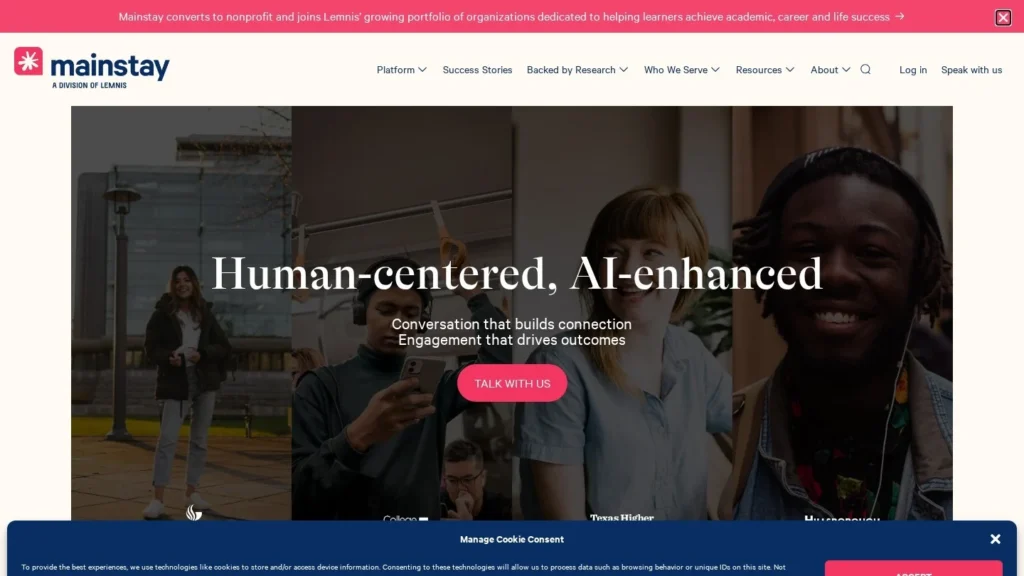
Mainstay is one of the few education AI products tested in randomized controlled trials. At Georgia State University’s Perimeter College, students who got its texts were 16% more likely to file the FAFSA by January 1, and summer melt fell 21.4%. At Cal Poly Pomona, Mainstay says 70% of student holds were resolved with AI and one communication specialist now supports more than 10,000 students a week.
Mainstay suits colleges, universities and college access nonprofits that want proactive, text-based coaching to keep students enrolled. Points to weigh: prices are shared through institutional agreements, most customer figures are vendor-reported, and the coach works through conversation rather than acting inside campus systems. We rate it 7.4/10 on our scale, with pricing transparency and integration detail, rather than evidence, as the areas to build on. We have not used Mainstay ourselves; this review is based on Mainstay’s website, outcomes page and press materials.
Georgia State Trials and Mainstay’s AI Coach by Text
- Randomized trials at Georgia State found 21.4% less summer melt and a 16% higher chance of filing the FAFSA by January 1.
- The AI coach texts students first, with check-ins on registration, aid and deadlines, and connects them to advisors when needed.
- Cal Poly Pomona reports 70% of holds resolved with AI and 300 holds cleared in 24 hours with one communication specialist.
- Mainstay, founded in 2014 as AdmitHub, converted to nonprofit status as a division of public charity Lemnis.
- No prices are published; contracts are institutional.
Randomized Studies and Customer Figures Behind Mainstay
Mainstay publishes more research than most student engagement vendors. The trial results come from studies at Georgia State run with outside academics; customer figures are from Mainstay’s own pages and are mostly undated.
| Fact | Detail | Source and Date |
|---|---|---|
| Summer melt | 21.4% reduction in a randomized controlled trial at Georgia State University Perimeter College | Mainstay outcomes page, viewed October 2026 |
| FAFSA filing | Students 16% more likely to file the FAFSA by January 1 in the Perimeter College trial | Mainstay outcomes page, viewed October 2026 |
| Grades | Georgia State students 16% more likely to earn a B or higher; first-generation students’ grades 11 points higher | Mainstay outcomes page, viewed October 2026 |
| Withdrawals | 50% lower withdrawal rate due to outstanding balances and 29% more academic advisor meetings at Georgia State | Mainstay outcomes page, viewed October 2026 |
| Cal Poly Pomona | 70% of student holds resolved with AI, 300 holds resolved in 24 hours, with one communication specialist | Mainstay outcomes page, viewed October 2026 |
| Other customers | University of Wyoming: 9.5% more incoming freshmen and 32% less summer melt; Wayne State: 14% more students enrolled | Mainstay outcomes page, viewed October 2026 |
| Research partners | Lindsay Page (Brown), Hunter Gehlbach (Johns Hopkins), Mitchell Stevens (Stanford) and Katharine Meyer (Brookings) | Mainstay outcomes page, viewed October 2026 |
| Company | Founded in 2014 as AdmitHub by Drew Magliozzi and Kirk Daulerio; based in Beaverton, Oregon; led by President Tony Frey | Mainstay about page, viewed October 2026 |
| Ownership | Converted to a nonprofit and joined the portfolio of Lemnis, a public charity | Mainstay press release, viewed October 2026 |
| Platform results | Vendor-reported averages include 85% of holds resolved by AI and a 3x increase in FAFSA submissions by the priority deadline | Mainstay home page, viewed October 2026 |
The randomized trials are the strongest point. Most AI products in education cite customer anecdotes; Mainstay can point to controlled studies with researchers from Brown, Johns Hopkins, Stanford and Brookings. For a provost or enrollment vice president who needs to justify spending, that is unusual and valuable.
The customer numbers are useful, though they carry less detail than the trials. Cal Poly Pomona’s 70% of holds and Wyoming’s 32% drop in summer melt show what a well-run deployment can do, but they are reported by Mainstay without dates or sample sizes. Treat them as targets to test, not guarantees.
Three Layers Built on Behavioral Intelligence
Mainstay calls its approach behavioral intelligence: AI coaching shaped by mindset science and behavioral economics. The platform has three layers, one for students, one for staff and one for leaders.
The Student Coach
- Reach out first: the coach texts students before deadlines, asking, for example, whether they have registered for courses.
- Answer questions: students reply by text or chat, and the coach answers questions such as whether they are eligible for aid.
- Help with tasks: it walks students through steps like the FAFSA and state grant applications and helps clear registration and financial holds.
- Connect to people: when a student misses registration or needs more help, the coach offers to connect them with an advisor.
Channels are SMS, live chat, web chat and social media. Content comes from pre-built conversation libraries and Mainstay’s SPARK model.
Staff and Leadership Tools
The Conversation Co-pilot helps staff answer the conversations the coach passes on, aiming for faster and more empathetic replies. Conversation Insights gives leaders a view of what students are asking and where they are stuck. Evidence-based Messaging supplies research-based message content, and Expert Services adds support from Mainstay’s own team.
Where It Is Used
Mainstay offers solutions for four-year colleges, minority-serving institutions and college access nonprofits. Named customers include Georgia State University, Cal Poly Pomona, Hillsborough Community College, Winston-Salem, the University of Wyoming, Wayne State and the University of West Florida, which reports a 10x return across enrollment, retention, time saved and staff impact. Mainstay has also worked with Wayfair, reporting 40% fewer first-day no-shows.
Institutions usually give the coach its own name. Hillsborough Community College’s coach is called Gwen, and Mainstay reports that 187 students re-enrolled after engaging with it, alongside a 3% lift in conversions. At Winston-Salem, the reported results reach beyond enrollment: 37% higher immunization compliance, an 8% rise in freshman yield and 74% more on-time payments. Those examples show the coach is used for compliance and billing tasks as well as admissions and advising, which widens the set of offices that might share the cost.
The Research Behind It
Mainstay’s evidence comes mostly from Georgia State University, where it ran trials in admissions, retention and individual courses. In the retention work, students filed the FAFSA by the priority deadline 6% more often, met with academic advisors 29% more often and re-registered for fall 3% more often, while withdrawals due to unpaid balances fell by half. In a course-level study, 70% of students found the messages helpful and 92% recommended the chatbot for that course and others. In the landmark admissions trial, 94% of students recommended continued use. Mainstay lists Lindsay Page of Brown, Hunter Gehlbach of Johns Hopkins, Mitchell Stevens of Stanford and Katharine Meyer of Brookings as study partners.
Advisors and Aid Staff Take Over Handoffs
Advisors, financial aid and registrar staff take over when the coach hands off, and they still change records, lift holds that need approval and handle sensitive cases. Someone also has to keep the coach’s information current, decide which campaigns to run and review insights. Mainstay’s own framing is AI and human expertise working together.
Sold to Institutions Through Quoted Agreements
Mainstay does not publish prices. Its products are sold to institutions and nonprofit organizations as part of an agreement.
| Plan | Price | Billing | What’s Included | Limits |
|---|---|---|---|---|
| AI Success Coaching for Students | Quote | Institutional agreement | AI coach by SMS, live chat, web chat and social media | Scope set by contract |
| Conversation Co-pilot for Staff | Quote | Institutional agreement | AI help for staff answering student conversations | Staff tool |
| Conversation Insights | Quote | Institutional agreement | Dashboards on student needs for leaders | Leadership tool |
| Evidence-based Messaging and Expert Services | Quote | Institutional agreement | Research-based messaging and support from Mainstay team experts | Service scope set by contract |
Sizing Mainstay by Staff Time Returned
With no prices published, the clearest way to size Mainstay is by the staff time it can return. These scenarios use Mainstay’s published rates and our own assumption of 10 minutes of staff time per hold.
- A campus with 1,000 student holds a term: at Cal Poly Pomona’s 70% AI resolution rate, 700 holds clear without staff, about 117 hours of staff time at 10 minutes each. At Mainstay’s 85% platform average, 850 holds clear, about 142 hours.
- A small communications team: Cal Poly Pomona reports one communication specialist supporting more than 10,000 students weekly with no added headcount; compare that with the staff you would need to text the same students by hand.
- Summer melt: if 800 admitted students would otherwise fail to enroll, a 21.4% reduction (the Perimeter College trial figure) would keep about 171 of them, and enrollment revenue from those students is often the business case.
Ask Mainstay how pricing scales with student headcount, whether Expert Services and Evidence-based Messaging are included or extra, and whether SMS costs are bundled.
Pricing Basis and Included Services to Pin Down
- Pricing basis: is the contract priced per enrolled student, per student messaged or per campaign?
- Included services: are Evidence-based Messaging, Expert Services and the staff co-pilot part of the base agreement?
- Messaging costs: are SMS fees bundled, and is there a cap on messages per student per term?
- Measurement: will Mainstay help set up a control group so you can measure your own effect, as in the Georgia State trials?
- Continuity: what changed in contracts, support and roadmap after the move to Lemnis?
Mainstay Compared With Element451 Bolt Agents, Agentforce and Khanmigo
| Agent | Starting Price | Free Plan | Main Strength | Main Trade-Off | Best For |
|---|---|---|---|---|---|
| Mainstay | Custom quote | No | Randomized trial evidence for student nudging | No published prices; acts through conversation | Retention, aid and summer melt programs |
| Element451 Bolt Agents | Custom quote | No | Admissions agents that read applications and screen fraud | Usage caps; no published prices | Admissions and enrollment teams |
| Agentforce | $0.10 per action (Flex Credits) | No | Custom agents working on Salesforce records | Layered pricing; needs Salesforce data | Universities standardized on Salesforce |
| Khanmigo | $4/month | Limited | Low-cost academic tutor | Tutoring rather than enrollment support | Course help for students |
Mainstay and Element451 overlap most. Element451 offers a wider roster of agents, including admissions work Mainstay does not do, while Mainstay brings deeper published research on nudging students to persist. Agentforce suits universities with Salesforce and in-house builders. Khanmigo solves a different problem, coursework help, and can sit alongside either. More options are in our AI agents for education and nonprofits guides.
Colleges Fighting Summer Melt and FAFSA Gaps
- Colleges fighting summer melt: the Georgia State trials and Wyoming’s reported 32% drop target exactly that gap between admission and enrollment.
- Financial aid offices: FAFSA nudges and hold resolution are among the best-documented uses.
- Minority-serving and access-focused institutions: Mainstay offers dedicated solutions, and Wayne State reports gains among first-generation, Pell-eligible and Hispanic students.
- College access nonprofits: Mainstay sells a solution for nonprofit organizations helping students reach college.
- Small communications teams: Cal Poly Pomona’s one-specialist setup shows how far the coach can stretch staff.
Admissions Offices Wanting Application Reading
- Admissions offices that want application reading or fraud screening: those are not part of Mainstay’s product.
- Buyers who need a published price: pricing comes through an institutional quote.
- Teams that want the agent to change records itself: Mainstay works through conversation and hands off to staff.
- K-12 schools: the product is built for college access and higher education.
- Institutions without staff to take handoffs: the model assumes advisors pick up the conversations the coach passes on.
Vendor Figures and the Dates and Samples to Request
- Vendor-reported customer figures: outside the Georgia State trials, most results come from Mainstay, which could add dates and sample sizes to them.
- Results vary by campus: the home page average of 85% of holds resolved by AI and Cal Poly Pomona’s 70% differ; plan around a range.
- Message fatigue: proactive texting only works if students keep reading; review opt-out handling and message frequency.
- Ownership change: Mainstay now operates as a division of Lemnis; confirm contract terms, support and roadmap.
- Data handling: ask for security documentation and FERPA terms during procurement, since the coach talks with students about holds, registration and financial aid.
The Strongest Evidence Base in Student Engagement
For colleges whose biggest problems are summer melt, aid paperwork and holds, Mainstay has the strongest evidence base we have seen in this category. We score it 7.4/10 on our scale, a number that reflects details Mainstay has not yet published (prices, integration and security detail, public ratings) rather than what the product does. On autonomy it earns a 6.5: it starts conversations, resolves a large share of holds and routes students to people.
If you are evaluating it, ask for the Georgia State studies and for a reference at an institution your size, then pilot a single campaign, such as summer melt or FAFSA completion, against a control group the way Georgia State did. That will tell you more than any vendor average. Bring the financial aid, registrar and bursar offices into the pilot early, since holds and payments are where Mainstay reports some of its largest gains.
AdmitHub, Georgia State and the Price Tag
How Much Does Mainstay Cost?
Mainstay does not publish prices. It sells AI coaching, the staff co-pilot, insights, messaging and expert services through institutional agreements, so ask for a quote based on your student headcount and campaigns.
Is Mainstay the Same Company as AdmitHub?
Yes. Mainstay was founded in 2014 as AdmitHub by Drew Magliozzi and Kirk Daulerio and later expanded from admissions chat into student success coaching. It now operates as a division of the public charity Lemnis.
What Did the Georgia State Studies Find?
In a randomized trial at Perimeter College, students who received Mainstay messages were 16% more likely to file the FAFSA by January 1, and summer melt fell 21.4%. At Georgia State, students were 16% more likely to earn a B or higher, and withdrawals due to unpaid balances fell 50%.
Does Mainstay Replace Advisors?
No. The coach handles routine check-ins and questions and offers to connect students with advisors when they need more help. Cal Poly Pomona uses it to let one communication specialist support more than 10,000 students a week.
How Is Mainstay Different From Element451?
Element451 sells a broader set of agents, including admissions agents that read applications and screen for fraud. Mainstay focuses on student nudging and success coaching, with randomized trial evidence behind its messaging.
User Reviews
Nobody has rated it here yet. Be the first AI Agents Choice user to rate Mainstay.