
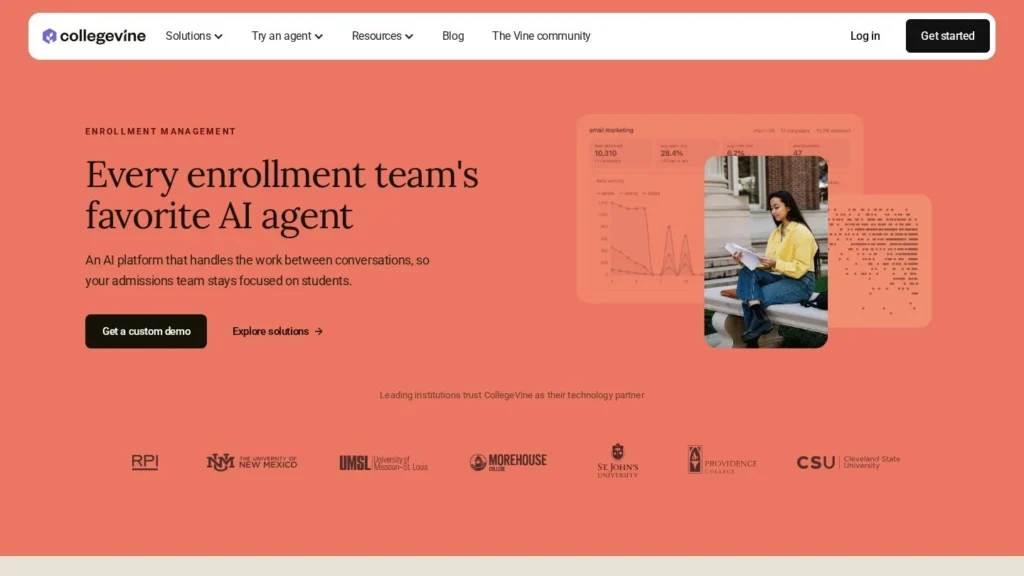
Colleges working with CollegeVine have put more than 3,000 AI agents to work across campus, and those agents have logged 236 million interactions with students, staff and faculty, according to CEO Zack Perkins at the company’s Vineyard 2026 conference in September. The agents do real work: they write and send recruitment email sequences, answer student questions by email, text and phone, run outreach to admitted students who might not show up in the fall, and read transcripts into the student information system.
CollegeVine AI Agents suit colleges and universities with a working CRM and SIS that want one vendor for enrollment, financial aid, student affairs and advancement agents. Cost visibility is the main area CollegeVine could improve: it sells by quote and publishes no plan prices, and nearly every performance figure comes from the company itself. We rate it 7.9/10 on our scale; published pricing and more public reviews would lift that score, and what the agents can do is not what limits it. We have not used CollegeVine; this review is based on CollegeVine’s published product pages, case studies and press releases.
3,000 Agents and 236 Million Campus Interactions
- CollegeVine reports more than 3,000 agents deployed at partner schools and 236 million interactions as of September 2026.
- Agents act on their own: they send personalized email sequences, answer a 24/7 helpdesk in 50+ languages and write transcript data into the SIS, while outbound missions need staff approval first.
- Vendor-published results include a 38.6% email open rate across 136,095 emails and a 57% cut in scholarship GPA pre-reads at Molloy University.
- There are no published prices; the only no-cost tool is an IPEDS Insights Agent CollegeVine describes as free.
- Against Element451 Bolt Agents and Mainstay, CollegeVine covers more campus departments, including advancement and finance, but all three sell by quote.
Usage Figures and Case Studies Worth Knowing
CollegeVine publishes a steady stream of usage figures and case studies. These are the most useful for a buyer, with their source and date.
| Fact | Detail | Source and Date |
|---|---|---|
| Agents deployed | More than 3,000 agents deployed by partner institutions across nearly every campus department | Vineyard 2026 keynote recap, September 14, 2026 |
| Interactions | 236 million interactions with students, staff and faculty | Vineyard 2026 keynote recap, September 14, 2026 |
| Early adoption | 50 partner institutions onboarded to the AI Recruiter two months after release | CollegeVine press release on Business Wire, July 24, 2024 |
| Growth by late 2024 | AI Recruiter deployed by more than 95 partner institutions, with more than 500,000 conversations with prospective students | Business Wire, citing CollegeVine’s October 30, 2024 release, viewed November 2026 |
| Email results | 38.6% open rate from 136,095 emails delivered, against a 13.5% industry average cited by CollegeVine | CollegeVine enrollment page, viewed November 2026 |
| Text results | 19.7% reply rate from 131,035 messages to prospective students | CollegeVine enrollment page, viewed November 2026 |
| Staff time | 13,357 staff hours saved across reported deployments; 10+ hours a week saved on email | CollegeVine enrollment page, viewed November 2026 |
| Transcript processing | Up to 10,000 transcripts a day, 1 to 2 minutes each, 98% less processing time than manual work, and 96% of results within 2% of reference GPA calculations | CollegeVine enrollment page, viewed November 2026 |
| Molloy University | 57% reduction in scholarship GPA pre-read volume, from four readers to three; 835 hours returned to the operations team | CollegeVine enrollment page and case study listing, October 2026 |
| Student network | 2.3 million students on CollegeVine’s student platform at the time of a General Assembly partnership | Business Wire, May 1, 2024 announcement |
| Conference | Vineyard 2026 drew 300 higher education leaders | CollegeVine updates, August 17, 2026 |
Two things stand out. First, the jump from 50 partners in mid-2024 to more than 3,000 deployed agents in 2026 shows schools adding agents across departments once the first one is live, which matches case studies such as Roosevelt University expanding a single enrollment pilot into agents for financial aid and student services. Second, the transcript figures are unusually specific, down to accuracy against reference GPA calculations, which gives an operations team something concrete to test in a pilot.
Every number in the table is published by CollegeVine. None of it is an independent evaluation yet, and industry benchmarks such as the 13.5% email open rate are CollegeVine’s own comparison points. Ask for the raw reporting from a school similar to yours before treating these as expected results.
AI Operations on a Shared Campus Data Layer
CollegeVine sells a platform it calls AI Operations, built on a shared data layer it calls an ontology, plus prebuilt agents for enrollment, finance, student affairs, academic affairs and advancement. Agents, apps and predictive models run on the same platform and draw from the same data.
Connecting Campus Data
The starting point is integration. CollegeVine’s enrollment page says the platform works with a school’s enrollment CRM, student information system and other campus data. Its case studies describe the University of Bridgeport and Goodwin University unifying Slate and Ellucian Colleague data into one layer. Once connected, the enrollment agent learns the school’s CRM, a process CollegeVine described in a June 2026 post, and answers from the institution’s own policies.
What the Enrollment Agents Do
- Email marketing: writes individual emails from each student’s profile, interests and engagement history, runs multi-email sequences, and matches the school’s tone and branding, with real-time reporting.
- Inbound helpdesk: answers student questions by email, SMS and phone in more than 50 languages, around the clock, using only the institution’s policies and knowledge base, and escalates complex or sensitive issues to staff.
- One-to-one student support: detects behavioral signals and runs proactive outbound missions by email, SMS and phone, for example to reduce summer melt. Staff approve each mission before it runs.
- Transcript processing: reads transcripts as they arrive, extracts GPA, coursework and other fields into the SIS, and routes exceptions to staff.
The original 2024 AI Recruiter also covered phone calls, direct mail and custom swag, and was pitched as an alternative to enrollment marketing consultancies that run static drip campaigns.
Beyond Admissions
Newer agents cover the rest of the student lifecycle. CollegeVine’s 2026 updates describe early alerts for student advisors, academic risk detection through what it calls domain modeling, course schedule planning, a financial aid agent that powers a deposit and melt tracker at Rensselaer Polytechnic Institute, and degree audits and a 24/7 helpdesk at Barry University. For advancement offices, an agent combines contact notes, giving history, volunteer roles and public research into a prospect brief with relationship context, discovery questions and suggested next moves.
At Vineyard 2026, Perkins described one partner’s agent, named Carly, building a melt prediction model from historical data. The 10% of students it flagged as highest risk accounted for half of all melt, and it found 23 students who should have applied but had not. Staff can assign Carly a task to contact those students directly from the platform.
Staff Approve Missions and Handle Escalations
Staff approve outbound missions before they run, handle the complex or sensitive questions the helpdesk escalates, and review transcript exceptions. CollegeVine frames agents as team members that need supervision, and its admin view lets administrators question an agent about its work rather than reading activity logs. Someone on campus also has to own the data connections and the policy content the agents answer from.
Free Tools Aside, Agents Are Custom Priced
CollegeVine does not publish prices for its agents. Based on its published pages, these are the products a buyer can price or try.
| Plan | Price | Billing | What’s Included | Limits |
|---|---|---|---|---|
| Enrollment agents | Custom quote | Contract | Email marketing, inbound helpdesk, student support missions, transcript processing | Set by contract |
| Finance, student affairs, academic affairs and advancement agents | Custom quote | Contract | Financial aid, advising alerts, academic risk, course scheduling and prospect research agents | Set by contract |
| AI Operations and Ontology platform | Custom quote | Contract | Shared data layer across CRM, SIS and campus systems, admin view, tasks | Set by contract |
| IPEDS Insights Agent | Free | None | Analysis of federal IPEDS data | Analysis only; no actions in campus systems |
| CRM analyst | Offered as a trial agent | None | Questions answered about CRM data | Analysis only |
Judging a Quote Against Reported Staff Time
Without list prices, the practical way to judge a quote is against the staff time and outreach results CollegeVine reports. The scenarios below use CollegeVine’s published figures; the hourly staff cost and working weeks are our own illustrative assumptions.
- A transcript-heavy admissions office: Molloy University reports 835 hours returned to its operations team through transcript processing. At an assumed loaded staff cost of $35 an hour, that time is worth $29,225. A transcript agent quote above that figure would need to be justified by speed or accuracy, not labor savings alone.
- A recruitment team sending email at scale: CollegeVine’s reported 38.6% open rate on 136,095 emails works out to about 52,533 opens, against about 18,373 at the 13.5% industry average it cites. A team sending a similar volume can ask what the extra 34,000 or so opens are worth in applications and deposits, using its own conversion rates.
- A small enrollment shop: CollegeVine reports 10 or more staff hours saved a week on email. Over an assumed 40 working weeks, that is 400 hours, or $14,000 at the same assumed $35 an hour. That sets a rough ceiling for what an email agent alone should cost a small office.
Variable costs to plan for: the integration work to connect Slate, Colleague or another CRM and SIS; the staff time to approve missions and maintain policy content; and the likelihood of adding agents in more departments, which is how CollegeVine’s customer base has grown. Ask whether pricing scales by agent, by department, by student headcount or by interaction volume before signing.
CollegeVine AI Agents Compared With Element451 Bolt Agents, Mainstay and Agentforce
Higher education buyers usually weigh CollegeVine against agents built on an admissions CRM, a student success messaging specialist, and a general platform agent built on Salesforce.
| Agent | Starting Price | Free Plan | Main Strength | Main Trade-Off | Best For |
|---|---|---|---|---|---|
| CollegeVine AI Agents | Custom quote | Free IPEDS Insights Agent only | Agents across enrollment, aid, student affairs, academics and advancement on one data layer | No published prices; vendor-published results | Universities that want agents in several departments |
| Element451 Bolt Agents | Custom quote | No | Prebuilt admissions agents, including application reading and fraud screening | No published base prices; usage caps | Admissions offices with high application volume |
| Mainstay | Custom quote | No | Student success texting backed by randomized trials | Chat-based coaching rather than actions inside campus systems | Retention and summer melt programs |
| Agentforce | $0.10 per action (Flex Credits) | No | Custom agents on Salesforce data | Layered pricing; assumes data lives in Salesforce | Universities standardized on Salesforce |
CollegeVine and Element451 overlap most in admissions. Element451 goes deeper on reading applications and screening fraud, while CollegeVine reaches further across campus, into financial aid, advising, course scheduling and fundraising. Mainstay is the closer peer for melt and persistence outreach and brings stronger independent research, but it does less inside campus systems. Agentforce is the pick for a university that already runs on Salesforce and has the staff to build its own agents. More options are in our AI agents for education guide, and K-12 buyers should look at tools such as Khanmigo instead.
Enrollment Offices Fighting Summer Melt
- Enrollment offices fighting summer melt: the student support agent runs approved outreach missions by email, text and phone, and partner case studies describe melt prediction and deposit tracking.
- Operations teams buried in transcripts: the transcript agent writes GPA and coursework into the SIS and routes exceptions, with Molloy reporting 835 hours returned.
- Schools that want after-hours student answers: the helpdesk covers email, SMS and phone in more than 50 languages, around the clock, from the school’s own policies.
- Universities on Slate and Colleague: published case studies describe unifying those two systems in CollegeVine’s data layer.
- Advancement shops with small research teams: the prospect brief agent assembles giving history, contact notes and public research for gift officers.
K-12 Schools and Price-First Buyers
- K-12 schools and individual teachers: the agents are built for college enrollment and campus operations.
- Buyers who need a list price first: nothing beyond the free IPEDS agent is priced publicly.
- Schools still connecting their CRM and SIS data: the agents depend on that data, so expect a cleanup and integration project before results.
- Teams that only need an FAQ bot: a general support agent may be cheaper if no outreach, data entry or cross-department work is needed.
- Committees that require independent evidence: CollegeVine’s results are self-reported so far, while Mainstay has published randomized trial work.
Getting CollegeVine’s Pricing Unit in Writing
- Quote-based pricing: there is no published rate card, so get the pricing unit in writing and ask how costs change as you add agents or departments.
- Self-reported results: open rates, reply rates, staff hours and transcript accuracy figures all come from CollegeVine. Ask for references at schools your size.
- Student data and FERPA: CollegeVine says the platform is designed for FERPA, SOC 2 Type II and HECVAT and uses role-based access controls. Request the SOC 2 report and a completed HECVAT, and confirm how student data is used by the underlying AI models.
- Outbound contact rules: text and phone outreach to prospective students carries consent obligations. Confirm who owns opt-out handling and message approval.
- Brand confusion in reviews: the CollegeVine name also belongs to a college planning site for students, so public reviews of the brand often describe that service rather than the institutional agents.
- Supervision load: mission approvals, escalations and transcript exceptions all land on staff, so the time savings depend on how many exceptions your data produces.
Molloy University Gets 835 Hours Back
- On October 8, 2026, CollegeVine posted a Molloy University case study reporting 835 hours returned to the operations team through AI transcript processing, alongside October case studies from Auburn University, Rensselaer Polytechnic Institute, Roosevelt University and NJIT.
- On September 29, 2026, Head of Advancement Jarrett Perkins described CollegeVine’s advancement agents, which turn contact notes, giving history, volunteer roles and public research into prospect briefs.
- On September 14, 2026, CEO Zack Perkins told Vineyard 2026 that partner schools had deployed more than 3,000 agents with 236 million interactions, and that institutions were now past adoption and focused on deployment.
- On July 21, 2026, CollegeVine introduced a free IPEDS Insights Agent that analyzes federal higher education data.
Broad Coverage for Campuses With Clean CRM Data
For a college or university that wants agents in several departments and has its CRM and SIS in reasonable shape, CollegeVine is one of the broader options available. It scores 7.9/10 on our scale: high on autonomy, solid on integrations and security, with room to grow on pricing transparency, and neutral on user sentiment because the institutional product has few public ratings so far. The agents send outreach, answer students, write transcript data and flag risk on their own, with staff approval where it matters most.
The score reflects how hard it is to judge value from the outside, not the agents’ capabilities. Results such as Molloy’s 835 hours and a 38.6% email open rate are promising and self-reported, and every quote is custom. Start with a single agent tied to a measurable problem, such as transcript backlog or melt, insist on baseline numbers before launch, and expand once the pilot pays for itself.
How CollegeVine Prices Its Campus Agents
How Much Do CollegeVine AI Agents Cost?
CollegeVine does not publish prices. Its enrollment, finance, student affairs, academic affairs and advancement agents are sold by custom quote. The IPEDS Insights Agent is the only tool CollegeVine describes as free.
Is the CollegeVine Student Site the Same as the AI Agents?
They share a name and company, but they serve different users. The student site helps applicants plan for college, and CollegeVine cited 2.3 million students on that platform in 2024. The AI agents are sold to colleges and universities to run recruitment, student support and campus operations.
Does CollegeVine Work With Slate and Ellucian Colleague?
Yes. CollegeVine’s case studies describe the University of Bridgeport and Goodwin University unifying Slate and Colleague into its shared data layer. Its enrollment page says the platform works with a school’s enrollment CRM, student information system and other campus data.
Is Student Data Safe With CollegeVine?
CollegeVine says its platform is designed for FERPA, SOC 2 Type II and HECVAT standards and uses role-based access controls. The helpdesk answers only from the institution’s policies and knowledge base and escalates sensitive issues to staff. Schools should still review the SOC 2 report and contract terms on data use.
How Does CollegeVine Compare With Element451?
Both sell AI agents to higher education by quote. Element451 is stronger on admissions tasks such as application reading and fraud screening, while CollegeVine extends further into financial aid, advising, course scheduling and advancement. Schools focused only on admissions volume may lean to Element451; those planning agents across campus may prefer CollegeVine.
User Reviews
Nobody has rated it here yet. Be the first AI Agents Choice user to rate CollegeVine AI Agents.