

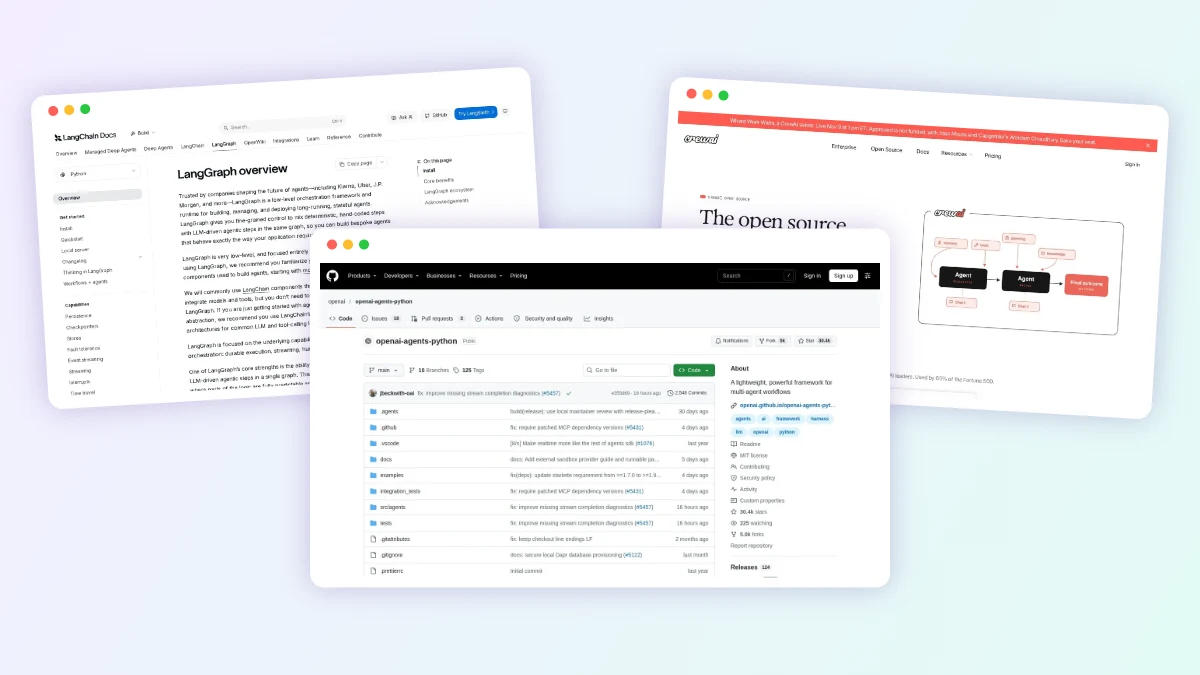
Two years ago, building an AI agent meant gluing a model to a loop of tool calls and hoping it stopped. In October 2026 every major model lab ships its own agent SDK, Microsoft has folded AutoGen and Semantic Kernel into one framework, and Google is on version 2.0 of its kit. Nearly all of them are free and open source. The money now sits in hosting, tracing and model tokens.
LangGraph remains the default for teams that want precise control over long-running Python or JavaScript agents. The OpenAI Agents SDK and Claude Agent SDK are the fastest routes if you have already picked a model vendor, Microsoft Agent Framework is the clear choice for .NET shops, and Google ADK covers the most languages. CrewAI, Mastra, Pydantic AI, Strands Agents and Browser Use each win a narrower niche, covered below.
TL;DR: Pick LangGraph if you need durable, inspectable workflows and are willing to write more code; its LangSmith tracing starts free and costs $39 per seat a month on Plus. Pick the OpenAI Agents SDK or Claude Agent SDK when one model vendor already powers your product, Microsoft Agent Framework for .NET and Azure, and Google ADK if your teams work across Python, Java, Go, TypeScript and Kotlin. Mastra is the strongest TypeScript-native option, CrewAI is the fastest way to prototype multi-agent crews in Python, and Browser Use is the pick for web automation.
All 10 Frameworks Are Free, but Licenses and Token Use Differ
- Every framework on this list is free to use. Nine are under MIT or Apache 2.0 licenses; the Claude Agent SDK is governed by Anthropic’s Commercial Terms of Service instead.
- Microsoft Agent Framework reached version 1.0 on April 3, 2026, with stable APIs for .NET and Python, and replaces AutoGen and Semantic Kernel as Microsoft’s main agent stack.
- Google ADK 2.0 became generally available in May 2026; in Google’s own refund example, a 2.0 workflow used 2,265 tokens per run against 5,152 for a plain LLM agent.
- Paid tracing starts at $39 per seat a month (LangSmith Plus), $49 a month for five seats (Pydantic Logfire Team) and $250 a month (Mastra Teams).
- Managed hosting is metered by compute: Google’s Agent Runtime charges $0.085 per vCPU-hour and AWS AgentCore Runtime $0.0895 per vCPU-hour on its v1 rate.
- Model tokens are usually the largest bill. Multi-agent designs multiply them, so pick the simplest pattern that works.
Quick Comparison of the Top AI Agent Frameworks
Pricing comes from each vendor’s published pricing pages and docs at the time of writing (October 2026). The framework itself is free in every case; the last column shows the cheapest paid hosting, tracing or platform tier where one exists.
| Framework | Best For | Languages | License | Paid Cloud From |
|---|---|---|---|---|
| LangGraph | Durable, controllable production agents | Python, JavaScript/TypeScript | MIT | LangSmith Plus $39 per seat/month |
| OpenAI Agents SDK | Teams building on OpenAI models | Python, TypeScript | MIT | No platform fee; tokens and tool calls |
| Claude Agent SDK | Agents that work in files and terminals | Python, TypeScript | Anthropic Commercial Terms | No platform fee; API tokens |
| Microsoft Agent Framework | .NET shops and Azure customers | C#/.NET, Python | MIT | Azure usage (Foundry hosting in preview) |
| Google ADK | Polyglot teams on Google Cloud | Python, Java, Go, TypeScript, Kotlin | Apache 2.0 | Agent Runtime $0.085 per vCPU-hour |
| CrewAI | Fast role-based multi-agent prototypes | Python | MIT | AMP Basic free; Enterprise custom |
| Mastra | TypeScript and web product teams | TypeScript | Apache 2.0 | Teams $250/month |
| Pydantic AI | Type-safe Python agents | Python | MIT | Logfire Team $49/month |
| Strands Agents | Teams on AWS and Bedrock | Python, TypeScript | Apache 2.0 | AgentCore Runtime $0.0895 per vCPU-hour |
| Browser Use | Agents that operate websites | Python | MIT | Pay as you go, browsers $0.02/hour |
The 10 Best AI Agent Frameworks, Ranked by Use Case
We ranked these on production readiness, language coverage, licensing, observability and how clearly the vendor publishes costs. We did not test them hands-on; everything below is based on the vendors’ documentation, pricing pages and release notes. Our AI agent frameworks directory lists more options, and our guide to building an AI agent from scratch explains the loop these frameworks automate.
1. LangGraph: Best for Production Control
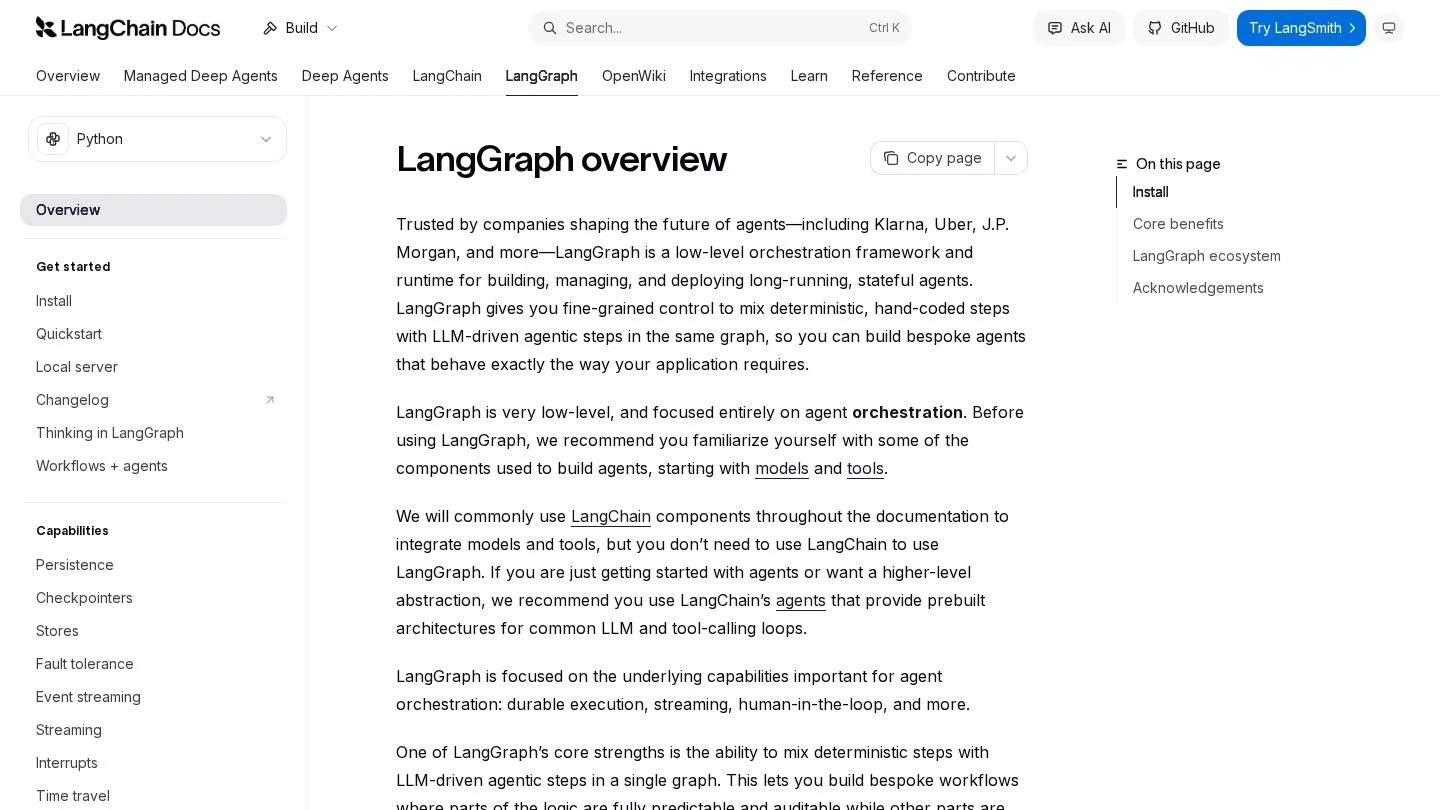
LangGraph is LangChain’s low-level framework for stateful agents. You describe an agent as a graph of nodes, edges and shared state, and the runtime checkpoints that state to memory, SQLite or PostgreSQL so a run can pause, wait for a human to approve or edit something, and resume hours later. It ships in Python and JavaScript under the MIT license.
The appeal is control. Retries, node timeouts, error handlers, streaming and short- and long-term memory are all explicit, which is why named users include Klarna, Uber, LinkedIn and J.P. Morgan. LangChain’s Deep Agents harness sits on top for teams that want more built in.
Observability and hosting come from LangSmith. The managed runtime formerly called LangGraph Platform is now LangSmith Deployment, and it can run in LangChain’s cloud, in a hybrid setup or fully self-hosted.
Pricing: The library is free. LangSmith Developer is $0 for one seat with 5,000 base traces a month. Plus costs $39 per seat per month with 10,000 base traces and one free small deployment, then pay-as-you-go traces. Deployments are metered in LangSmith units of $1 each, for example 0.0675 units per vCPU-hour of runtime. Enterprise is custom, with hybrid and self-hosted options.
Pros
- MIT-licensed in both Python and JavaScript
- Checkpoints and human approval built into the core
- Large ecosystem and well-known production users
- Self-hosting available for regulated teams
Cons
- More code than higher-level frameworks
- Fast release pace means pinning versions and testing upgrades
- Tracing and managed deployment are paid add-ons at scale
Best for: Engineering teams building long-running, auditable agents who want to own every step of the workflow.
2. OpenAI Agents SDK: Best Lightweight API
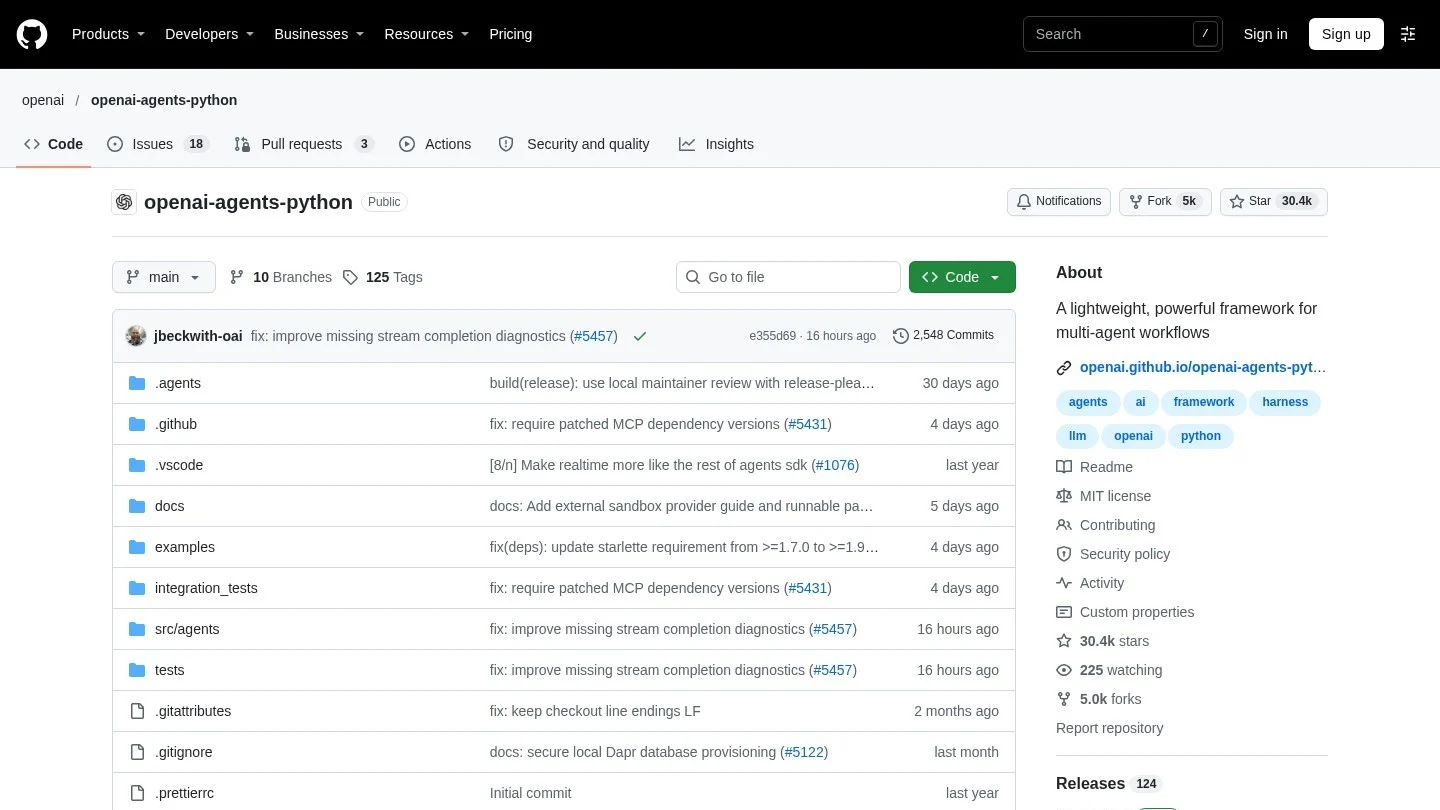
The OpenAI Agents SDK keeps the number of concepts small: agents with instructions and tools, handoffs between agents, guardrails that check inputs and outputs, sessions that keep history, and tracing that records every run. It is MIT-licensed, with a Python package (openai-agents) and a TypeScript package (@openai/agents), and the Python repository had about 30,400 GitHub stars in October 2026.
The April 2026 update added sandbox agents that work with a filesystem, shell and apply-patch tool inside isolated containers, with snapshots that resume a run in a fresh container. It supports sandbox providers including Blaxel, Cloudflare, Daytona, E2B, Modal, Runloop and Vercel. The sandbox harness launched in Python first.
You are not locked to OpenAI models: the SDK reaches 100-plus other LLMs through LiteLLM or any-llm. The hosted tools, though, such as web search and file search, are OpenAI API features.
Pricing: The SDK is free. OpenAI API usage is billed per token at standard rates. Built-in tools cost $10 per 1,000 web search calls for most models, $2.50 per 1,000 file search calls plus $0.10 per GB per day of storage after the first free GB, and hosted containers from $0.03 (1 GB) to $1.92 (64 GB) per 20-minute session.
Pros
- Very small API that is quick to learn
- Tracing, guardrails and human approval built in
- Native sandbox support across seven providers
- Published per-call prices for hosted tools
Cons
- No visual builder
- Newest sandbox features reached Python before TypeScript
- Best hosted tools only work on the OpenAI API
Best for: Product teams already on OpenAI models who want a simple, well-documented way to add tools, handoffs and sandboxed code execution.
3. Claude Agent SDK: Best for Agents That Work on Files and Code
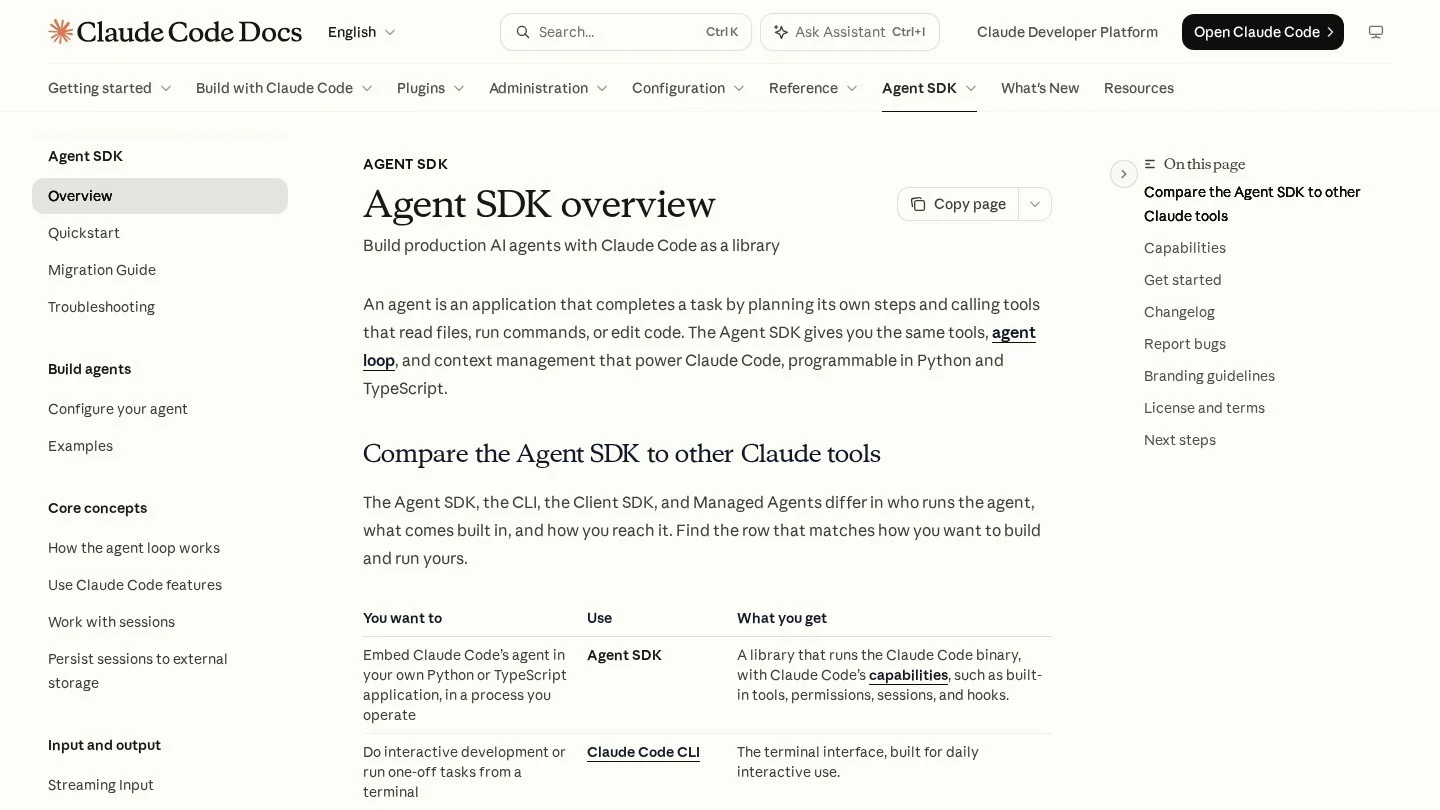
Anthropic’s Claude Agent SDK packages the agent loop, tools and context management that power Claude Code as a library for Python and TypeScript. Out of the box, the agent can read, write and edit files, run commands and search the web, which suits agents that triage bugs, process documents or run operations scripts.
Around that loop you get hooks that run your code at points in the agent lifecycle, subagents for focused subtasks, MCP connections to outside tools, permissions that decide which tools run automatically and which need approval, and sessions you can resume or fork.
Licensing differs from the rest of this list. Use of the SDK is governed by Anthropic’s Commercial Terms of Service rather than an open-source license, and products built on it must authenticate with API keys rather than offering claude.ai login. If you would rather not operate the runtime, Anthropic’s Managed Agents service hosts the harness in an Anthropic cloud sandbox or a self-hosted sandbox.
Pricing: No charge for the SDK; you pay Claude API token rates. Managed Agents adds a runtime charge reported at $0.08 per active session-hour, with idle time not billed.
Pros
- Same proven tools and loop as Claude Code
- Fine-grained permissions and lifecycle hooks
- Subagents, sessions and MCP built in
Cons
- Built around Claude models
- Not released under an open-source license
- Only Python and TypeScript as native libraries
Best for: Teams that want an agent to act inside files, shells and codebases with Claude, and who value guardrails over model choice.
4. Microsoft Agent Framework: Best for .NET and Azure Teams
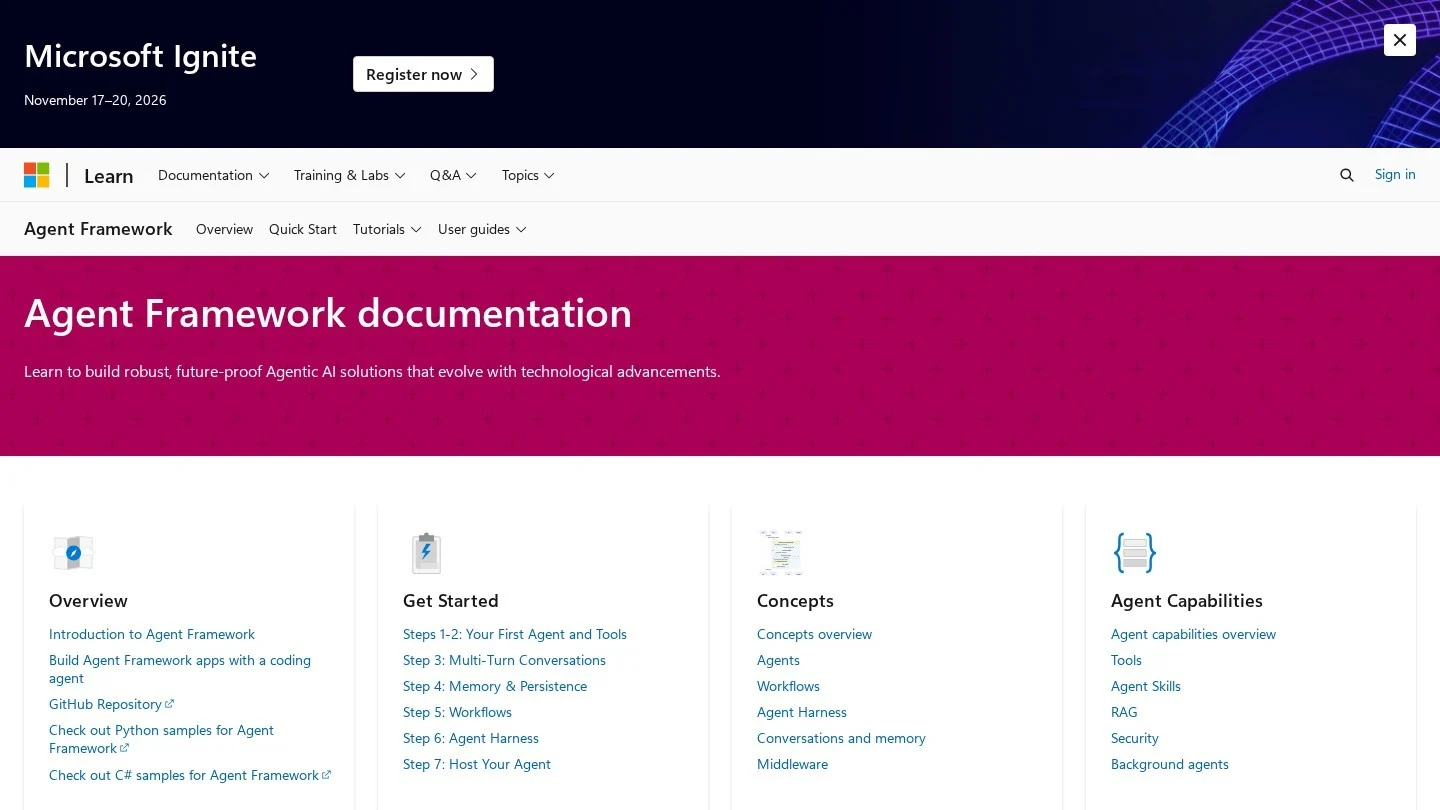
Microsoft Agent Framework merges AutoGen, the multi-agent project from Microsoft Research, with Semantic Kernel’s enterprise plumbing. Version 1.0 shipped on April 3, 2026 for .NET and Python with stable APIs and a long-term support commitment, and the MIT-licensed repository has passed 14,000 GitHub stars.
It offers a single-agent abstraction with typed function tools plus graph-based workflows with branching, fan-out, streaming and checkpointing. Five orchestration patterns come built in: sequential, concurrent, handoff, group chat and Magentic-One. First-party connectors cover Microsoft Foundry, Azure OpenAI, OpenAI, Anthropic Claude, Amazon Bedrock, Google Gemini and Ollama, and it speaks MCP and A2A.
Several operational pieces were still in preview at 1.0, including the DevUI debugger, Foundry hosted agents and Foundry observability and evaluations.
Pricing: The framework is free under MIT and installs from pip or NuGet. You pay for the models you call and for hosting, whether that is Microsoft Foundry, Azure Durable Functions or your own servers. Microsoft publishes no separate fee for the framework itself.
Pros
- First-class C# and .NET support alongside Python
- Stable 1.0 APIs with long-term support
- Seven model connectors, including non-Microsoft models
- Clear upgrade path from AutoGen and Semantic Kernel
Cons
- Debugger and Foundry hosting still in preview at 1.0
- Coding required throughout
- Best tooling assumes Azure
Best for: .NET development teams, Azure customers and anyone with existing AutoGen or Semantic Kernel code.
5. Google ADK: Best for Multi-Language Teams
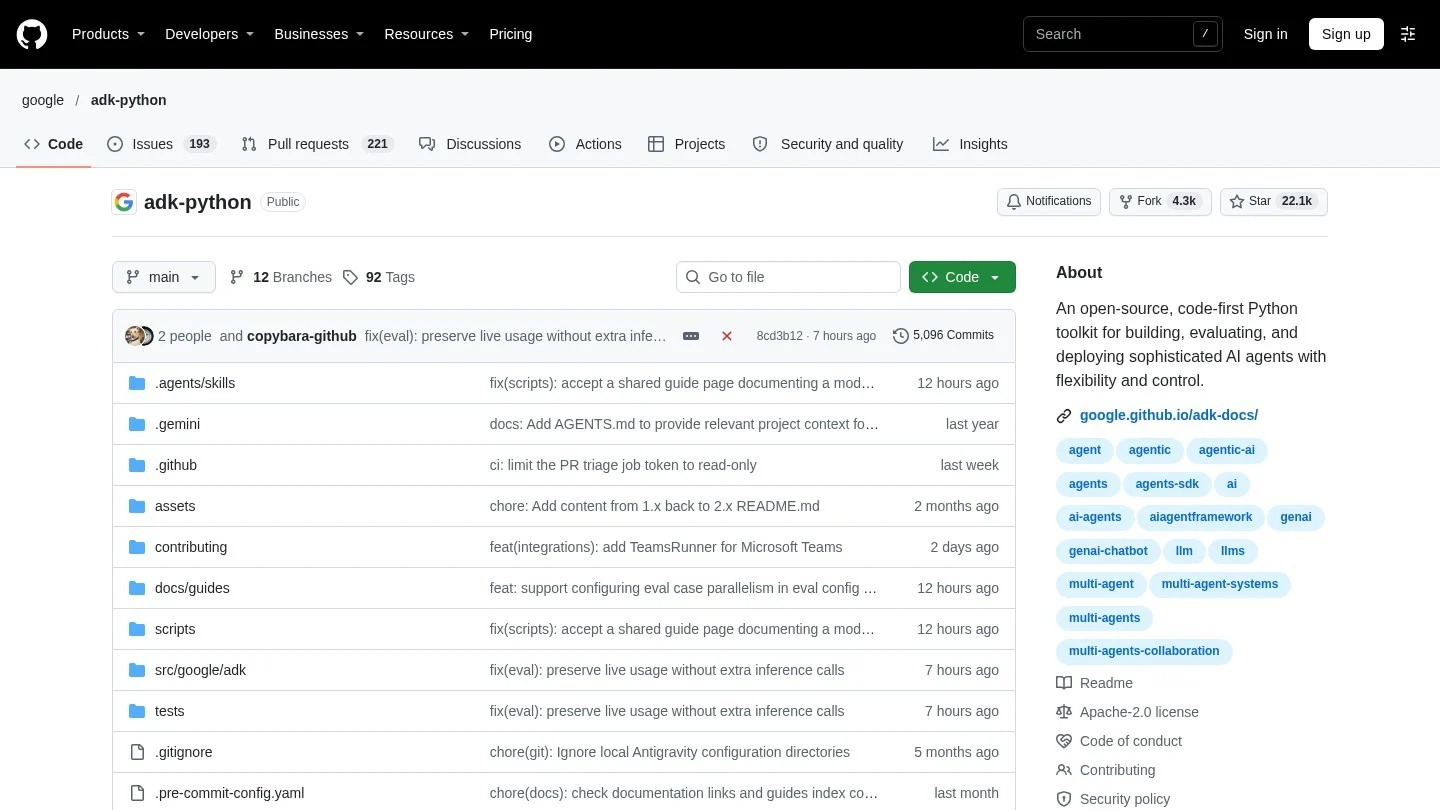
Google’s Agent Development Kit is an Apache 2.0 framework available in Python, Java, Go, TypeScript and Kotlin, with Kotlin still in beta. The Python repository has about 22,000 GitHub stars, and releases land roughly every two weeks.
ADK 2.0, generally available since Google I/O in May 2026, added a graph-based workflow runtime that mixes deterministic code steps with model-led steps, with routing, loops, retries and nested workflows. In Google’s refund-processing example, a 2.0 workflow cut tokens per run from 5,152 to 2,265.
Tooling covers the full loop: an ADK Web interface for testing and debugging, built-in evaluation with adk eval, Tool Confirmation for human approval, and deployment to Cloud Run, Docker or Google’s managed Agent Runtime. ADK works with Gemini and other models, plus MCP tools, OpenAPI specs and the A2A protocol.
Pricing: ADK is free. Agent Runtime on Google Cloud costs $0.085 per vCPU-hour, $0.009 per GiB-hour of memory and about $0.30 per GiB-month of storage, with no charge for idle time between turns. Sessions and Memory Bank have been billed since September 1, 2026. Model tokens are extra.
Pros
- Five language SDKs from one vendor
- Deterministic workflows can sharply cut token use
- Published hosting rates with idle time free
- Built-in evaluation and dev UI
Cons
- Tuned for Gemini and Google Cloud
- Feature parity varies by language
- New metered charges for sessions and memory in 2026
Best for: Engineering groups that work in several languages or already run on Google Cloud and Gemini.
6. CrewAI: Best for Fast Multi-Agent Prototypes
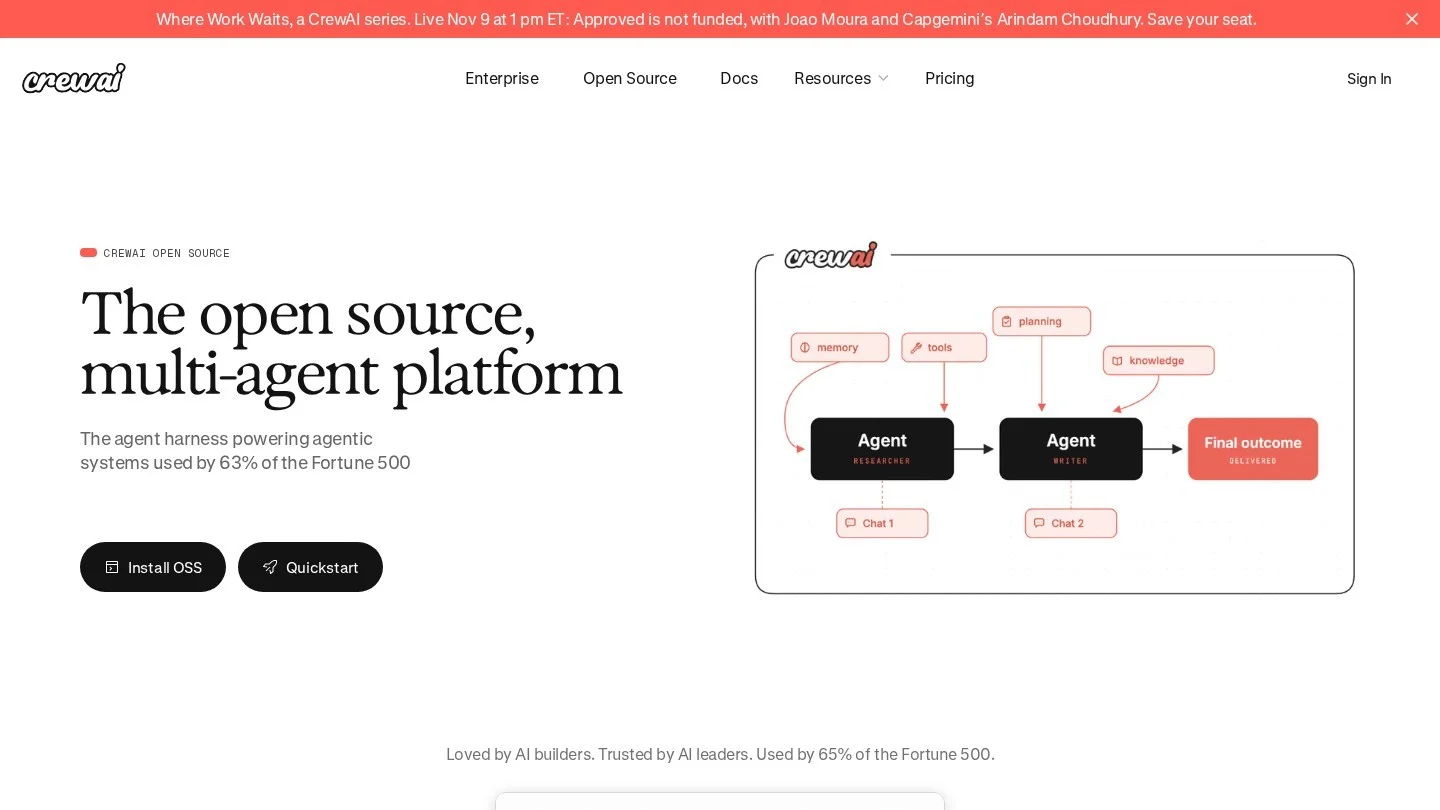
CrewAI organizes work as crews of role-based agents that plan and delegate, plus Flows for event-driven, step-by-step control when you need predictability. You can define agents in YAML, in Python code or both. The framework is MIT-licensed, Python only, and has no dependency on LangChain.
Recent releases added checkpointing to replay or fork runs, MCP tools, A2A collaboration and sandboxed code execution. CrewAI reported more than 400 million agent runs a month in 2025. The company disclosed four CVEs in March 2026, which it says are fixed, so keep the package current.
The commercial layer, CrewAI AMP, adds a Studio editor, tracing with OpenTelemetry, guardrails, scheduling and Slack or Teams chat, and can run in CrewAI’s cloud, a private VPC or your own infrastructure.
Pricing: The framework is free. AMP Basic is free with 50 workflow executions and two automations a month, and workflows stop at the cap. Enterprise is custom-quoted with SSO, RBAC and PII redaction. The former $25 Professional plan was removed in 2026. Model costs are billed by your LLM provider.
Pros
- Quickest path from idea to a working multi-agent crew
- MIT license with no LangChain dependency
- Private VPC and self-managed deployment options
Cons
- Python only
- Free hosted tier is small and Enterprise pricing is unpublished
- Multi-agent runs multiply token costs and are harder to debug
Best for: Python teams that want to prototype role-based multi-agent workflows quickly and grow into a managed platform.
7. Mastra: Best for TypeScript Teams
Mastra is an open-source TypeScript framework under Apache 2.0, with about 29,000 GitHub stars. It lives inside your web app rather than in a separate Python service, with adapters for Next.js, React, Astro, Express, SvelteKit and Hono, and it runs on Node.js, Bun, Deno and Cloudflare.
Agents get tool use, memory and a model router that reaches more than 1,000 models. Workflows support branches, loops, suspend and resume for human approval, and time-travel replay, and supervisor agents coordinate specialists. Mastra Studio handles testing, prompts, datasets and cost monitoring. Named users include Replit, Salesforce, Workday and MongoDB.
Pricing: The framework is free to self-host. The hosted Starter plan is $0 with 100,000 observability events, 24 CPU hours and 15-day retention, then $10 per 100,000 events and $0.35 per CPU hour. Teams costs $250 a month with 1 million events, 250 CPU hours, six-month retention and SSO, then $8 per 100,000 events and $0.25 per CPU hour. The model gateway adds 5.5% to token rates. Enterprise is custom.
Pros
- TypeScript-native, so web teams avoid a second stack
- Memory, workflows, evals and Studio in one package
- Free Starter tier with published overage rates
Cons
- No Python support
- Many separate usage meters on the hosted platform
- Gateway markup of 5.5% on tokens
Best for: JavaScript and TypeScript product teams building agents into web apps.
8. Pydantic AI: Best for Type-Safe Python
Pydantic AI comes from the team behind Pydantic, the validation library used across the Python ecosystem. It is MIT-licensed, reached version 1 in September 2025, and was reported at more than 17,600 GitHub stars and over 33 million monthly downloads in mid-2026, with a version 2 in beta.
Its pitch is predictability for Python developers. Agent outputs are validated against Pydantic models, with the model asked to correct itself when validation fails, and type hints run through the whole API. Durable execution integrates with Temporal, DBOS, Prefect and Restate, Pydantic Graph handles multi-step control flow, and deferred tools support human approval. It supports MCP and A2A, ships an evals framework, and works with most major model providers.
Observability comes from Logfire, Pydantic’s OpenTelemetry-based platform, which also accepts traces from other frameworks.
Pricing: Pydantic AI is free. Logfire Personal is $0 for one seat and 10 million records a month with 30-day retention. Team is $49 a month for five seats and Growth is $249 a month for unlimited seats and projects, each including 10 million records, then $2 per million. Enterprise is custom, including self-hosted. These prices took effect January 1, 2026.
Pros
- Validated, typed outputs reduce parsing bugs
- Durable execution through four workflow engines
- Broad model provider support
- Affordable OpenTelemetry tracing
Cons
- Python only
- Version 2 in beta means API changes ahead
- Fewer prebuilt multi-agent patterns than CrewAI or Microsoft
Best for: Python developers who want agents that behave like well-typed application code.
9. Strands Agents: Best for AWS Teams
Strands Agents is the Apache 2.0 SDK that AWS open-sourced in May 2025 after using it internally. It takes a model-first approach: you give the model a prompt and tools and let it plan, rather than drawing a fixed graph. AWS Transform for .NET uses multiple Strands agents. TypeScript support entered preview on December 3, 2025, alongside the Python SDK, and PyPI downloads were reported at 16.7 million a month in June 2026.
Amazon Bedrock is the default model provider, but Strands also supports Anthropic, OpenAI, Gemini, Mistral, Ollama, llama.cpp and models reachable through LiteLLM. Multi-agent work uses swarm, graph and workflow patterns, MCP is supported natively, and tracing and metrics are reported to use OpenTelemetry. Agents run anywhere Python runs, including Lambda, Fargate and EC2, or on Amazon Bedrock AgentCore.
Pricing: Strands is free. AgentCore Runtime is billed per second at $0.0895 per vCPU-hour and $0.00945 per GB-hour on its v1 rates, with v2 consumption rates of $0.1276 and $0.0169. AgentCore telemetry is billed at Amazon CloudWatch rates. New AWS customers get up to $200 in Free Tier credits.
Pros
- Very little code for a working agent
- Deep AWS integration with Bedrock, Lambda and AgentCore
- Wide model support despite the AWS origin
Cons
- TypeScript SDK arrived later than Python
- Model-first design gives less step-by-step control
- Smaller community than LangGraph or CrewAI
Best for: Teams already on AWS who want agents that deploy cleanly to Lambda or AgentCore.
10. Browser Use: Best for Web-Browsing Agents
Browser Use is a specialist. Its open-source Python library gives an agent control of a real browser so it can click, type and read pages on sites without an API, and it can sit inside a larger agent built with any framework above. The company reported 89.1% on the WebVoyager benchmark in December 2024 using GPT-4o, and it now trains its own browsing models, BU 1.0 and BU 2.0. Those results are self-published.
The cloud adds hosted browsers, residential proxies, CAPTCHA handling and webhooks, with SOC 2 Type II and a HIPAA mode on Enterprise. If your use case is repeat portal work such as invoice downloads, compare it with Skyvern, which has an AGPL-licensed core and plans from $29 a month.
Pricing: The library is free. Browser Use Cloud has no subscription: a free tier with a one-time $1 credit and 10 concurrent sessions, then prepaid credits from $5. Browsers cost $0.02 per browser-hour, residential proxy traffic $5 per GB, and model tokens are billed per million by model. Enterprise is custom.
Pros
- Open-source core you can run and inspect
- Every cloud rate is published
- Very cheap browser time
Cons
- Narrow focus on browser tasks
- Token costs vary widely by model and task length
- Web agents break when sites change or block automation
Best for: Developers adding web navigation, form filling or scraping to an agent.
How To Choose an AI Agent Framework
Shortlist two or three frameworks and build the same small agent in each. These criteria narrow the field.
Start With Your Language and Cloud
Language rules out more options than any feature does. TypeScript teams should look first at Mastra, with the OpenAI Agents SDK, LangGraph, Google ADK and Strands as cross-language alternatives. C# teams have one first-class choice in Microsoft Agent Framework. Your cloud matters next: ADK leans toward Google Cloud, Strands toward AWS and Microsoft’s framework toward Azure, though all three can run elsewhere.
Decide How Much Control You Need
Graph frameworks such as LangGraph, ADK 2.0 workflows and Microsoft’s workflows let code decide each transition, which helps with audits, retries and token budgets. Model-first SDKs such as Strands, the OpenAI Agents SDK and the Claude Agent SDK hand more planning to the model and need far less code.
Check Licensing and Lock-In
MIT and Apache 2.0 let you fork, embed and redistribute freely. The Claude Agent SDK falls under Anthropic’s commercial terms, and Skyvern’s AGPL core carries obligations if you offer a modified version as a service. Browse more permissively licensed options on our open-source AI agents page.
Price Observability Before You Need It
Every production agent needs tracing. Compare LangSmith at $39 per seat a month, Logfire from $49 a month for five seats, Mastra Teams at $250 a month and CrewAI AMP Enterprise on quote, or self-host an OpenTelemetry stack. Seat pricing hurts large teams; event pricing hurts busy agents.
Budget for Tokens, Not Licenses
Hosting at under $0.10 per vCPU-hour is rarely the big line item. Model calls are, and every extra agent in a crew adds more of them. Use multi-agent patterns only when a single agent with good tools falls short; our multi-agent systems page covers when the split pays off.
Consider Whether You Need a Framework at All
If nobody on the team writes code, a visual builder is a better fit. Our roundup of no-code AI agent builders covers tools such as n8n and Microsoft Copilot Studio, which costs $200 a month for 25,000 Copilot Credits. And if you want a ready-made agent rather than a toolkit, open-source agents such as goose and OpenHands already do coding and computer tasks; see our list of the best agentic AI coding tools.
LangGraph or CrewAI, TypeScript Support and What Replaced AutoGen
What Is the Best AI Agent Framework in 2026?
There is no single winner. LangGraph is the most proven choice for complex production agents in Python or JavaScript, Microsoft Agent Framework leads for .NET, Google ADK covers the most languages, and Mastra leads for TypeScript. If you already build on one model vendor, its own SDK is the fastest start.
Are AI Agent Frameworks Free?
Yes. All ten frameworks here are free to download and use. Costs come from model tokens, hosting and optional paid platforms for tracing and deployment, such as LangSmith, CrewAI AMP, Mastra’s hosted platform, Pydantic Logfire, Google Agent Runtime and AWS AgentCore.
Is LangGraph Better Than CrewAI?
They solve different problems. LangGraph gives fine control over state, checkpoints and human approval, at the cost of more code. CrewAI gets a role-based multi-agent crew running faster with less code but is Python only. Teams that need audit trails and long-running workflows usually prefer LangGraph.
What Replaced AutoGen?
Microsoft Agent Framework. It combines AutoGen’s multi-agent ideas with Semantic Kernel’s enterprise features and reached version 1.0 in April 2026. Microsoft provides migration assistants for both, and AutoGen still receives bug fixes and security patches.
Which AI Agent Frameworks Support TypeScript?
Mastra is TypeScript-only. LangGraph, the OpenAI Agents SDK, the Claude Agent SDK, Google ADK and Strands Agents all offer TypeScript or JavaScript packages alongside Python. CrewAI and Pydantic AI are Python only, and Microsoft Agent Framework targets .NET and Python.
