
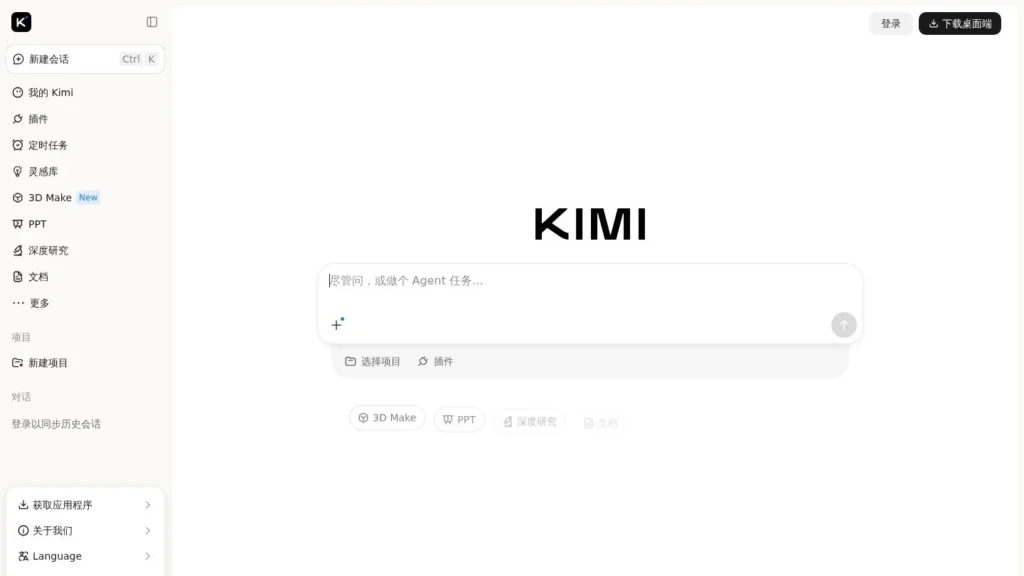
Moonshot AI’s annual recurring revenue doubled from more than $100 million to more than $200 million between early March and April 2026, according to a May 2026 report in The Standard, growth the paper tied to the K2.5 model update, more paid subscribers and higher API usage. Launched on September 26, 2025 as OK Computer, Kimi Agent takes one prompt and returns a deployed website, an editable slide deck, a spreadsheet with pivot tables or a long document, and it can split big jobs across up to 300 sub-agents.
It is best for individuals and small teams who want a cheap, highly autonomous agent for research and office deliverables. Transparency is the main area to weigh: Moonshot is a Beijing company, action traces are abbreviated, prices on its help center are in Chinese yuan and all features share one quota. There is a free tier with limits, paid plans start at ¥49 a month, and we rate it 8.4/10 on our scale. We have not used Kimi ourselves; this review is based on Moonshot’s help center, MIT’s AI Agent Index, Wikipedia and news coverage.
Moonshot’s $200 Million ARR and $20 Billion Valuation
- Moonshot AI’s annual recurring revenue passed $200 million in April 2026 and a Meituan-led round valued the company above $20 billion, as reported in May 2026.
- The agent plans tasks, uses 20+ tools including a terminal, browser and website deployment, and recovers from errors on its own.
- Agent Swarm runs up to 300 sub-agents and more than 4,000 tool calls, about 4.5 times faster than a single agent, according to Moonshot.
- Memberships run from ¥49 to ¥1,399 a month, with one shared monthly quota and roughly 20% off on annual billing.
- Against Manus and Genspark, Kimi offers similar deliverables at a low entry price, with lighter admin controls and transparency so far.
Help Center Figures and the MIT AI Agent Index View
Moonshot publishes product figures in its help center, and its funding has been widely reported. The independent MIT AI Agent Index adds an outside view of how the agent operates.
| Fact | Detail | Source and Date |
|---|---|---|
| Launch | OK Computer released September 26, 2025 as Kimi’s first agent mode, in alpha | MIT AI Agent Index, 2025 |
| Autonomy rating | Rated L3, user as consultant: the agent plans and executes, users mainly give feedback | MIT AI Agent Index, 2025 |
| Agent Swarm | Up to 300 sub-agents and more than 4,000 tool calls, about 4.5 times faster than a single agent | Kimi help center, viewed November 2026 |
| Long runs | K2.6 supports up to 5 days of continuous autonomous operation in proactive agent frameworks | Kimi help center, viewed November 2026 |
| Latest model | K3, released July 16, 2026: 2.8 trillion parameters, 1 million token context, native vision, open weights announced | Kimi help center, viewed November 2026 |
| Funding | About $2 billion round led by Meituan, with China Mobile’s investment arm and CPE participating | The Standard, May 7, 2026 |
| Valuation | Above $20 billion, up from more than $4.3 billion in November 2025 | The Standard, May 7, 2026 |
| Revenue | Annual recurring revenue above $200 million in April 2026, up from over $100 million in early March | The Standard, May 7, 2026 |
| Users | Kimi’s monthly active users reportedly exceeded 36 million in late 2024 | Wikipedia, viewed November 2026 |
| Company | Moonshot AI founded in March 2023; Kimi became publicly available in November 2023 | Wikipedia, viewed November 2026 |
The funding and revenue figures point to a well-resourced developer that is unlikely to vanish, and the jump in recurring revenue after the K2.5 update suggests paying users value the agent and model upgrades. Moonshot also releases open-weight models, so the technology behind the agent is unusually visible for a consumer product.
The MIT index adds context. It rates the agent as highly autonomous and describes its action traces as highly abbreviated, with no visible chain of thought. For a buyer, that means you will see what the agent produced more clearly than how it got there.
Agent Mode on kimi.com, Mobile and Kimi Work Desktop
Agent mode is available on kimi.com, in the Kimi mobile apps and in the Kimi Work desktop app. On a phone or tablet, users choose K3 or K3 Swarm in the model switcher.
From Prompt to Deliverable
- Describe the task: state the goal in plain language, for example a market research report, a website or a deck from a spreadsheet.
- Planning: the agent breaks the job into subtasks and chooses tools for each one.
- Execution: it writes code, runs terminal commands, browses the web, pulls financial data and generates images or audio, adjusting its plan when a step fails.
- Watch and steer: users see reasoning, tool calls, sources and intermediate files as it works and can pause, stop or answer its questions.
- Deliver: results arrive as previewable, downloadable or shareable files, or as a website deployed to the cloud with a link.
What It Produces
Moonshot lists websites and web apps, editable slides, documents in Word, PDF, Markdown and TXT, spreadsheets in Excel and CSV with pivot tables, code projects, data-analysis charts and folders of intermediate files. Its examples include working through 100-page contracts, translating 50-page PDFs and analyzing 1,000-row spreadsheets.
Agent Swarm and Long Tasks
For large jobs, Agent Swarm divides the work among up to 300 sub-agents running in parallel. Higher plans add parallel Agent tasks, scheduled tasks and Goal mode, and Moonshot says its K2.6 model can run for up to five days continuously inside proactive agent frameworks. The Pro plan and above include a dedicated Kimi Claw, which Moonshot pairs with 40 GB of cloud storage.
The Models Behind It
The agent was built by training Kimi K2 with reinforcement learning to use tools, according to MIT’s index. Moonshot has since shipped K2.5 in January 2026, K2.6 in April 2026 as open source and K3 in July 2026, which is available in the apps, the desktop app, Kimi Code and the Kimi API.
A Typical Job
Based on Moonshot’s description of the workflow, a request to compare five competitors and present the results might run like this. The agent plans the research, browses each company’s site and public data, writes code to clean and chart the figures in a spreadsheet, drafts a slide deck and, if asked, deploys a one-page summary site with a shareable link. The user watches the to-do list and intermediate files fill in, answers any questions the agent raises and downloads the finished files at the end.
Goals, Source Checks and Publishing Calls Are Yours
A person sets the goal, answers the agent’s questions, checks sources and numbers in research output and decides what to publish or send. Because traces are abbreviated, reviewing the final files carefully matters more than with agents that log every step in detail.
Free With Limits, Paid Memberships Priced in Yuan
Kimi’s apps are free to use with rate limits. Paid memberships below are listed in Chinese yuan on Kimi’s help center as of October 2026; all features draw on one shared monthly quota that does not roll over.
| Plan | Price | Billing | What’s Included | Limits |
|---|---|---|---|---|
| Free | ¥0 | None | Kimi apps on web and mobile | General rate limits |
| Go | ¥49 a month; ¥468 a year (¥39 a month) | Monthly or annual | Documents, slides, deep research and site deployment | No Kimi Code |
| Plus | ¥99 a month; ¥948 a year (¥79 a month) | Monthly or annual | Go plus Kimi Code and agent clusters | Rolling 5-hour Kimi Code limit |
| Pro | ¥199 a month; ¥1,908 a year (¥159 a month) | Monthly or annual | Plus features, Goal mode, a dedicated Kimi Claw, larger quota | Shared monthly quota |
| Max | ¥699 a month; ¥6,708 a year (¥559 a month) | Monthly or annual | Larger quota and more parallel task capacity | Shared monthly quota |
| Ultra | ¥1,399 a month; ¥13,428 a year (¥1,119 a month) | Monthly or annual | Agent quota twice Max, 4 parallel Agent tasks, 25 scheduled tasks, 100 projects, 50 GB storage | Shared monthly quota |
Earlier subscribers may be on legacy plans named Andante, Moderato, Allegretto or Allegro, which keep their existing terms. When OK Computer launched, MIT’s index recorded beta pricing of ¥49 for 10 uses, ¥99 for 20 and ¥199 for 40.
A Consultant’s ¥588 Year on the Go Plan
These scenarios use the yuan prices above. Usage patterns are our own illustrative assumptions.
- A consultant making weekly decks and reports: Go costs ¥588 a year paid monthly or ¥468 paid annually, a saving of ¥120.
- A developer who also wants Kimi Code: Plus costs ¥948 a year on annual billing, ¥240 less than twelve monthly payments.
- A power user running scheduled and parallel jobs: Ultra costs ¥13,428 a year on annual billing against ¥16,788 paid monthly, a saving of ¥3,360, the maximum Kimi cites.
Costs to watch: the shared quota means heavy agent use also eats into chat, code and research allowances, and unused quota is lost at the end of each month.
Kimi Agent Compared With Manus, Genspark Super Agent and ChatGPT Work
General-purpose agents now produce similar outputs: research, slides, sheets and simple sites. The differences are price, transparency and where your data goes.
| Agent | Starting Price | Free Plan | Main Strength | Main Trade-Off | Best For |
|---|---|---|---|---|---|
| Kimi Agent | Free; paid from ¥49 a month | Limited | Agent Swarm and very high autonomy at a low price | Abbreviated traces; yuan pricing; Beijing developer | Individuals wanting cheap, autonomous deliverables |
| Manus | Free; paid from $20 a month | Yes | Research, presentations and simple web apps in one agent | Credit-based limits | Individuals and small teams |
| Genspark Super Agent | Free; Plus $24.99 a month | Limited | Slides, sheets, docs and sites from one tool | Free tier is limited | Small teams that want to start free |
| ChatGPT Work | Free on desktop; $20 a month (Plus) | Limited | Works across connected work apps with OpenAI models | Tied to the ChatGPT ecosystem | Teams already on ChatGPT |
Kimi stands out on autonomy per dollar, especially with Agent Swarm. ChatGPT Work is the safer pick for teams that need connections to their work apps, and Manus and Genspark sit between the two with dollar pricing. See more in our general-purpose AI agents guide, or compare MiniMax Code for another agent from a Chinese AI lab.
Budget Solo Professionals, Researchers and Analysts
- Solo professionals on a budget: entry plans cost ¥49 a month and the free tier allows testing first.
- Researchers and analysts: the agent reads long documents, analyzes spreadsheets and returns charts and reports.
- Marketers and founders: it builds and deploys a website or landing page from a prompt with a shareable link.
- Heavy batch users: Agent Swarm and parallel tasks on higher plans suit large research or data jobs.
- Fans of open models: Moonshot’s open-weight releases let technical users run related models themselves.
Regulated Firms and Teams Needing Audit Controls
- Regulated companies: organizations with vendor-origin or data residency rules may not be able to send data to a Beijing-based provider.
- Teams needing admin and audit controls: the agent’s action traces are abbreviated, according to MIT’s index.
- Buyers who need business app connectors: its tools are built in rather than linked to CRMs, inboxes or project tools.
- Anyone who wants predictable usage: one shared quota covers every feature and resets monthly.
Beijing Data Location and Abbreviated Action Traces
- Data location: Moonshot is incorporated in Beijing; read the privacy policy before uploading sensitive files.
- Trace detail: you see a summary of actions rather than every step, so verify outputs.
- Quota sharing: agent runs, chat, research and code draw on the same monthly pool.
- Currency: the help center lists prices in yuan; check the purchase page for prices in your region.
- Fast model updates: K2.5, K2.6 and K3 arrived within six months, so behavior and quotas can change quickly.
Meituan Leads a $2 Billion Round in May 2026
- On May 7, 2026, The Standard reported that Moonshot AI was closing a roughly $2 billion round led by Meituan at a valuation above $20 billion, after annual recurring revenue passed $200 million in April.
- In July 2026, Moonshot released Kimi K3, with 2.8 trillion parameters and a 1 million token context window, and made it available in agent mode with a K3 Swarm option.
- In April 2026, Moonshot released and open-sourced K2.6, which it says can run for up to five days in proactive agent frameworks.
Maximum Autonomy for Little Money
For individuals and small teams who want maximum autonomy for little money, yes. Kimi Agent scores 8.4/10 on our scale: top marks for autonomy and ease of use, with room to grow on transparency, business connectors and public ratings. Agent Swarm and long-running models make it one of the most capable general agents for research, slides, sheets and websites.
Companies with strict data rules or audit needs should look at ChatGPT Work or Manus instead. Everyone else can test it on the free tier, check how much quota a typical job uses, and choose between Go and Pro from there.
OK Computer, Model Choice, Price and Company Data Safety
What Is Kimi OK Computer?
OK Computer is the original name of Kimi’s agent mode, launched by Moonshot AI on September 26, 2025. It plans and runs multi-step tasks with more than 20 tools and delivers websites, slides, documents and spreadsheets.
How Much Does Kimi Agent Cost?
Kimi is free with rate limits. Paid memberships on Kimi’s help center run from ¥49 a month for Go to ¥1,399 a month for Ultra, with annual billing cheaper, and all features share one monthly quota.
Which Model Powers Kimi Agent?
The agent runs on Moonshot’s Kimi models. It was first built on K2, and K3, released in July 2026 with a 1 million token context window and native vision, is now available in agent mode alongside a K3 Swarm option.
Is Kimi Agent Safe for Company Data?
Moonshot is based in Beijing and publishes terms and a privacy policy. MIT’s AI Agent Index describes the agent’s action traces as highly abbreviated, so companies with strict data or audit rules should review the privacy policy and keep sensitive files out.
How Does Kimi Agent Compare With Manus?
Both turn prompts into research, slides and simple sites. Kimi offers Agent Swarm with up to 300 sub-agents and a lower entry price in yuan, while Manus bills in dollars from $20 a month with a free plan.
User Reviews
Nobody has rated it here yet. Be the first AI Agents Choice user to rate Kimi Agent (OK Computer).