
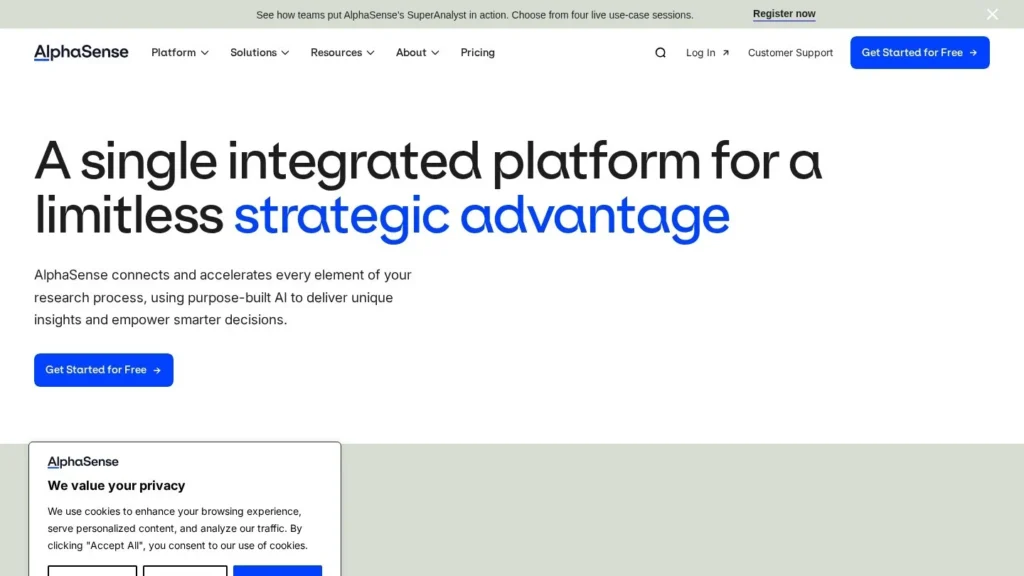
AlphaSense is a market intelligence platform whose AI agents research competitors in a licensed library of more than 500 million business documents: filings, earnings call transcripts, broker research, expert interviews and news. Deep Research writes cited briefings, Workflow Agents run research on a schedule and push it to you, and SuperAnalyst, launched in June 2026, runs as an always-on agent. Pricing is quote-based, with a free trial.
It fits corporate strategy, competitive intelligence and investment teams who track rivals through what they say to investors, analysts and the press. Teams that want alerts when a rival edits its pricing page will need a different tool, since AlphaSense reads documents and data. The company passed $600 million in ARR in early 2026 and serves more than 7,000 enterprises. It scores 8.1/10 on our scale.
AlphaSense Competitor Research in Five Points
- AlphaSense raised $350 million at a $7.5 billion valuation on June 3, 2026, after passing $600 million in ARR in Q1 2026.
- More than 7,000 enterprises use it, including a majority of the Fortune 500, according to the company.
- Workflow Agents run research on a schedule and push results, and Deep Research produces cited briefings.
- Gartner named AlphaSense a Leader in its inaugural Magic Quadrant for Competitive and Market Intelligence Platforms in April 2026.
- Pricing is quote-based with a free trial; G2 reviewers give 4.6 out of 5 across 335 reviews and mention a learning curve.
AlphaSense by the Numbers
AlphaSense is the largest company in this category by revenue, and its June 2026 funding release carries most of its public figures.
| Fact | Detail | Source and Date |
|---|---|---|
| Latest round | $350 million at a $7.5 billion valuation, nearly double the prior $4 billion | AlphaSense press release, June 3, 2026 |
| Lead investors | Vitruvian Partners, Accenture Ventures, J.P. Morgan Asset Management | AlphaSense press release, June 3, 2026 |
| Total funding | Well over $1 billion | AlphaSense press release, June 3, 2026 |
| ARR | Above $600 million in Q1 2026, up from $500 million in October 2025 | AlphaSense press release, June 3, 2026 |
| Customers | More than 7,000 enterprises, including a majority of the Fortune 500 | AlphaSense press release, June 3, 2026 |
| Named customers | Adobe, Amazon, Microsoft, Nvidia and Pfizer among more than 7,000 enterprises | FinTech Global, June 4, 2026 |
| Content library | More than 500 million business documents | AlphaSense AI page |
| Analyst recognition | Leader, Gartner Magic Quadrant for Competitive and Market Intelligence Platforms | AlphaSense press release, April 21, 2026 report |
| New agent | SuperAnalyst, an always-on AI agent | AlphaSense press release, June 3, 2026 |
| Channel partner | Accenture, first strategic channel partner for agentic systems | AlphaSense press release, June 3, 2026 |
| G2 rating | 4.6 out of 5 from 335 reviews | G2 |
The ARR growth is the figure to note. Going from $500 million to more than $600 million in about two quarters means a large and fast-growing customer base, which usually brings steady investment in agents and content. The 500 million documents matter more than the AI for competitor work, because the answers are only as good as the sources behind them, and much of AlphaSense’s library is licensed content that public web tools cannot read.
The Gartner Leader placement and Fast Company recognition help with procurement at large companies. For smaller buyers, the same numbers signal an enterprise vendor with enterprise pricing.
How AlphaSense Agents Research a Competitor
AlphaSense layers several agents on one content library. Each handles a different kind of competitor question.
The Content Underneath
The library holds more than 500 million business documents. AlphaSense lists expert interview transcripts from Tegus, broker and analyst reports, financial data covering fundamentals, comparables, M&A transactions and funding rounds, and real-time company earnings. Enterprise Intelligence connects shared drives, so a company’s own memos, meeting notes and decks become searchable next to outside sources.
Generative Search for Everyday Questions
Generative Search is described as a multi-agent research system. It reasons across qualitative documents, structured financial data and internal files and returns answers that trace back to sources. A competitive analyst might ask what a rival’s CEO said about pricing on the last three earnings calls and get a cited answer.
Deep Research for Larger Projects
Deep Research works like a small team of analysts on a bigger question, such as mapping a rival’s expansion plans across filings, expert calls and news. AlphaSense says it compresses weeks of analysis into minutes. The output is an investment-grade briefing that the analyst reviews.
Workflow Agents and SuperAnalyst for Ongoing Tracking
Workflow Agents run custom research on a schedule. A team could set one to summarize every new filing, earnings call and expert interview that mentions its top five competitors each Monday. Results are pushed to the user. SuperAnalyst, launched on June 3, 2026, is described as an always-on agent built to act like an extension of the team.
Monitoring, Alerts and Sentiment
Customizable dashboards and regular alerts flag new documents on watched companies and topics, and a mobile app carries them. Sentiment indices track tone across earnings calls, and Channel Check Intelligence summarizes channel-check research.
Work Products in the Team’s Format
Work Products build decks, reports and tables in a firm’s own formats. Users refine them through PowerPoint and Excel add-ins, so a competitor briefing can go to leadership without rebuilding slides.
Setting Up Agents for a Five-Rival Watchlist
A competitor program in AlphaSense starts with a watchlist and a few standing questions. The setup below is our suggestion for a team new to the platform.
- Build the watchlist: Add the five rivals that matter most, plus their parent companies and key suppliers if they report publicly.
- Write standing questions: Examples: what each rival said about pricing, capacity and new products this quarter, and what experts say about their sales teams.
- Schedule Workflow Agents: Run one weekly digest across all five rivals and one deeper monthly review per rival.
- Connect internal files: Link the shared drive with win-loss notes and past competitor decks so answers combine outside and inside knowledge.
- Set alert thresholds: Turn on alerts for earnings, filings and major news only, to keep the feed readable.
Reviewers mention information overload, so narrow questions produce better digests than broad ones such as “everything about rival X.”
A Quarter of Competitor Tracking in AlphaSense
Picture a strategy team at a medical device maker tracking four rivals. It sets a Workflow Agent to send a summary every Monday of new filings, earnings remarks and expert interviews that mention those rivals. When one rival reports earnings, the team runs Deep Research on its margin commentary and pricing plans across the last year of calls and expert interviews. The briefing comes back with citations; an analyst checks the key claims, edits the deck in PowerPoint and sends it to leadership the same week. Alerts on the mobile app catch news between reports.
What Analysts Still Own
Analysts choose the questions, check citations and decide what goes to leadership. AlphaSense’s auditable outputs make that checking faster, since each claim links to its source.
AlphaSense Pricing and Budget Planning
AlphaSense offers a free trial and quotes subscriptions. It does not list plan prices on its AI pages.
| Item | Price | Billing | What Is Included | Notes |
|---|---|---|---|---|
| Free trial | $0 | Trial period | Access to the platform to test search and agents | Start from the AlphaSense site |
| Platform subscription | Quote-based | Contract | Generative Search, Deep Research, monitoring, alerts, mobile app | Seats and content shape the quote |
| Premium content | Quote-based | Add-on | Tegus Expert Insights, broker research, financial data | Confirm which sets are included |
| Workflow Agents and SuperAnalyst | Ask in demo | Contract | Scheduled and always-on agents | Confirm availability on your plan |
Building the Business Case Without a Price List
With no list price, the planning work is on the value side and on scope.
- A five-person strategy team: If agents save each analyst 4 hours a week of reading and summarizing, that is 20 hours a week, or about 1,000 hours a year across 50 working weeks. Compare that with the quote.
- A competitive intelligence team replacing several sources: List what you pay today for expert calls, broker research and news. If AlphaSense content replaces some of it, the net cost falls.
- An enterprise rolling out to product and sales leaders: Ask about pricing for light users who read briefings but do not run research, since they may not need full seats.
G2 reviewers describe pricing as premium. Ask about multi-year terms and which content packages are essential for competitor work in your industry.
AlphaSense Compared With Klue, Crayon and Visualping
These tools all track competitors, from different starting points: AlphaSense from documents and investor content, Klue and Crayon from sales and marketing signals, and Visualping from web pages.
| Agent | Starting Price | Free Plan | Main Strength | Main Weakness | Best For |
|---|---|---|---|---|---|
| AlphaSense | Quote-based | Trial | Licensed library of 500M+ documents with research agents | Premium pricing and learning curve | Strategy and investment teams |
| Klue | Quote-based | No | Deal Tips and battlecards for sellers | No published pricing | B2B sales teams with a CI owner |
| Crayon | Quote-based | No | Field Agent capture of rep insights | High cost per reviewer data | Product marketing teams |
| Visualping | Free; $14 a month | Yes | Watches any web page with AI importance flags | No document research | Teams watching rival web pages |
AlphaSense and Crayon both sit in Gartner’s first Magic Quadrant for this market, but they serve different users. AlphaSense suits people who brief executives and investors; Klue and Crayon suit people who brief sellers. Visualping fills the web-change gap that none of the others focus on. See more in our competitor monitoring agents guide and the research agents category.
Strategy, Investment and Corporate Intelligence Teams
- Corporate strategy and CI teams at large companies: Rivals’ filings, earnings calls and expert commentary are the core sources, and AlphaSense licenses them.
- Investment firms: AlphaSense says nearly all of the world’s largest financial institutions use it, and its financial data and expert insights serve that work.
- Life sciences and industrial companies: AlphaSense lists life sciences among its focus areas, where expert interviews and analyst reports carry weight.
- Teams that report to executives: Work Products and the PowerPoint add-in turn research into decks in the firm’s format.
- Companies with years of internal research: Enterprise Intelligence makes old memos and decks searchable next to new outside sources, so past competitor work is not lost.
Teams That May Want a Different Competitor Tool
- Small businesses and startups: Premium, quote-based pricing may not fit a small budget; Visualping’s free plan covers web changes.
- Sales enablement teams: Klue and Crayon push guidance into deals and Slack, which AlphaSense does not focus on.
- Online stores tracking prices: Prisync tracks product prices and reprices by rules.
Learning Curve, Pricing and Source Checks
- Learning curve: G2 reviewers cite a steep learning curve and a complex interface. Plan training time for new users.
- Information overload: A 500-million-document library returns a lot. Narrow Workflow Agents to specific companies and topics.
- Price: Reviewers call pricing premium. Get a written quote that lists content sets and agents.
- Citations: Outputs are auditable, but analysts should still check key claims before they reach leadership.
- Coverage gaps: AlphaSense covers documents and data. Pair it with a web or price monitor for page-level changes.
SuperAnalyst Launch and the $7.5 Billion Valuation
On June 3, 2026, AlphaSense raised $350 million at a $7.5 billion valuation, led by Vitruvian Partners, Accenture Ventures and J.P. Morgan Asset Management, with D. E. Shaw Ventures and Pinegrove joining. The same release introduced SuperAnalyst and named Accenture its first strategic channel partner for building market intelligence into agentic systems. FinTech Global reported that SuperAnalyst runs high-value financial and strategic workflows in the background and that headcount more than doubled across EMEA and APAC.
The release also noted that Gartner named AlphaSense a Leader in its inaugural Magic Quadrant for Competitive and Market Intelligence Platforms on April 21, 2026, and that Fast Company listed it among its Most Innovative Companies for 2026.
Where AlphaSense Fits in a Competitor Program
AlphaSense scores 8.1/10 on our scale. Its licensed content, scheduled agents and auditable briefings make it a heavy-duty choice for teams that track competitors through investor and expert sources. The growth figures and Gartner placement show a vendor with resources to keep building.
Two areas could improve: published pricing for mid-size teams and a gentler learning curve for new users. For sales enablement, Klue or Crayon fit better, and for web page changes, Visualping. A free trial on two or three real competitor questions is the best way to judge whether the content library covers your market.
During the trial, pick one question the team answered by hand last quarter, such as how a rival framed a price increase, and compare AlphaSense’s cited answer with the original work. If the agent finds the same sources faster, or finds expert or broker material the team missed, the coverage is there. If your rivals are private companies with little public disclosure, check how much the library holds on them before signing.
Strategy Teams’ Questions About AlphaSense Agents
How Much Does AlphaSense Cost?
AlphaSense does not publish plan prices on its AI pages. It offers a free trial, and subscriptions are quoted based on seats and content packages such as expert insights and broker research.
What Is AlphaSense SuperAnalyst?
SuperAnalyst is an always-on AI agent launched on June 3, 2026. AlphaSense describes it as built to act like an extension of a research team.
Can AlphaSense Monitor Competitors Automatically?
Yes. Workflow Agents run custom research on a schedule and push results, and dashboards and alerts flag new documents on watched companies.
What Sources Does AlphaSense Search?
More than 500 million business documents, including expert interviews from Tegus, broker and analyst reports, financial and transaction data, earnings content and your own connected files. The licensed content, especially expert interviews and broker research, is the part public AI search tools cannot reach.
Is AlphaSense Hard to Learn?
Some G2 reviewers mention a steep learning curve and a complex interface, while ease of use is also the most-discussed topic overall. Budget onboarding time for new users, and start with a few saved searches and one scheduled agent before rolling out the full platform.
User Reviews
Nobody has rated it here yet. Be the first AI Agents Choice user to rate AlphaSense.