
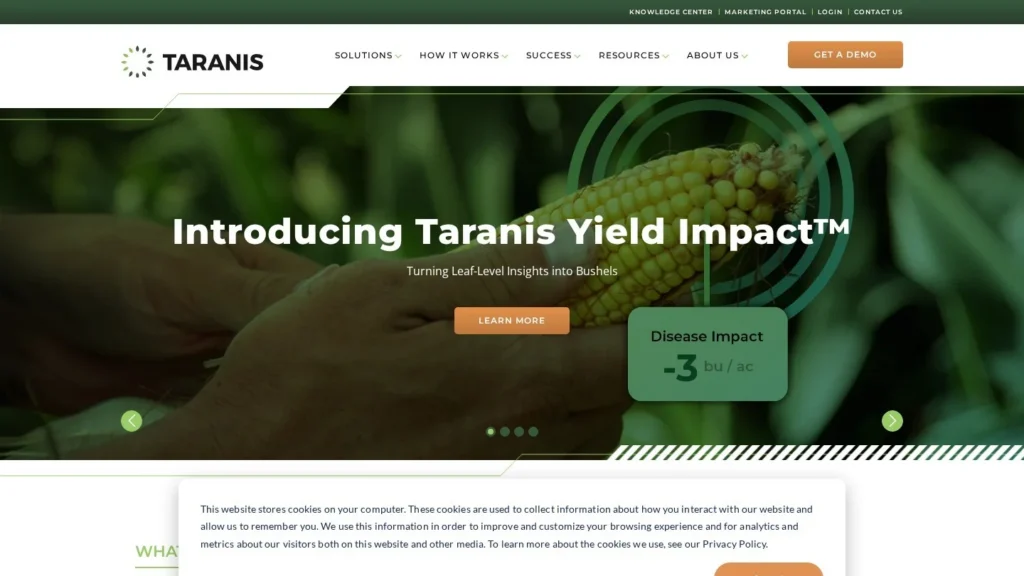
Taranis Ag Assistant writes the agronomy report so the agronomist does not have to. After each scouting mission, it turns Taranis’s leaf-level imagery, weather maps, machinery data and research into a field-specific recommendation, and since May 2026 it can attach an estimate of bushels per acre lost to each threat it finds. It is best for ag retailers and advisors that sell scouting services and want to deliver more advice per agronomist.
Access runs through partners. Taranis sells through retailers, advisors and crop protection companies, shares pricing on request and keeps a human advisor in the loop on every recommendation. We rate it 7.3/10 on our scale. We have not used Taranis ourselves; this review is based on Taranis’s press releases and partner announcements, plus agricultural trade and investment coverage.
A Generative Scouting Assistant and Yield Impact Estimates
- Ag Assistant launched in July 2024 as a generative AI model that reads images, text and audio and writes field reports after each scouting mission.
- Taranis Yield Impact, added in May 2026, estimates yield loss in bushels per acre for each detected threat.
- Syngenta turned a pilot into a formal partnership in October 2025, bringing Taranis to Midwest retailers starting with the 2026 season.
- Taranis had raised $100 million in total by its $40 million Series D in 2022, led by Inven Capital, with more than 100 retailer and advisor partners.
- Pricing is quote only and access usually runs through a retailer; independent growers wanting a free advisor should start with Norm by FBN.
Partners and Funding on the Public Record
Taranis has published more about its partners and funding than about pricing. These are the facts we could confirm on the source pages.
| Fact | Detail | Source and Date |
|---|---|---|
| Ag Assistant launch | Generative AI model taking in images, text and audio; field reports after each scouting mission and across the season | Taranis press release, July 17, 2024 |
| Training data | Several years of in-season crop intelligence from fields across the continental US, plus weather maps, machinery data, university research and product studies | Taranis press release, July 17, 2024 |
| Founded and offices | Founded in 2015; offices in Westfield, Indiana, Tel Aviv, Israel and Campinas, Brazil | Taranis press release, July 17, 2024 |
| Coverage | Millions of acres across the US, Brazil and Europe | Global AgInvesting, October 9, 2025 |
| Series D | $40 million led by Inven Capital, with Seraphim Space Investment Trust and Farglory Group joining; total raised $100 million | FreshPlaza, September 9, 2022 |
| Partners and data | More than 100 ag retailers and advisors as innovation partners; crop dataset of more than 200 million AI data points | FreshPlaza, September 9, 2022 |
| Syngenta deal | Multi-year agreement covering leaf-level insights, an AI-driven ag assistant and conservation services, with a planned Cropwise integration | Global AgInvesting, October 17, 2024 |
| Syngenta expansion | Pilot became a formal partnership; rollout to Midwest retailers from the 2026 season; yield projection algorithms planned for Ag Assistant | Global AgInvesting, October 9, 2025 |
| Yield Impact | Proprietary model estimating yield loss in bushels per acre for each detected threat | Taranis press releases, May 11, 2026 |
| 2026 rollouts | Field validation program with SiFly for aerial crop intelligence (January 21); Apex Ag Solutions became the first Arkansas-based retailer to offer it (January 28) | Taranis press releases, January 2026 |
The Syngenta relationship is the strongest signal here. A crop protection major moving from pilot to formal partnership, and putting Taranis in front of Midwest retailers for 2026, suggests the reports are useful enough for retailers to sell. It also means many recommendations will sit next to a specific supplier’s product line, so growers should ask how product suggestions are chosen.
The funding total is a 2022 figure. Taranis has announced partnerships and product launches since; buyers making multi-season commitments should still ask about the company’s runway.
Imagery From the Service, Interpretation From the Assistant
Ag Assistant is the reporting layer on top of Taranis’s crop intelligence service. The service collects the imagery; the assistant interprets it.
Step 1: Leaf-Level Scouting
Taranis captures high-resolution imagery of fields during the season and runs detection models on it. According to the 2024 Syngenta announcement, the insights cover stand count, weed and disease detection, insect damage, nutrient deficiencies and field health trends. Seraphim, an investor, pointed to sub-millimeter imaging as the reason it backed the company in 2022. In January 2026 Taranis started a field validation program with SiFly to scale aerial capture.
Step 2: The Assistant Writes the Report
Once a scouting mission is processed, Ag Assistant combines the detections with weather maps, machinery data, university research reports and product studies, then writes a report for that field. Taranis’s own example: if widespread weeds suggest the control program failed, the assistant generates an expert-level report with a targeted control recommendation for that field, instead of an agronomist spending days scouting and checking records. Reports also roll up across the season to guide nutrient management and input decisions for the next crop.
Step 3: Putting a Number on the Threat
Yield Impact, launched in May 2026, estimates bushels per acre lost for each detected threat. That lets an advisor compare the expected loss from, say, a disease patch with the cost of treating it, which is the conversation retailers want to have with growers.
Who Does What
- Taranis does: image capture and processing, threat detection, report writing and yield loss estimates.
- The advisor does: review the report, adjust recommendations to local knowledge and present them to the grower.
- The grower does: decide, buy inputs and apply them according to the label.
Taranis’s CTO, Gershom Kutliroff, described the job as gathering and analyzing many disparate data sources for agronomists. That retrieval and synthesis is what makes it more agent than chatbot, though it does not yet act in other systems.
Where the Syngenta Partnership Fits
Syngenta Crop Protection signed a multi-year agreement with Taranis in October 2024 covering intelligence services, leaf-level imagery and an AI-driven ag assistant for advisors, retailers and growers, with a planned integration of Syngenta’s Cropwise platform for retail partners. A year later the two companies formalized a broader partnership: Midwest retailers pair Taranis detections with Syngenta’s crop protection portfolio starting in the 2026 season, and Ag Assistant is due to gain yield projection algorithms. For a retailer, that means a supplier-backed program; for a grower, it means many reports will arrive through a Syngenta-aligned channel.
Reaching Taranis Through a Participating Retailer
Most growers reach Taranis through a participating retailer. Retailers and advisors contract with Taranis directly,, and Taranis’s knowledge base explains how to install its Android mobile app. Ask your retailer whether it offers Taranis scouting for your crops and region.
Retailers Package the Service, Growers Get No Rate Card
Taranis does not publish prices. Its customers are primarily ag retailers, advisors and crop protection companies, who package the service for growers.
| Plan | Price | Billing | What’s Included | Limits |
|---|---|---|---|---|
| Retailer or advisor contract | Custom quote | Set by contract | Leaf-level scouting, detections, Ag Assistant reports, Yield Impact | Coverage depends on regions and crops Taranis serves |
| Grower access via retailer | Set by the retailer | Usually part of a retail agronomy program | Field reports and recommendations from the retailer’s advisors | Depends on the retailer offering Taranis |
| Syngenta program | Through participating Midwest retailers | Set by the retailer | Taranis crop intelligence paired with Syngenta crop protection | Starts with the 2026 season |
Does a Treatment Pay, Using Yield Impact Math
With no price list, the useful arithmetic is the one Yield Impact supports: whether a treatment pays. The scenarios below use our own illustrative numbers, not Taranis data or market prices.
- A disease patch on 40 acres: if Yield Impact estimates a loss of 6 bushels an acre and grain is worth an assumed $4.50, the threat costs about $27 an acre, or $1,080 across the patch. A treatment costing an assumed $20 an acre, or $800, would pay.
- A weed escape on 160 acres: at an estimated 3 bushels an acre lost and $4.50 grain, the loss is $13.50 an acre, or $2,160 in total. A $25-an-acre rescue pass would cost $4,000 and would not pay on this field alone.
- An advisor’s time: if a report that once took an agronomist four hours now takes 30 minutes to review, a book of 50 fields saves about 175 hours a season, before counting the cost of the service.
When you ask for a quote, find out whether pricing is per acre or per account, how many scouting missions a season are included, whether Yield Impact costs extra, and who owns the imagery and reports.
Taranis Ag Assistant Compared With AGMRI AI Agent, Norm by FBN and Instacrops
All four use AI to tell farmers what to do in the field; they differ in where the data comes from and who buys them.
| Agent | Starting Price | Free Plan | Main Strength | Main Trade-Off | Best For |
|---|---|---|---|---|---|
| Taranis Ag Assistant | Custom quote | No | Leaf-level scouting imagery turned into field reports with yield loss estimates | Sold mainly through retailers | Retail agronomy teams selling scouting |
| AGMRI AI Agent | Custom quote | No | Answers from an operation’s own imagery, soil, input and yield records, including breakeven math | Only inside AGMRI | Retailers and large row-crop farms on AGMRI |
| Norm by FBN | Free with FBN membership | Yes | Free agronomy and livestock answers in chat | General advice, not tied to field imagery | Individual farmers in the US and Canada |
| Instacrops | Custom quote | Limited | WhatsApp agents for irrigation and yield; can control irrigation | Focused on Latin American fruit crops | Fruit and nut growers in Latin America |
Taranis and AGMRI are the closest rivals. Taranis’s edge is leaf-level detection and the Syngenta channel; AGMRI’s is conversational analysis across a farm’s history, such as hybrid placement and breakeven yield. Norm suits growers who want free answers today without a scouting contract. Browse more in our AI agents for agriculture guide.
Ag Retailers With Scouting Programs
- Ag retailers with scouting programs: automated reports after each mission let a limited team cover more acres.
- Retailers in Syngenta’s Midwest program: the 2026 rollout pairs Taranis detections with a crop protection portfolio.
- Independent crop advisors: written, field-specific reports make it easier to show growers what was found and why a treatment is suggested.
- Growers whose retailer already offers Taranis: you get leaf-level insights without buying a platform yourself.
- Teams that need economic framing: Yield Impact converts detections into bushels per acre lost.
Growers Without a Retailer and Farms Wanting Automated Action
- Growers without a participating retailer: Taranis is designed around retailers rather than as a direct self-serve app for individual farms.
- Farms wanting automated field action: the assistant recommends; it does not run equipment or irrigation.
- Buyers who want published prices before talking to sales: Taranis shares pricing by quote.
- Growers who want supplier-neutral advice: partnerships with crop protection companies mean you should ask how product recommendations are made.
- Specialty and fruit growers outside Taranis’s core markets: check crop and region coverage first.
Advisor Sign-Off and Syngenta Ties
- Recommendation, not prescription: follow labels and local rules, and have an advisor confirm each report before acting.
- Supplier ties: the Syngenta partnership is useful for retailers, but growers should ask whether non-Syngenta products are considered.
- Scouting coverage: reports depend on Taranis scouting your fields, so missed missions mean missed reports.
- Vendor claims: efficiency and accuracy statements come from Taranis and its partners, and independent trials would add weight.
- Switching retailers: because access usually runs through a retailer, ask whether your field imagery and season reports move with you if you change suppliers, and in what format.
- Yield Impact is new: the bushels-per-acre model launched in May 2026, so compare its estimates with your own harvest data before relying on it for spending decisions.
- Funding visibility: the last disclosed round was in 2022; ask about long-term support and data ownership.
Yield Impact Debuts in May 2026
- On May 11, 2026, Taranis introduced Taranis Yield Impact, a model estimating yield loss in bushels per acre for each detected threat.
- On January 28, 2026, Apex Ag Solutions became the first Arkansas-based retailer to provide Taranis leaf-level crop intelligence to growers.
- On January 21, 2026, Taranis and SiFly launched a field validation program to scale aerial crop intelligence.
- In October 2025, Syngenta expanded its AI partnership with Taranis, rolling out to Midwest retailers for the 2026 season and planning yield projection algorithms for Ag Assistant.
Well Developed for Retailers Already Selling Scouting
For ag retailers and advisors that already sell scouting, yes, it is one of the more developed agronomy agents available: it writes field-specific reports from leaf-level imagery and, since May 2026, puts a bushels-per-acre figure on each threat. It scores 7.3/10 on our scale, with quote-only pricing, access through retailers and recommendations that leave action to the grower shaping the score.
For individual growers, the question is whether your retailer offers it. If it does, ask to see a sample season of reports and how Yield Impact estimates compared with harvest. If it does not, a free tool such as Norm by FBN or an imagery platform you can buy directly will be easier to start with. Retailers weighing a contract should run it on a sample of fields for a season and track how many reports led to a treatment the grower accepted.
Can Growers Use Taranis Directly, and Other Questions
How Much Does Taranis Ag Assistant Cost?
Taranis does not publish prices. Retailers, advisors and crop protection companies contract with Taranis, and growers usually get Ag Assistant reports as part of their retailer’s agronomy program.
Can a Farmer Buy Taranis Directly?
Taranis’s model centers on ag retailers and advisors who deliver the service to growers. Farmers should ask their retailer whether it offers Taranis scouting for their fields.
What Does Taranis Yield Impact Do?
Launched in May 2026, Yield Impact estimates yield loss in bushels per acre for each threat Taranis detects. Advisors can weigh that loss against the cost of treatment.
How Is Taranis Different From the AGMRI AI Agent?
Taranis focuses on leaf-level scouting imagery and writes reports after each mission. The AGMRI agent is a conversational tool that analyzes an operation’s imagery, soil, input and yield history for hybrid placement, trials and breakeven yield.
Does Taranis Ag Assistant Apply Treatments Itself?
No. It produces reports and recommendations. An advisor reviews them, and the grower decides on and applies any treatment according to the product label.



User Reviews
Nobody has rated it here yet. Be the first AI Agents Choice user to rate Taranis Ag Assistant.