

Agentic commerce is shopping where an AI agent finds, compares and sometimes buys products for a person. In a McKinsey survey of about 21,000 consumers in 11 markets in June 2026, 53% had used AI to shop in the past three months. Yet only 14% of AI users had let an AI tool finish a purchase.
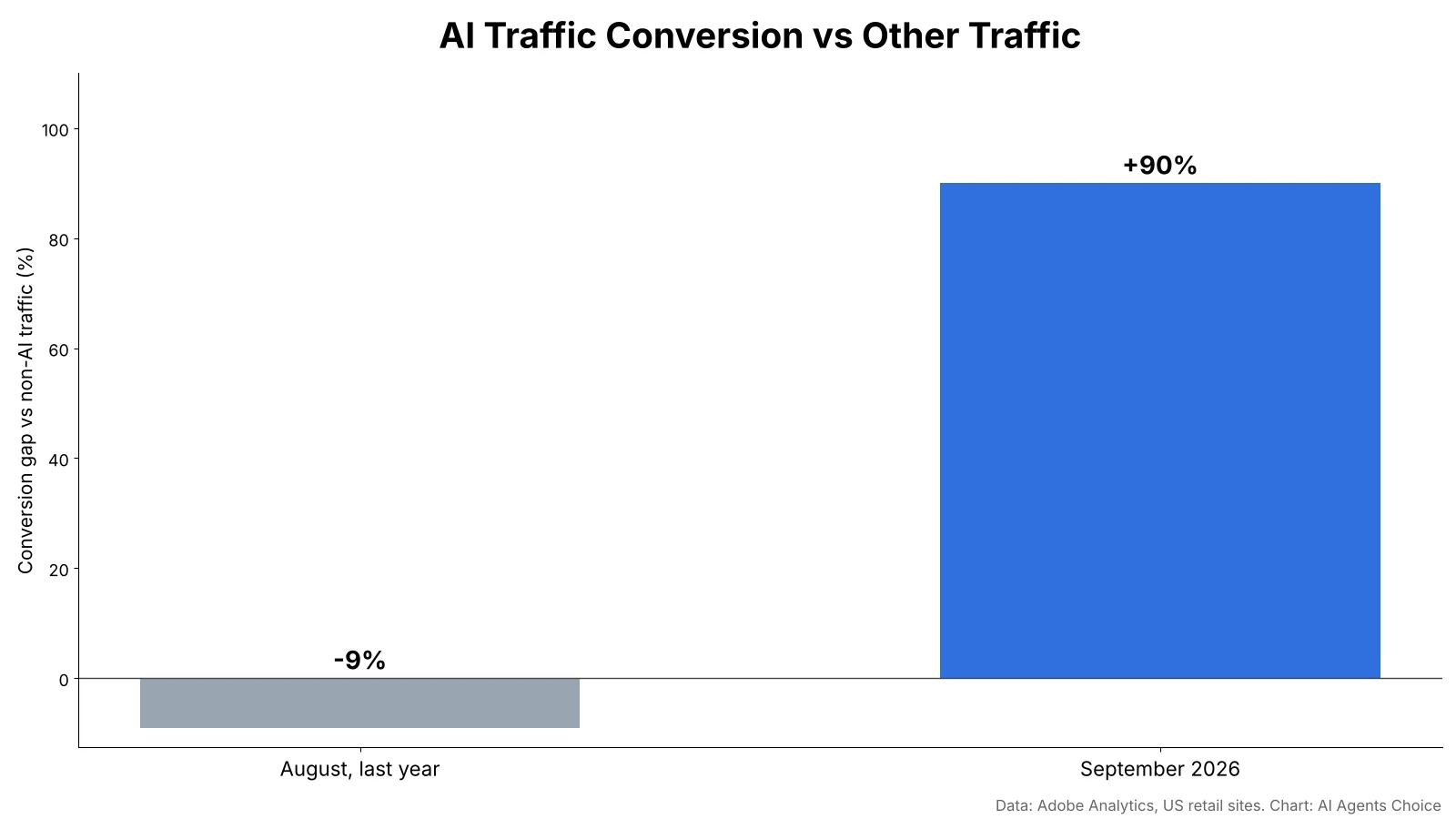
That gap between help and checkout is the main story in the data. Traffic from AI tools to US retail sites keeps climbing, and it now converts better than other traffic. In September 2026, AI traffic converted 90% better than non-AI traffic on US retail sites. Just a year before, it converted 9% worse.
Payment firms are building for the next step. Visa, Mastercard and Google all launched agent checkout tools in the past year. And McKinsey puts sales led by agents at $3 trillion to $5 trillion worldwide by 2030.
The rest of this page covers shopper use, buys made by agents, store traffic, the holidays, payment rails, brand agents and 2030 forecasts.
Agentic Commerce Statistics by Age and Country
Agentic commerce statistics show that about half of shoppers now use AI while they shop. Young buyers and Asian markets lead. In the June 2026 McKinsey survey, 61% of consumers used AI tools of any kind, and 53% used them for shopping.
Use is not even across groups. Gen Z reached 62% and millennials 63%, well above the average. China and India ran about 29 points ahead of the other markets. By contrast, the US sat at 48%, and US Gen Z at 57%.
| Shopper group | Used AI to shop | Trust AI chat and search |
|---|---|---|
| All 11 markets, June 2026 | 53% | 73% of AI users |
| US | 48% | 74% of AI users |
| India | About 29 points over most other markets | 87% of AI users |
| Gen Z, all markets | 62% | 67% of AI users |
| Millennials, all markets | 63% | No figure given |
Other trackers land in the same range. In a Visa survey from October of last year, 47% of US shoppers used AI tools for at least one shopping task. And in a Salesforce study published in July 2026, 50% of shoppers used an AI assistant at some point while buying, up 67% in a year.
Europe trails on shopping use. In a McKinsey survey of 749 people in France, Germany and the UK in December of last year, 84% used AI tools in daily life. Even so, only 38% used them to research products or decide what to buy.
Purchases Completed Inside AI Tools
Only 14% of AI users across 11 markets have completed a purchase with an AI tool, which is about 9% of all consumers. The US is moving faster. There, the share of AI users who bought something through AI rose from 10% to 17% in a year, a 70% jump.
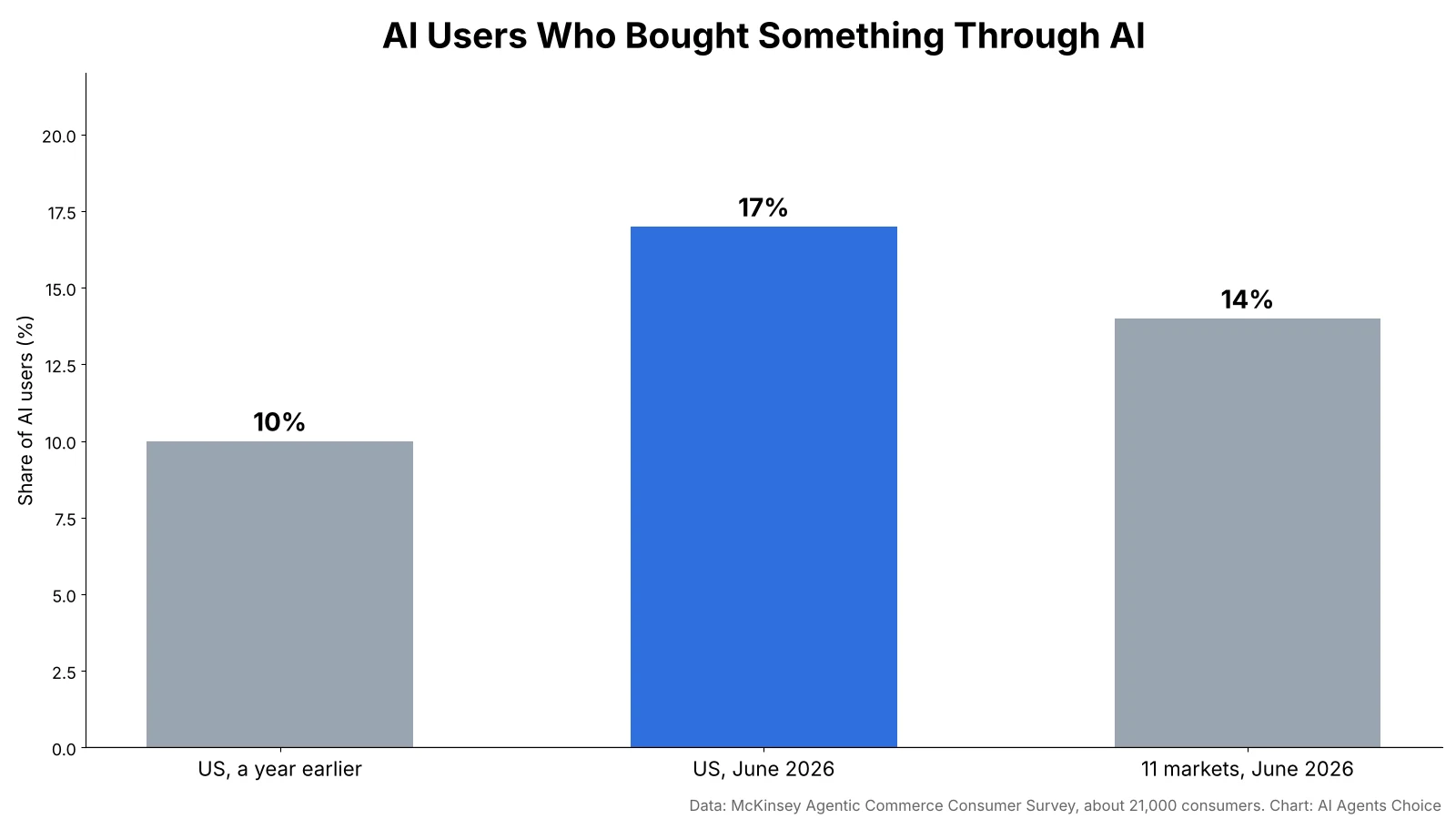
That 17% equals 5% to 10% of the whole US public. Across product types, between 7% and 18% of AI users had finished a purchase with AI, and apparel led the list.
Room to grow is plain in the same survey. In the top six product types, 21% to 30% of AI users would let AI complete a purchase. That is about 1.5 times the share who had already done it.
AI also sways buyers who still click the final button. Nearly a third of AI shoppers named AI chat or search as the biggest influence on their latest purchase. In fact, AI users were 3.2 times more likely to rank AI search above classic search engines. To see how this shifts store traffic, read our guide to AI agents for ecommerce SEO.
Retail Traffic Sent by AI Assistants
AI traffic to US retail sites grew 71% year over year in September 2026, and it now brings in more money per visit than other traffic. In that month, AI visits made 83% more revenue per visit than non-AI visits. A year earlier, they made less than half as much as a typical visit.
AI visitors also act differently once they land. Compared with other visitors, they stay 73% longer and view 25% more pages. Their add-to-basket rate is 53% higher as well.
Last holiday season showed how fast the base is growing. From November 1 to December 31 of last year, traffic to US retail sites from generative AI tools rose 693.4% over the year before. On Cyber Monday alone, AI traffic rose 670%.

Read also: Agentic AI Statistics: Adoption, ROI, Jobs and Pricing Data
Holiday 2026 Outlook for AI-Led Shopping
Adobe expects AI traffic to US retail sites to rise 130% this holiday season. The season runs from November 1 to December 31, 2026. In the September 2026 forecast, the biggest jump comes on Thanksgiving, at 159%.
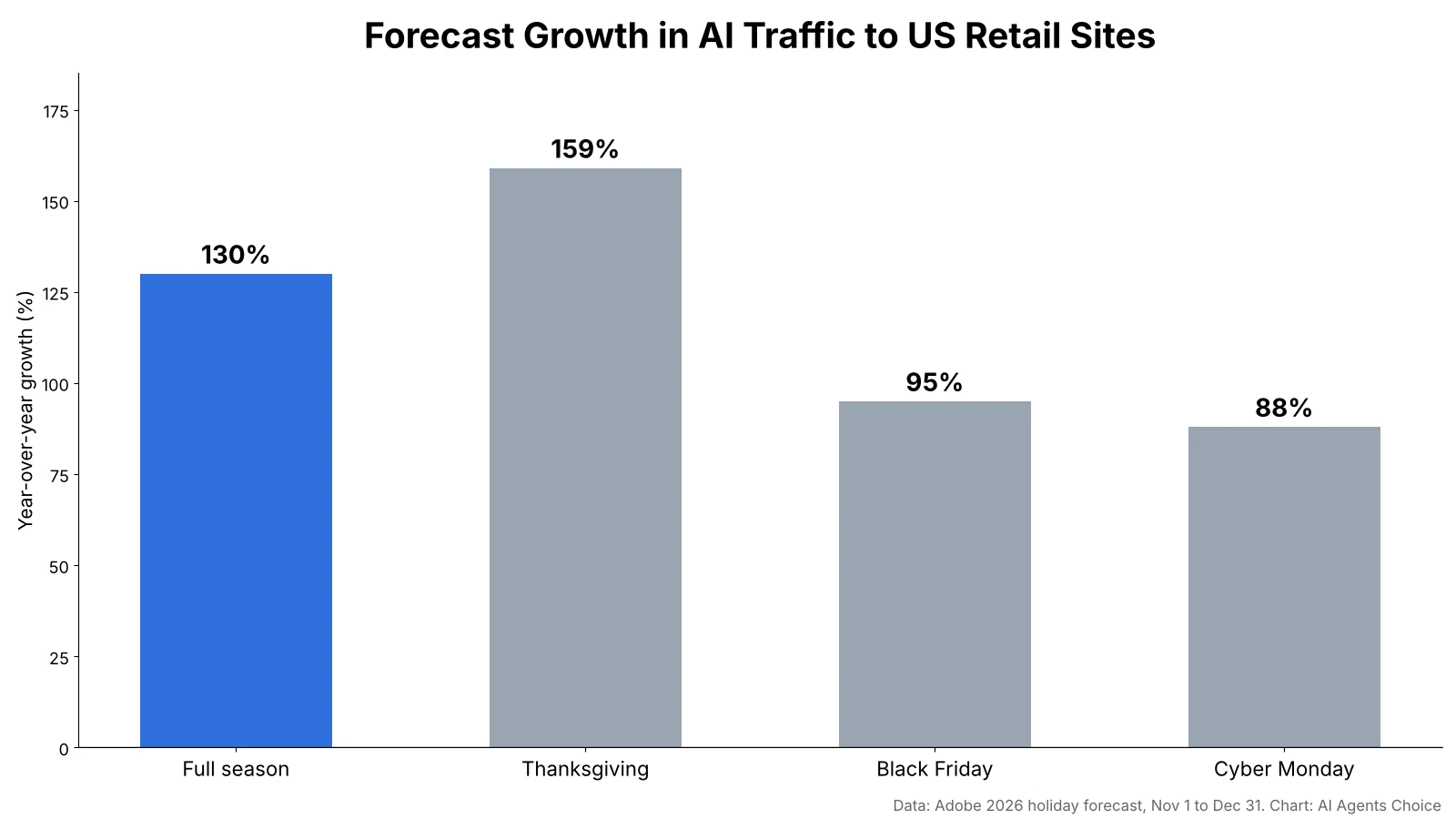
Total online spend for the season should reach $275.1 billion, up 6.7%. Cyber Week alone should bring in $47.5 billion. In an Adobe survey of 5,000 consumers in July 2026, 77% of those who had shopped with AI felt more sure of their purchases, and 69% were less likely to send items back.
Salesforce sees agents in a bigger role still. In its July 2026 holiday forecast, AI chat agents drive 20% of all holiday web store traffic. It also expects one in three ecommerce sites to have a shopping agent of their own live by Cyber Week.
| Holiday 2026 forecast | Figure | Who and when |
|---|---|---|
| AI traffic, whole season | Up 130% | Adobe, Sept 2026 |
| AI traffic, Thanksgiving | Up 159% | Adobe, Sept 2026 |
| AI traffic, Black Friday | Up 95% | Adobe, Sept 2026 |
| AI traffic, Cyber Monday | Up 88% | Adobe, Sept 2026 |
| Web store traffic from AI chat agents | 20% | Salesforce, July 2026 |
| Sites with their own shop agent by Cyber Week | 1 in 3 | Salesforce, July 2026 |
Payment Networks and Checkout Protocols Built for Agents
Visa, Mastercard, Google and OpenAI have each launched systems that let an AI agent pay for goods. Visa shared its first results in December of last year. By then, Visa and its partners had completed hundreds of agent-led transactions, with more than 100 partners and over 30 of them building in its sandbox.
Mastercard followed in Latin America. By March 2026, nearly 100% of card issuers in the region could use its agent tokens. Also, 17 banks and payment firms had run live agent payments in test settings. Mastercard also projects that one in 10 consumers will routinely use agents to buy by 2030.
Google built a shared protocol. On January 11, 2026, it launched the Universal Commerce Protocol. Shopify, Etsy, Wayfair, Target and Walmart helped build it, and more than 20 other firms back it. In March 2026, cart, catalog and identity linking were added, so agents can buy several items from one store.
OpenAI took a different path. It launched Instant Checkout in ChatGPT in September of last year with US Etsy sellers and the Agentic Commerce Protocol, built with Stripe. Then in March 2026, Instant Checkout moved into merchant apps inside ChatGPT. To try an agent that can act on the web for you, see our ChatGPT agent profile.
| Firm | Agent pay tool | Latest step and date |
|---|---|---|
| Visa | Visa Intelligent Commerce | Hundreds of agent sales and 100+ partners by December of last year |
| Mastercard | Agent Pay and agent tokens | Live agent payments with 17 banks in Latin America, March 2026 |
| Universal Commerce Protocol | Built by 5 firms, backed by 20+, January 2026 | |
| OpenAI and Stripe | Agentic Commerce Protocol | Instant Checkout moved into store apps in ChatGPT, March 2026 |

How Shoppers Reach AI Shopping Assistants
Shoppers reach AI assistants mostly through third-party chat apps, with social apps and store-owned assistants behind. In the July 2026 Salesforce study, 21% of shoppers had used a third-party AI chat assistant in the past 12 months. Another 17% had used an AI assistant inside a social app, and 12% had used one run by a brand.
AI is also becoming the first stop. Reliance on AI assistants as the place where shopping starts grew 200% from May of last year to May 2026. Even in stores, 12% of shoppers now ask an AI assistant for advice at the shelf.
On brand sites, shoppers use agents in a few set ways. When they talk to a brand agent on its own store, 37% run plain-language searches and 27% use classic search. Another 26% ask the agent to compare products or sum up reviews.
Habits are forming fast. In the June 2026 McKinsey survey, nearly a quarter of AI users used an AI tool every day, and about one in ten used three or more tools daily. In Europe, the most common AI shopping task was comparing brands, models, prices and reviews, at 63%. Learning about a product type came next at 55%, then finding new products at 46%.
Results From Brand and Marketplace Shopping Agents
Brand and store shopping agents are lifting sales where they run. In the Amazon third-quarter results of October 29, 2026, more than 400 million customers had used Alexa for Shopping in the past 12 months. Customer chats with it were up 570% year over year.
Alexa for Shopping users are 60% more likely to complete a purchase. And US users spend 40% more on average. Amazon also gave the agent more than 100 new skills, such as building gift lists and changing repeat orders.
Retailers with their own agents grew faster last season. In the Salesforce data, brands with a branded shopping agent saw holiday sales grow 6.2%, against 3.9% for brands without one. Tools such as Agentforce Shopper Agent are built for that job.
Still, stand-alone AI tools reach more shoppers than store agents do. In the June 2026 McKinsey survey, 56% of consumers used an AI chat or search tool, while 27% used a retailer’s AI shopping assistant. Clean product data helps stores catch up. AI searches on the Shopify catalog, which holds more than a billion products, convert at about twice the rate of scraped or stale data. Shopify merchants can also lean on Shopify Sidekick for store work.
You can compare more tools of this kind in our shopping agents directory.
Forecasts for Agent-Led Sales by 2030
Agentic commerce could steer up to $1 trillion of US retail sales by 2030. That is the top of a McKinsey range from October of last year, which runs from $900 billion to $1 trillion in US retail.
Worldwide, the same work puts sales led by agents at $3 trillion to $5 trillion by 2030. Both ranges count goods only. They leave out services and sales between firms.
For the size of the agent market itself, see our AI agent market size statistics.
Where Shoppers Still Want the Final Say
Most shoppers want AI to suggest and a person to decide. In McKinsey data from April 2026, 56% were at ease with AI suggesting options as long as people made the final choice. Meanwhile, 47% did not want AI to run their repeat purchases on its own.
Trust in advice is higher than trust in action. In the Salesforce study, 74% of shoppers trusted product tips from AI chat. And 41% felt much more sure of a purchase after using a brand’s own AI assistant, while only 5% did not trust its answers at all.
Shoppers like what AI saves them, too. In the June 2026 McKinsey survey, 81% agreed that AI narrows choices well and 79% that it saves a lot of time. Yet only 67% felt it gets the result right on the first try, which is the gap any buying agent still has to close.
Related AI Agents




Read also: Duplicates, Typos and Broken Dates: Which AI Agent Should Clean Your Data?
Explore Agent Categories
Related Articles
 GuidesAgentic AI Statistics: Adoption, ROI, Jobs and Pricing Data
 GuidesAgentic AI in HR Statistics: New Research
 GuidesHow to Protect Sensitive Data in AI Agent Workflows
 GuidesAI Agent Data Leakage: Causes and Prevention
 GuidesDuplicates, Typos and Broken Dates: Which AI Agent Should Clean Your Data?
 Guides10 Best Agentic AI Courses for Beginners
