
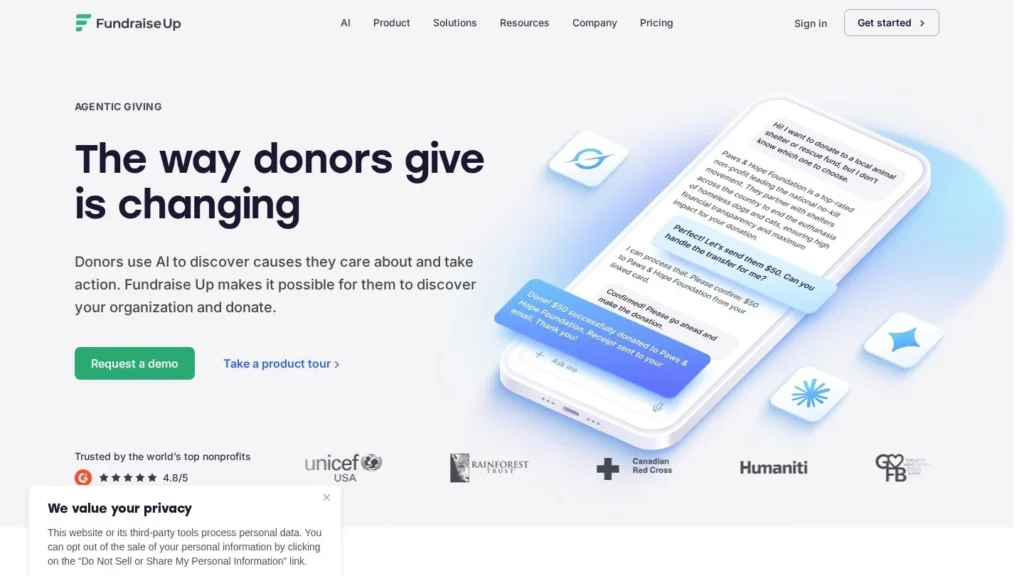
Fundraise Up is the AI fundraising platform to look at if most of your money arrives through online donation forms. It charges no subscription, sets a personalized ask for each donor, pushes recurring gifts and now lets donors give through AI assistants. More than 3,000 nonprofits use it, according to TechCrunch, and Fundraise Up says its case studies include $3 million in extra revenue for UNICEF USA through upsell prompts.
The fee model is the main thing to plan for: costs rise with every dollar raised, and reviewers say total fees can reach 7 to 8%. It also works on the checkout rather than on donor outreach. We rate it 8.6/10 on our scale. We have not used Fundraise Up ourselves; this review is based on the company’s published pricing and product pages, TechCrunch reporting and public user reviews.
No Subscription, Just a Reported 4% Share of Each Gift
- No setup fee, subscription or contract; Fundraise Up takes a share of each gift, reported at 4% in January 2025.
- The company says donors who cover fees bring its average effective cost to about 1%, excluding processing.
- AI sets ask amounts, prompts recurring upgrades, answers donor questions and tries to save cancellations.
- Agentic Giving lets donors give from inside AI assistants, with confirmation before any charge.
- Rated 4.8 out of 5 from 94 Capterra reviews; fees are the most common complaint.
Platform Figures From an Established Nonprofit Vendor
Fundraise Up is a funded, established platform, so it publishes more numbers than most nonprofit AI tools. These are the ones we confirmed on the source pages.
| Fact | Detail | Source and Date |
|---|---|---|
| Latest funding | $70 million minority growth investment led by Summit Partners, with Telescope Partners | TechCrunch, January 23, 2025 |
| Total raised | More than $80 million | TechCrunch, January 23, 2025 |
| Customers | More than 3,000 nonprofit organizations | TechCrunch, January 23, 2025 |
| Founded | 2017, by Peter Byrnes, Anton Isaykin and Yuriy Smirnov | TechCrunch, January 23, 2025 |
| Reported fee | 4% per transaction plus payment processor fees | TechCrunch, January 23, 2025 |
| Effective cost | About 1% on average after donor fee coverage, excluding processing, according to Fundraise Up | Fundraise Up pricing page, checked November 2026 |
| UNICEF USA | 82% of donors cover processing fees; $3 million in additional revenue through Upsell | Fundraise Up pricing page, checked November 2026 |
| The Salvation Army UK | 49% donor conversion rate; 70% of gifts made with personalized ask amounts | Fundraise Up pricing page, checked November 2026 |
| Agentic Giving scope | Profile covers up to 25 of the busiest live campaigns from the last 30 days | Agentic Giving page, checked November 2026 |
| Capterra rating | 4.8 out of 5 from 94 reviews | Capterra, checked November 2026 |
For a buyer, the fee figures matter most. The reported 4% is the platform’s cut; the 1% average is what Fundraise Up says it nets after donors cover fees, which depends on how many of your donors tick that box. UNICEF USA’s 82% coverage rate shows what a strong result looks like, not what every nonprofit will see.
The customer results are vendor-published case studies. They are useful evidence that the AI asks and upsells work at large organizations, but test them against your own conversion and average gift before and after switching.
AI That Acts at the Moment a Donor Picks an Amount
Fundraise Up replaces or sits alongside a nonprofit’s donation form. Its AI works at the moment a donor decides how much to give, and now also outside the website, inside AI assistants.
On the Nonprofit’s Website
- Personalized asks: the AI Donor Experience tailors suggested amounts to each donor. At The Salvation Army UK, 70% of gifts were made with personalized ask amounts, according to Fundraise Up.
- Recurring upgrades: one-time donors are invited to give monthly instead.
- Cancel saves: donors about to cancel a recurring gift are offered options, according to TechCrunch.
- Donor questions: AI Fundraiser answers questions during checkout in real time.
- Staff questions: Fundraise Up MCP lets staff ask about donor data in plain language.
What the Company Says the AI Changes
Fundraise Up claims, against an industry benchmark, about three times higher donation conversion, roughly 30% larger average gifts and about 80% recurring donor retention after one year. It says it runs more than 70 A/B tests a year on the checkout. Its published customer stories add more detail:
- Northwest Harvest: 624 hours a year saved on admin tasks and 360 new recurring giving plans.
- Greater Good Charities: a 161% lift in online revenue and a 230% increase in recurring giving revenue.
- International Justice Mission UK: a 203% increase in recurring donors.
- UNICEF USA: more than 26,000 donations saved by the Reminder Element.
All of these are vendor-published results from organizations that chose to be case studies, so treat them as a ceiling to test against rather than a forecast.
Inside AI Assistants: Agentic Giving
A donor asks an AI assistant how to help with a cause. The assistant suggests organizations, and the donor picks one and names an amount. With a payment method saved through Stripe Link, the donor finishes the gift in the conversation; otherwise the assistant opens a prefilled Fundraise Up donation page to review and submit. The agent works only from the campaigns, gift purposes and terms the nonprofit publishes, and donors confirm recipient, amount and frequency before any charge.
Gifts made this way get the same receipts, consent handling, source attribution and CRM sync as website gifts, and recurring gifts become normal recurring plans in the donor portal. The nonprofit receives the full donor record.
Free White-Glove Onboarding and Embedding the Checkout
- Onboard: Fundraise Up includes white-glove onboarding and migration support at no charge.
- Embed checkout: add the donate button or checkout to the existing website, or build campaign pages.
- Connect systems: set up CRM sync and payment methods such as cards, Apple Pay, Google Pay, crypto and bank transfers.
- Enable Agentic Giving: an Organization Administrator opens Settings, previews the data shared, accepts the terms and confirms. It can be turned off at any time, though an assistant may use a cached copy briefly.
Major Gifts, Appeals and Stewardship Stay With Staff
Donor relationships. Fundraise Up optimizes the checkout and answers questions, but it does not run major gift outreach, write appeals or call donors. Staff still plan campaigns, steward donors and handle anything the AI Fundraiser cannot answer.
A Performance Model Paid From Donations Processed
Fundraise Up uses a performance-based model: it earns a share of donations processed rather than a software fee. This is how that works, based on its pricing page and TechCrunch’s reporting.
| Plan | Price | Billing | What’s Included | Limits |
|---|---|---|---|---|
| Fundraise Up platform | $0 upfront; share of each donation (4% reported in January 2025) | Per donation | All features, unlimited users and donors, onboarding, migration, support, AI features | Payment processing fees extra; donors can cover fees |
| Agentic Giving | No additional fee | Same rate as online gifts | Gifts through AI assistants, receipts, CRM sync, donor portal | Rolling out in stages; up to 25 campaigns in the profile |
| AI Visibility Assessment | Free | None | Report on how AI answer engines find and describe the organization | Report only |
Fundraise Up says the average effective cost is about 1% after donor fee coverage, excluding processing fees. That average depends on donor behavior, gift size, payment method and the organization’s own pricing.
What a Small Charity and a Large One Would Pay
These scenarios use the reported 4% rate and the company’s 1% average; the fundraising totals are our assumptions, and card processing is not included.
- A small charity raising $50,000 online a year: about $2,000 in platform fees at 4%, or about $500 if donor coverage brings the effective rate to 1%.
- A mid-size nonprofit raising $500,000 online: about $20,000 at 4%, or about $5,000 at the 1% average.
- A national charity raising $2 million online: about $80,000 at 4%, or about $20,000 at 1%.
Compare those numbers with a subscription donation tool plus any AI add-on. For context, Dataro lists a $15,000 minimum yearly platform fee for its fundraising AI. Donor perception is also worth planning for: reviewers say some donors question the fees even when they choose to cover them.
Fundraise Up Compared With Version2, Virtuous Momentum and Dataro
Fundraise Up works at the checkout, while most nonprofit AI agents work on donor outreach and planning. These are the closest alternatives on our site.
| Agent | Starting Price | Free Plan | Main Strength | Main Trade-Off | Best For |
|---|---|---|---|---|---|
| Fundraise Up | $0 upfront; per-donation fee (4% reported) | No | AI asks, recurring upgrades and agentic giving at checkout | Fees rise with volume | Nonprofits with significant online giving |
| Version2 | Custom quote | No | Fully autonomous outreach, solicitation and stewardship | No published pricing | Universities and hospitals with many unassigned donors |
| Virtuous Momentum | Custom quote | No | Daily priorities and drafted outreach with a human in control | No published pricing | Major and mid-level gift officers |
| Dataro | From $15,000/year plus $0.10 per active donor | No | Published fees and predictive appeal targeting | $15,000 minimum platform fee | Charities with tens of thousands of active donors |
These tools do different jobs. Version2 and Momentum reach out to donors and help gift officers; Dataro predicts who to ask; Fundraise Up converts the donor who arrives at the form or asks an AI assistant. Many larger nonprofits could use Fundraise Up alongside one of the others. On cost, Fundraise Up’s bill is tied to donation volume, which suits organizations with uneven giving. Once online revenue is large, compare its projected fees with the quotes the others give, and remember that a checkout tool and an outreach agent are not substitutes for each other. See more in our AI agents for nonprofits guide.
Nonprofits With Heavy Online Giving and Monthly Donors
- Nonprofits with large online giving: personalized asks and recurring upgrades act on every website donation.
- Organizations growing monthly giving: recurring prompts and cancel saves target donor retention, which Fundraise Up puts at about 80% after one year.
- Charities worried about falling web traffic: Agentic Giving and the free AI Visibility Assessment address donors who now start in AI assistants.
- Teams without budget for a software subscription: there is no upfront fee or contract.
- International charities: payment options include iDEAL | Wero and bank transfers, and The Salvation Army UK reports 74% of donors claiming Gift Aid.
Small Charities Watching Fees and Event-Driven Teams
- Very small charities focused on fees: a percentage on every gift can add up at low volumes, so a flat-fee tool may be a closer fit.
- Teams that need event management: reviewers note it has no event tools.
- Organizations seeking a donor outreach agent: tools such as Version2 contact donors on their own.
- Nonprofits that need deep built-in reporting: some reviewers build LYBUNT and SYBUNT reports through exports.
Fee Totals, Rollout Timing and Sync Points to Check
- Fees at scale: the cost grows with every dollar raised, and one reviewer says total fees often reach 7 to 8%.
- Fee percentage not on the page: the pricing page explains the model but not the rate, so get your rate in writing.
- Staged rollout: Agentic Giving capabilities and timing vary while it rolls out.
- No ranking control: AI assistants answer from public content and may recommend other organizations; Fundraise Up says it does not rank nonprofits.
- Cached data: after switching Agentic Giving off, an assistant may use a cached copy of your profile for a short time.
- CRM sync: some reviewers report data that does not sync cleanly and needs manual entry.
- Campaign page limits: one lower-rated review says campaign page customization is limited for item-based or sponsorship campaigns, so test your most unusual appeal before migrating.
- Vendor-published evidence: the conversion, gift size and retention claims come from Fundraise Up and its case studies, and TechCrunch’s headline described them as claims. Independent results would help buyers judge them.
Summit Partners Leads a $70 Million Round in 2025
- January 2025: Fundraise Up raised $70 million in a minority growth round led by Summit Partners, with Telescope Partners participating, to fund product development and expansion.
Worth Evaluating if Much of Your Money Comes In Online
For nonprofits that raise a meaningful share of their money online, Fundraise Up is worth evaluating. It scores 8.6/10 on our scale: easy to start, well reviewed and active where donors actually give, with the fee model as the main thing to plan for.
Ask for your fee rate in writing, model it against last year’s online revenue, and compare conversion, average gift and recurring sign-ups for a few months before and after the switch. If most of your revenue comes from major gifts or events, put your AI budget into an outreach agent instead.
Agentic Giving is the part to watch over the next year. Fundraise Up cites a 35% drop in nonprofit web traffic as donors start with AI assistants, and its answer costs nothing extra to switch on. Because donors confirm every gift and the nonprofit keeps the full record, the risk of trying it is low for existing customers.
Fee Rates, Agentic Giving and Charges for AI Features
How Much Does Fundraise Up Charge Nonprofits?
There is no setup fee, subscription or contract. Fundraise Up takes a share of each donation, reported by TechCrunch as 4% per transaction plus processing in January 2025. The company says donor fee coverage brings its average effective cost to about 1%.
What Is Agentic Giving in Fundraise Up?
Agentic Giving lets donors give to a nonprofit from inside an AI assistant. The assistant uses only the nonprofit’s published campaigns and terms, and the donor confirms recipient, amount and frequency before any charge. It carries no extra fee.
Does Fundraise Up Charge Extra for Its AI Features?
The pricing page says all features are included with no restrictions, and Agentic Giving has no additional fees. The free AI Visibility Assessment reports how AI answer engines describe your organization.
Is Fundraise Up Safe for Donor Data?
Agentic gifts get the same receipts, consent handling and CRM sync as website gifts, and the nonprofit receives the full donor record. Administrators preview what data is shared before enabling Agentic Giving and can switch it off at any time.
How Does Fundraise Up Compare With Version2?
Version2 is an autonomous outreach agent that contacts and solicits donors for gift officers. Fundraise Up works at the checkout, personalizing asks and capturing gifts on your site or through AI assistants. Larger nonprofits may use both.
User Reviews
Nobody has rated it here yet. Be the first AI Agents Choice user to rate Fundraise Up AI.