
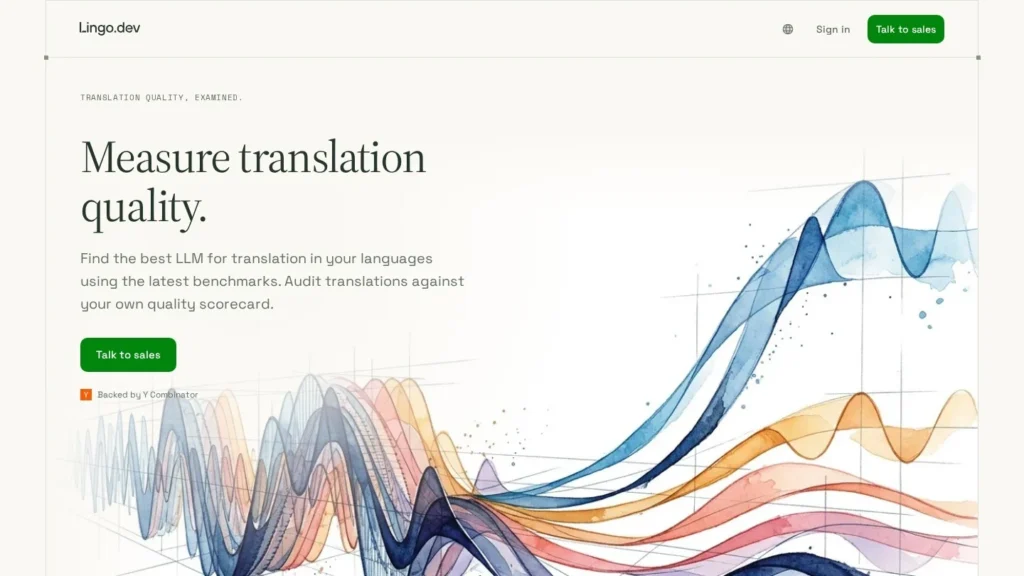
Lingo.dev turns translation into part of the build. When engineers add or change text in an app, its engine translates the new strings with AI and opens a pull request, so translations ship with the next deployment. The company raised a $4.2 million seed round led by Initialized Capital, counts Mistral AI and Cal.com among early users, and publishes a $0 Sandbox plan and a $99 Production plan.
It is best for engineering teams that want localization handled inside Git, without a separate translation portal. The main limit is that cost is usage-based and the security features larger companies expect, such as SSO and audit logs, sit in the Enterprise tier. We rate it 8.5/10 on our scale. We have not used Lingo.dev ourselves; this review is based on the company’s published pricing and news, and press coverage.
Lingo.dev Facts for Engineering Leads
- New strings are translated on each code change and delivered as pull requests for engineers to approve and merge.
- Sandbox costs $0 a month base and Production $99, plus $0.50 per engine, $2 per million tokens and $0.01 per AI review run, with LLM costs at no markup.
- Version 1.0 in March 2026 added stateful engines and quality scoring, with a claimed 17 to 45% drop in terminology errors from retrieval.
- A $4.2 million seed round led by Initialized Capital backs the company, which went through Y Combinator in fall 2024.
- SSO, audit logs, BYOK and EU or US data residency require an Enterprise contract.
Lingo.dev by the Numbers
Lingo.dev is young, so most of its public numbers come from its funding coverage and its own release notes.
| Fact | Detail | Source and Date |
|---|---|---|
| Seed round | $4.2 million led by Initialized Capital, with Y Combinator and angels | TechCrunch, February 18, 2025 |
| Origin | Founded in Barcelona in December 2023 as Replexica; renamed Lingo.dev in December 2024 | Slator, 2025 |
| Accelerator | Joined Y Combinator’s fall 2024 program | Slator, 2025 |
| Early customers | Mistral AI, Cal.com and Captions AI | Slator, 2025 |
| Languages | Localization into 83 languages | Slator, 2025 |
| Team size at seed | Two founders and one founding engineer | TechCrunch, February 18, 2025 |
| Version 1.0 | Stateful localization engines with per-locale models, glossaries and quality scoring | Lingo.dev news, March 15, 2026 |
| Terminology errors | Claimed 17 to 45% fewer LLM terminology errors from retrieval-augmented localization | Lingo.dev news, March 2026 |
| Production plan | $99 a month base, 5M tokens a day, LLM costs at 0% markup | Lingo.dev pricing, viewed November 2026 |
| Enterprise SLA | 99.99% uptime on Enterprise contracts | Lingo.dev pricing, viewed November 2026 |
Two numbers matter most for a buyer. The first is the 0% markup on LLM usage: you pay model providers’ rates plus Lingo.dev’s $2 per million tokens of infrastructure, which makes costs easier to reason about than per-word pricing. The second is the claimed 17 to 45% reduction in terminology errors, which is a vendor figure but points at the job glossaries and retrieval do in keeping product names and technical terms consistent.
The small founding team and seed-stage funding are worth weighing too. The product moves fast, with v1.0 and a Localization API both arriving in spring 2026, but buyers who need long-term guarantees should look at the Enterprise SLA.
The customer names are also a useful signal. Mistral AI, Cal.com and Captions AI are software companies with fast release cycles, which is the profile the pull request model fits best. A company that ships quarterly releases or translates mostly documents would get less from the same design.
Inside the Lingo.dev Pull Request Workflow
Lingo.dev treats localization as code. Everything happens in the repository, and engineers are pulled in only to review.
Connecting a Repository
Teams install the GitHub App or connect GitLab or Bitbucket, or call the engine from the CLI. They choose target languages and set brand voice, glossaries and phrase rules. Slator described the setup as connecting the codebase, choosing languages and brand voice, then continuing to code as usual.
What Happens on Each Code Change
When new text appears, the engine analyzes it in context. According to TechCrunch, it orchestrates several LLMs, including models from Anthropic and OpenAI, choosing the best model for each task. It reads neighboring strings in localization files, applies translation memory and style rules, and adjusts text length so it fits the interface. The result arrives as an automated pull request with translation updates.
Stateful Engines Since Version 1.0
Version 1.0 reframed the product as a platform for building localization engines. Each engine holds per-locale models, glossaries and rules, keeps state across runs and reports quality scores. Teams can create several engines, for example one per product, and the pricing page lists unlimited engines, seats, glossaries and rules on every plan.
Quality Checks and Human Review
All plans include translation logs and quality scores, and AI quality review runs cost $0.01 each. Enterprise adds a configurable pipeline with pre-localization AI edits, human-in-the-loop review, selective routing of strings to human reviewers, post-localization AI review, rephrasing and back-translation checks. Human review is billed per word at 0% markup.
API, MCP and Webhooks for Custom Pipelines
Not every team wants pull requests. The pricing page lists a sync and async API, an engine provisioning API, a Management API with an MCP server, and webhooks on every plan. A product that lets its own customers create content, such as a help desk or a store builder, can call the API to translate that content on demand, and the engine provisioning API lets a multi-tenant product give each customer its own engine with separate glossaries. Per-engine consumption tracking then shows which customer or product used how many tokens, which helps when you pass localization costs on.
The MCP server means AI coding assistants can manage engines and glossaries through the same interface. For teams already working with agents in their editor, that keeps localization settings next to the code rather than in another web console.
What Engineers Still Own
Engineers approve and merge each pull request, so nothing ships without a human click. The founders told TechCrunch the engine does not handle cultural meanings of colors or symbols, and unit conversions such as metric and imperial stay in application code. Someone still needs to write good glossaries and test translated screens.
Lingo.dev Plan Prices and Usage Rates
| Plan | Price | Billing | What Is Included | Limits |
|---|---|---|---|---|
| Sandbox | $0 per month base | Credits with auto-reload | Unlimited engines, seats, glossaries and rules; GitHub, GitLab, Bitbucket; API, MCP, webhooks; community support | 100K tokens a day; 7-day data retention; no SLA |
| Production | $99 per month base | Credits with auto-reload | Everything in Sandbox plus email support | 5M tokens a day; 30-day data retention; no SLA |
| Enterprise | Custom | Annual contract | Human review routing, governance reports, Jira, Zendesk and Payload CMS, SSO, RBAC, BYOK, data residency, audit logs, dedicated Slack | Unlimited throughput; 99.99% uptime SLA |
| Usage on all paid and free plans | $0.50 per engine per month; $2 per million tokens; $0.01 per AI review run | Credits | LLM costs passed through at 0% markup | Enterprise rates are custom |
Lingo.dev Bills for Three Development Teams
These examples use Lingo.dev’s published rates and leave out LLM provider charges, which pass through at cost and depend on the models used.
- Side project on Sandbox: one engine ($0.50) and 2 million tokens a month ($4.00) come to $4.50 a month in Lingo.dev fees. Sandbox caps throughput at 100K tokens a day, roughly 3 million over 30 days.
- Startup app on Production: the $99 base, 4 engines ($2.00), 20 million tokens ($40.00) and 500 AI review runs ($5.00) total $146 a month before LLM costs.
- Scale-up with several products: 10 engines ($5.00), 100 million tokens ($200.00) and 2,000 review runs ($20.00) on top of the $99 base reach $324 a month before LLM costs, and security needs may push the team to Enterprise.
The variable parts are token volume, the number of review runs and LLM provider rates. Data retention is short on the self-serve plans, 7 days on Sandbox and 30 on Production, so keep your own translation history in Git.
Lingo.dev Compared With Crowdin Copilot, Lokalise AI Agents and Phrase AI Agents
| Product | Starting Price | Free Plan | Main Strength | Main Weakness | Best For |
|---|---|---|---|---|---|
| Lingo.dev | $0 Sandbox; $99 per month Production plus usage | Yes (usage charges apply) | Translations delivered as pull requests in Git | Usage-based bill; developer-only workflow | Engineering teams shipping apps |
| Crowdin Copilot | Free app; Crowdin from $0, Pro $59 per month | Yes | Agent inside a widely used TMS | Requires the Crowdin platform | Software and open-source projects |
| Lokalise AI Agents | $149 per month (Explorer) | No (14-day trial) | Translator-friendly editor plus agents | Higher fixed entry price | Product teams with translators |
| Phrase AI Agents | $27 per month (Freelancer); $525 per month for software teams | No (14-day trial) | Enterprise TMS depth | Costs climb for software plans | Larger localization departments |
Lingo.dev is the most developer-native of the four. Crowdin, Lokalise and Phrase are translation management systems with editors for linguists and project managers, and their agents work inside those portals. Lingo.dev skips the portal and keeps translation inside pull requests, which suits teams without localization managers. Teams with in-house translators or many non-code content types will usually prefer a TMS. See more in our translation agents and coding agents categories.
Development Teams Suited to Lingo.dev
- Startups shipping web and mobile apps: the $0 Sandbox and $99 Production plans let a small team localize without a translation budget line.
- Teams already living in GitHub, GitLab or Bitbucket: translations arrive as pull requests, so review fits existing code review habits.
- AI-native companies: early users named in press coverage include Mistral AI and Captions AI, and the MCP server lets AI assistants manage engines.
- Products with strict terminology: glossaries, rules and retrieval are designed to keep product names and technical terms consistent.
Teams That May Prefer Another Translation Setup
- Marketing and content teams: websites and campaigns are better served by a website tool such as Localize AI Suite.
- Companies with in-house linguists: a TMS such as Lokalise AI Agents gives translators a full editor.
- Security-heavy enterprises not ready for an Enterprise contract: SSO, audit logs and data residency are not on self-serve plans.
Lingo.dev Usage and Security Considerations
Usage pricing is fair but needs watching. Tokens, engines and review runs add up, and LLM provider costs come on top. Set alerts on the credit balance, since plans auto-reload.
Security features are tiered. SOC 2 Type II, GDPR and CCPA cover the platform, but SSO, role-based access control, personal and service API keys, bring-your-own-keys, EU or US data residency and audit logs are Enterprise-only. If your security team needs any of these, budget for Enterprise from the start.
Quality still needs human eyes on important screens. AI review and quality scores help catch problems, and the claimed drop in terminology errors is encouraging, but checkout flows, legal text and onboarding screens deserve native-speaker review. Enterprise’s selective human review routing is built for that.
Pull request volume can become noise. On a busy codebase, every text change can trigger a translation update, so agree on a merge routine early, for example batching translation pull requests daily or letting a bot merge them after checks pass. Otherwise reviewers may start approving without reading, which defeats the purpose of review.
Retention limits matter for audits. Sandbox keeps data for 7 days and Production for 30, so if you need a long record of who changed which translation and when, rely on your Git history or move to Enterprise, where retention is custom and audit logs are included.
The company is small and young. Ask about the roadmap for features you rely on, and about data export so your translations stay portable.
Lingo.dev Milestones and Coverage
In February 2025, TechCrunch covered Lingo.dev’s $4.2 million seed round led by Initialized Capital, with Y Combinator and angels taking part. Slator reported that the company had been founded as Replexica in Barcelona in December 2023, rebranded in December 2024 and moved to San Francisco. On March 15, 2026, Lingo.dev introduced version 1.0, built around stateful localization engines, per-locale models, glossaries and quality scoring.
How Lingo.dev Scores for App Localization
Lingo.dev earns 8.5/10 on our scale. It does well on autonomy, setup and pricing value: translations happen on every code change and arrive as pull requests, a $0 plan lets anyone start, and LLM costs are passed through without markup. It loses points because the bill is variable, the stronger security controls are reserved for Enterprise, and public user ratings are still to come, so sentiment sits at our neutral mark. More published customer results would help buyers judge quality.
For developer-led teams that want localization to behave like any other part of CI/CD, it is one of the simplest options to try. Teams with translators, marketing content or strict compliance needs should compare it with a full TMS first.
A practical trial takes a week: connect one repository on Sandbox, add two languages, write a short glossary of product terms, and let a few real feature branches run through the engine. Track how many translation pull requests need edits and what the token bill looks like, then decide whether Production or Enterprise fits.
Developer Questions About Lingo.dev
Is Lingo.dev Free to Use?
The Sandbox plan has a $0 base price, but engines, infrastructure tokens and AI review runs are still billed, and LLM costs pass through. Sandbox limits throughput to 100K tokens a day.
How Does Lingo.dev Deliver Translations?
Through automated pull requests in GitHub, GitLab or Bitbucket, or through the CLI and API. Engineers review and merge, and translations go live with the next deployment.
Does Lingo.dev Use My Data to Train Models?
Lingo.dev lists SOC 2 Type II, GDPR and CCPA, and Enterprise customers can bring their own keys and choose EU or US data residency. Ask the company directly about model training terms for your contract.
How Is Lingo.dev Different From Crowdin?
Crowdin is a translation management system with an editor and an agent inside it. Lingo.dev has no translator portal; it translates inside your Git workflow and charges by usage.
What Does Lingo.dev Leave to My Team?
Merging pull requests, writing glossaries and rules, reviewing sensitive screens, and handling cultural details such as colors, symbols and unit conversions in code.


User Reviews
Nobody has rated it here yet. Be the first AI Agents Choice user to rate Lingo.dev.