
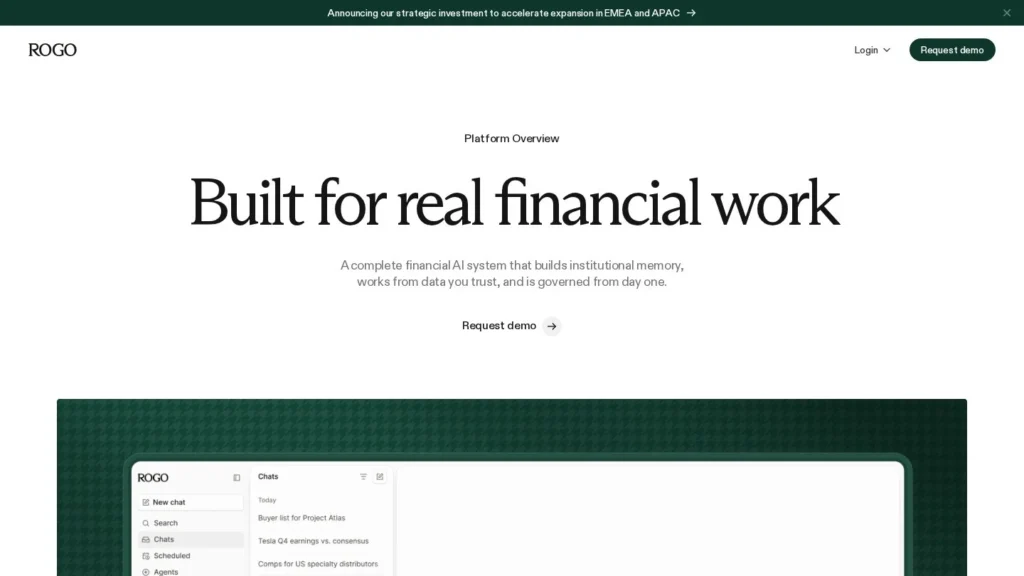
Rogo is an AI platform built for investment bankers, and its Felix agent does the multi-step work usually handed to analysts: screening deals, drafting confidential information memorandums (CIMs), running buyer outreach and reviewing data rooms. It is the best fit for investment banks, advisory boutiques, private equity firms and asset managers with heavy research and materials workloads. Pricing is shared privately, and the product is sold on enterprise terms.
Rogo has unusual traction for a finance AI startup. More than 35,000 finance professionals at over 250 institutions use it daily, including bankers at Rothschild & Co, Jefferies, Lazard, Moelis and Nomura, and in April 2026 it raised a $160 million Series D led by Kleiner Perkins at a reported $2 billion valuation. This review is based on funding announcements and news coverage as of October 2026; we have not tested Rogo hands-on.
Rogo’s Enterprise Terms, 35,000 Users and $160M Raise
- Starting price: Custom quote on enterprise terms; no free plan or self-serve trial.
- Scale: More than 35,000 finance professionals at 250-plus institutions use Rogo daily, with clients including Lazard, Jefferies and Nomura.
- Funding: $160 million Series D led by Kleiner Perkins in April 2026, more than $300 million raised in total and a reported $2 billion valuation.
- Felix agent: Runs deal screening, CIM generation, buyer outreach and data room diligence as multi-step processes.
- Our score: 7.6/10, strong on autonomy and banking depth, with room to grow through published pricing guidance and public user ratings.
Series D Figures Behind Rogo’s Growth
Most of what is public about Rogo comes from its April 2026 funding round and the coverage around it. Each figure below was checked on the source page.
| Fact | Detail | Source and date |
|---|---|---|
| Series D | $160 million led by Kleiner Perkins | FinTech Global, April 29, 2026 |
| Other investors | Sequoia, Thrive Capital, Khosla Ventures, J.P. Morgan Growth Equity Partners, BoxGroup, Mantis VC, Jack Altman, Evantic and Positive Sum | Pulse 2.0, April 29, 2026 |
| Total raised | More than $300 million | FinTech Global, April 29, 2026 |
| Valuation | $2 billion | Dealroom, April 30, 2026 |
| Daily users | More than 35,000 financial professionals at over 250 institutions | Pulse 2.0, April 29, 2026 |
| Named clients | Rothschild & Co, Jefferies, Lazard, Moelis and Nomura | FinTech Global, April 29, 2026 |
| Felix workflows | Deal screening, CIM generation, buyer outreach and data room diligence run as multi-step processes | Pulse 2.0, April 29, 2026 |
| Founders | Gabriel Stengel, formerly of Lazard, and John Willett, a former JPMorgan banker, both Princeton computer science graduates; founded in late 2021 in a Manhattan apartment | Dealroom, April 30, 2026 |
| Expansion | Growing its London office and its presence across Asia-Pacific | Dealroom, April 30, 2026 |
The client list carries the most weight for a buyer. Lazard, Moelis, Jefferies and Rothschild & Co run some of the most confidential work in finance, and Nomura brings a large global bank into the mix. Getting through their security and compliance reviews is a high bar for any AI vendor, and the daily user count suggests the tool is in regular use rather than in a lab.
The investor list also matters. J.P. Morgan Growth Equity Partners joined the round, alongside Sequoia, Thrive and Khosla. Kleiner Perkins partner Mamoon Hamid said Rogo’s technical depth and proprietary data integrations are why it is pulling away from rivals. Rogo will spend the money on international growth, deeper relationships with large institutions and expanding Felix.
A Platform Layer Between Deal Teams and Their Data
Rogo works as a platform layer between a deal team and its data. It connects to the firm’s internal information and to external financial data sources, then automates the research, analysis and presentation work that fills junior bankers’ days.
The Research and Analysis Platform
At its base, Rogo aggregates data, builds financial models and assembles slide decks. Bankers ask for what they need and get structured output they can edit. Rogo lists four broad use cases: origination, execution, advisory and portfolio intelligence. That covers the life of a deal, from finding targets to running a process to tracking companies afterward.
Felix, the Agent Layer
Felix is Rogo’s recently launched agent. Instead of answering one question at a time, it runs multi-step processes on its own. The workflows named in Rogo’s funding announcement are:
- Deal screening: sorting through potential targets or opportunities against a firm’s criteria.
- CIM generation: drafting the confidential information memorandum that describes a company for sale.
- Buyer outreach: preparing outreach to potential buyers in a sell-side process.
- Data room diligence: reviewing documents in a virtual data room and flagging red issues.
Chief executive Gabriel Stengel has described the direction as AI-native firms whose agentic systems improve with each deal.
Forward-Deployed Teams
Rogo does not hand over a login and leave. It embeds forward-deployed bankers and engineers inside client firms, with expertise in security, legal and regulatory compliance as well as applied AI. They set up workflows, connect data and fit the agent to how each firm works. Rogo calls itself a long-term AI transformation partner for financial institutions.
How a Sell-Side Process Might Run
Mapped onto a typical sale mandate, the four Felix workflows line up in order. Early on, the agent screens the universe of possible buyers or targets against the criteria the deal team sets. Once the mandate is signed, it drafts the CIM from company materials and the firm’s own data, ready for bankers to edit. It then prepares outreach to the buyer list. When bidders enter the data room, it reviews the documents and flags issues the team should look at first. At each stage a banker checks the work before it moves on, which is where most of the time saving and most of the risk sit.
Procurement Questions for Security Teams
- Data separation: how the platform keeps one deal team’s documents away from another team working on the other side of a transaction.
- Model training: whether client documents are ever used to train models and how long data is retained.
- Audit trail: whether every Felix action, source and output is logged for compliance review.
- Regional hosting: where data is stored for London and Asia-Pacific teams as Rogo expands there.
Bankers Keep Deal Choices, Sign-Offs and Client Talks
Bankers decide which deals to pursue, edit and sign off on CIMs and pitch materials, and own every client conversation. Compliance teams still control information barriers between deal teams and what data the platform can see. Diligence red flags from Felix are a starting point for the deal team’s own judgment, not a final opinion.
Institutional Contracts Priced by Quote
Rogo does not publish pricing. It is sold to institutions on enterprise contracts, and the forward-deployed support model suggests pricing reflects a full rollout rather than individual seats bought online.
| Plan | Price | Billing | What’s Included | Limits |
|---|---|---|---|---|
| Enterprise | Custom quote | Enterprise contract | Research and analysis platform, Felix agent workflows, data integrations, forward-deployed bankers and engineers | No published rates; demo first |
Valuing Hours Saved Across a 30-Banker Advisory Team
Without list prices, buyers should build the case on time saved by deal teams and test it during a pilot.
A 30-banker advisory team. If Felix and the platform saved each banker five hours a week across 48 working weeks, the team would recover 7,200 hours a year. Put your own loaded hourly cost against that figure and ask Rogo to price the contract against it.
A single sell-side process. The four Felix workflows map to the early stages of a sale: screening, the CIM, outreach and diligence. Ask Rogo to run one live process through Felix and track how many analyst hours each step takes compared with your last comparable deal.
A private equity fund screening deals. A fund that reviews hundreds of opportunities a year spends much of its associate time on first-pass screening and diligence. Track how many opportunities Felix screens per week and how many diligence red flags it surfaces that the team would otherwise have found later, then compare that with the contract price.
Hidden and variable costs. Budget for internal compliance review of data access and information barriers, IT time to connect internal data, any third-party data licenses the platform draws on, and senior banker time to check agent output.
Billing Units, Felix Access and Data Sources to Pin Down
- Unit of billing: whether pricing is per seat, per team or a firm-wide platform fee.
- Felix access: whether the agent is included or priced separately, and any usage limits.
- Data sources: which external datasets are included and which require your own licenses.
- Forward-deployed support: how long the embedded team stays and what it costs after the initial rollout.
Rogo Compared With Perplexity Deep Research, Gemini Enterprise and Julius AI
Rogo’s most direct competitors are other finance-specific AI startups such as Hebbia, plus incumbents like Bloomberg and Microsoft. On our site, the closest alternatives are general research and analysis agents that some deal teams use instead.
| Tool | Starting Price | Free Plan | Main Strength | Main Trade-Off | Best For |
|---|---|---|---|---|---|
| Rogo | Custom quote | No | Felix runs deal screening, CIMs, outreach and diligence for banking workflows | Private pricing; enterprise only | Investment banks, PE firms and asset managers |
| Perplexity Deep Research | Free; Pro $20 per month | Limited | Fast, cited web research reports | Public web focus, not deal workflows | Quick sourced overviews of companies and markets |
| Gemini Enterprise | $21 per seat per month (Business edition, annual) | No | Prebuilt agents and a no-code builder across Google and Microsoft apps | General purpose; banking workflows must be built | Firms that want one governed agent platform for all staff |
| Julius AI | Free; paid plans from $16 per month (billed annually) | Limited | Charts and analysis from spreadsheets without code | Data analysis only, no deal process automation | Analysts crunching numbers in files |
The general tools are far cheaper and quicker to start, but none ships banking workflows such as CIM drafting or data room review, and none comes with bankers who set it up inside your firm. Rogo makes sense when the volume of deal work justifies an enterprise contract. More options are on our research agents and banking agents pages.
Investment Banks, Boutiques and PE Deal Teams
- Investment banks and advisory boutiques: the client list is built around this group, and Felix targets sell-side tasks directly.
- Private equity deal teams: deal screening and data room diligence match the front end of the investment process.
- Asset managers: portfolio intelligence is one of Rogo’s four named use cases.
- Firms with strict security reviews: forward-deployed staff with security, legal and regulatory expertise help get through procurement. See also our data analysis agents page.
Retail Banks and Solo Advisors Need Different Tools
- Retail, commercial and community banks: Rogo is built for capital markets rather than customer service, lending or compliance operations; tools such as nCino Digital Partners or Bretton AI fit those jobs.
- Solo advisors and small teams: an enterprise contract with embedded staff may be hard to justify at low deal volume.
- Teams wanting to try before buying: there is no free plan or self-serve trial.
- Firms happy with general AI tools: if cited web research is enough, Perplexity or Gemini costs a fraction of an enterprise deal.
Information Barriers and Review of Client-Facing Output
- Confidential data: deal teams handle material non-public information. Confirm how Rogo enforces information barriers, access controls and data residency before connecting internal systems.
- Output review: CIMs and buyer outreach go to third parties, and errors there carry legal and reputational exposure, so keep senior review on every draft.
- New agent: Felix launched recently, and the funding will go into expanding it, so workflows and terms may change.
- Pricing by quote: list prices are not published, so compare quotes on a per-banker basis.
- Crowded field: Rogo competes with Hebbia and other well-funded startups as well as Bloomberg and Microsoft. Ask for a roadmap and contract terms that protect you if priorities shift.
Kleiner Perkins Leads Rogo’s April 2026 Round
On April 29, 2026, Rogo closed a $160 million Series D led by Kleiner Perkins, bringing total funding above $300 million. Pulse 2.0 reported that more than 35,000 professionals at over 250 institutions use the platform daily and that the money will fund global expansion and Felix.
On April 30, 2026, Dealroom reported the round at a $2 billion valuation and noted Rogo’s growing London office and Asia-Pacific expansion.
What Sits Behind Rogo’s 5.2 Score
For investment banks, advisory boutiques and private equity firms, Rogo is one of the most credible AI agents built for deal work, and it scores 7.6/10 on our scale. Felix takes on whole processes, from screening deals to reviewing data rooms, and a client list that includes Lazard, Jefferies, Moelis, Rothschild & Co and Nomura shows it can pass the toughest security reviews in finance.
The score reflects private pricing and public user ratings that have yet to appear, both areas Rogo could open up. If your firm runs enough deals to justify an enterprise contract, ask for a pilot on one live process and measure analyst hours saved and the editing needed on Felix’s drafts. If not, a general research agent will cover much of the same ground for far less.
Deal Teams’ Most Common Rogo Questions
How Much Does Rogo Cost?
Rogo does not publish pricing. It sells to financial institutions on enterprise terms after a demo, with forward-deployed bankers and engineers included in the rollout.
What Is Rogo Felix?
Felix is Rogo’s AI agent. It runs multi-step finance processes such as deal screening, CIM generation, buyer outreach and data room diligence, rather than answering single questions.
Which Banks Use Rogo?
Named clients include Rothschild & Co, Jefferies, Lazard, Moelis and Nomura. Rogo says more than 35,000 finance professionals at over 250 institutions use it daily.
Who Founded Rogo and How Much Has It Raised?
Rogo was founded in late 2021 by Gabriel Stengel, who left Lazard, and John Willett, a former JPMorgan banker. It has raised more than $300 million, including a $160 million Series D in April 2026 led by Kleiner Perkins.
Can Rogo Replace Junior Bankers?
Rogo automates much of the research, modeling, deck and diligence work juniors usually do, but bankers still review its drafts, make judgment calls and handle clients. Treat Felix’s output as a first draft that needs sign-off.
User Reviews
Nobody has rated it here yet. Be the first AI Agents Choice user to rate Rogo.