
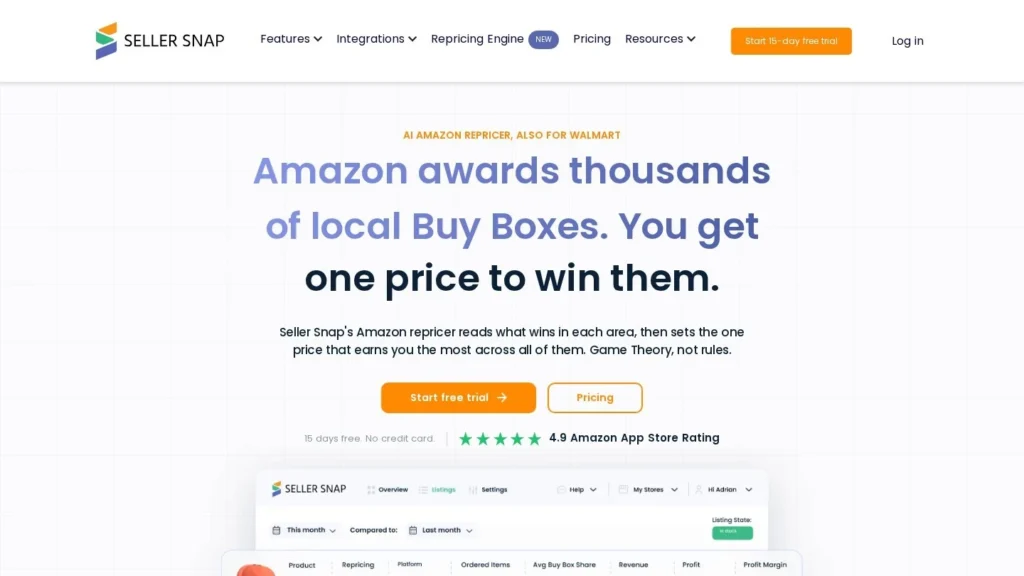
Seller Snap reprices Amazon and Walmart listings by modeling each competitor as a player in a game. It reads how a rival reacts, picks the strategy that wins Buy Box share at the highest price the situation allows, and stays inside the seller’s floor, ceiling, MAP and Amazon’s Competitive Price Threshold. Plans start at $100 a month on annual billing and are priced by catalog, not by a share of sales.
It fits resellers, wholesalers and brands with contested listings who want a repricer plus profit, inventory and reimbursement analytics in one place. Sellers on eBay or with used items will need another tool. We rate it 8.6/10 on our scale; public review sites do not yet rate it, so that criterion sits at neutral.
Seller Snap Pricing and Engine Facts
- Starter costs $100 a month paid annually; Accelerator runs $212 to $250 and Standard $425 to $500 a month.
- Billing is based on the catalog repriced, with no percentage of sales, and every plan includes the full engine.
- On Amazon US the AI reads local Buy Box awards and sets one price per listing that earns the most across areas.
- Seller Snap says sellers who used it for a year grew Amazon profit by an average of 23 percent.
- Founded in 2016, it has offices in Las Vegas and Tel Aviv and offers a 15-day trial with no credit card.
Seller Snap by the Numbers
These numbers come from Seller Snap’s home page, AI repricer page and About page.
| Fact | Detail | Source |
|---|---|---|
| Starter price | $100 a month, paid annually | Seller Snap home page |
| Accelerator price | $250 monthly or $212 a month paid annually | Seller Snap home page |
| Standard price | $500 monthly or $425 a month paid annually | Seller Snap home page |
| Free trial | 15 days, no credit card | Seller Snap home page |
| Marketplaces | Amazon US with local Buy Box pricing; Amazon Business, Walmart and 20 other Amazon marketplaces at marketplace level | Seller Snap home page |
| Reported profit growth | Average 23 percent for sellers after a year (vendor figure) | Seller Snap home page |
| Founded | 2016, by Eli Engelberg, Yuval Kaufman and Joshua Beam | Seller Snap About page |
| Leadership | Adrian Rich, CEO | Seller Snap About page |
| Offices | Las Vegas, Nevada and Tel Aviv-Yafo, Israel | Seller Snap About page |
| Integrations | InventoryLab, Ez Cloud, ScanPower, Sellercloud, SkuVault, Boxem, Walmart | Seller Snap About page |
The 23 percent profit figure is Seller Snap’s own and comes from sellers who stayed for a year, which leaves out those who left early. Read it as the vendor’s best case. The more checkable claim is structural: billing by catalog means a seller’s fee does not rise as sales grow, which matters for anyone doing six or seven figures a month.
The integrations list is aimed at resellers. InventoryLab and ScanPower are common among online and retail arbitrage sellers, and Sellercloud and SkuVault among wholesale operations, so cost data can flow in from tools these sellers already run.
How the Seller Snap Engine Prices a Listing
Seller Snap pitches itself against rule-based repricers that follow fixed instructions such as beat the lowest price by a cent. Its argument is that rules lead sellers into a race to the bottom where everyone shares the Buy Box at their minimum.
Reading Competitor Behavior
The AI detects how a specific competitor behaves and makes price moves aimed at that seller. If a rival always matches within minutes, undercutting only lowers both prices; the engine can hold or raise instead. If a rival never reacts, a small cut may win the Buy Box cheaply. Seller Snap describes the engine as self-learning and inspired by game theory.
Local Buy Box on Amazon US
Amazon can award the Buy Box differently by shopper location, partly because of delivery times. On Amazon US, Seller Snap reads those local awards and sets one price per listing that earns the most across areas. It also factors in fulfillment method and shipping times for FBA and FBM offers. Other Amazon marketplaces, Amazon Business and Walmart are priced at the marketplace level.
Floors From Real Costs
Minimum prices can be calculated from the seller’s target margin, Amazon and FBA fees pulled through Amazon’s API, fulfillment costs and operating expenses. Entering cost is optional but recommended. The engine never prices past Amazon’s Competitive Price Threshold, which protects a listing from losing Buy Box eligibility, and it follows MAP for brands that sell under it.
Custom and Rule-Based Strategies
Sellers who want specific behavior can build custom strategies, and rule-based strategies can run alongside the AI unchanged. A seller switching from a rules-based repricer can keep a few legacy rules on sensitive products while moving the rest of the catalog to the AI.
Analytics That Come With the Repricer
Seller Analytics and DataHub cover profit and trend analysis. The suite also tracks ACOS, CTR and RoAS, inventory age, reimbursement data and replenishment forecasts, with multi-store management and a profit margin calculator. An open API and FTP support let larger sellers feed data in and out.
What Customers Report
Seller Snap’s AI repricer page quotes customers and does not publish a study. One PowerSeller reports holding the Buy Box more than 50 percent of the time, and a seller managing more than 10,000 products reports sales growth above 100 percent after switching. These are testimonials chosen by the vendor, so treat them as examples of what is possible. The home page adds nine testimonials, including sellers described as doing about $1 million and $4 million a year.
Settings for European Fulfillment
Sellers using Amazon’s European Fulfillment Network get optional settings for it, which matters because the same FBA stock can serve several EU marketplaces with different delivery times and fees. Seller Snap prices those marketplaces at the marketplace level, using the fees and fulfillment data it pulls from Amazon.
A Week for a Wholesale Account
A wholesale seller with 8,000 SKUs connects Sellercloud so costs flow in, sets a 12 percent target margin and lets Seller Snap calculate minimums. On day one the engine identifies that one rival on a top product matches every cut within minutes, so it holds price and shares the Buy Box at a higher level. On another product a dormant rival never reacts, and a small cut wins most of the Buy Box. By Friday the seller checks DataHub for profit by SKU and inventory age to plan the next purchase order.
Inputs a Seller Snap User Still Owns
Costs, margins and MAP values are the seller’s responsibility. The seller decides which products get custom strategies and reviews analytics to steer purchasing. Listings, advertising management and account health sit outside the repricer.
Seller Snap Plans and Billing
Seller Snap prices by the size of the catalog repriced. Every plan includes the full engine.
| Plan | Price | Billing | What’s Included | Limits |
|---|---|---|---|---|
| Starter | $100/month | Paid annually | Full AI engine, analytics suite | Catalog size set by plan |
| Accelerator | $250/month or $212/month | Monthly or annual (15 percent savings) | Full AI engine, analytics suite | Larger catalog allowance |
| Standard | $500/month or $425/month | Monthly or annual | Full AI engine, analytics suite | Larger catalog allowance |
| Custom | Contact sales | Custom | Full engine with custom terms | For large catalogs |
What Each Plan Costs Over a Year
Starter at $100 a month paid annually comes to $1,200 a year. Accelerator paid annually is $212 a month, or $2,544 a year, against $3,000 if paid monthly, a saving of $456. Standard paid annually is $425 a month, or $5,100 a year, against $6,000 monthly, a saving of $900.
Compare that with a repricer that charges by sales tier. A seller doing $200,000 a month would sit on Aura’s Plus plan at $157 a month. Seller Snap’s Accelerator at $212 annually costs more on paper, so the extra $55 a month has to come back through better prices from the game theory engine or from the analytics the seller would otherwise buy separately.
Because billing ignores sales volume, a seller doing $300,000 a month pays the same as one doing $30,000 with the same catalog. For the larger seller, a $212 monthly fee is under 0.1 percent of revenue.
The pricing page shows an annual-only label on one view while plan cards show monthly options, so confirm billing terms during signup.
Seller Snap Compared With Aura, Eva and Teikametrics
| Tool | Starting Price | Free Plan | Main Strength | Main Gap | Best For |
|---|---|---|---|---|---|
| Seller Snap | $100/month (annual) | No (15-day trial) | Game theory AI, local Buy Box pricing, analytics | No eBay or used items | Resellers with contested listings |
| Aura | $37/month | No (14-day trial) | Low price, unlimited listings, Hyperdrive | Thin public reviews | Budget-minded resellers |
| Eva | Quote-based | No | Repricing plus ads, inventory and reimbursements | Pricing on request | Brands wanting software plus service |
| Teikametrics | $149/month (annual) | No (free trial) | Ad bidding plus listings and inventory across marketplaces | Not a Buy Box repricer | Private-label brands focused on ads |
Seller Snap sits between Aura and Eva. Aura costs less and gives unlimited listings; Seller Snap costs more but adds local Buy Box pricing, MAP support and analytics. Eva reprices on a 119-second cycle and adds ads and a growth team, priced by quote. Teikametrics serves private-label brands whose growth comes from ads. Amazon’s free Seller Assistant can sit alongside any of them. More options are on our Amazon seller agents page.
Sellers Who Fit Seller Snap
Resellers and wholesalers on Amazon US who share listings with active competitors fit best. Local Buy Box pricing and competitor modeling target their exact problem. A seller who keeps landing in price wars with the same two or three rivals on a product line is the classic case, because the engine is built to read those rivals and stop the slide.
Sellers moving off a rule-based repricer also fit. They can keep some rules running while the AI takes over the rest, so the switch does not have to happen in one day.
High-revenue sellers gain from catalog-based billing, since fees do not grow with sales. Sellers using InventoryLab, ScanPower, Sellercloud or SkuVault can connect costs directly.
Multi-store operators fit as well. Multi-store management lets one team run several seller accounts from the same dashboard, with analytics for each.
Brands selling under MAP also fit, since the engine respects MAP and Amazon’s Competitive Price Threshold.
When Seller Snap May Not Be the Right Repricer
eBay sellers and those with used inventory need a different repricer. Very small sellers may find Aura’s $37 Starter plan easier to justify than a $1,200 annual commitment.
Sellers who want a single tool for ads, listings and repricing may prefer a broader platform. Seller Snap tracks ad metrics such as ACOS and RoAS but does not describe managing bids.
Private-label sellers with no competing offers will see less effect from a Buy Box engine and may get more from ad automation.
Cost Data, Billing Terms and Review Gaps
Margin-based minimums only work with accurate cost data. Load costs before switching on calculated floors, and update them when suppliers change prices.
Game theory pricing can hold a price above the lowest offer on purpose. That is the point of the engine, but it can look like lost sales in the first days if a seller expects to win every Buy Box. Judge results on margin and total Buy Box share over two weeks, not on single hours.
Confirm the billing cycle and catalog allowance in writing at signup, given the mixed labels on the pricing page.
Public review sites do not yet show a qualifying rating for Seller Snap, and its own site cites an app store score. Seller Snap could build profiles on independent review sites and publish its security practices so buyers have outside evidence.
Our Take on Seller Snap’s Game Theory Repricer
Seller Snap earns 8.6/10 on our scale. Autonomy, setup and pricing value score high: the engine runs on its own within limits, setup is a toggle plus costs, and plans are published with a trial. Integrations are good for resellers. User sentiment sits at a neutral score until independent reviews exist.
The gaps are about evidence and documentation. Independent review profiles, a published security summary and clearer billing labels on the pricing page would each help buyers compare Seller Snap with less effort, and would likely lift its sentiment and trust scores on our scale.
For a reseller who has outgrown rule-based repricing and wants analytics in the same tool, Seller Snap is a sensible trial. Use the 15 days to compare Buy Box share and margin on a test group of listings.
Questions Resellers Ask About Seller Snap
How Much Does Seller Snap Cost?
Starter is $100 a month paid annually. Accelerator costs $250 monthly or $212 annually, Standard $500 monthly or $425 annually, and Custom is quoted.
What Does Game Theory Repricing Mean?
The engine models how each competitor responds to price changes and picks the move that wins Buy Box share at the highest price, aiming to avoid price wars that rule-based repricers can start. In practice, that can mean holding or raising a price when a rival is known to match every cut, which a simple beat-by-a-cent rule would never do.
Does Seller Snap Support Walmart?
Yes. Walmart repricing is supported at the marketplace level, along with Amazon Business and 20 other Amazon marketplaces. The local Buy Box feature that prices by shopper area applies to Amazon US only, so Walmart and other marketplaces get one price per listing based on marketplace-wide competition.
Will Seller Snap Break MAP Pricing?
No. Seller Snap says it respects MAP for sellers who sell under it and never prices past Amazon’s Competitive Price Threshold. Prices also stay within the minimum and maximum the seller sets or the engine calculates from costs and margin.
Can I Keep My Existing Repricing Rules?
Yes. Rule-based strategies can run alongside the AI engine, and custom strategies are available. Many sellers move in stages, testing the AI on part of the catalog during the 15-day trial while legacy rules stay on the rest.
User Reviews
Nobody has rated it here yet. Be the first AI Agents Choice user to rate Seller Snap.