
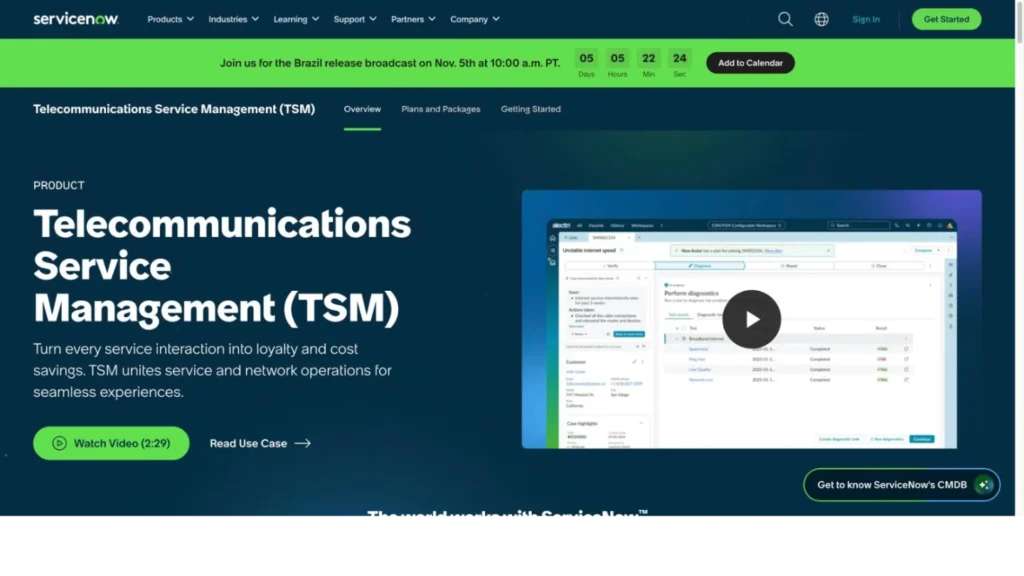
One of ServiceNow’s telecom customers cut average case resolution time from 4.7 hours to one minute, according to ServiceNow’s product page, and another deflected 3 million support calls a year. Those figures come from Telecommunications Service Management, the product into which ServiceNow put three telecom AI agents in March 2025: a service test and repair agent that diagnoses faults and dispatches field engineers, a network incident analysis agent and a billing resolution agent. They suit service providers already running ServiceNow for customer service or operations. For other operators, the agents come as part of a larger platform purchase.
Pricing is quote-only, set inside a ServiceNow platform agreement. We rate it 7.9/10 on our scale: capable agents on a well-reviewed platform, with room to grow on pricing transparency and setup effort. We have not used ServiceNow ourselves; this review is based on ServiceNow’s launch announcement, product page and documentation, Fierce Network’s reporting and Gartner Peer Insights ratings.
From 4.7 Hours to One Minute per Telecom Case
- ServiceNow cites a telecom customer that cut average case resolution from 4.7 hours to one minute, and another that deflects 3 million support calls a year.
- Three agents launched in March 2025: service test and repair (including field engineer scheduling), network incident analysis and billing resolution.
- They were built with NVIDIA AI Enterprise, DGX Cloud, NIM and NeMo, and run on the ServiceNow AI Platform with AI Agent Orchestrator.
- Pricing is quote-only within a ServiceNow agreement, and some AI features are unavailable in FedRAMP, self-hosted and other regulated deployments.
- ServiceNow Customer Service Management holds 4.4 out of 5 from 158 ratings on Gartner Peer Insights, with licensing complexity a common theme among reviewers.
Launch Dates and Operator Figures From ServiceNow
ServiceNow’s telecom figures come from its own product page and launch announcement, plus trade press coverage of how operators use the platform.
| Fact | Detail | Source and Date |
|---|---|---|
| Launch | Telecom AI agents announced at Mobile World Congress in Barcelona; available March 12 with the Yokohama release | ServiceNow press release, March 3, 2025 |
| Initial agents | Service test and repair, network incident analysis and billing resolution | ServiceNow press release, March 3, 2025 |
| AI stack | Built with NVIDIA AI Enterprise software and NVIDIA DGX Cloud, using NVIDIA NIM microservices and NeMo | ServiceNow press release, March 3, 2025 |
| Rollout scale | GenAI-capable AI agents being rolled out to nearly 1,000 ServiceNow platform customers | ServiceNow press release, March 3, 2025 |
| Case resolution | Average case resolution of one minute, down from 4.7 hours (unnamed customer) | ServiceNow TSM product page, viewed October 2026 |
| Call deflection | 3 million customer support calls deflected a year; 80% reduction in ticket creation (unnamed customers) | ServiceNow TSM product page, viewed October 2026 |
| Analyst recognition | Named a major player in the IDC MarketScape: Worldwide Customer Experience Platforms for Telecommunications 2025 | ServiceNow TSM product page, viewed October 2026 |
| Operator users | Verizon Business says ServiceNow powers its managed services tooling; BT was trialing generative AI case summaries; Bell Canada named as a user | Fierce Network, March 10, 2025 |
| Moveworks deal | ServiceNow announced a $2.85 billion acquisition of Moveworks the same day as the telecom agents | Fierce Network, March 10, 2025 |
| User rating | Customer Service Management: 4.4 out of 5 from 158 ratings | Gartner Peer Insights, viewed October 2026 |
The resolution and deflection figures are striking, and naming the customers behind them would make them easier to weigh; they also describe the whole Telecommunications Service Management product rather than the agents alone. Treat them as the ceiling of what a mature deployment can reach.
The NVIDIA partnership and the same-day Moveworks deal point the same way: ServiceNow is investing heavily in agents across its platform, and telecom is one industry edition of that push. That brings fast-moving tooling such as AI Agent Orchestrator and AI Agent Studio, and also a product whose names and packaging change often, as the documentation’s use of both the Now Assist and ServiceNow Otto names shows. Confirm the exact product names and SKUs in any quote.
The more reliable signal for a telecom buyer is who already runs on the platform. Verizon Business told Fierce Network that ServiceNow powers its managed services tooling, and BT and Bell Canada also use ServiceNow. For operators in that position, the agents are an add-on to data and workflows they already have, which is where they make the most sense.
Agents Built Into Telecommunications Service Management
The agents are part of Telecommunications Service Management (TSM), which combines telecom apps with ServiceNow Customer Service Management and core platform features. ServiceNow’s product page says TSM agents triage cases, diagnose service issues and recommend solutions around the clock.
The Three Telecom Agents
- Service test and repair: analyzes network data, diagnoses faults, recommends fixes and coordinates repairs, including scheduling field engineers.
- Network incident analysis: detects network alerts, finds root causes and resolves service disruptions. It generates resolution playbooks and aims to predict disruptions before customers are affected.
- Billing resolution: flags unusual usage, explains charges in real time and recommends lower-cost plans, with the goal of fewer billing complaints and call center contacts.
ServiceNow’s Rohit Batra told Fierce Network the agents are not just another version of chatbots, and his blog post describes them as able to learn, reason and solve problems on their own.
The Platform Around Them
- AI Agent Orchestrator: coordinates several agents across tasks, systems and departments.
- AI Agent Studio: lets teams build and refine custom agent workflows without complex coding.
- Workflow Data Fabric: connects structured and unstructured enterprise data that the agents draw on.
- Telco Customer 360: puts sales, service, support and network data in one workspace for service agents.
- Proactive service: detects incidents, changes and maintenance that affect customers and notifies them early.
- Service Exchange: links a provider’s instance with a business customer’s so cases, updates and actions flow between them.
Generative AI Skills for Service Teams
ServiceNow’s documentation for the current release, which calls the application ServiceNow Otto for TMT, lists skills that summarize service problem cases, account onboarding cases, engagements and test results, and that generate case resolution notes. These run in the customer and field service workspaces.
Field Repairs and High-Impact Oversight Stay Human
Field engineers do on-site repairs that the agents schedule. ServiceNow’s documentation tells customers to keep appropriate human oversight of AI output, especially for high-impact uses, and not to rely only on AI output for decisions. It also warns that output may be inaccurate or incomplete and recommends testing.
The value of putting these agents on one platform shows up in a common telecom chain: a network alarm becomes an incident, the incident affects business customers, those customers open cases, and a field engineer goes out. ServiceNow’s pitch is that the incident agent, the proactive notice, the case summary and the repair agent’s dispatch all sit on the same records rather than in separate systems.
TSM Data Models and Field Workflows Come First
The agents need the ServiceNow platform with TSM configured, including telecom data models, network and service data, and field service workflows. ServiceNow says TSM includes industry data models and built-in APIs to speed deployment, and it offers Impact success plans and expert services. Access starts with a demo.
Licensed Through a Negotiated ServiceNow Agreement
ServiceNow does not publish prices for Telecommunications Service Management or its AI agents. They are licensed through a negotiated ServiceNow agreement.
| Plan | Price | Billing | What’s Included | Limits |
|---|---|---|---|---|
| Telecommunications Service Management | Custom quote | Negotiated ServiceNow agreement | Telco Customer 360, proactive service, Service Exchange, telecom data models | Requires the ServiceNow platform |
| Telecom AI agents | Custom quote | Licensed with the platform | Service test and repair, network incident analysis and billing resolution agents | Some AI features unavailable in regulated deployments |
| Implementation and success services | Custom quote | Separate engagement | ServiceNow Impact success plans and expert services | Scope set per project |
Sizing 20,000 Monthly Billing Calls for an Operator
With no list prices, the useful exercise is sizing the work the agents target. The volumes below are our own illustrative assumptions.
- Billing calls: an operator taking 20,000 billing calls a month at eight minutes each spends about 2,667 agent hours. If the billing agent deflects 10% of those calls, that frees about 267 hours a month.
- Business service cases: 1,000 enterprise service cases a month at the 4.7-hour average ServiceNow cites before automation is 4,700 hours of case time. Even a partial cut is large, though the one-minute figure is a best case from one customer.
- Field dispatch: if 15% of 2,000 monthly repair tickets need a truck roll, the repair agent’s job is to get 300 visits scheduled with the right diagnosis, which is where wasted visits get expensive.
Costs to plan for beyond the license: Customer Service Management and Field Service Management if you do not already have them, an implementation partner, data integration from network and billing systems, and ongoing admin time to tune agents and workflows.
ServiceNow AI Agents for Telecom Compared With Amdocs aOS, Netcracker Agentic AI and Agentforce
Telecom care and operations agents come from three directions: BSS vendors, OSS vendors and general enterprise platforms. ServiceNow is the third kind, with telecom-specific agents on top.
| Agent | Starting Price | Free Plan | Main Strength | Main Trade-Off | Best For |
|---|---|---|---|---|---|
| ServiceNow AI Agents for Telecom | Custom quote | No | Links customer cases, network incidents and field repairs on one platform | Needs the ServiceNow platform and implementation | Operators already on ServiceNow |
| Amdocs aOS | Custom quote | No | Built around telecom BSS and OSS processes and data | Commercial model still being settled in 2026 | Operators running Amdocs systems |
| Netcracker Agentic AI | Custom quote | No | 60+ prebuilt telecom agents across care, sales and network | No public pricing or packaging | Operators wanting one telecom agent platform |
| Agentforce | $0.10 per action (Flex Credits) | Limited | Published usage pricing on a large CRM platform | Costs grow with action volume | Operators running Salesforce for sales and service |
If your service desk already runs on ServiceNow, its agents are the shortest path. If your BSS is Amdocs or Netcracker, their native agents sit closer to billing and ordering data. Agentforce is the comparable general platform with a published per-action price. More options are in our AI agents for telecom and customer support guides.
Operators Already Running ServiceNow
- Operators already on ServiceNow: the agents use the case, network and field data you already hold, so the added work is configuration rather than a new platform.
- Providers serving business customers: Service Exchange and proactive notices suit managed services, the area where Verizon Business says ServiceNow powers its tooling.
- Teams with costly truck rolls: the repair agent diagnoses faults before scheduling field engineers.
- Call centers with heavy billing traffic: the billing agent explains charges and suggests cheaper plans.
Non-ServiceNow Carriers and Small ISPs
- Operators not on ServiceNow: adopting a full enterprise platform to get three agents is a large project.
- Small ISPs: negotiated platform licensing and implementation costs are sized for large organizations.
- Regulated deployments: some AI features are unavailable for FedRAMP, IL5, IRAP-Protected, in-country and self-hosted instances.
- Network teams wanting deep telemetry analysis: network-native tools such as Kentik AI Advisor or Selector AI work closer to flow and device data.
Customer References, Licensing and Deployment Limits
- Customer references: the one-minute resolution and 3 million deflected calls come from customers not named on the product page, so ask for named telecom references.
- Licensing complexity: some Gartner Peer Insights reviewers of Customer Service Management mention complex licensing.
- Low-code scope: one reviewer says simple changes sold as low-code still needed engineering support.
- Regulated environments: ServiceNow’s docs say not all AI models or features are available for in-country SKUs, FedRAMP, IL5, IRAP-Protected, self-hosted or regulated markets.
- Accuracy: ServiceNow warns AI output may be inaccurate, incomplete or inappropriate, and advises testing and human oversight.
- Reporting: some reviewers would like built-in reporting to support calculations across data points over time.
The NVIDIA-Backed Launch at Mobile World Congress
- On March 3, 2025, at Mobile World Congress, ServiceNow introduced AI agents built for the telecom industry with NVIDIA, available from March 12 with the Yokohama release.
- On March 10, 2025, Fierce Network reported on the telecom agents and on ServiceNow’s $2.85 billion deal to acquire Moveworks, announced the same day.
Worth a Pilot for Carriers Already on the Platform
For operators already running ServiceNow for customer service, field service or managed services, yes, they are worth a serious pilot. The agents connect a customer’s complaint, the network incident behind it and the engineer who fixes it on one platform, which few telecom tools do. ServiceNow AI Agents for Telecom scores 7.9/10 on our scale, a score that reflects quote-only pricing and a sizable implementation rather than what the agents can do.
For operators not on ServiceNow, the agents are one factor in a larger platform decision. Ask for named telecom references behind the resolution and deflection figures, confirm which AI features your deployment type supports, and price the platform, field service and implementation together before comparing with Amdocs, Netcracker or Agentforce.
Points Telecom Operators Raise on ServiceNow’s Agents
How Much Do ServiceNow AI Agents for Telecom Cost?
ServiceNow does not publish prices. The agents are licensed within a negotiated ServiceNow agreement, usually with Telecommunications Service Management, Customer Service Management and implementation services.
Which Telecom Agents Does ServiceNow Offer?
The March 2025 launch included a service test and repair agent, a network incident analysis agent and a billing resolution agent. Teams can build more with AI Agent Studio and coordinate them with AI Agent Orchestrator.
Do ServiceNow’s Telecom Agents Use NVIDIA Models?
Yes. ServiceNow says it built them with NVIDIA AI Enterprise software and NVIDIA DGX Cloud, using NVIDIA NIM microservices and NeMo.
Can I Use Them in a FedRAMP or Self-Hosted Instance?
Not fully. ServiceNow’s documentation says not all AI models or features are available for in-country SKUs, FedRAMP, IL5, IRAP-Protected, self-hosted deployments or regulated markets, and that availability varies by region.
How Do ServiceNow AI Agents for Telecom Compare With Amdocs aOS?
Amdocs builds its agents around telecom BSS and OSS processes, which suits operators on Amdocs systems. ServiceNow’s agents are stronger at linking customer cases, network incidents and field service on a general enterprise platform.
User Reviews
Nobody has rated it here yet. Be the first AI Agents Choice user to rate ServiceNow AI Agents for Telecom.