
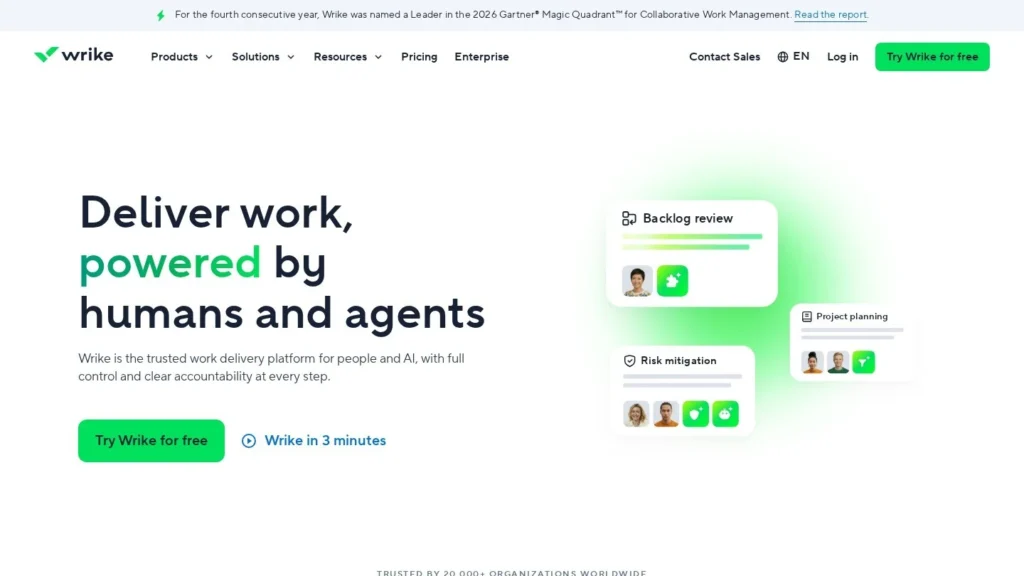
Wrike says early adopters of its AI agents saved up to 520 hours per employee a year, and that one customer replaced 30 automation rules with a single agent. Those claims came with general availability on February 5, 2026, after a preview in which weekly active AI users on Wrike rose 4,900%. The agents are aimed at the work a project office does every day: checking new requests, sorting them and spotting schedule or cost risks before they turn into missed deadlines.
Wrike AI Agents fit mid-market and enterprise teams that already run portfolios and request intake in Wrike. The entry point is the main thing to plan for: agents need the Business plan at $25 per user per month, billed annually, or a quoted Pinnacle or Apex contract, and AI use has been metered by monthly action allowances since April 1, 2026. We rate the agents 8.6/10 on our scale. We have not used Wrike ourselves; this review is based on Wrike’s announcements, published pricing analysis and news coverage.
520 Hours a Year Saved per Employee, Wrike Says
- Wrike reports early adopters saved up to 520 hours per employee a year, about 10 hours a week, and that one customer replaced 30 automation rules with one agent.
- Three prebuilt agents cover risk status reporting, request triage and intake checks, and a no-code Agent Builder handles custom work.
- Agents need Business at $25 per user per month billed annually, or a quoted Pinnacle or Apex plan; Free and Team plans do not include them.
- Since April 1, 2026, Copilot and agents draw on monthly AI action allowances of 300 on Business, 1,000 on Pinnacle and 10,000 on Apex.
- Gartner named Wrike a Leader in its 2025 Magic Quadrant for Collaborative Work Management, and the platform rates 4.2 out of 5 from 4,538 G2 reviews.
Adoption Figures and AI’s Move From Free to Metered
Wrike published unusually detailed adoption figures when the agents launched, and its pricing history shows how quickly AI moved from free to metered.
| Fact | Detail | Source and Date |
|---|---|---|
| Time saved | Up to 520 hours per employee a year, or up to 10 hours a week, reported by early adopters | Wrike press release, February 5, 2026 |
| Preview adoption | Weekly active AI users up 4,900% during the preview; AI use in enabled accounts rose from 1% to 53% | Wrike press release, February 5, 2026 |
| Share of AI traffic | Agents account for 23% of AI traffic on Wrike; January 2026 AI actions nearly matched all of 2025 | Wrike press release, February 5, 2026 |
| Customer demand | 72% of early adopters asked for multi-step execution in a single agent; one customer replaced 30 automation rules with one agent | Wrike press release, February 5, 2026 |
| Customer base | More than 20,000 organizations; uptime above 99.9% | Wrike Collaborate 2025 release, October 8, 2025 |
| Analyst recognition | Named a Leader in Gartner’s 2025 Magic Quadrant for Collaborative Work Management | Reworked, February 6, 2026 |
| Integrations | More than 400 app integrations; MCP server for third-party agents introduced September 2025 | Reworked, February 6, 2026 |
| Business plan price | $25 per user per month billed annually, up from $24.80, effective January 21, 2026 | UsagePricing, viewed October 2026 |
| AI action allowances | Business 300, Pinnacle 1,000, Apex 10,000 per month from April 1, 2026, after free access ended March 31 | UsagePricing, viewed October 2026 |
| G2 rating | 4.2 out of 5 from 4,538 reviews of Wrike | G2, viewed October 2026 |
These are vendor figures from early adopters, so they show what is possible rather than what an average team will see. The 30-rules-to-one-agent example is the most practical: teams with sprawling automation rules may be able to replace brittle rule chains with a single agent that handles the exceptions.
The pricing rows tell a second story. Wrike gave AI away until March 31, 2026, then started metering it, and agents now sit only on the Business plan and above. That is a typical path for work management vendors in 2026, and buyers should expect allowances to shift again.
Agents on Wrike’s Work Intelligence Graph
Wrike AI Agents run inside the Wrike platform on what Wrike calls its Work Intelligence Graph, the projects, tasks, requests and people a customer already manages there.
Risk Reporter, Triage and Intake Agents
- Risk Status Reporter: monitors changes in scope, schedule, cost or resources and flags risks early.
- Triaging agent: classifies incoming requests by type so they land with the right team.
- Intake agent: checks new requests for required information before work starts.
Jellyfish, an early customer, used the agents to automate intake across departments. Its VP of project management, James Ball, said they are “like adding other team members” in Wrike’s October 2025 announcement.
Custom Agents, Multi-Actions and Chaining
Agent Builder is a no-code tool for designing agents from natural-language instructions. Wrike’s examples include an agent that reassigns tasks based on expertise and one that triggers multi-step automations. Multi-Actions let one agent run several steps, a feature Wrike says 72% of early adopters asked for, and Agent Chaining links agents so one hands off to the next.
Testing and Control
- Sandbox: a pre-launch space to simulate, test and tune agents.
- Visible reasoning: users can see why an agent took an action.
- Admin-only deployment: only space admins can create and deploy agents.
- MCP server: since September 2025, third-party AI agents can work with live Wrike data through Wrike’s MCP server.
Where Agents Fit in the Wider Platform
Wrike’s October 2025 Collaborate announcement placed the agents inside a broader push: Wrike Whiteboard, built on the Klaxoon visual collaboration tool Wrike acquired, a Solution Center where customers publish and download prebuilt templates, and packaged solution suites for marketing, client service delivery, portfolio management, product lifecycle and agencies. Wrike says Agent Builder agents can extend those suites, so a team that adopts a suite can add its own agents on top rather than starting from a blank space.
Admins Test in the Sandbox, PMs Act on Risks
Admins decide which agents run in which spaces and test them in the sandbox. Project managers still act on the risks the Risk Status Reporter raises, and teams still own the work once a request has been checked and classified. Agents speed up the routing and checking, not the delivery.
AI Essentials and AI Elite Across Per-User Plans
Wrike sells per-user plans. AI comes in two tiers: AI Essentials from the Team plan up, and AI Elite, which covers Copilot and agents, from Business up. The figures below are from UsagePricing’s tracking of Wrike’s pricing page and help center.
| Plan | Price | Billing | What’s Included | Limits |
|---|---|---|---|---|
| Free | $0 | None | Task management with limits on active tasks | No AI agents |
| Team | $10 per user per month | Annual | AI Essentials; 2 to 15 users | No AI agents |
| Business | $25 per user per month | Annual only | AI agents; 300 AI Elite actions a month; 5 to 200 users | Seats in blocks of 5 up to 30 seats |
| Pinnacle | Quote | Sales-led | AI agents; 1,000 AI Elite actions a month | No public price |
| Apex | Quote | Sales-led | AI agents; 10,000 AI Elite actions a month; most add-ons bundled | No public price |
| AI Elite Actions Pack | Quote | Lasts until renewal | 12,000 extra actions | No public price |
UsagePricing notes that Wrike’s help center describes the allowances as per Full User license but pooled across the account, and calls the wording ambiguous. Wrike does not invoice overage automatically: admins are alerted at 90% and 100% of the allowance, AI Elite features may be restricted once it runs out, and Wrike then contacts the customer. Other add-ons include Whiteboard at $15 per user per month; Integrate, Two-Way Sync and Datahub are custom-priced.
A 7-Person Project Office Buying Seat Blocks
These scenarios use Wrike’s published Business price and seat-block rule. Team sizes are our own illustrative assumptions.
- A 7-person project office: Business seats sell in blocks of 5 up to 30 seats, so the team buys 10 seats at $25, or $250 a month billed annually, rather than $175 for seven.
- A 23-person marketing team: 25 seats at $25 come to $625 a month, or $7,500 a year paid up front on the annual-only Business plan.
- A team that needs more AI actions: if the Business allowance of 300 a month is applied per account rather than per license, a busy team will exhaust it fast and need the 12,000-action pack or a move to Pinnacle, both quoted by sales.
The ambiguity over the allowance is the biggest unknown in Wrike’s pricing. Ask sales in writing how actions are counted per agent run and whether the allowance scales with seats before signing an annual contract.
Wrike AI Agents Compared With Asana AI Teammates, monday.com AI Agents and ClickUp Super Agents
All four put agents inside a work management platform, but Wrike is the only one whose agents start on a mid-tier plan with an annual-only contract.
| Agent | Starting Price | Free Plan | Main Strength | Main Trade-Off | Best For |
|---|---|---|---|---|---|
| Wrike AI Agents | $25 per user per month (Business, annual) | No (agents need Business) | Prebuilt risk, triage and intake agents with chaining and a sandbox | Quoted upper tiers and ambiguous AI allowance | Project offices in mid-market and enterprise firms |
| Asana AI Teammates | Included with paid Asana plans; extra requests $0.50 to $0.60 | No | Teammates inside projects and goals with a clear per-request price | Small included request pool | Cross-functional teams on Asana |
| monday.com AI Agents | $9 per seat per month plus required credits | Limited (no AI) | Board-event triggers and many outside channels | Credit use per run varies widely | Business teams running work on boards |
| ClickUp Super Agents | $9 per user per month AI add-on on top of a plan | No | Agents across tasks, docs and chat | Crowded interface and learning curve | Teams that want one workspace for everything |
Wrike’s prebuilt agents speak the language of formal project management, which suits PMOs and agencies with structured intake. monday.com and ClickUp are cheaper to start, and Asana’s per-request price is the easiest to forecast. See more options in our AI agents for project management and agencies guides.
PMOs and Teams Flooded With Requests
- Project management offices: the Risk Status Reporter watches scope, schedule, cost and resources across projects.
- Teams with heavy request intake: the Intake and Triaging agents check and classify requests before anyone picks them up.
- Agencies and client service teams: Wrike packages solution suites for agencies and client delivery that Agent Builder agents can extend.
- Accounts with large automation rule sets: Multi-Actions and chaining can replace long rule chains, as one customer did with 30 rules.
- Enterprises standardizing on Wrike: Pinnacle and Apex carry larger AI allowances, and the MCP server opens Wrike to other agents.
Free and Team Plan Users and Price-List Seekers
- Small teams on Free or Team plans: agents start at Business, which is annual-only.
- Buyers who need full published pricing: Pinnacle, Apex and the extra actions pack are quoted.
- Teams that want a fast, simple tool: G2 reviewers cite a steep learning curve.
- Software teams on Jira: Rovo works on their existing backlog.
- Teams that want agents in many outside channels: monday.com lists more outside tools for its agents.
Per-License or Per-Account Actions, and Limits
- Allowance wording: confirm whether AI Elite actions are per license or per account, and how one agent run is counted.
- Restricted features at the limit: once the allowance runs out, AI Elite features may be restricted until Wrike and the customer agree on more capacity.
- Annual commitment: Business and higher plans are annual-only, and seats are sold in blocks.
- Vendor-reported results: the 520-hour figure comes from early enterprise adopters, not an independent study.
- Recent price changes: Business moved to $25 on January 21, 2026, and free AI access ended March 31, 2026.
- Admin-only deployment: only space admins can create and deploy agents, which adds control and can slow experiments in large organizations.
General Availability Lands in February 2026
- On February 5, 2026, Wrike announced general availability of AI Agents on Business, Pinnacle and Apex, with Agent Builder, Multi-Actions, Agent Chaining and a sandbox.
- On February 6, 2026, Reworked covered the launch, noting Wrike’s MCP server from September 2025 and its Leader placement in Gartner’s 2025 Magic Quadrant for Collaborative Work Management.
- On October 8, 2025, Wrike previewed AI agents and Agent Builder at Collaborate 2025, alongside Wrike Whiteboard powered by Klaxoon.
PMOs on Business or Higher Should Turn Them On
For project offices already on Wrike Business or higher, yes. Wrike AI Agents score 8.6/10 on our scale, with their best marks for autonomy, integrations and user sentiment. The prebuilt agents target real project office chores, and the sandbox, visible reasoning and admin-only deployment make them easier to trust with live portfolios.
Pricing and access are the areas to improve. Agents start on an annual-only $25 plan, the upper tiers and extra actions are quoted, and the AI allowance wording could be clearer. A 7-person team pays $250 a month because of seat blocks. Use the sandbox to test the Intake and Triaging agents on real requests, then get the action allowance terms in writing before renewal.
Wrike Agent Actions and Plan Limits, Plain Answers
Which Wrike Plans Include AI Agents?
AI agents are available on Business, Pinnacle and Apex. Business costs $25 per user per month billed annually; Pinnacle and Apex are quoted by sales. The Free and Team plans do not include agents.
How Many AI Actions Does Wrike Business Include?
Since April 1, 2026, Business includes 300 AI Elite actions a month, Pinnacle 1,000 and Apex 10,000. Wrike’s help center describes them as per Full User license but pooled across the account, so ask sales how that applies to your contract.
What Happens When Wrike AI Actions Run Out?
Wrike does not bill overage automatically. Admins are notified at 90% and 100% of the allowance, AI Elite features may be restricted, and customers can buy a 12,000-action pack, which has no public price.
What Do Wrike’s Prebuilt Agents Do?
The Risk Status Reporter flags changes in scope, schedule, cost or resources. The Triaging agent classifies incoming requests by type, and the Intake agent checks new requests for required information. Agent Builder covers anything else.
How Do Wrike AI Agents Compare With monday.com AI Agents?
Wrike starts at $25 per user on an annual plan and focuses on project office work such as risk and intake. monday.com starts at $9 per seat plus a required credit bucket and gives agents more outside channels such as Gmail, Slack and WhatsApp.
User Reviews
Nobody has rated it here yet. Be the first AI Agents Choice user to rate Wrike AI Agents.