
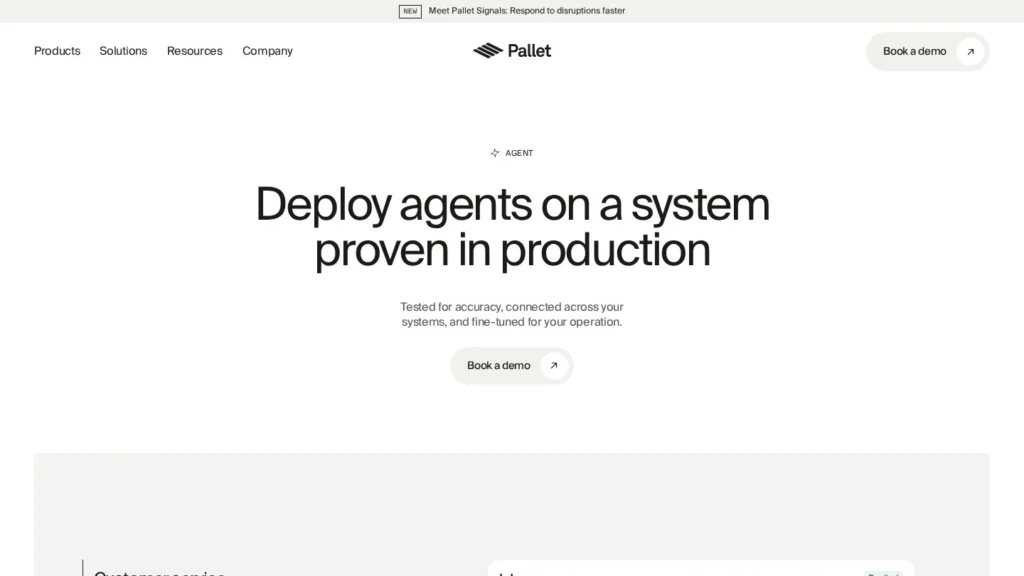
Lineage has run 2 million tasks through Pallet’s agents at more than 99% accuracy, and Eassons Transport Group went live in 40 days and now processes 98% of its tenders without a human touch, according to Pallet. Pallet builds custom agents that take over order entry, quoting, rate negotiation, portal updates and freight finance checks, and it works in carrier portals and old desktop systems that have no API.
Pallet is best for brokers, carriers, 3PLs, forwarders and shippers with high-volume repetitive work spread across many systems. Everything is custom: there is no price list, agents typically take about six weeks to go live, and you pay for what the agents deliver. We rate it 8.3/10 on our scale, with its highest marks for integrations and documented security. We have not used Pallet ourselves; this review is based on Pallet’s product page and blog, its investor’s announcement and trade press coverage.
Lineage’s 2 Million Tasks and Eassons’ Touchless Tenders
- Named results include Lineage Logistics at 2 million tasks and more than 99% accuracy, and Eassons at 98% touchless tenders after going live in 40 days.
- Agents work through email, voice, documents, APIs, EDI, web portals and remote desktop apps, with named integrations including CargoWise, McLeod, SAP and Blue Yonder.
- Pricing is custom and outcome-based: start with a proof of concept, then pay for delivered work rather than seats.
- Pallet states SOC 2 Type II, GDPR and CCPA compliance and saves every human correction to agent memory.
- Pallet raised $27 million in May 2025 led by General Catalyst, $50 million in total, and won FreightWaves’ first AI Excellence in Supply Chain award.
Named Results, Funding and an Industry Award
Pallet publishes named customer results alongside its own claims. Its funding and an industry award add context on the company behind them.
| Fact | Detail | Source and Date |
|---|---|---|
| Funding | $27 million Series B led by General Catalyst, with Bain Capital Ventures, Activant Capital and Bessemer Venture Partners; $50 million raised in total | DC Velocity, May 27, 2025 |
| Founder | Sushanth Raman, who previously held engineering and sales roles at Retool | General Catalyst investment note, May 27, 2025 |
| Award | Winner of FreightWaves’ inaugural AI Excellence in Supply Chain award | FreightWaves, August 25, 2025 |
| Customer-reported savings | 50% to 70% lower staffing costs for repetitive workflows and up to ten times higher throughput | FreightWaves, August 25, 2025 |
| Carrier redeployment | A midsized carrier moved 25 full-time employees from order entry to other roles | General Catalyst and FreightWaves, 2025 |
| Intermodal order entry | A Chicago intermodal carrier cut a 20-minute order process to seconds; the agent learned its rules in eight weeks | FreightWaves, August 25, 2025 |
| Lineage | 2 million tasks completed at more than 99% accuracy | Pallet product page, viewed October 2026 |
| Prism Logistix | Agents follow 20,000 customer rules across 400 accounts | Pallet product page, viewed October 2026 |
| Mallory Alexander | 100% accuracy on import filings | Pallet product page, viewed October 2026 |
| Eassons Transport Group | Live in 40 days; 98% touchless on the tenders Pallet processes; each additional customer account onboarded in 48 hours after the first | Pallet blog, May 14, 2026 |
| Everest Transportation Systems | Agents run on more than 20,000 customer-specific memories inferred from its inbox | Pallet blog, May 14, 2026 |
| Security | SOC 2 Type II, GDPR and CCPA compliance | Pallet product page, viewed October 2026 |
The named customers matter more than the headline claims. Lineage Logistics’ 2 million tasks is real production volume, not a pilot. The Eassons figures show what happens after go-live: 98% of tenders handled without a touch, with each additional customer account onboarded in 48 hours once the first was done. That pattern, a slow first build followed by fast expansion, is what you should expect to pay for.
The broader savings figures, 50% to 70% lower staffing costs and up to ten times throughput, are customer reports gathered by Pallet. They describe repetitive workflows only, so they will not apply across a whole operations team.
Agents for Workflows and Atlas for Decisions
Pallet sells two products: Agents, which run operational workflows end to end, and Atlas, a decision intelligence tool for supply chain teams. This review covers Agents.
Customer Service and Logistics Jobs the Agents Run
- Customer service: quotes, orders, returns and delivery questions.
- Logistics: order entry, load building, rate negotiation, portal updates, inbound freight and customer deliveries.
- Procurement: comparing quotes for materials and services and cutting supplier follow-up.
- Warehouse operations: receiving, inventory and fulfillment records across warehouses, distribution centers and production sites.
- Financial operations: catching supplier overcharges, recovering customer deductions, reconciling credits and chasing overdue invoices.
Where the Agents Work
Pallet’s agents use whichever surface the task needs: email in Outlook, Gmail or Front; inbound and outbound phone calls; PDFs, spreadsheets and scanned images; REST APIs and EDI 204 and 210 messages; web apps and carrier portals through a browser; and desktop applications through remote desktop. Named systems include CargoWise, McLeod, Turvo, Revenova, Manhattan Associates, SAP, Oracle, Blue Yonder, Kinaxis, E2open, Descartes and Trimble. FreightWaves described the agents reading varied document formats with AI vision and moving through applications with browser automation and APIs.
How Forge Builds Each Agent
In May 2026 Pallet introduced Forge, its agent factory. Setup runs in three stages, according to CEO Sushanth Raman:
- Connect: link the TMS, WMS, ERP, EDI, email and on-premises systems such as AS400. Pallet builds APIs where none exist.
- Encode: Forge learns from historical emails, chats and operational data, turning operator knowledge, carrier preferences and exceptions into the agent’s working knowledge.
- Test: Forge runs thousands of simulations and iterates until accuracy meets the workflow’s bar, a cycle Pallet says runs five to six times faster than heavy manual tuning.
Pallet combines its own custom models, trained on customer data, with frontier models, and says customers face no lock-in.
Low-Confidence Cases Go Back to People
Pallet keeps humans in the loop. When an agent’s confidence is low, it asks for guidance, and every human fix is stored in memory so the same exception is not handled twice. People still own SOPs, customer relationships, exception decisions and the review of accuracy during the first weeks. Everest Transportation Systems’ agents run on more than 20,000 memories inferred from its inbox, which shows how much tribal knowledge the system absorbs, and how much there is to review.
Proof of Concept First, Then Pay for Results
Pallet does not publish prices. Its product page describes the model: start with a proof of concept, then pay for what the agents deliver instead of seats or licenses.
| Plan | Price | Billing | What’s Included | Limits |
|---|---|---|---|---|
| Proof of concept | Custom quote | Agreed per project | A first agent built on your workflow and data | Scoped to one workflow |
| Production agents | Custom quote | Outcome-based, tied to delivered work | Custom agents, memory, integrations, simulations | Volume and scope set by contract |
| Atlas | Custom quote | Contract | Supply chain decision intelligence | Separate product |
Work Removed at Illustrative Freight Volumes
These scenarios apply Pallet’s published customer results to illustrative volumes we chose. They show the work removed, which is what an outcome-based contract will be priced against.
- An intermodal carrier entering 2,000 orders a month: at 20 minutes each, as the Chicago carrier’s process took, that is about 667 staff hours a month that the agent could reduce to seconds per order.
- A carrier processing 5,000 tenders a month at Eassons’ 98% touchless rate: about 100 tenders would still need a person each month.
- A ten-person order entry team: at the 50% to 70% lower staffing costs customers report, the remaining cost would equal three to five people’s worth of work, before Pallet’s own fees.
Costs outside the contract: staff time during the six-week build and simulation phase, IT work to grant system and portal access, and reviewing agent memory as rules change. Because pricing tracks delivered work, ask how a task is defined and what happens to the bill in peak season.
Questions to Settle in the Proof of Concept
- Which workflow first: pick the one with the most volume and the clearest rules, such as tender entry or carrier invoice checks.
- What counts as done: define a delivered task, a failed task and a task a human finished, since billing follows that definition.
- Accuracy bar: agree the accuracy threshold Forge’s simulations must reach before go-live, using a sample of your own historical work.
- Exception routing: decide who receives low-confidence cases and how fast they must respond, so agents are not left waiting.
- Exit terms: Pallet says customers face no lock-in; confirm what happens to custom models, memory and connectors if you leave.
Pallet Compared With HappyRobot, Augie by Augment, Vooma and Raft
Pallet competes with freight agents that focus on one channel or one customer type. Its pitch is breadth: any workflow, any system, built to order.
| Agent | Starting Price | Free Plan | Main Strength | Main Trade-Off | Best For |
|---|---|---|---|---|---|
| Pallet | Custom quote; pay for delivered work | No (proof of concept) | Custom agents across many named systems, portals and desktop apps | About six weeks to go live | Logistics operations with varied systems |
| HappyRobot | Custom quote | No | Voice, email and document agents in production at large brokers | High reported minimum spend | Large brokers and 3PLs with heavy call volume |
| Augie by Augment | Custom quote | No | Front and back office freight work in one agent | Geared to mid-size and large operations | Brokers and 3PLs with high load volumes |
| Vooma | Custom quote | No | Email quoting and load building tied to McLeod and Turvo | Smaller team than leading rivals | Brokers with heavy email quoting |
| Raft | Custom quote | No | Customs and freight finance for forwarders | Narrower set of customer types | Freight forwarders and customs brokers |
Pallet suits companies whose work crosses several systems, especially those stuck with portals or desktop software that other agents cannot reach. HappyRobot and Augie are stronger choices when phone volume is the main load. Vooma is a lighter fit for brokers focused on email quoting, and Raft for forwarders centered on customs. More options are in our AI agents for logistics and browser automation guides.
Carriers and Brokers Keying Orders by Hand
- Carriers and brokers keying orders by hand: order entry is Pallet’s best-documented use, from the 25 redeployed staff at a midsized carrier to the Chicago intermodal case.
- Teams stuck with portals and legacy software: browser and remote desktop agents reach systems with no API, including AS400.
- Large warehouse operators: Lineage Logistics’ 2 million tasks show the agents can run at that scale.
- Forwarders and customs teams: CargoWise is a named integration and Mallory Alexander reports 100% accuracy on import filings.
- Procurement teams that need documented security: SOC 2 Type II, GDPR and CCPA are stated on the product page.
Low-Volume Shops That May Prefer Off-the-Shelf Tools
- Small teams with low volume: a six-week custom build and outcome pricing make most sense at scale.
- Buyers who want a ready-made tool today: every agent is assembled for your workflow.
- Brokers whose only need is phone automation: a voice-first agent will be quicker to deploy.
- Companies unwilling to share historical email and chat data: Forge learns from it.
The Six-Week Build and Results to Verify
- Six weeks is the typical build: Eassons took 40 days. Plan staff time for that period.
- Reported figures: ten times faster, half the cost and 50% to 70% lower staffing costs are Pallet and customer claims.
- Outcome pricing definitions: agree in writing what counts as a delivered task and how disputed or partial tasks are billed.
- Memory upkeep: agents store thousands of customer rules and fixes. Review them when contracts, lanes or SOPs change.
- Data scope: Forge reads historical emails, chats and operational data; confirm retention and access terms with legal.
Forge, Pallet’s Agent Factory
- On May 14, 2026, Pallet CEO Sushanth Raman introduced Forge, an agent factory that learns from a customer’s historical data and runs thousands of simulations before launch.
- On August 25, 2025, FreightWaves named Pallet the winner of its first AI Excellence in Supply Chain award for CoPallet.
- On May 27, 2025, Pallet raised a $27 million Series B led by General Catalyst, bringing total funding to $50 million.
One of the More Credible Agent Vendors in Freight
For logistics companies with high-volume repetitive work spread across many systems, Pallet is one of the most credible agent vendors in freight. It scores 8.3/10 on our scale: high for autonomy, integrations and documented security, with quote-based pricing, a typical six-week build and a neutral sentiment score as the main considerations.
The evidence that it works at scale is specific: Lineage’s 2 million tasks at more than 99% accuracy and Eassons’ 98% touchless tenders. Use the proof of concept to measure your own touchless rate on one workflow, then negotiate the outcome-based price against the staff hours that rate frees. If the first workflow clears your accuracy bar, the Eassons pattern suggests later accounts and workflows should come online much faster than the first, which is where the contract starts to pay back.
Go-Live Time, Charging Model and CoPallet
How Does Pallet Charge for Its Agents?
Pallet does not publish prices. You start with a proof of concept and then pay for what the agents deliver rather than for seats or licenses, so cost tracks your volume of completed work.
How Long Does a Pallet Agent Take to Go Live?
Pallet says most custom agents go live in about six weeks using Forge. Eassons Transport Group went live in 40 days, and a Chicago intermodal carrier’s agent learned its rules in eight weeks.
Is CoPallet the Same as Pallet Agents?
CoPallet was the name Pallet used for its AI workforce in 2025, when it raised its Series B and won the FreightWaves award. Pallet’s product page now presents the offering as Agents, alongside a decision intelligence product called Atlas.
Can Pallet Work With CargoWise and Legacy Systems?
Yes. CargoWise, McLeod, SAP, Oracle and Blue Yonder are among its named integrations, and agents can operate web portals and desktop apps through a browser or remote desktop. Forge also connects to on-premises systems such as AS400.
Is Pallet Secure Enough for Enterprise Use?
Pallet states SOC 2 Type II certification and GDPR and CCPA compliance, and says customer data is never shared. Because agents learn from historical emails and chats, review data scope and retention terms before granting access.
User Reviews
Nobody has rated it here yet. Be the first AI Agents Choice user to rate Pallet.