


The global AI agent market was worth about $7.6 billion to $8.0 billion in 2025, and the forecasts we compared place it between $40.6 billion and $54.4 billion by 2030. Most research firms expect it to grow 42% to 47% a year.
Headlines make the firms look far apart, because one quotes $47.1 billion for 2030 and another quotes $251.38 billion for 2034. Put them on the same year and they mostly agree. The real gap sits between market reports that count agent software and spending forecasts from Gartner and IDC that add infrastructure and services. We collected more than 50 published figures from 15 publishers, recomputed each growth rate in Python and marked which number belongs in a pitch deck.
Where Eight Research Firms Put the AI Agent Market Today
Every figure below comes from the publisher’s own report page or press release, with the month it was issued or last updated. Two firms (Precedence Research and Mordor Intelligence) call the category “agentic AI”; the rest call it “AI agents”. The scopes overlap heavily, and both describe software that plans and acts on a goal.
Base-Year Sizes for 2023 and 2024
- SNS Insider (November 2024) valued the AI agents market at $3.7 billion in 2023.
- MarketsandMarkets (September 2024) put the market at $5.1 billion in 2024.
- Grand View Research estimated the global AI agents market at $5.40 billion in 2024, in the report behind its May 2025 forecast.
- BCC Research (report dated October 2025, press release January 2026) sized the 2024 market at $5.7 billion.
- Grand View Research (May 2025) sized the US AI agents market alone at $1,603.0 million in 2024.
Estimates From 2025 Onward
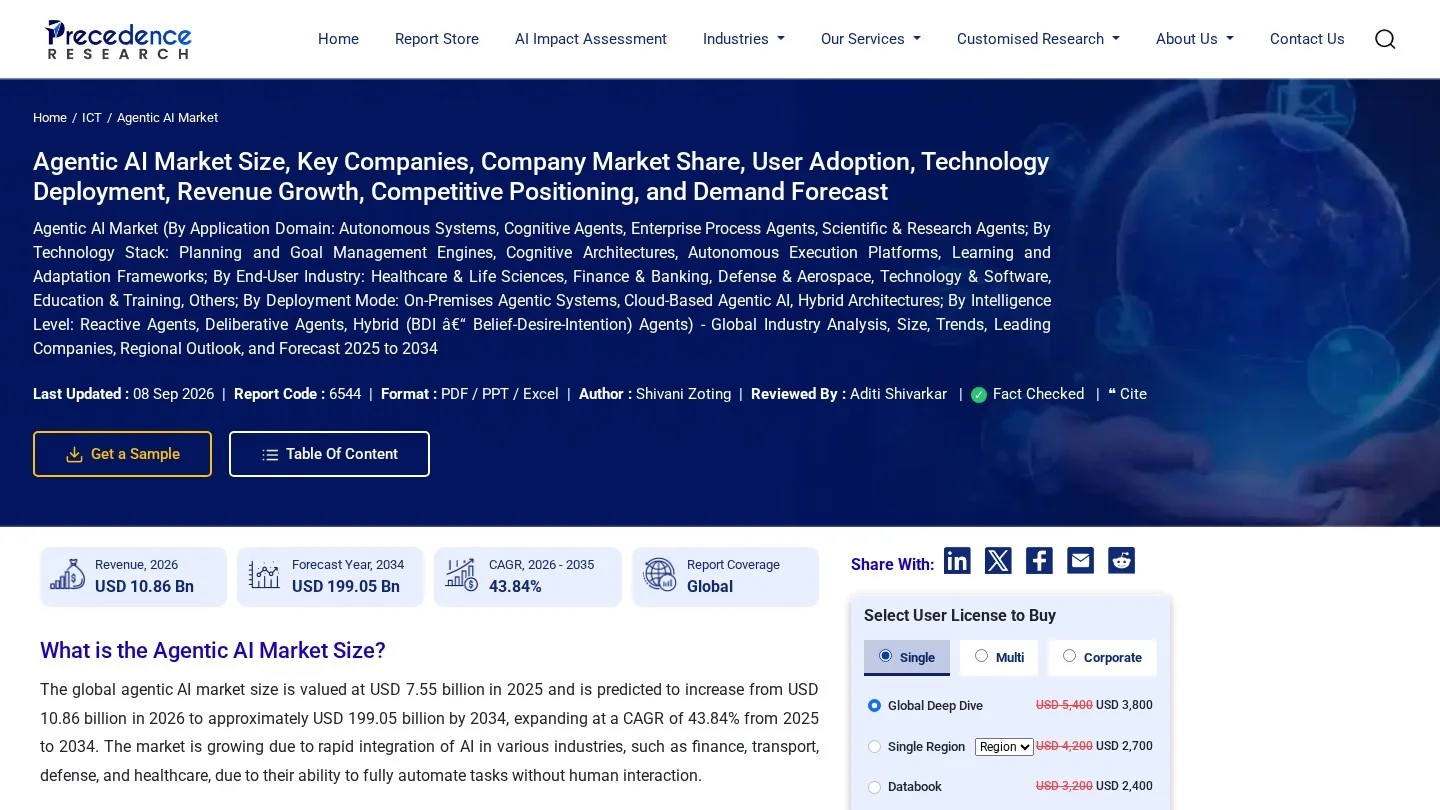
- Precedence Research (page updated September 2026) puts the agentic AI market at $7.55 billion in 2025 and $10.86 billion in 2026.
- MarketsandMarkets (April 2025) gives $7.84 billion for 2025.
- BCC Research (October 2025) gives $8 billion for 2025.
- Fortune Business Insights (updated October 2026) values the AI agents market at $8.03 billion in 2025 and $11.78 billion in 2026.
- Mordor Intelligence (updated October 2026) sizes agentic AI at $9.89 billion in 2026 and $14.06 billion in 2027.
- Precedence Research (September 2026) puts the US agentic AI market at $2.43 billion in 2025.
The 2025 estimates sit within 6.4% of each other, from $7.55 billion to $8.03 billion. The 2024 figures spread a little wider, at 11.8% between $5.1 billion and $5.7 billion.
2030 and 2034 Forecasts From Each Publisher
Forecast horizons differ, which is the main reason the headline numbers look so far apart. Four firms stop at 2030, two run to 2032 and two run to 2034.
- Grand View Research (May 2025) forecasts $50.31 billion by 2030, growing at a 45.8% CAGR from 2025 to 2030.
- MarketsandMarkets (April 2025) forecasts $52.62 billion by 2030 at a 46.3% CAGR.
- MarketsandMarkets (September 2024) had earlier forecast $47.1 billion by 2030 at a 44.8% CAGR.
- BCC Research (October 2025) forecasts $48.3 billion by the end of 2030 at a 43.3% CAGR.
- MarketsandMarkets (July 2025) forecasts a separate enterprise agentic AI market of $40 billion by 2030, growing at 47% a year.
- Grand View Research (May 2025) expects the US AI agents market to grow at a 43.3% CAGR from 2025 to 2030.
- Grand View Research (May 2025) forecasts AI agents in financial services alone at $4.49 billion by 2030, with a 45.4% CAGR.
- SNS Insider (November 2024) forecasts $103.6 billion by 2032 at a 44.9% CAGR.
- Mordor Intelligence (October 2026) forecasts $82.27 billion by 2032 at a 42.38% CAGR from 2027.
- Precedence Research (September 2026) forecasts about $199.05 billion by 2034 at a 43.84% CAGR.
- Precedence Research (September 2026) expects the US market to reach about $65.25 billion by 2034, growing 44.10% a year.
- Fortune Business Insights (October 2026) forecasts $251.38 billion by 2034 at a 46.61% CAGR from 2026.
MarketsandMarkets raised its own 2030 figure by 11.7% in seven months, from $47.1 billion to $52.62 billion. Older versions keep circulating after a revision, so check the month on any forecast you quote.
We Recomputed Every Growth Rate From the Published Numbers
We took each firm’s first and last published values and computed the compound annual growth rate ourselves. Where a firm did not publish a 2030 figure, we grew its own earliest value at its own implied rate to 2030. That gives every firm a number for the same year without borrowing anything from another firm.
| Publisher (date) | Start value | End value | Stated CAGR | Our implied CAGR | 2030 value |
|---|---|---|---|---|---|
| Grand View Research (May 2025) | $5.40B (2024) | $50.31B (2030) | 45.8% | 45.1% | $50.3B |
| MarketsandMarkets (Sep 2024) | $5.1B (2024) | $47.1B (2030) | 44.8% | 44.8% | $47.1B |
| MarketsandMarkets (Apr 2025) | $7.84B (2025) | $52.62B (2030) | 46.3% | 46.3% | $52.6B |
| BCC Research (Oct 2025) | $8.0B (2025) | $48.3B (2030) | 43.3% | 43.3% | $48.3B |
| SNS Insider (Nov 2024) | $3.7B (2023) | $103.6B (2032) | 44.9% | 44.8% | $49.4B* |
| Precedence Research (Sep 2026) | $7.55B (2025) | $199.05B (2034) | 43.84% | 43.8% | $46.5B* |
| Fortune Business Insights (Oct 2026) | $11.78B (2026) | $251.38B (2034) | 46.61% | 46.6% | $54.4B* |
| Mordor Intelligence (Oct 2026) | $14.06B (2027) | $82.27B (2032) | 42.38% | 42.4% | $40.6B* |
* Our interpolation. We grew the firm’s own start value at its own implied CAGR to 2030. Grand View Research’s stated 45.8% covers 2025 to 2030, which is why it differs from our 2024-based 45.1%.
Seven of the eight implied rates match the stated CAGR to within a tenth of a point. The firms are internally consistent. They differ on the starting size and on how long the steep growth lasts.

How Far Apart the Highest and Lowest 2030 Figures Sit
On a common 2030 basis, the lowest figure is $40.6 billion (Mordor Intelligence) and the highest is $54.4 billion (Fortune Business Insights). The high estimate is 1.34 times the low one, a gap of $13.8 billion. The median of the eight is $48.9 billion.
The gap widens fast after 2030. For 2034, Fortune Business Insights sits $52.3 billion above Precedence Research, even though their 2025 estimates differ by less than half a billion dollars. Under three points of annual growth, compounded over eight years, turn a small disagreement into a large one.
Growth the Firms Expect From 2025 to 2027
The near-term years are where a forecast can be checked first, so we computed the one-year growth each firm builds in. Precedence Research goes from $7.55 billion in 2025 to $10.86 billion in 2026, a 43.8% rise. Fortune Business Insights goes from $8.03 billion to $11.78 billion, a 46.7% rise. Mordor Intelligence expects 42.2% growth from 2026 to 2027. BCC Research’s own 2024 and 2025 figures imply 40.4% growth in 2025.
All four sit in a band about six points wide. When the 2026 actuals arrive in next year’s updates, the firm whose 2026 number holds up deserves more weight in your model.
Why a $50 Billion Market and a $1.3 Trillion Spend Figure Can Both Be Right
IDC’s agentic AI spending forecast for 2029 is 25.8 times Grand View Research’s 2030 market figure. The two firms measure different things.
Market Reports Size Revenue From Agent Products
Grand View Research, MarketsandMarkets, BCC Research and the others size the revenue of agent products. Their segments are agent type (ready-to-deploy or build-your-own), agent system (single or multi-agent), technology and application. This is closest to what an agent startup actually sells.
Scope still differs inside this group. Mordor Intelligence splits its market into solutions (61.21%) and services, so about 38.79% of its total is services revenue such as integration and support. MarketsandMarkets (April 2025) counts consumer agents as well and says enterprises take the larger share. Grand View Research sizes financial services agents as a separate $4.49 billion market for 2030, which sits inside its global figure. A report that adds services or consumer apps will run higher than one that counts enterprise software licenses alone.
Gartner and IDC Add Infrastructure and Services
IDC (August 2025) expects spending on agentic AI to reach $1.3 trillion in 2029 and to exceed 26% of worldwide IT spending. IDC puts year-over-year AI spending growth at 31.9% from 2025 to 2029, with service providers taking 80% of infrastructure spend. That total includes the infrastructure and services that agents run on.
Gartner (January 2026) forecasts worldwide AI spending of $2.52 trillion in 2026, up 44% on the year. AI software accounts for $283.1 billion in 2025, $452.5 billion in 2026 and $636.1 billion in 2027 in Gartner’s table. By our math, that is 59.8% growth in 2026 and 40.6% in 2027. AI application development platforms, the category closest to agent builders, grow from $6.6 billion in 2025 to $8.4 billion in 2026.
Gartner (August 2025) also predicts that 40% of enterprise applications will include task-specific AI agents by the end of 2026, up from less than 5% in 2025. In its best case, agentic AI could drive about 30% of enterprise application software revenue by 2035, more than $450 billion, up from 2% in 2025.
Capgemini Measures Value Created for Adopters
Capgemini Research Institute (July 2025) estimates that agentic AI could deliver up to $450 billion in economic value by 2028. That figure measures value created for adopters, such as cost savings and new revenue, so it does not belong next to market size in a model.

Read also: Enterprise AI Agent Adoption Statistics by Size, Stage and Region
North America Holds Roughly Four in Ten Dollars
Every firm we read names North America as the largest region, though the share varies by about eight points.
- Precedence Research (September 2026) gives North America 46% of the agentic AI market.
- Mordor Intelligence (October 2026) gives North America 39.95% of 2026 revenue and expects Asia-Pacific to grow fastest, at a 45.2% CAGR from 2027 to 2032.
- Fortune Business Insights (October 2026) splits 2025 revenue as North America 38%, Europe 27%, Asia-Pacific 25% and rest of world 10%.
- Fortune Business Insights (October 2026) gives China 12% of the global market, Germany 8% and the UK 7%.
- SNS Insider (November 2024) gave North America more than 38.2% of 2023 revenue.
- Grand View Research’s $1,603.0 million US figure for 2024 equals 29.7% of its $5.40 billion global figure, by our math.
- Precedence Research’s US numbers equal 32.2% of its global market in 2025 and 32.8% in 2034, so it expects the US share to hold steady.
Applying Fortune Business Insights’ shares to its own $8.03 billion 2025 total gives about $3.05 billion for North America, $2.17 billion for Europe and $2.01 billion for Asia-Pacific. China alone comes to about $0.96 billion.

How Segment Shares Split by Agent Type and Deployment
Segment splits show where the money goes inside the market. The firms slice it differently, so compare within a firm before comparing across firms.
- Fortune Business Insights (October 2026) gives ready-to-deploy agents 57% of the market and build-your-own agents 43%.
- Grand View Research (May 2025), MarketsandMarkets (April 2025) and BCC Research (October 2025) all name ready-to-deploy agents as the largest type segment.
- Fortune Business Insights (October 2026) puts multi-agent systems at 54% and single-agent systems at 46%. Mordor Intelligence (October 2026) gives multi-agent systems 53.81%.
- Grand View Research (May 2025) still found single-agent systems dominant in 2024, which shows how fast this split has moved or how differently firms define it.
- By application, Fortune Business Insights gives customer service and virtual assistants 29%, robotics and automation 18%, financial services 16% and marketing and sales 15%.
- Machine learning took over 29% of 2024 revenue by technology in Grand View Research’s report. Fortune Business Insights gives it 28%, with natural language processing at 24%.
- Precedence Research (September 2026) gives cloud deployment 62% and technology and software companies 38% of end use.
- Mordor Intelligence (October 2026) gives solutions 61.21%, cloud 59.83%, large enterprises 64.7% and banking, financial services and insurance 19.03% of the market.
- Mordor Intelligence (October 2026) puts autonomous process automation at 23.03%, the largest application segment in its split.
Customer service shows up as the top application in nearly every report. That matches what buyers can see. Products like Intercom Fin and Decagon sell resolved conversations, which gives buyers a clear unit to count. Our customer support agents category is the second largest on the site.
Enterprise Budgets Behind the Forecasts
Market reports are models. Spending surveys show what companies paid for in a given year, which makes them a useful check.
- Menlo Ventures (December 2025) found enterprise generative AI spending reached $37 billion in 2025, up from $11.5 billion in 2024. That is 3.2 times growth in one year.
- Menlo Ventures (December 2025) put application-layer spending at $19 billion, more than half of the total, and infrastructure at $18 billion.
- Coding tools took $7.3 billion of 2025 enterprise spend, the largest single application category in Menlo Ventures’ data.
- Menlo Ventures (December 2025) found only 16% of enterprise AI deployments qualify as true agents.
- Menlo Ventures (December 2025) found 76% of AI solutions are now purchased, leaving 24% built in house.
- Capgemini Research Institute (July 2025) surveyed 1,500 executives at companies with more than $1 billion in revenue across 14 countries. Only 2% had fully scaled agent deployments, and 14% had begun implementation.
- Trust in fully autonomous agents fell from 43% to 27% in a year in the same Capgemini survey.
A Cross-Check Against Menlo Ventures’ Spend Data
We tested the market reports against Menlo Ventures’ $37 billion. The 2025 agent market estimates of $7.55 billion to $8.03 billion equal 20.4% to 21.7% of that enterprise spend. Menlo’s 16% share of deployments that qualify as true agents, applied to $37 billion, gives about $5.9 billion.
Menlo’s 16% counts deployments, so the $5.9 billion works only as a rough check on dollars. It still lands within about $2 billion of the research firms’ figures, from a completely different method. Consumer agents and services revenue, which Menlo’s enterprise data leaves out, could account for the rest.
With only 16% of deployments counted as true agents, most enterprise AI money still goes to copilots and assistants. If even a modest share of that $37 billion shifts to agents, the market reports’ 2030 numbers look reachable. For ways buyers keep that spend in check, see our guide to controlling AI agent costs.
Venture Money Flowing Into AI and Agent Startups
Funding numbers move faster than market sizes, and they include foundation model labs, so read the agent-specific lines carefully.
- Crunchbase (December 2025) counted $202.3 billion invested in AI in 2025, more than 75% above the $114 billion invested in 2024.
- AI took close to 50% of all global venture funding in 2025, up from 34% in 2024, in the same Crunchbase data.
- Foundation model companies raised $80 billion of that, or 40% of global AI funding, Crunchbase (December 2025) found.
- PitchBook-NVCA data for full-year 2025 shows AI took more than 52.7% of $512 billion in global venture deal value, about $270 billion by our math.
- In the US, AI companies took 65.4% of venture deal value in 2025, or $222.1 billion, in the PitchBook-NVCA Venture Monitor.
- Prosus and Dealroom (August 2025) counted $2.8 billion of venture funding into agentic AI startups in the first half of 2025.
- Prosus and Dealroom (August 2025) projected agentic AI at 10% of AI funding rounds for 2025, amounting to $6.7 billion.
- CB Insights’ AI 100 list (April 2025) found more than 20% of the 100 companies build AI agents or the tools that support them.
Agent startups raise a small slice of total AI funding. Most of the capital goes to model labs and infrastructure, which the agent layer then pays for through API bills. Our agentic AI statistics page tracks adoption and ROI numbers alongside these.
What 594 Listings in Our Directory Say About Demand
We counted every live agent listing on AI Agents Choice by category. Our directory lists 594 agents, and one agent can sit in several categories, so the shares add up to more than 100%.
| Category | Agents listed | Share of 594 listings |
|---|---|---|
| Enterprise | 167 | 28.1% |
| Customer support | 86 | 14.5% |
| Voice | 82 | 13.8% |
| Small business | 81 | 13.6% |
| Marketing | 71 | 12.0% |
| Sales | 61 | 10.3% |
| Healthcare | 29 | 4.9% |
| Multi-agent | 24 | 4.0% |
| Banking | 24 | 4.0% |
| Coding | 22 | 3.7% |
Our counts line up with the research firms on customer service. It is the top application segment in Fortune Business Insights’ split and the largest function in our directory after enterprise. Voice agents come close behind, with 82 listings. Multi-agent products are rarer on our side, at 24 listings. The 54% multi-agent share in the reports likely reflects revenue from large platforms more than the number of products on sale.
Founders scanning for gaps can compare these counts with demand. Our posts on high-demand AI tool niches and profitable AI agent business ideas go deeper on where buyers are paying.
Picking a Market Size Number for a Pitch Deck
Investors check two things on a market size slide. The number has to fit the product, and the source has to carry a date.
Take the Base Year and Growth Rate From One Report
Pull the base, the forecast and the CAGR from the same report. Mixing Fortune Business Insights’ 2025 base with Mordor Intelligence’s growth rate produces a figure neither firm published. Cite the publisher and month on the slide, for example “$48.3 billion by 2030, BCC Research, October 2025”.
Quote a Figure Near the Middle of the Range
BCC Research’s $48.3 billion and Grand View Research’s $50.31 billion sit next to our $48.9 billion median for 2030. Quoting the highest 2034 number invites a question you do not want.
Keep Spending Forecasts Off the TAM Line
IDC’s $1.3 trillion and Gartner’s $2.52 trillion include servers and services. Unless you sell infrastructure, they overstate your market by more than 20 times. Use them as context on budget momentum and say so.
Build a Bottom-Up Number Under the Top-Down One
Multiply the number of target customers you can reach by what each would pay a year. Use your own pricing and a customer count from a public source such as a census or industry body. Our guides on AI pricing models and AI agent subscription pricing strategies cover the price side. A bottom-up figure that lands well below the top-down one is normal and more believable.
Short Answers on AI Agent Market Size
How Big Is the AI Agent Market in 2026?
Three firms publish a 2026 figure. Mordor Intelligence (October 2026) gives $9.89 billion, Precedence Research (September 2026) gives $10.86 billion and Fortune Business Insights (October 2026) gives $11.78 billion.
What CAGR Should I Use for AI Agents?
Published rates run from 42.38% (Mordor Intelligence) to 46.61% (Fortune Business Insights). Use the rate from the same report as your base and forecast. Do not average rates across firms.
Is the Agentic AI Market the Same as the AI Agents Market?
The two labels describe overlapping software. Precedence Research and Mordor Intelligence use “agentic AI”, while Grand View Research, MarketsandMarkets, BCC Research and Fortune Business Insights use “AI agents”. Their 2030 figures land in the same range on our common basis. For a plain explanation of the difference between agents and chatbots, see AI agents vs AI chatbots.
Which Region Is Growing Fastest?
Asia-Pacific. Mordor Intelligence (October 2026) expects a 45.2% CAGR there from 2027 to 2032, and SNS Insider and Precedence Research also name it the fastest-growing region. North America remains the largest by revenue.
Does Agent-to-Agent Traffic Count in These Numbers?
The reports count revenue from agent products, so multi-agent systems are included through what customers pay for them. Protocols that let agents call each other are not sized on their own. Our explainer on agent-to-agent communication covers how those systems work.
Related AI Agents



Read also: 100 AI Agent Statistics for Retail Companies
Explore Agent Categories
Related Articles
 GuidesEnterprise AI Agent Adoption Statistics by Size, Stage and Region
 Guides100 AI Agent Statistics for Retail Companies
 GuidesNewest AI Agent Statistics for Small Businesses
 GuidesAI Customer Support Agent Cost Reduction Statistics
 GuidesAgentic AI Statistics: Adoption, ROI, Jobs and Pricing Data
 GuidesSynthesia AI Video Usage Among Corporate Training Teams
