Generative AI in marketing statistics track how marketing teams use AI tools that write copy, make images and run campaigns. Three in four marketers have adopted AI, in the Salesforce State of Marketing survey of 4,450 marketing leaders published in February 2026. HubSpot puts the rate even higher, with 86.4% of teams using AI in at least a few areas. Money is moving too. CMOs now put 15.3% of their marketing budgets into AI, in the Gartner 2026 CMO Spend Survey.
Use and payoff are not the same thing, though. Only 30% of CMOs in that Gartner survey have mature AI readiness. On the buyer side, half of US consumers would prefer brands that keep generative AI out of their ads and content. So 2026 is a year of fast adoption, mixed results and a real trust gap with customers.
The sections cover use rates, tasks, budgets and time saved. They also cover ad creative, AI agents, AI search, buyer reactions and skills.
Generative AI Adoption Rates Among Marketers
Between 75% and 86% of marketers use generative AI in 2026, depending on the survey. Salesforce found 75% adoption among marketing leaders surveyed from October to November last year. In the same data, 39% of teams have reached full AI integration, while 61% call it a work in progress.
HubSpot found a higher rate in its 2026 State of Marketing report. There, 86.4% of marketing teams use AI in at least a few areas. Just 1.7% neither use AI nor plan to.
| Survey | Date | Sample | AI use |
|---|---|---|---|
| Salesforce | Fall last year | 4,450 leaders | 75% have adopted AI |
| HubSpot | 2026 report | 1,500+ marketers | 86.4% use AI |
| McKinsey | Mid-2026 | 1,719 people | Nearly 9 in 10 use AI |
| Gartner | Early 2026 | 401 leaders | 15.3% of budget on AI |
Big US firms report the same climb. In The CMO Survey from January 2026, AI use in marketing more than doubled over two years. Those 308 US marketing leaders also expect AI to drive more than half of their marketing work within three years.
Share of Marketing Budgets Spent on AI
CMOs spend an average of 15.3% of their marketing budgets on AI, in the Gartner 2026 CMO Spend Survey. Firms that Gartner rates as AI-ready spend more, at 21.3%. Marketing budgets came to 7.8% of company revenue in 2026, or 8.9% at AI-ready firms.
Most of the 401 leaders in that survey work at firms with more than $1 billion in revenue. So take a $1 billion company as a worked example:
- Average firm: $1 billion x 7.8% = $78 million for marketing. Then $78 million x 15.3% = about $11.9 million for AI.
- AI-ready firm: $1 billion x 8.9% = $89 million for marketing. Then $89 million x 21.3% = about $19 million for AI.
That gap is about $7 million a year at the same revenue. Even so, money is tight. In the same survey, 56% of CMOs lack the budget to deliver their 2026 plan, and 54% report too few resources.
Chat tools are the top place for new spend. In the HubSpot survey, 37.7% of marketers plan to raise spending on AI chatbots such as ChatGPT and Claude. No other area had a higher share. Meanwhile, total marketing budgets grew just 1.7% in The CMO Survey from January 2026, the weakest rate in several years.
Content Creation Tops Generative AI Use Cases in Marketing
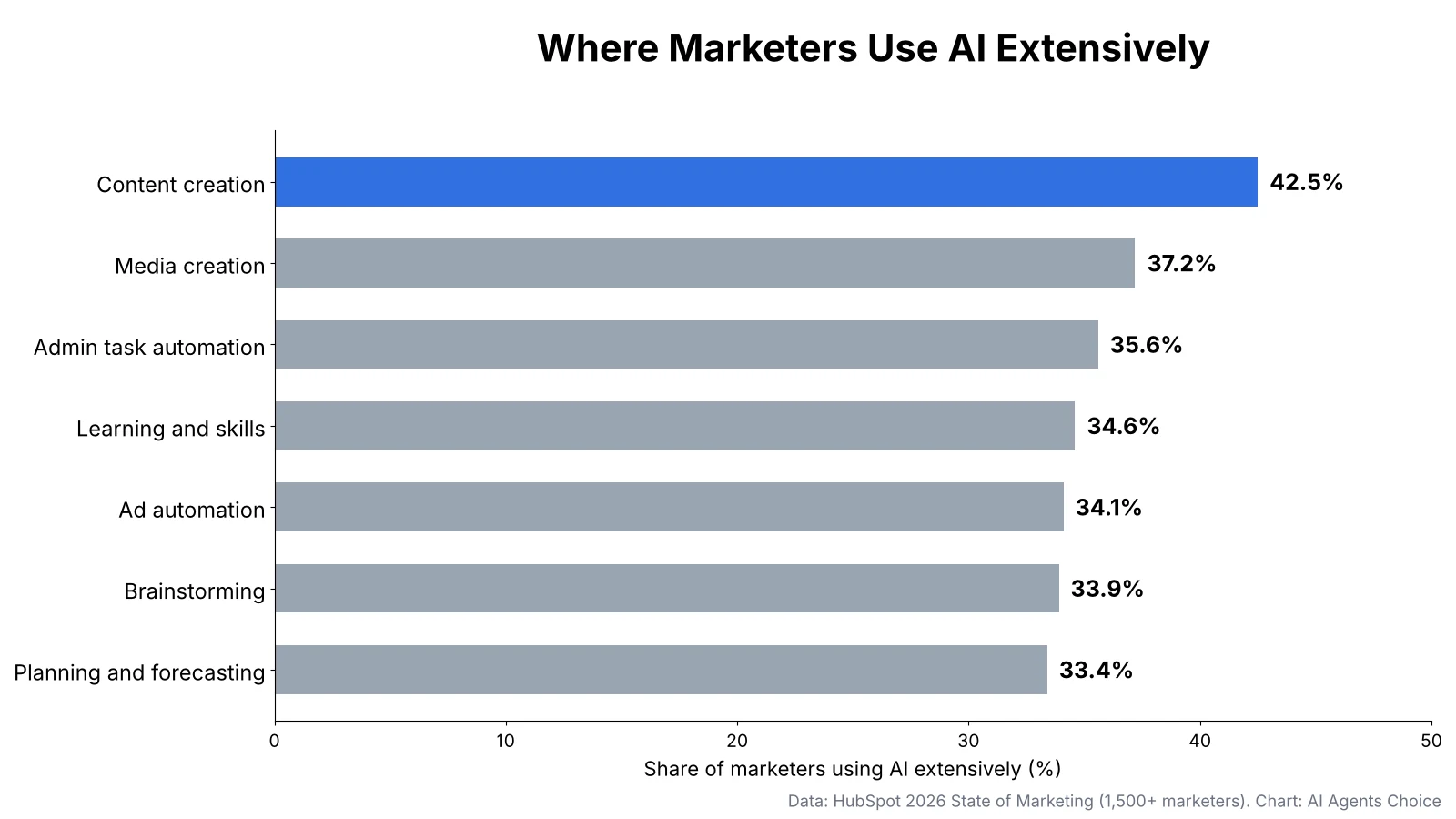
Marketers use generative AI most for content creation, where 42.5% use it extensively in the HubSpot 2026 survey. Another 38% use it for content now and then. Media creation comes next at 37.2%, then admin tasks at 35.6%.
Personalized content is the biggest single job for AI. In the Salesforce data, personalizing content is the top AI use case. Also, 78% of marketers need more personalized content than they can produce. In the HubSpot study, using AI to make personalized content was the top trend at 48.6%.
Teams outside marketing are making content too. In the Adobe 2026 AI and Digital Trends report, 71% of CMOs saw a better ability for non-creative teams to make content. Tools such as Jasper and other AI copywriting agents are built for this kind of work.
Hours Marketing Teams Save With Generative AI
Generative AI saves about two in three marketing teams 10 or more hours a week, in the HubSpot 2026 data. About a third save 10 to 14 hours, and another third save more than 15. Just under a third save 1 to 9 hours.
The productivity lift is real but mostly modest. In that HubSpot survey, 26.5% say AI raised their productivity a great deal. Another 66.2% say it raised output a little or a fair amount.
Faster output brings higher targets. For example, 83.5% of HubSpot respondents are now expected to produce more content because of AI, and 35.7% say much more. In the Adobe 2026 report, 75% of CMOs saw gains in the volume and speed of content. Also, 64% saw revenue growth from marketing work, and 63% saw more testing and new ideas.
Automation will climb from here. In a Gartner survey of 402 CMOs run from August to October last year, leaders expect AI to automate 16% of marketing work in 2026. They expect that share to reach 36% by 2028.
Read also: 8 Steps to Create a WhatsApp AI Agent for Marketing
Generative AI in Advertising Creative
83% of US ad executives say their company uses AI in the creative process, in an IAB study published in January 2026. That share was 60% in 2024. Social media is the top channel for AI ads.

Cost is now the main reason to use it. Cost savings ranked as the top benefit at 64% in 2026, up from fifth place in 2024. Creative ideas came next at 61%. Paid media teams that want this in their daily work can compare tools in our guide to AI agents for paid advertising.
Many buyers still feel unsure about the tech. In the IAB 2026 Outlook Study of more than 200 brand and agency buyers, 38% named understanding generative AI as a major challenge. That figure rose 14 points from 2024. Also, five of the six top areas of new focus for advertisers tie straight to AI.
AI Agents in Marketing Teams
AI agents are still early in marketing, with 13% of marketing teams using self-directed agents in the Salesforce 2026 data. Marketers expect agents to save them up to 8 hours a week. Agents also show up more in teams with clean data. Marketers with unified data are 60% more likely to use AI agents to scale their work.
Content work is one of the main places agents run today. In the Adobe 2026 report, a quarter or fewer of CMOs have agentic AI built in across the firm or many teams.

Plans for the next 18 months go much further. In that Adobe study, 63% of CMOs expect agents to support sales, and 59% expect them to automate routine service tasks. Also, 80% expect agentic AI to handle at least half of support chats within 18 months. Yet 78% name data integration and quality as a top barrier, and 71% point to skills gaps.
Ad buying is moving to agents as well. In the IAB 2026 Outlook Study, two-thirds of buyers are focused on agentic AI for ad buying and campaign work. Then in the IAB video ad report from May 2026, 21% of video buyers were live with agentic AI for 2026 campaigns. Another 20% were testing it, and 25% planned to use it this year.
Leaders outside marketing expect a lot. A Gartner survey of 282 senior executives ran from September to October 2026. In it, 91% expect AI to do at least a quarter of CMO duties within two years. One in five expect AI to do 50% to 74% of them. Tools like HubSpot Breeze agents are an early sign of that shift, and our marketing AI agents page has more. For agent data across all business teams, see our agentic AI statistics.
How AI Search Is Changing Marketing Content
88% of marketers have started to optimize content for AI answers such as ChatGPT and Google AI Overviews, in the Salesforce 2026 survey. Also, 85% say AI is reshaping their SEO plan. High performers are 2.2 times more likely than weak performers to have done this work.
CMOs are acting on it. A Gartner survey of 408 marketing leaders ran from July to August 2026. In it, 61% had changed their content so AI systems can read and show their brand. Also, 42% had taken steps to track and fix false facts about their brand in AI output. Even so, 94% plan to spend more on human touchpoints next year.
The shift has a name in some firms. In The CMO Survey from January 2026, 4 in 10 companies use generative engine optimization, or GEO. In the IAB 2026 Outlook Study, 73% of marketers put content built for AI answers at the top of their list.
Buyers are moving too, though slowly. In the Adobe 2026 report, 25% of customers use AI platforms as their main tool to research products. In a Gartner survey of 328 US consumers from February 2026, 17% rely on AI summaries to research what to buy. Another 16% use AI chatbots to find new products. Online stores can see how this plays out in our post on AI agents for ecommerce SEO.
How Consumers React to AI-Made Marketing
Half of US consumers would rather buy from brands that avoid generative AI in ads and content. Gartner asked 1,539 US consumers about this in October last year. In the same survey, 68% often wonder if the content they see is real.
Many people also think AI has made content worse. In the Gartner survey from March 2026, 49% of US consumers held that view. Among Gen Z and millennial consumers, the share rose to 57%.
Advertisers read the mood very differently. In the IAB study from January 2026, 82% of ad executives think consumers feel good about AI ads. Only 45% of consumers do. That gap grew from 32 points in 2024 to 37 points in 2026.
| Word used for AI ad brands | Ad executives | Young consumers |
|---|---|---|
| Forward-thinking | 46% | 22% |
| Unique | 44% | 26% |
| Manipulative | 10% | 20% |
| Unethical | 7% | 16% |
Age matters a lot here. In that IAB data, 39% of Gen Z consumers feel negative about AI ads, against 20% of millennials. Negative feeling is 12 points higher than in 2024.
Skills and Data Gaps Holding Marketers Back
70% of CMOs say their marketing processes are not mature enough to scale AI, in the Gartner 2026 CMO Spend Survey. Only 30% report mature or fully built AI readiness. Yet 70% call becoming an AI leader a critical goal for 2026.
People are part of the problem. In the Gartner survey of 402 CMOs from late last year, 80% named staff fear and anxiety as a barrier to AI tests. In the Adobe 2026 report, only 17% say executives and hands-on staff are very aligned on AI plans.
Skills are improving, however. In the HubSpot 2026 survey, 68.2% of marketers know how to use AI in their work, up from 47% last year. Also, 67.5% know how to measure its impact, up from 48%.
Data remains the hardest part. In the Salesforce 2026 survey, 98% of marketers hit barriers to personal content, and data issues are the most common cause. Only 26% are fully happy with how their data is unified. High performers are 2.4 times more likely to have unified their data sources.
Quick Answers on Generative AI Marketing Data
Do advertisers tell people when an ad uses AI?
Most advertisers disclose AI use at least some of the time. In the IAB study from January 2026, 89% of advertisers who use generative AI for ads disclose it at least sometimes. Fewer than half always do. Meanwhile, 73% of Gen Z and millennial consumers say knowing an ad used AI would raise or not change their chance of buying.
How many young consumers think they have seen an AI ad?
71% of Gen Z and millennial consumers believe they have seen an AI-made ad, in IAB data from January 2026. That is up from 54% in 2024.
Is AI changing how people type search queries?
Yes, for about one in five US consumers. In the Gartner survey from February 2026, 20% say their searches are more specific because of AI. Another 19% now phrase searches as questions more often.
Which business function gets the most revenue from AI?
Marketing and sales is the function where firms most often report revenue gains from AI. It ranks ahead of product development and software work in the McKinsey State of AI survey from August 2026.
Is AI cutting marketing jobs?
Fewer marketing jobs are being cut than leaders expected. In the McKinsey 2026 survey, firms cut marketing and sales staff about half as often as they had predicted a year earlier.
Related AI Agents




Read also: Agentic AI Statistics: Adoption, ROI, Jobs and Pricing Data