


Harvey and Legora are the two legal AI platforms that large law firms most often put head to head, and both now run AI agents that review documents, research and draft at scale. Harvey is the larger and more established choice, with deeper legal research content and the widest set of security certifications. Legora is the faster-growing challenger, with an agent that plans and checks its own work, add-ins for Word and Outlook, and usage-based billing for its top agent tier.
For most firms, the decision rests less on features than on three practical questions: whose legal content you need, how you want to pay, and which product your lawyers will actually use every day. Neither company publishes prices, so this comparison is based on each vendor’s announcements, security pages and product pages, plus independent research and funding coverage. We did not test either platform hands-on.
Harvey or Legora for Your Firm
- Harvey is used by 80% of the Am Law 100 and five of the Fortune 10, was valued at $15.5 billion in September 2026, and reportedly passed $400 million in annual recurring revenue.
- Legora raised $550 million at an $8.8 billion valuation on October 21, 2026, and reported more than $200 million in annual recurring revenue and over 2,400 law firm and in-house customers.
- Harvey’s pricing is reported at about $1,200 per lawyer a month on 12-month contracts with a minimum of roughly 20 seats.
- Legora sells by quote, and since June 2026 its Agent Pro tier has been billed on consumption credits rather than seats.
- Harvey adds LexisNexis case law with Shepard’s citation checks and a long list of certifications, including FedRAMP Class D as of October 2026.
- Legora’s agent proposes a plan, pauses for review at each step and can watch email and documents to act when something needs attention.
Harvey and Legora by Pricing, Workflows and Security
Both products sell to the same buyers: large and midsize law firms and corporate legal departments. The table compares them on the points that usually come up during procurement.
| Harvey | Legora | |
|---|---|---|
| Founded | 2022, San Francisco | 2023, Stockholm |
| Latest valuation | $15.5 billion (September 2026) | $8.8 billion (October 2026) |
| Reported revenue | More than $400 million in annual recurring revenue | More than $200 million in annual recurring revenue |
| Customers | 80% of the Am Law 100; five of the Fortune 10 | Over 2,400 firms and in-house teams; more than half of the Am Law 50 |
| Pricing model | Quote only; reported per-seat annual contracts | Quote only; Agent Pro billed on consumption credits |
| Reported price | About $1,200 per lawyer a month, roughly 20-seat minimum | No public figure |
| Core tools | Assistant, Vault, Workflows, Agent Builder | Agent, Tabular Review, Workflows, Skills, Monitors |
| Legal content | LexisNexis case law and statutes with Shepard’s, EUR-Lex, EDGAR | Legal Research and regulatory Monitors |
| Office tools | Microsoft 365 Copilot collaboration | Word and Outlook add-ins; editable Word, Excel and PowerPoint output |
| Certifications | SOC 2 Type II, ISO 27001, 27701, 42001, FedRAMP Class D and more | SOC 2 Type II, ISO 27001, ISO 42001, GDPR |
| Free trial | Demo and negotiated pilot only | Demo and negotiated pilot only |
How Harvey Works and Where It Leads
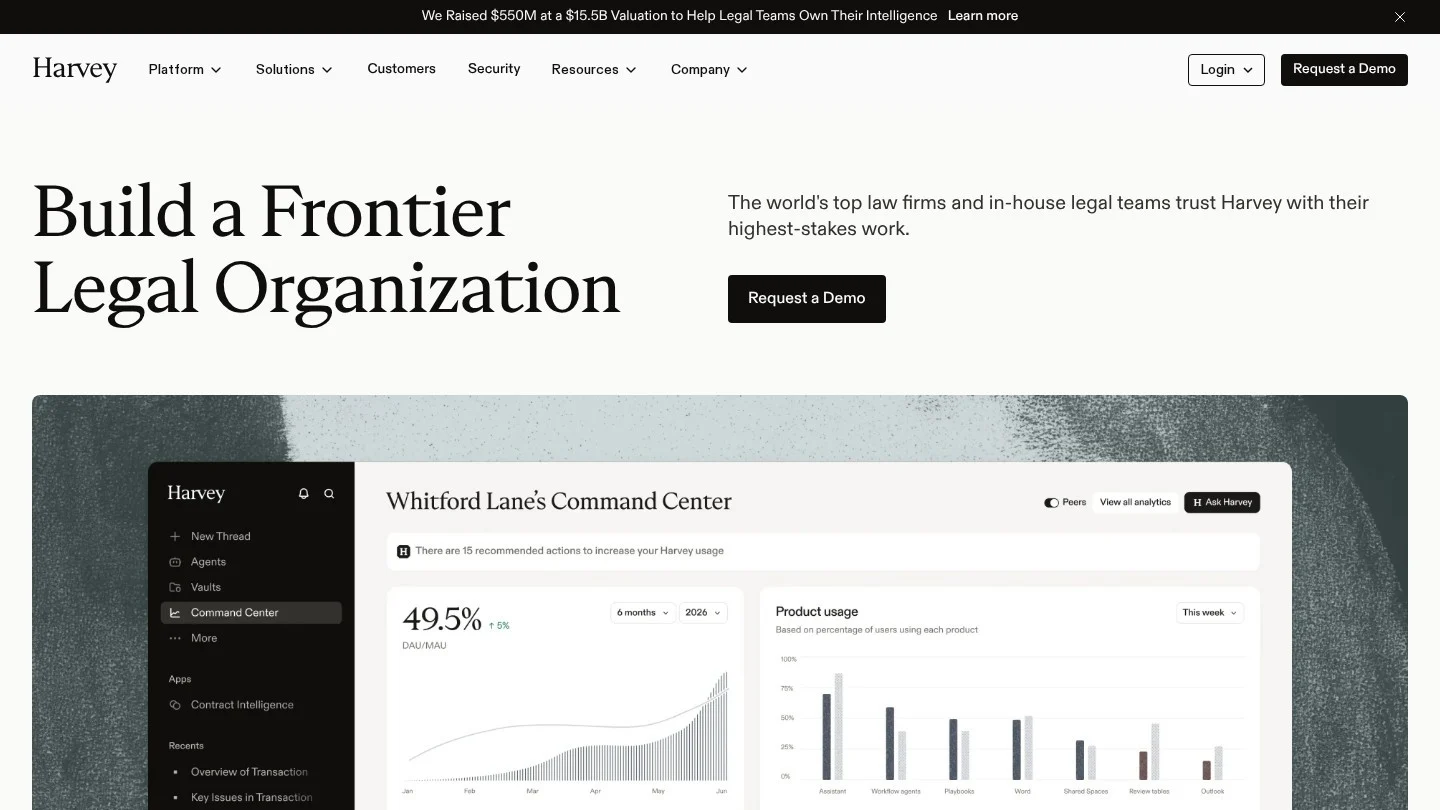
Harvey runs in the browser and is organized around a few connected tools. Assistant is the chat interface for drafting, editing, summarizing and answering questions, with answers linked to their sources. Vault holds large document sets, such as a data room, for bulk review through review tables and batch questions. Workflows are prebuilt, multi-step agents for defined jobs such as redlining or translation. Agent Builder, launched in March 2026, lets practice groups create their own agents without code, and more than 25,000 custom agents were running on the platform by that month.
Legal Content and Research
Harvey’s biggest edge over Legora is content. A 2025 alliance with LexisNexis brought LexisNexis case law and statutes into Harvey, with citations checked through Shepard’s. Harvey also draws on EUR-Lex for European law and EDGAR for US company filings. In late October 2026 it announced expanded Italian coverage across legislation, case law and commentary, a sign that it is building local content country by country. For a litigation team that lives on case law, this matters more than any interface detail.
Security and Government Work
Harvey holds one of the longest certification lists in legal AI. It lists SOC 2 Type II, ISO 27001, ISO 27701 and ISO 42001, along with IRAP, TX-RAMP Level 2, GDPR and CCPA. On October 28, 2026, it announced FedRAMP Class D through Knox Systems’ certified cloud, which opens the door to US federal agencies and contractors. Model providers are barred from training on customer data and must use zero data retention. Customers can choose processing in the EU and Switzerland, the US or Australia, and Harvey syncs a firm’s existing ethical walls so restricted users cannot see walled matters.
Momentum
Harvey’s growth has been steady and well funded. It raised $550 million at a $15.5 billion valuation in September 2026, and The Next Web reported the same month that its annual recurring revenue had passed $400 million and that customers had grown to more than 3,000 organizations. October alone brought announcements that Hogan Lovells Cadwalader and CVS Health had adopted Harvey, a collaboration with Latham & Watkins on fund formation work, and plans for a Tokyo office. The company also made four acquisitions in 2026, so its product and packaging will keep changing during any contract.
How Legora Works and Where It Leads

Legora is a collaborative workspace for lawyers built around one agent. The company describes the agent as the engine of its agentic operating system, called aOS, and it follows a clear loop. It analyzes the task, picks tools and proposes a plan. Then it carries out the work across documents, data sources and tools, checks whether it met the goal, and loops back to adjust before delivering the result for a lawyer to approve.
The Agent Loop in Practice
- Set the goal. A lawyer describes the job, such as reviewing a data room for change-of-control clauses, and attaches the documents.
- Answer questions. The agent asks about scope, jurisdiction or output format before it starts.
- Approve the plan. Legora’s chief revenue officer has described the plan as the prompt, so editing the plan is how lawyers steer the work.
- Let it run. Long tasks take 20 to 120 minutes, according to the company, with a review point at each step.
- Review the output. Results arrive as structured reports, tables or editable Word, Excel and PowerPoint files.
Two features set the agent apart. First, it can be proactive: Legora says it monitors email, documents and projects and acts when something needs attention. Second, Skills let a firm encode its standards and preferences as reusable instructions, so output follows house style. Around the agent sit Tabular Review for bulk extraction across large document sets, Workflows, Legal Research and Monitors for tracking legal and regulatory change.
Where Legora Fits Into Office Work
Legora puts more weight on meeting lawyers inside the tools they already use. It offers add-ins for Microsoft Word and Outlook and a mobile app. In August 2026 it joined the launch of Google Cloud’s Gemini Enterprise for Legal, where approved shared customers can ask Legora legal questions from inside Gemini and follow links back to the full Legora thread. Legora has also announced a partnership with PointOne to record time spent in Legora and assign it to the lawyer at their billable rate.
Security and Momentum
Legora lists SOC 2 Type II, ISO 27001 and ISO 42001, and it operates under GDPR. It encrypts data with AES-256 at rest, offers bring-your-own-key encryption, isolates data by matter and states that it will not use customer data to train or fine-tune any AI model. TechCrunch reported in March 2026 that the platform is built mostly on Anthropic’s Claude models.
Its growth has been unusually fast. Legora says it went from $1 million to $100 million in annual recurring revenue in under 18 months and then added the next $100 million in under six months. Its October 2026 Series E, led by Atreides Management, brought total funding to $866 million. The company now has more than 1,000 employees across 18 offices, says in-house teams made up 40% of new customers in the third quarter, and counts the US as its largest market by revenue.
Read also: Lindy vs Relevance AI: Which AI Agent Platform Fits Your Team?
Pricing and Contracts Compared
Neither vendor publishes a price list, so every figure here is either reported by a third party or shaped by your own negotiation. The bigger difference is the pricing model, which affects how your bill behaves month to month.
| Harvey | Legora | |
|---|---|---|
| How you buy | Through Harvey’s sales team | Through a demo and enterprise contract |
| Billing unit | Per lawyer seat (reported) | Platform by contract; Agent Pro by consumption credits |
| Reported list price | $1,200 per lawyer a month, per research firm Sacra | Not published |
| Contract term | 12 months (reported) | Set by contract |
| Minimums | About 20 seats (reported) | Set by contract |
| Spend controls | Seat count | User-level caps, budgets by matter, real-time usage dashboards |
What Harvey Costs in Practice
At Sacra’s reported $1,200 per lawyer a month and the reported 20-seat minimum, a 20-lawyer litigation group pays $24,000 a month, or $288,000 a year. Each seat costs $14,400 a year. If your firm values a lawyer hour at $500, a seat pays for itself once it saves each lawyer about 2.4 hours a month. At $800 an hour, the break-even falls to 1.5 hours. A 50-lawyer corporate practice at the same rate would pay $720,000 a year before any volume discount, and Sacra reports that the median customer doubles its seat count within 12 months.
How Legora’s Consumption Model Behaves
Legora moved Agent Pro from per-seat licenses to consumption credits in June 2026. Its chief revenue officer has explained the logic: seats sit idle when lawyers are on holiday or in trial, while credits charge for work actually done. Credits combine document processing and model usage, and firms can cap spending per user and track it by matter. A heavy deal month will cost more than a quiet one, which suits firms that can pass costs through to clients and frustrates firms that need a fixed annual budget.
Ask both vendors the same questions in a pilot: the full rate card, how usage is measured, whether unused credits or seats can be reassigned, and what happens when a cap is reached halfway through a task.
How to Run a Fair Pilot
Because both vendors sell through demos and negotiated pilots, the pilot is where the real comparison happens. A fair test gives each platform the same work, the same lawyers and the same scoring rules, so the result reflects the product rather than the sales process.
- Pick two or three real workflows. Good candidates are a diligence review across a data room, a first draft of a standard agreement and a research memo on a live question.
- Use the same documents on both. Load identical, cleared files into Harvey’s Vault and Legora’s workspace, and give both the same instructions.
- Measure time and corrections. Record how long each task takes, how many citations or facts a lawyer had to fix, and how much editing the draft needed.
- Track cost the way you would pay. Count seats for Harvey and consumption credits for Legora’s Agent Pro, then convert both into a cost per finished task.
- Ask the lawyers. The platform people open without being reminded is usually the one that pays back its cost.
Which One Should You Pick
The right platform depends on your practice mix, your research stack and how you want to budget. These scenarios cover the most common buyers.
- You are an Am Law 100 or large international firm. Shortlist both and run parallel pilots. Harvey has the deepest adoption among your peers, while Legora is already used by more than half of the Am Law 50.
- Your litigators live on case law and citations. Lean toward Harvey, since LexisNexis content with Shepard’s checks is built in. If your firm researches in Westlaw, also look at CoCounsel Legal, and if it already pays for Lexis+, compare Lexis+ AI Protégé.
- You serve government clients or work as a federal contractor. Lean toward Harvey, which announced FedRAMP Class D in October 2026 alongside IRAP and TX-RAMP.
- Your lawyers spend their day in Word and Outlook. Lean toward Legora, whose add-ins and editable Office output keep work inside the tools lawyers already use.
- AI adoption across your practice groups is uneven. Lean toward Legora, since consumption billing for Agent Pro avoids paying for seats that some lawyers rarely open.
- You need a fixed annual budget. Lean toward Harvey’s per-seat model, which is expensive but predictable once negotiated.
- You run a solo or small practice. Neither is built for you. Look at Clio Work for small firms or Spellbook for contract drafting in Word.
- You run a plaintiff personal injury firm. Specialist tools such as EvenUp, Supio and Eve are built around medical records, demand letters and case intake.
For a broader view of the market, browse our pages on legal AI agents, AI agents for law firms and enterprise AI agents. Our list of AI agent examples also shows how agents are being used in other professional services.
Limits Both Share
Both platforms still make mistakes, so every citation, fact and draft needs a lawyer’s check before it reaches a client or a court. Long agent runs make this harder, not easier, because they produce more output to review. Firms should also decide how they will bill for AI-assisted work before rollout, since faster work can cut billable hours.
Both companies are also changing fast. Harvey made four acquisitions in 2026 and built its own Tenet model on Kimi K3, an open-weight model from China’s Moonshot AI, which firms with rules on model origin should ask about. Legora rebranded from Leya in 2025, changed its pricing model in 2026 and folded in three acquisitions covering litigation, real estate and regulatory monitoring. Revenue and customer figures for both come largely from the companies themselves and from funding coverage.
Legal AI Questions Lawyers Ask
Is Legora Better Than Harvey?
Neither is better for every firm. Harvey leads on legal research content, certifications and adoption among the largest firms, while Legora leads on Office add-ins, a proactive agent and consumption-based pricing for its Agent Pro tier. The most reliable test is a side-by-side pilot on your own matters.
How Much Does Harvey Cost?
Harvey does not publish prices. Research firm Sacra reports a base price of $1,200 per lawyer a month on 12-month contracts with a minimum of about 20 seats, which works out to $288,000 a year for 20 lawyers. Large firms negotiate their own terms.
How Much Does Legora Cost?
Legora does not publish prices either. Firms get a quote after a demo, and since June 2026 the Agent Pro tier has been billed on consumption credits that combine document processing and model usage, with caps per user and tracking by matter.
Which AI Models Do Harvey and Legora Use?
Harvey routes tasks across models from Anthropic, Google and OpenAI and has built its own Tenet model on Kimi K3. TechCrunch reported that Legora is built mostly on Anthropic’s Claude models, and Legora routes simpler work to less costly models.
Do Harvey or Legora Train AI on Client Data?
Both say no. Harvey contractually bars its model providers from training on customer data and requires zero data retention. Legora states that it will not use customer data to train or fine-tune any AI model.
Related AI Agents




Read also: Perplexity Comet vs Opera Neon: Which AI Browser Should You Use?
Explore Agent Categories
Related Articles
 ComparisonsLindy vs Relevance AI: Which AI Agent Platform Fits Your Team?
 GuidesBest Outreach AI Alternatives: Platforms, AI SDRs and Stacks
 GuidesOpen-Source AI Agents vs Commercial Platforms: Licenses, Costs and Security
 GuidesDuplicates, Typos and Broken Dates: Which AI Agent Should Clean Your Data?
 GuidesThe Research Before the Draft: Which AI Agent Should Find Your Next Topic?
 ComparisonsPerplexity Comet vs Opera Neon: Which AI Browser Should You Use?
