


About one in four companies now runs an AI agent at scale somewhere in the business. McKinsey’s State of AI survey (November 2025) put that share at 23%, with another 39% still experimenting. The agents themselves still miss a lot of work. In Carnegie Mellon’s TheAgentCompany benchmark (paper version of September 2025), the best setup finished 30.3% of 175 office tasks without help.
We collected more than 60 agentic AI statistics from named surveys, benchmarks and company reports, each with its publisher and date. We then added numbers of our own from the 594 agents listed on AI Agents Choice, such as how many hide their price behind a sales call. Market value forecasts sit on our page of AI agent market size statistics, where eight research firms put the 2030 market between $40.6 billion and $54.4 billion.
Share of Companies Already Running AI Agents
Adoption figures depend on who answers the survey. Panels of executives at billion-dollar firms report higher use than broad global samples, and surveys of engineers who build agents report the highest use of all.
Executive and Enterprise Surveys
- McKinsey’s State of AI (November 2025, 1,993 respondents in 105 countries) found 23% of organizations scaling an agentic AI system somewhere in the enterprise and 39% experimenting with agents.
- No more than 10% of McKinsey respondents in any single business function said agents were scaled in that function.
- 88% of McKinsey respondents said their organization regularly uses AI in at least one function, up from 78% a year earlier.
- KPMG’s Q3 AI Pulse Survey (September 2026, 314 US leaders at companies with $1 billion or more in revenue) found 62% building, deploying or developing AI agents, up from 53% the quarter before.
- 25% of KPMG’s Q3 respondents were developing or implementing multi-agent systems, up from 6% in each of the two prior quarters.
- PwC’s AI Agent Survey (May 2025, 308 US executives) found 79% saying AI agents were already adopted in their companies, while 18% said they were not using agents at all.
- 35% of PwC’s adopting companies described their adoption as broad, and 17% of respondents said agents were fully adopted across almost all workflows and functions.
- 68% of PwC respondents said half or fewer of their employees interact with agents in everyday work.
- Gartner (September 2025, 360 IT application leaders) found 75% piloting, deploying or running some form of AI agent, but only 15% considering, piloting or deploying fully autonomous agents.
- IBM’s 2025 CEO Study (June 2025, 2,000 CEOs in 33 countries) found 65% of UK and Ireland CEOs saying their organization is actively adopting AI agents and ready to implement them at scale.
- Deloitte’s State of AI in the Enterprise (April 2026, 3,235 leaders in 24 countries) found 74% expecting their companies to use AI agents at least moderately by 2027. 23% expect extensive use and 5% expect agents to become a core part of operations.
- Microsoft’s 2025 Work Trend Index (April 2025) found 46% of leaders saying their organization uses agents to fully automate workstreams or business processes.
PwC’s 79% is 3.4 times McKinsey’s 23%, and the two surveys ran in the same year. The gap comes from the question. PwC counted any adoption, while McKinsey asked about scaling a system. For a budget slide, the McKinsey and Gartner figures describe production use more closely.
Surveys of Engineers Who Build Agents
- LangChain’s State of Agent Engineering report (June 2026, 1,340 responses) found 57.3% of respondents with agents in production, up from 51% the year before. Another 30.4% were building agents with plans to deploy.
- In the same LangChain report, 67% of organizations with 10,000 or more employees had agents in production, compared with 50% of those under 100 people.
- Customer service was the top primary use case at 26.5%, followed by research and data analysis at 24.4% and internal workflow automation at 18%.
- More than three quarters of LangChain respondents use more than one model in production or development, and more than two thirds use OpenAI’s GPT models.
- 57% of LangChain respondents do not fine-tune models at all.
Builders adopt earlier, so a 57.3% production rate among LangChain’s audience says more about engineering teams than about the average company. Teams picking a toolkit can compare options in our guide to AI agent frameworks.

Teams That Put Agents to Work First
- PwC (May 2025) found customer service at the top of current or planned agent use within six months, at 57%. Sales and marketing followed at 54%, with IT and cybersecurity at 53%.
- McKinsey (November 2025) found agent use reported most often in IT and in knowledge management. By industry, technology, media and telecom, and healthcare led.
- Gartner (September 2025) found 64% of IT application leaders placing analytics and business intelligence among the three domains agents will affect most, ahead of customer service at 55% and office productivity at 39%.
- 44% of PwC’s respondents said they were developing new agentic products and services.
Customer service sits in the top two of every list above. Support agents have a countable unit, the resolved ticket, and vendors such as Intercom Fin now price on it. Our customer support agents category lists the products in this group.
Budget Plans and Cost Controls for Agent Programs
Most budget surveys ask about AI spending in general and then ask how agents change the plan.
- 88% of PwC’s respondents (May 2025) said their team or function plans to raise AI-related budgets in the next 12 months because of agentic AI.
- More than a quarter of PwC’s respondents planned budget increases of 26% or more.
- CEOs in IBM’s 2025 CEO Study (June 2025) expect their AI investment to more than double over the next two years.
- Among McKinsey’s AI high performers (November 2025), more than one third commit over 20% of their digital budgets to AI.
- KPMG’s Q3 AI Pulse (September 2026) found 74% of leaders including cost reviews in AI approval processes, up from 61% one quarter earlier.
- 70% of KPMG’s Q3 respondents use AI monitoring dashboards, and 43% set usage or token budgets.
- Cost tied with cybersecurity as the top-ranked challenge in PwC’s survey, each cited by 34% of executives.
- LangChain (June 2026) found cost named as a barrier less often than in earlier years, while quality led at 32%.
The KPMG jump from 61% to 74% in one quarter is the sharpest move on this list. Agent bills grow with every step and tool call, and finance teams have started asking for limits before approval. Our guide on how to control AI agent costs covers token budgets and step caps.
Returns Companies Report After Deploying Agents
Self-reported gains run high and profit figures run low. Surveys that ask about productivity get far more positive answers than those that ask about return on investment.
- Among PwC’s adopters (May 2025), 66% reported higher productivity, 57% reported cost savings, 55% reported faster decisions and 54% reported better customer experience.
- 73% of PwC’s respondents expect agents to give them a significant competitive advantage in the next 12 months.
- KPMG (September 2026) found nearly 6 in 10 leaders reporting measurable business value from AI. Productivity was the most common area at 55%, then faster decisions at 49%, customer and employee experience at 38% and financial performance at 37%.
- IBM’s 2025 CEO Study found only 25% of AI initiatives delivered the expected return over the last few years, and only 16% had scaled across the enterprise.
- 39% of McKinsey’s respondents (November 2025) attribute any EBIT impact to AI, and most of them say AI accounts for less than 5% of EBIT.
- About 6% of McKinsey’s respondents qualify as AI high performers, and in most functions those firms are at least three times as likely as others to be scaling agents.
- Gartner (September 2025) found 26% of IT application leaders expecting agents to transform productivity, 53% expecting a significant but smaller gain and 20% expecting only marginal gains.
- Only 14% of Gartner’s respondents strongly agreed that IT, business users and leadership agree on what AI should solve. Leaders with that agreement were 1.6 times as likely to call agents transformative.
- Salesforce says AI and agents influenced $67 billion of global Cyber Week sales in 2025, about 20% of orders, based on its own platform data (December 2025).
- Salesforce also says retailers using Agentforce and their own branded agents grew Cyber Week sales 32% faster than retailers without them.
PwC’s 66% productivity figure and IBM’s 25% ROI figure describe different tests. A team can feel faster without the change reaching the income statement. McKinsey’s 39% with any EBIT impact sits between the two. Vendor figures such as Salesforce’s come from the vendor’s own customers, so read them as platform activity.

Read also: Enterprise AI Agent Adoption Statistics by Size, Stage and Region
Where Agents Still Fail
Agents fail in two ways. They miss steps on the task, and the organization around them lacks the controls to trust what they do. Benchmarks measure the first problem and governance surveys measure the second.
Benchmark Results on Simulated Office Work
TheAgentCompany, built by Carnegie Mellon researchers, gives agents 175 tasks inside a simulated software company. The September 2025 version of the paper reports these results.
- Gemini 2.5 Pro running on the OpenHands framework completed 30.3% of tasks in full and earned a 39.3% partial-credit score.
- That setup took 27.2 steps per task on average and cost $4.20 per task.
- Claude 3.7 Sonnet completed 26.3% of tasks and Claude 3.5 Sonnet completed 24.0%.
- GPT-4o completed 8.6% of tasks, and the open-weight Llama 3.1 405B completed 7.4%.
We divided each model’s cost per task by its full completion rate to get the cost of one finished task. Cheap models stop looking cheap on this measure.
| Model (TheAgentCompany, Sep 2025) | Tasks completed | Cost per task | Cost per completed task (our math) |
|---|---|---|---|
| Gemini 2.5 Pro | 30.3% | $4.20 | $13.86 |
| GPT-4o | 8.6% | $1.30 | $15.12 |
| Claude 3.7 Sonnet | 26.3% | $4.10 | $15.59 |
| Claude 3.5 Sonnet | 24.0% | $6.30 | $26.25 |
| Llama 3.1 405B | 7.4% | $3.20 | $43.24 |
GPT-4o costs less than a third as much per attempt as Gemini 2.5 Pro, yet each finished task costs more. The same math applies to any agent you pay per run. The OpenHands framework used in the benchmark is open source, so teams can repeat this kind of test on their own tasks.
Governance Gaps Inside Companies Using Agents
- Only 19% of Gartner’s IT application leaders (September 2025) had high or complete trust in their vendors’ protection against hallucinations.
- 74% of the same Gartner respondents see AI agents as a new attack vector, and just 13% strongly agree they have the right governance structures for agents.
- Deloitte (April 2026) found 21% of organizations with a mature governance model for agentic AI.
- KPMG (September 2026) found 49% of leaders had defined high-risk use cases where agents may not decide on their own.
- 30% of KPMG’s Q3 respondents were building controls into agents alongside monitoring and evaluation, down from 43% two quarters earlier.
- In KPMG’s banking sample, 75% do not let agents touch sensitive data without human oversight, up from 51% in Q2. 80% of banks named data readiness and access as the top barrier to agent deployment.
- 28% of PwC’s respondents (May 2025) placed trust among their top three agent challenges.
- PwC found trust in agents highest for data analysis at 38%, and lowest for autonomous interactions with employees at 22% and financial transactions at 20%.
- Capgemini Research Institute (July 2025, 1,500 executives in 14 countries) found fewer than one in five organizations with high maturity in the data and technology infrastructure agents need.
The KPMG drop from 43% to 30% in teams building controls into agents is a warning sign. Use is rising while fewer teams build guardrails at the agent level. Banks moved the other way and tightened human review.
What Keeps Agents Out of Production
- LangChain (June 2026) found output quality named as the top barrier to production by 32% of respondents, with latency second at 20%.
- Among LangChain respondents at companies with 2,000 or more employees, security ranked second at 24.9%.
- 89% of LangChain respondents have some form of observability on their agents, and 62% trace individual steps and tool calls.
- Among teams with agents in production, 94% have observability and 71.5% have full tracing.
- The share of production teams running no evaluations fell from 29.5% to 22.8% in a year.
- 59.8% of LangChain respondents use human review to evaluate agents, and 53.3% use another model as a judge.
Headcount Plans and Early Job Effects
Workforce numbers split into two groups. Leaders forecast what they plan to do, and payroll research measures what has already happened.
- McKinsey (November 2025) found 32% of respondents expecting AI to cut their total workforce by 3% or more in the coming year. 43% expect no change and 13% expect an increase of 3% or more.
- At the function level, a median of 17% of McKinsey respondents reported AI-linked workforce declines in the past year, and a median of 30% expect declines in the next year.
- Microsoft’s Work Trend Index (April 2025) found 82% of leaders expecting to use digital labor to expand workforce capacity within 12 to 18 months.
- 33% of Microsoft’s surveyed leaders are considering headcount reductions, while 78% are considering hiring for new AI roles.
- Leaders in the same Microsoft study expect their teams to be training agents (41%) and managing them (36%) within five years.
- 67% of PwC’s respondents (May 2025) expect agents to transform existing roles drastically within 12 months, and 48% say they will likely increase headcount because of agents.
- Gartner (September 2025) found 7% of IT application leaders strongly agreeing that agents will replace workers within two to four years, and another 29% somewhat agreeing.
- CEOs in IBM’s 2025 CEO Study estimate about 30% of their workforce will need retraining or reskilling within three years. 68% plan to use automation to close skills gaps.
- Stanford Digital Economy Lab researchers (paper presented September 2025, built on payroll records from the largest US payroll provider) found a 13% relative employment decline for workers aged 22 to 25 in the most AI-exposed occupations.
- The Stanford decline was concentrated in jobs where AI automates work. Older workers in the same occupations held steady or grew.
- KPMG (September 2026) found 44% of leaders reporting significant workforce adoption of AI, up from 23% a quarter earlier and 10% a year earlier.
- Capgemini (July 2025) expects 38% of organizations to have AI agents working as members of human teams by 2028.
- Capgemini’s respondents expect 15% of business processes to reach semi or full autonomy within 12 months.
PwC’s 48% planning to hire because of agents does not contradict McKinsey’s 32% expecting cuts. PwC polled US executives at adopting firms, while McKinsey asked a global panel about total headcount. The Stanford data is the only measured result here, and it points at entry-level roles first.
Consumers Who Let Agents Shop and Act for Them
Menlo Ventures’ State of Consumer AI report (September 2026) surveyed 5,067 US adults with Morning Consult in July 2026. It has the most detailed consumer agent figures we found.
- 64% of US adults use AI, up from 61%, and 25% use it daily.
- 72% of AI users know what an AI agent is, 41% have tried one and 24% use one regularly.
- 32% of AI users have let AI take an action without giving final approval.
- Agent users have given agents access to email (36%), web browsers (33%), messaging apps (31%), calendars (27%) and financial accounts (20%).
- 92% of agent users pay for AI. Among all payers, 65% use agents, compared with 13% of people who do not pay.
- 21% of paying agent users spend $100 or more a month on AI, compared with 5% of paying users who do not use agents.
- 55% of AI users pay for at least one AI product, and the typical payer spends $20 to $49 a month.
- Among shoppers who use AI, 50% use it to compare prices, 37% let its recommendation decide the final purchase and 26% let AI complete a purchase.
- Among agent users, 35% use Codex, 32% use Claude Code or Cowork and 24% use Perplexity.
- Adobe (January 2026) measured traffic from generative AI tools to US retail sites up 693.4% year over year in the 2025 holiday season, with a 670% rise on Cyber Monday.
- US online holiday spending reached $257.8 billion from November 1 to December 31, 2025, up 6.8%, in the same Adobe data.
- Salesforce says agentic customer service conversations on its platform grew 55% week over week during Cyber Week 2025.
We multiplied Menlo’s shares to reach a figure for all adults. 64% of adults use AI, and 24% of those users run an agent regularly, so about 15% of US adults use an agent regularly. About 26% have tried one. The typical spend of $20 to $49 a month also lines up with the $43.50 median entry price in our directory. Agents in this group include Claude Cowork and the Perplexity Comet browser.
Agent Prices and Free Plans Across Our Listings
Our directory lists 594 live agents, and 590 of them carry pricing fields copied from the vendor’s own pricing page. We sorted each starting price with a Python script. Annual prices were divided by 12, prices in other currencies were left out of the medians, and an agent can sit in several categories, so category counts overlap.
| How the starting price is shown | Listings | Share of 590 |
|---|---|---|
| Quote only (sales call or demo) | 270 | 45.8% |
| Published monthly or annual subscription | 226 | 38.3% |
| Usage price first (per minute, outcome or action) | 35 | 5.9% |
| Free, with no paid tier listed | 34 | 5.8% |
| Other (bundled, hardware or non-USD) | 25 | 4.2% |
Median Starting Price of $43.50 a Month
- The median lowest published monthly price across 226 agents is $43.50.
- The middle half of those prices runs between $19.99 and $149 a month.
- 31.4% of agents with a published price start at $20 a month or less, 58.0% at $50 or less and 73.0% at $100 or less.
- 12 agents, or 5.3%, start above $500 a month.
- Voice and phone agents have the highest category median at $199 a month (13 priced listings), followed by healthcare at $150 (9 listings).
- Design agents have the lowest median at $18, with productivity and coding agents at $20.
- SEO agents have a median of $99 and customer support agents $89.
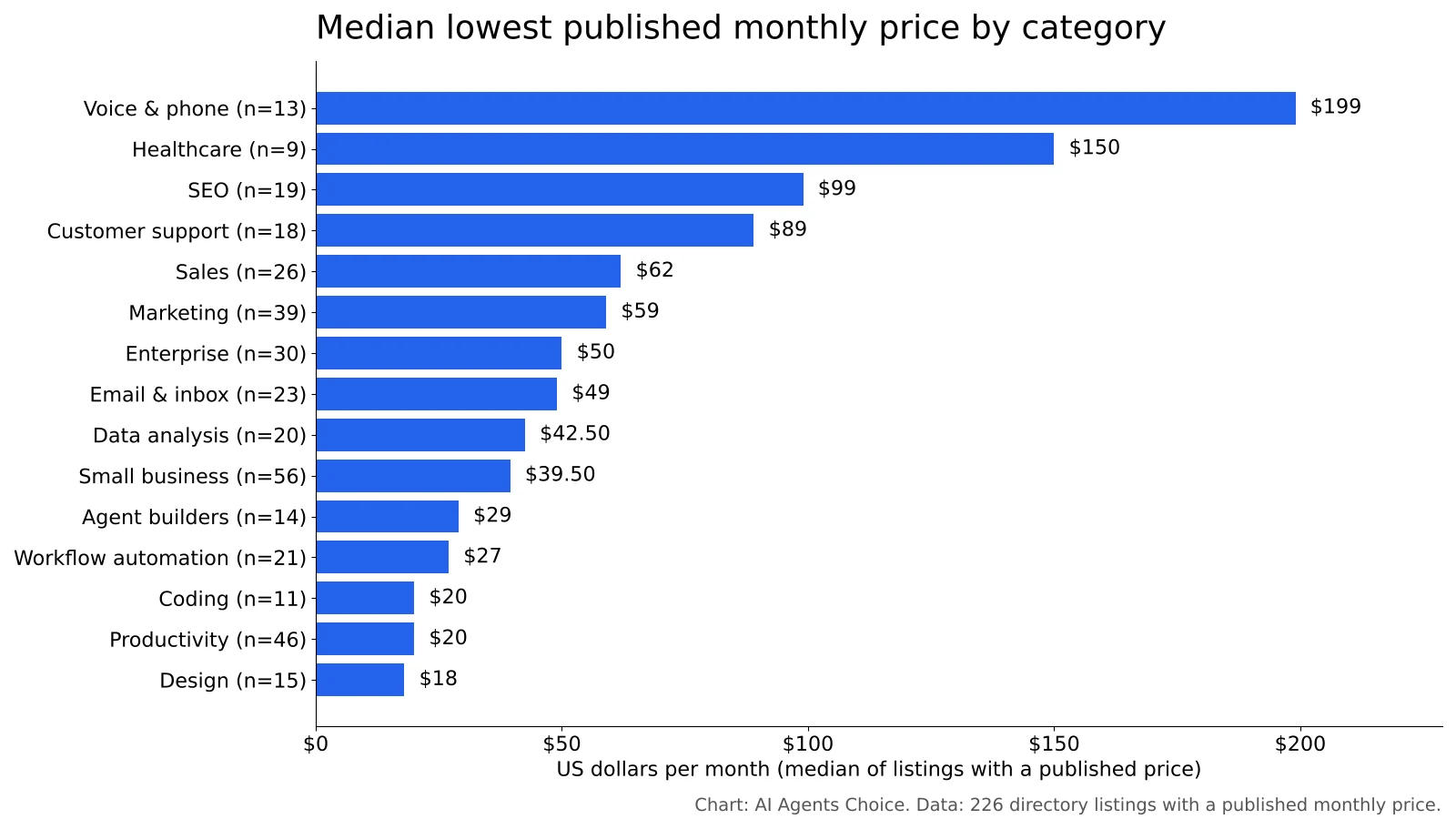
Voice agents price high because each call uses speech models and telephone minutes, so even entry plans carry real running costs. Browse our voice AI agents to compare entry plans, or our coding agents for the $20 tier. Our study of SEOs using AI agents looks at the SEO group from the buyer’s side.
Quote-Only Pricing Rises With Deal Size
- 45.8% of all priced listings show no price and ask buyers to contact sales.
- Banking and fintech agents are the most closed, with 83.3% quote only.
- Voice agents follow at 75.3%, legal at 73.9%, real estate at 71.4% and healthcare at 67.9%.
- 65.9% of enterprise agents and 61.2% of customer support agents are quote only.
- Only 11.2% of small business agents, 4.5% of coding agents and none of the design agents hide their price.

Free Plans Cluster in Developer and Creative Tools
- 15.3% of priced listings offer a full free plan, and 27.6% offer a free or limited free plan.
- 84.2% of design agents and 77.3% of coding agents have a free or limited free plan.
- 37.5% of small business agents have one, against 12.0% of enterprise agents.
- 1 of 81 voice agents offers a free plan, which is 1.2%.
Usage Prices Some Agents Publish
35 listings lead with a usage price. Intercom Fin charges $0.99 per outcome, HubSpot’s Breeze Customer Agent lists $0.50 per resolved conversation, Agentforce lists $0.10 per action on Flex Credits and Retell AI lists $0.07 per minute. Our explainer on AI pricing models compares these units for buyers, and founders setting their own prices can read our AI agent subscription pricing strategies.

Common Questions About Agentic AI Adoption Figures
What Share of Companies Use AI Agents?
It depends on the bar. 23% of McKinsey’s global respondents (November 2025) were scaling an agent, 62% of KPMG’s large US companies (September 2026) were building or deploying one and 79% of PwC’s US executives (May 2025) reported some adoption.
Do AI Agents Pay Off?
Most adopters report productivity gains, with 66% in PwC’s survey. Fewer see profit. IBM’s CEOs said 25% of AI initiatives delivered the expected return, and most McKinsey respondents who see any EBIT impact put it under 5%.
How Many People Use AI Agents at Home?
Menlo Ventures (September 2026) found 24% of US AI users running an agent regularly. By our math that is about 15% of all US adults.
How Much Does an AI Agent Cost per Month?
Across 226 agents in our directory with a published price, the median entry plan is $43.50 a month. Another 45.8% of listings show no price at all, and those are mostly enterprise, voice and regulated-industry products.
Related AI Agents


Read also: Duplicates, Typos and Broken Dates: Which AI Agent Should Clean Your Data?
Explore Agent Categories
Related Articles
 GuidesEnterprise AI Agent Adoption Statistics by Size, Stage and Region
 GuidesAre AI Agents the Future of IT Jobs?
 GuidesGoogle Ads Optimization AI Agents For ROI-First Campaigns
 GuidesAI Agent Data Leakage: Causes and Prevention
 GuidesDuplicates, Typos and Broken Dates: Which AI Agent Should Clean Your Data?
 Guides10 Best Agentic AI Courses for Beginners
