

Gemini 3.1 Pro scored 94.3% on GPQA Diamond, a test of graduate science questions. The same model scored 44.4% on Humanity’s Last Exam without tools. AI model accuracy by task category swings that much, so no single model tops every test.
Google DeepMind published both scores in its own comparison table. Coding sits in between, with the top three models at about 80% on SWE-Bench Verified.
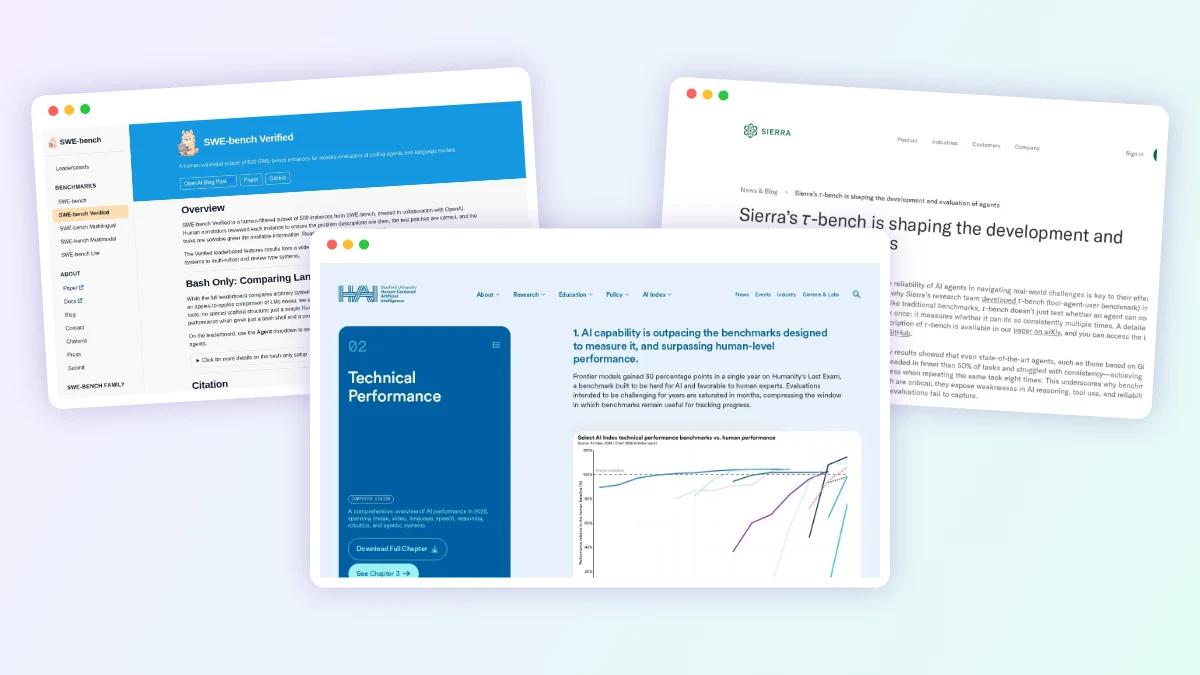
Our sources were official leaderboards, Anthropic’s latest system card, Google’s model page, the Stanford AI Index 2026 and the benchmark papers. Once we sorted the scores by task category, one gap was clear. Agent tasks, such as using a computer, still trail plain question answering by a wide margin.
Accuracy Scores We Compiled for Each Task Category
We kept each score next to the test that produced it. Also, we noted the model and the publisher, because self-reported scores and leaderboard scores are not always run the same way.
| Task category | Benchmark | What it tests | Top score we found | Model | Original source |
|---|---|---|---|---|---|
| Science knowledge | GPQA Diamond | Graduate-level biology, physics and chemistry questions | 94.3% | Gemini 3.1 Pro | Google DeepMind Gemini 3.1 Pro page |
| Broad knowledge | MMLU-Pro | Harder multiple-choice questions across many subjects | 91.2% | Gemini 3.1 Pro | Stanford AI Index 2026 |
| Expert reasoning | Humanity’s Last Exam, no tools | 2,500 expert-written questions | 64.4% | Claude Opus 5.5 | Claude Opus 5.5 system card |
| Abstract puzzles | ARC-AGI-2 | Visual pattern puzzles that are new to the model | 77.1% | Gemini 3.1 Pro | Google DeepMind Gemini 3.1 Pro page |
| Coding | SWE-Bench Verified | 500 human-checked GitHub issues | 80.8% | Claude Opus 4.6 | Google DeepMind Gemini 3.1 Pro page |
| Coding | SWE-bench Pro | Large multi-file fixes in active repositories | 89.9% | Claude Opus 5.5 | Claude Opus 5.5 system card |
| Terminal work | Terminal-Bench 4.0 | 66 command-line tasks | 66.4% | Claude Opus 5.5 | Claude Opus 5.5 system card |
| Advanced math | FrontierMath Tier 4 | Research-level math problems | 31.3% | GPT-5.2 Pro | Stanford AI Index 2026 |
| Tool use with a customer | τ2-bench Telecom | Support chats where the agent calls tools | 99.3% | Gemini 3.1 Pro and Claude Opus 4.6 | Google DeepMind Gemini 3.1 Pro page |
| Web research | BrowseComp | Hard-to-find facts on the web | 85.9% | Gemini 3.1 Pro | Google DeepMind Gemini 3.1 Pro page |
| Computer use | OSWorld 2.0, strict pass rate | 108 long tasks on a live Ubuntu machine | 48.7% | Claude Opus 5.5 | Claude Opus 5.5 system card |
| General assistant tasks | GAIA | 466 real-world questions that need tools and browsing | 74.5% | Not named in the report | Stanford AI Index 2026 |
Two things jump out. First, knowledge tests are close to full marks. Second, tests that make a model act over many steps still leave plenty of room. For example, the best strict OSWorld 2.0 score in the table finishes fewer than half of its tasks.

The chart shows one fair slice. All three models sit on the same Google table, so the settings are as close as public data allows. Even so, the order changes from test to test. For instance, Claude Opus 4.6 tops τ2-bench Retail, while Gemini 3.1 Pro tops ARC-AGI-2 by more than eight points.
Coding Accuracy on SWE-Bench Verified and Harder Tests
SWE-Bench Verified gives a model a real GitHub issue and the code base. Then it checks whether the model’s patch passes the project’s tests. The set holds 500 tasks that people screened by hand, and it was built with OpenAI.

On Google’s table the top three models land within one point of each other. Claude Opus 4.6 scored 80.8%, Gemini 3.1 Pro 80.6% and GPT-5.2 80.0%. However, each lab used its own agent setup for those runs. Google’s footnote also says three tasks had harness bugs, so it raised its own score by 0.6% after fixing them.
The official leaderboard tells a different story. Its bash-only view runs every model in the same small agent loop. On that view the Stanford AI Index reports that Claude 4.5 Opus led at about 76.8% in February 2026. So the shared harness gives lower numbers than the labs’ own setups.
Why Labs Now Report Harder Coding Sets
Scores near 80% leave little room to tell models apart. That is why newer cards add tougher sets. For example, Anthropic reports 89.9% for Claude Opus 5.5 on SWE-bench Pro, which uses large multi-file changes. The model also scored 93.9% on SWE-bench Multilingual, which covers nine programming languages.
Meanwhile, terminal work stays harder. Claude Opus 5.5 scored 66.4% on Terminal-Bench 4.0 at its xhigh effort setting. The test has 66 command-line tasks with a science and engineering lean. Coding agents such as OpenHands and Devin run on these models. Also, our list of agentic AI coding tools and the coding agents category compare more products.
Knowledge and Reasoning Scores Near the Ceiling
GPQA Diamond asks graduate-level science questions that are hard to look up. The Stanford AI Index puts the expert human validator baseline at 81.2%. In fact, OpenAI’s o3 was the first model to pass it, with 87.7% in late 2024.
Now the top models sit far above that line. On Google’s table, Gemini 3.1 Pro scored 94.3%, GPT-5.2 92.4% and Claude Opus 4.6 91.3%. Also, MMLU-Pro is in the same place. In the AI Index, Gemini 3.1 Pro scores 91.2%, and the top 15 models all score above 87%.
Humanity’s Last Exam Still Splits the Field
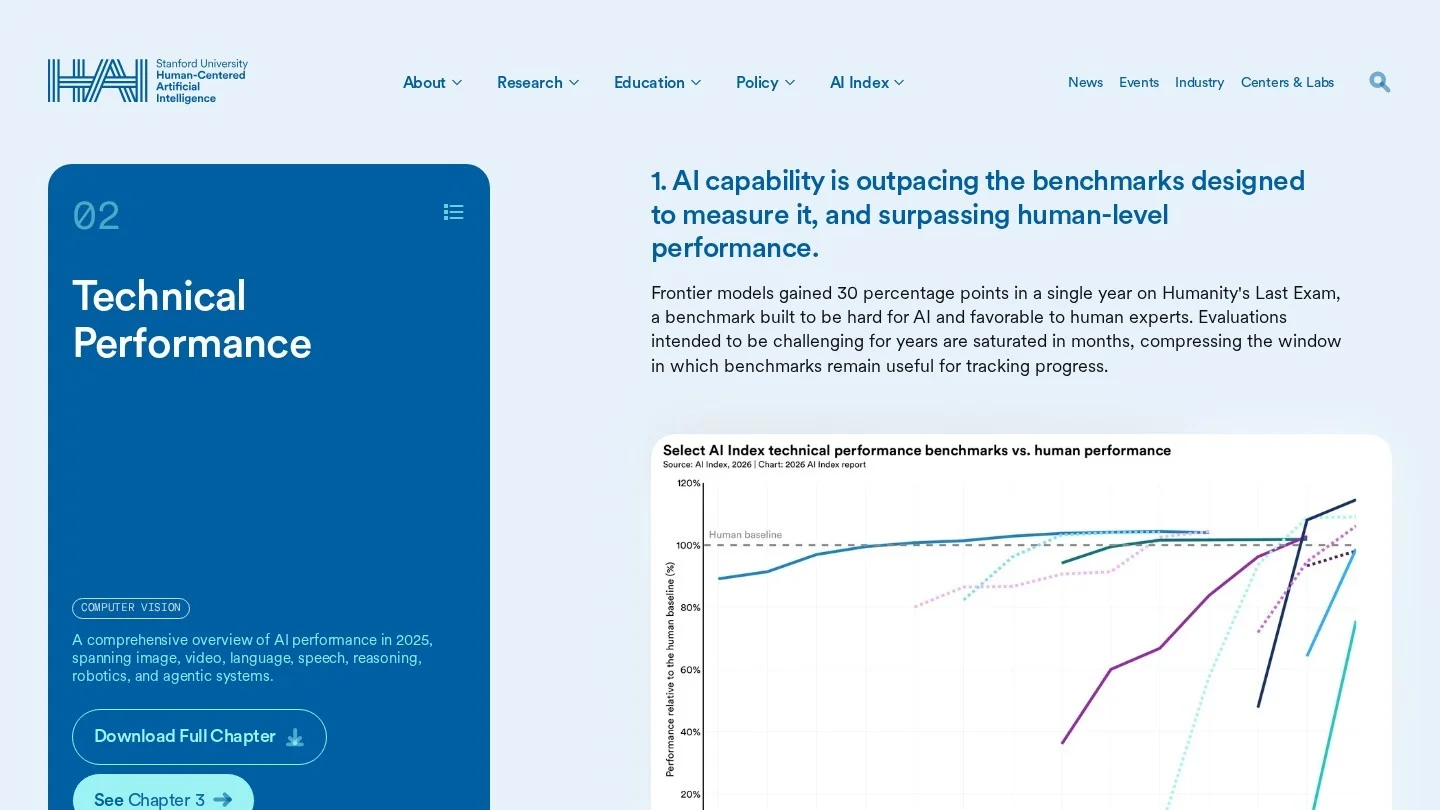
Humanity’s Last Exam was built to stay hard. It has 2,500 questions written by experts. Still, scores climb fast. Accuracy rose from under 10% to 38.3% in a single year.
Since then, the top score has kept moving. Claude Opus 5.5 scored 64.4% without tools and 67.7% with tools in its September system card. By contrast, Gemini 3.1 Pro scored 44.4% without tools on Google’s February table. So a model’s age matters a lot on this test.
Read also: AI Tools Pricing Models Explained: A Guide for Buyers and Builders
Math Scores on AIME and FrontierMath
School-level contest math is mostly solved. Models have reached or come close to the human baseline on AIME. AI can now also win gold at the International Mathematical Olympiad.
Research math is another matter. On FrontierMath Tier 4, accuracy rose from near zero to 31.3%. GPT-5.2 Pro held the top spot by the end of last year. So if your work needs new proofs, expect the model to miss most of the time.
ARC-AGI-2 tests a different skill. The puzzles are visual patterns the model has not seen before. On Google’s table Gemini 3.1 Pro scored 77.1%, against 68.8% for Claude Opus 4.6 and 52.9% for GPT-5.2.
Tool Use and Customer Service Tasks on τ-bench
Sierra’s research team built τ-bench in June 2024. It puts an agent between a simulated customer and a set of company APIs. Also, it reports pass^k, which asks whether the agent succeeds on the same task k times in a row.

Early results were weak. The best GPT-4o agent averaged under 50% across the retail and airline domains. Then it fell to about 25% on pass^8 in retail. So a model that solves a task once may still fail it on the next try.
Today the newer τ2-bench domains look very different. On Google’s table, Claude Opus 4.6 scored 91.9% on Retail and Gemini 3.1 Pro 90.8%. Both scored 99.3% on Telecom. However, the AI Index tracks the original τ-bench, and there the top pass@1 score was 70.2% for Claude Opus 4.5. So always check which version and domain a vendor quotes.
For support teams, these pass^k numbers matter more than a single score. Our post on AI agent human intervention rates shows how those failures turn into handoffs in real deployments.
Computer Use and Browsing Accuracy
OSWorld drops an agent into a real desktop and asks it to finish tasks across apps. On the original OSWorld, the AI Index reports Claude Opus 4.5 at 66.3%. The human baseline sits at 72.35%. So the gap has shrunk, but it has not closed.
Then the bar went up. OSWorld 2.0 has 108 long tasks on a live Ubuntu virtual machine. On it, Claude Opus 5.5 scored 81.8% on partial credit but 48.7% on the strict pass rate. As a result, an agent often gets most of the way and still misses the final step.

GAIA and BrowseComp for Research Assistants
GAIA has 466 questions that people answer without much trouble. Still, each one needs browsing, files or tools. In the original paper, human testers scored 92% while GPT-4 with plugins scored 15%. By last September, the top score had reached 74.5%.

BrowseComp asks for facts buried deep on the web. On Google’s table, Gemini 3.1 Pro scored 85.9% using Deep Research with search, Python and browsing. Claude Opus 4.6 scored 84.0% and GPT-5.2 65.8%. Browser agents such as Browser Use and Manus lean on exactly these skills. Our Browser Use vs Playwright comparison covers when to script the browser yourself.
Why One Model Gets Two Different Scores
We often found two numbers for one model on one test. That is normal. Still, the footnotes usually explain the gap.
- Harness: SWE-Bench Verified scores change with the agent loop. For example, the shared bash-only view gives lower scores than each lab’s own setup.
- Effort setting: Claude Opus 5.5 scored 66.4% on Terminal-Bench 4.0 at xhigh effort and 64.8% at max effort.
- Attempts: Google reports pass@1 with no majority voting. Anthropic averages five trials for its table.
- Who ran it: Google’s table mostly uses other labs’ self-reported numbers. Anthropic’s card takes rival scores from system cards or public leaderboards.
- Test version: τ-bench, τ2-bench Retail and τ2-bench Telecom give very different numbers for the same model.
Also, the AI Index warns about the tests themselves. It found invalid-question rates from 2% to 42% across nine common benchmarks. So a one-point lead on a crowded test may be noise.
Matching a Model to the Work You Need Done
First, pick the benchmark that looks most like your task. A support bot should care about τ2-bench and pass^k. Coding teams should read SWE-bench Pro and Terminal-Bench. For a research assistant, weigh BrowseComp and GAIA.
Second, run your own small test. Take 30 to 50 real tasks from your queue and score each model on them. Then run each task more than once, because τ-bench showed how fast success drops on repeats. Planning style also changes results, which we cover in dynamic planning in LLM agents.
Finally, price the run. Higher effort settings raise accuracy but also raise token use. Our breakdown of AI agent token consumption and our guide to controlling AI agent costs show how to keep that bill in check. For more market numbers, see our roundup of agentic AI statistics.
Benchmark Questions Buyers Ask Us
Which AI Model Is Most Accurate Overall?
None wins every category. On the latest tables we opened, Claude Opus 5.5 posts the top coding, terminal and computer-use scores in its card. However, Gemini 3.1 Pro tops GPQA Diamond, MMLU-Pro and ARC-AGI-2 in the sources we used.
What Does SWE-Bench Verified Measure?
It measures whether a model can fix a real GitHub issue so the project’s tests pass. The set has 500 tasks that people checked by hand. Top models now score about 80% with their own agent setups.
Are AI Benchmark Scores Reliable?
They are useful but rough. Settings, harnesses and test versions shift scores by several points. Also, the AI Index found invalid questions in many common tests. So treat small gaps as a tie and test on your own tasks.
How Accurate Are AI Agents at Using a Computer?
They still fall short of people on hard tasks. Claude Opus 5.5 passes 48.7% of OSWorld 2.0 tasks on the strict measure. On the older OSWorld, the top score of 66.3% trails the 72.35% human baseline.
Related AI Agents



Read also: Best Regie.ai Alternatives for AI Prospecting and Outbound
Explore Agent Categories
Related Articles
 GuidesHow AI Agents Maintain Context Across Multiple Tasks
 GuidesAI Tools Pricing Models Explained: A Guide for Buyers and Builders
 GuidesSynthesia AI Video Usage Among Corporate Training Teams
 GuidesBest CAMEL AI Alternatives and What They Cost
 Guides100 AI Agent Statistics for Retail Companies
 GuidesLLM or AI Agent? AI Search Engines and What They Actually Are
