


Small business AI agent tasks are the jobs that owners now hand to AI tools, from writing promos to sorting the books. Marketing is the top task, with 41% of small firms that use AI putting it to work on marketing. The US Chamber of Commerce found this in a 2026 study of 3,732 small businesses, run from July to August. Customer experience comes second at 35%. Accounting and customer records tie for third at 31% each.
True agents are a smaller group. In that same Chamber survey, 24% of small businesses use agentic AI tools, which carry out tasks on their own. Another 34% plan to add them. Even so, most owners still keep a hand on the wheel. Only 22% of owners in a Bluevine survey from April 2026 fully trust AI to handle low-level tasks with no person checking.
The sections break the data down by task type: marketing, customer service, finance and operations. They also show which jobs owners trust AI to run alone. Finally, they cover how many tasks each firm hands over and how much staff time AI now covers.
Top AI Tasks at Small Businesses, Survey by Survey
Small businesses give AI marketing, customer service and bookkeeping tasks more than any other work. The order shifts a little from survey to survey. Still, the same few jobs sit near the top of every list.
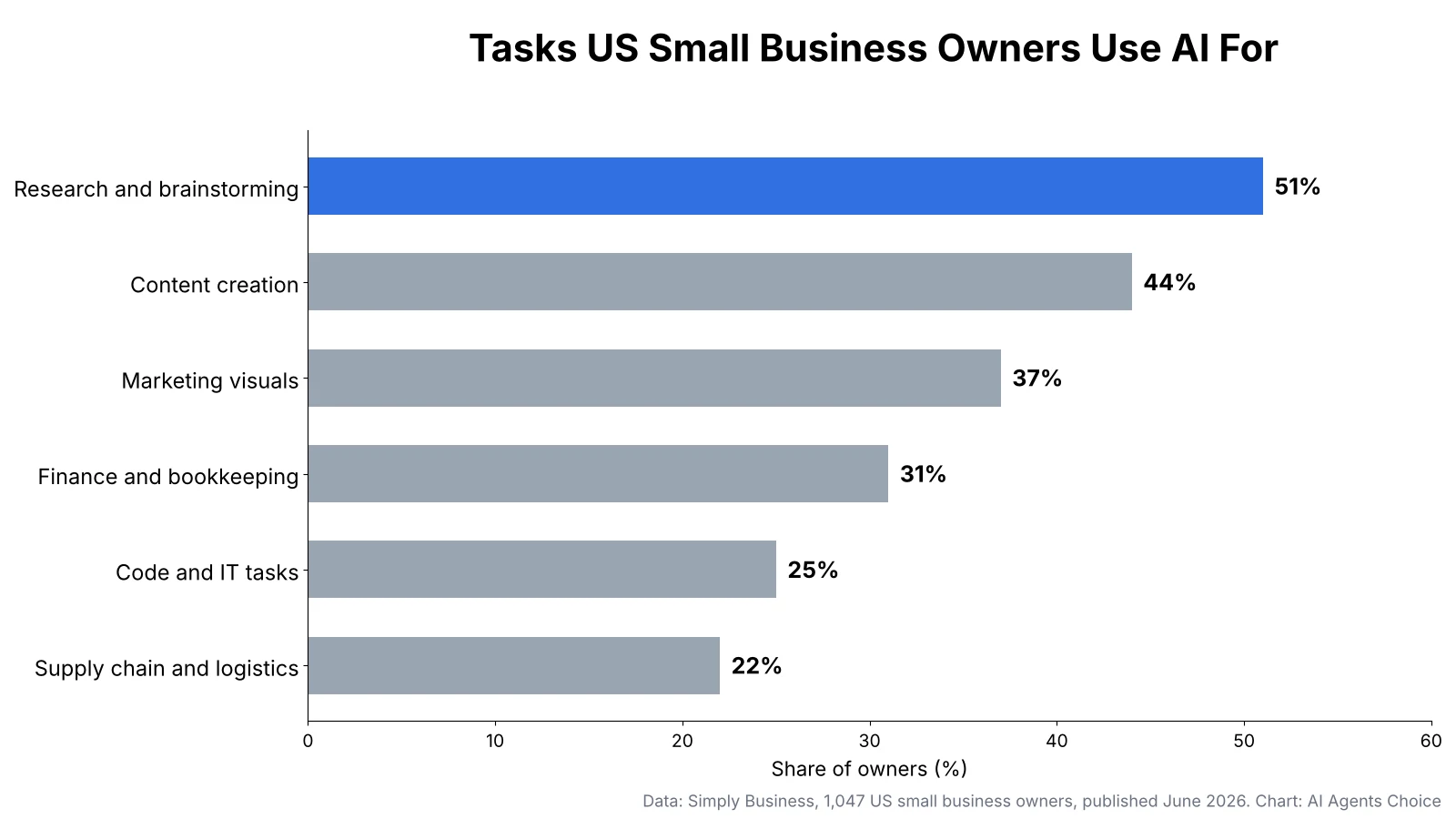
Research comes first in one survey. In Simply Business data on 1,047 US owners, published in June 2026, 51% use AI for research and brainstorming. Next come content such as emails and social posts at 44%, then marketing visuals at 37%.
Marketing work makes the top two in every major small business survey of 2026. The rest of the order shifts from one survey to the next.
| Survey and date | Top AI task | Second task | Third task |
|---|---|---|---|
| US Chamber, Jul to Aug 2026 | Marketing (41%) | Customer experience (35%) | Accounting (31%) |
| Intuit, Jan 2026 | Marketing (45%) | Customer service (37%) | Bookkeeping (35%) |
| Bluevine, Apr 2026 | Data analysis (39%) | Marketing and sales (37%) | Running operations (29%) |
| Simply Business, Jun 2026 | Research (51%) | Content (44%) | Visuals (37%) |
Agentic AI Tools Reach One in Four Small Firms
24% of US small businesses use agentic AI tools for tasks, in the US Chamber survey from July to August 2026. Another 34% plan to adopt them. So agents already reach about one in four small firms, close to other types of AI tools.
| AI tool type | Share of small businesses |
|---|---|
| Generative AI chatbots | 41% |
| Predictive AI tools | 27% |
| AI coding tools | 26% |
| Agentic AI tools | 24% |
| Image tools | 22% |
Most firms still use AI in a narrow way. The Census Bureau ran an AI add-on to its business survey from November last year to January 2026. In a Census working paper on that data, published in April 2026, 18% of all US firms used AI in a business function. Among those firms, 57% used it in three or fewer functions.
Worker use was narrow too. In that Census data, 23% of firms had staff using AI for work tasks. Yet 65% of those firms kept AI to three or fewer tasks. Writing, document review and searching for facts led those tasks.
Marketing Tasks Lead Small Business AI Use
Marketing is the task small businesses hand to AI most often. In the Census working paper, sales and marketing was the top business function for AI at 52% of firms that use it. Strategy and business development came next at 45%, then IT at 41%.
The same pattern shows up in owner surveys. In Intuit QuickBooks data from its 2026 AI Impact Report, 45% of US businesses using AI apply it to marketing. In the Chamber survey, 25% of AI users also use it to find new customers.
Marketing is also the first job owners plan to hand off instead of hiring. A Bluevine survey of 729 owners ran from June 25 to 30, 2026. In it, 39% planned to automate marketing and sales work in place of a new hire. Tools like Square ManagerBot come built into the apps many shops already use to run sales.
Customer Service Tasks Small Firms Hand to AI
Customer service is the second most common AI task at small firms. In the Chamber survey, 35% of AI users use it to improve the customer experience. Also, 31% use it to manage customer relationships, and 28% use it to talk with customers and prospects.
Other surveys land in the same range. In the Intuit QuickBooks data, 37% of US businesses using AI apply it to customer service. In the Bluevine trends report, 27% of owners use AI for customer service.
Still, customers want a person on call. In the Simply Business data, 86% of owners rated the ability to reach a human as important when AI runs a service. In fact, 66% rated it very important. Phone agents such as the Jobber AI Receptionist answer calls and texts for contractors and book visits.
Read also: Newest AI Agent Statistics for Small Businesses
Bookkeeping, Payroll and Finance Tasks
About one in three small businesses that use AI give it bookkeeping or accounting tasks. In the Chamber survey, 31% of AI users apply it to accounting. In the Intuit QuickBooks data, 35% use it for bookkeeping. In the Simply Business data, 31% of owners use AI for finance and bookkeeping.
Other money tasks follow behind. In the Chamber survey, 28% of AI users use it to prevent fraud and check who they do business with. Payroll comes in at 23%, and managing credit and cash flow at 17%. In the Bluevine trends report, 23% of owners use AI for financial management.
Firms that want an agent for this work can compare options on our bookkeeping AI agents page. For example, Booke AI sorts bank feed items and prepares reconciliations in QuickBooks Online and Xero.
Sales, Inventory and Supply Chain Tasks
Operations tasks such as sales, stock and suppliers draw about one in four small AI users. In the Chamber survey, 27% of AI users apply it to processing sales. Also, 26% use it to manage inventory, and 20% use it to find lower-cost suppliers.
The list goes deeper from there. Some 18% of Chamber AI users use AI to handle supply chain problems. Another 17% use it to process returns, and 17% use it to find and hire staff. In the Simply Business data, 22% of owners use AI for supply chain and logistics, and 25% for code or IT work.
Bluevine owners describe this work in broader terms. In its April 2026 trends report, 29% of owners use AI to automate operations.
Customer Data, Security and Product Tasks
About three in ten small businesses that use AI apply it to customer data. In the Chamber survey, 30% of AI users rely on it to learn from customer data. Also, 28% use it to collect and manage that data.
Security work is close behind. In the same survey, 26% of AI users use AI to manage cyber security. Data security is also a worry for 34% of AI users in the Simply Business data.
Product work is less common. Only 20% of Chamber AI users use AI to develop new products or services. On the tech side, IT is the third most common AI function in the Census working paper, at 41% of firms that use AI.
Firm-wide shares are much lower than the shares among AI users. In April 2026 Census AI data, about 15% of US firms of all sizes used AI in sales and marketing. Nearly 10% put it to work in public relations.
Which Tasks Owners Trust AI to Do Alone
Small business owners trust AI most to write marketing content with little review. A Gusto survey of 1,731 owners of firms with 24 or fewer staff ran from August 17 to September 7, 2026. In it, 60% of AI adopters were fine with AI writing marketing content with limited human review.

The gap between users and non-users is wide. Non-adopters were far less willing on every task, at 27% for marketing content and just 6% for bookkeeping. Also, 5% of all owners reject AI help with limited review outright. Owners felt less sure about data analysis and direct replies to customers.
Doubts about accuracy are the main brake. In the Simply Business data, 36% of AI users worry about accuracy and 34% about data security. Another 31% were never shown how to use the tools well. In the Bluevine trends report, 78% of owners do not fully trust AI with low-level tasks unless a person checks.
Some tasks stay off limits for now. For example, only 10% of owners in the Simply Business survey would use AI to handle business insurance.
Depth of AI Use: Most Firms Hand Over a Few Tasks
Most small businesses give AI only a few tasks. In the Gusto survey, 28% use AI for some tasks and 19% are still testing it. Just 15% use it regularly across many functions, and 5% have built it into every part of the business they can.
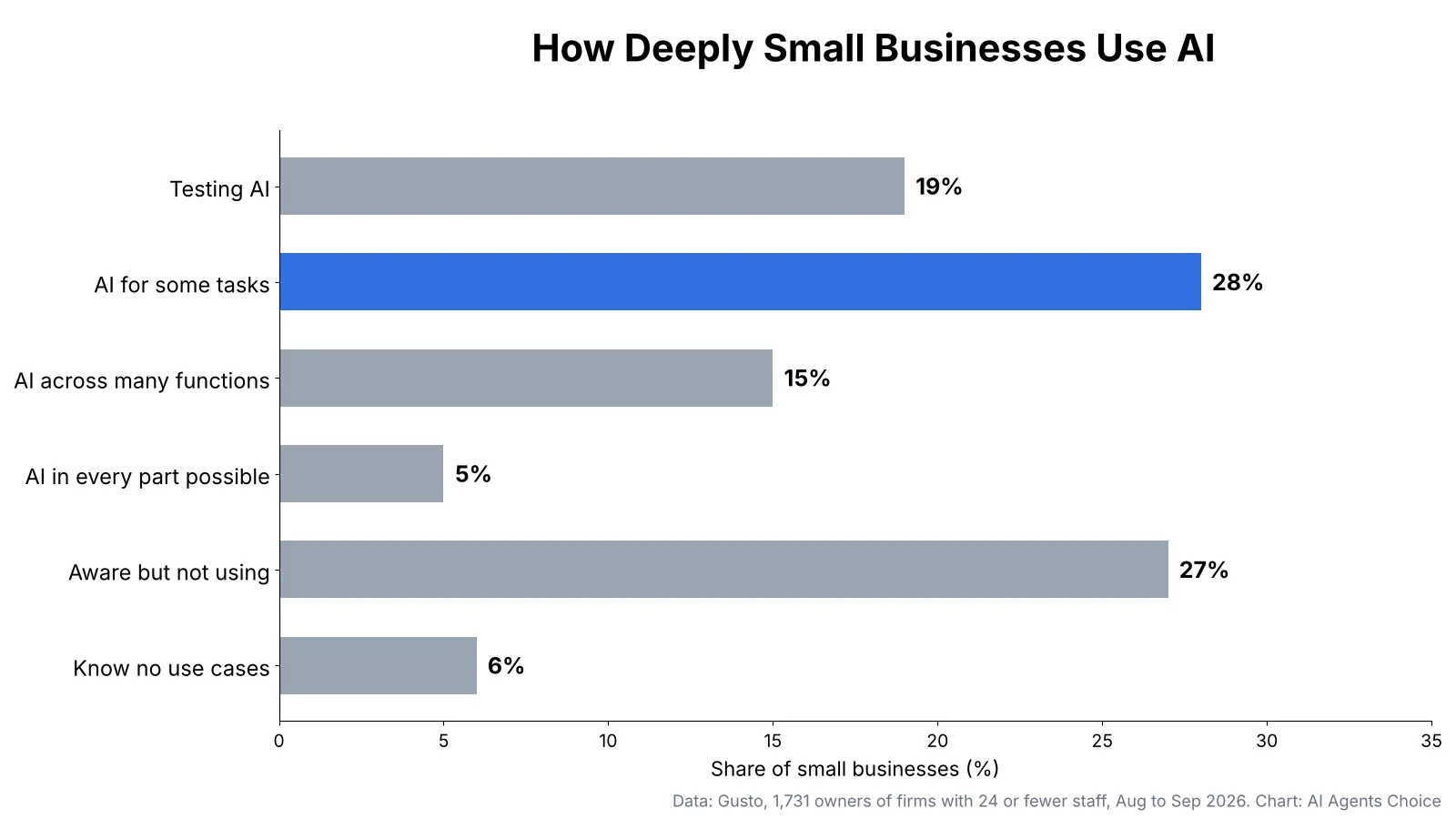
The type of business matters. In the Gusto data, 27% of professional service firms use AI across many functions or the whole business. That share falls to 16% for personal services and 13% for community services. Solo owners and firms with 10 to 24 staff report similar rates of heavy use.
Other surveys show the same shallow depth. In the Bluevine trends report, 33% of owners use AI across many business areas. Among Goldman Sachs 10,000 Small Businesses owners surveyed in early 2026, only 14% have fully built AI into core operations.
AI Doing the Work of an Extra Employee
About half of small business owners say AI now does the work of at least one person. In the Bluevine lean team survey from June 2026, 53% report that AI or automation lets their team handle at least one extra employee’s workload. That share was 82% at firms with 50 to 99 staff, against 34% at firms with 2 to 4.
Hiring plans are shifting as a result. In that Bluevine survey, 75% plan to hand at least one business function to software or AI within 12 months. They would do so in place of hiring for it. In a Thryv survey of 561 owners from April 2026, 46% would pick AI over a new hire for equally capable work. That was 38% a year earlier.
Time savings back this up. In the Thryv survey, 92% of AI users say it saves them time. Also, 79% expect to win back 11 to 60 hours a month. Among Bluevine owners in April 2026, 48% save at least four hours a week with AI.
Jobs are not vanishing, though. In that April Census AI data, about 10% of AI-using firms say AI now does tasks staff once did. In the Thryv survey, 13% hired fewer people because of AI. For a wider view of adoption, cost and barriers, see our AI agent statistics for small businesses. More tools for owners are on our small business AI agents page.
Small Business Owners’ Questions About AI Task Data
How much do small businesses spend on AI tools each month?
Just over half of small businesses spend at least $100 a month on AI tools. In the Thryv survey from April 2026, 53% spent $100 or more a month. Also, one-third spent more on AI than they did 12 months earlier.
Do small businesses have a written policy for AI tasks?
One in four small businesses with staff has an AI policy, in the Gusto survey from August to September 2026. That is up from 15% the year before. Still, 47% have no policy and no plan to write one.
Do owners need training before handing more tasks to AI?
Yes, most owners want more training. In the Thryv survey, 70% need more training to use AI well. Also, 57% learn mainly from YouTube and social media. Among Goldman Sachs owners in early 2026, 73% want more training and support to use AI.
Is small business AI use still growing?
Yes, small business AI use keeps rising each year. In the Chamber surveys, AI use at small firms rose from 23% in 2023 to 40% in 2024. It then hit 58% last year and 66% in 2026. In the Thryv survey, adoption rose to 66% in April 2026, up from 55% a year earlier.
Does AI help small firms earn more?
Most owners who use AI report a gain in sales or savings. In the Thryv survey, 70% say AI raised revenue over the past 12 months, and 55% say it cut costs. Among Goldman Sachs owners, 67% expect AI to raise revenue.
Related AI Agents




Read also: Most Profitable AI Agent Business Ideas, Scored and Ranked
Explore Agent Categories
Related Articles
 GuidesNewest AI Agent Statistics for Small Businesses
 GuidesLong-Running AI Agent Tasks: Managing Context and State
 GuidesHow AI Agents Maintain Context Across Multiple Tasks
 GuidesAI Model Accuracy by Task Category
 GuidesAI Agents for Business Process Automation
 GuidesAI Agents for Business Intelligence
