

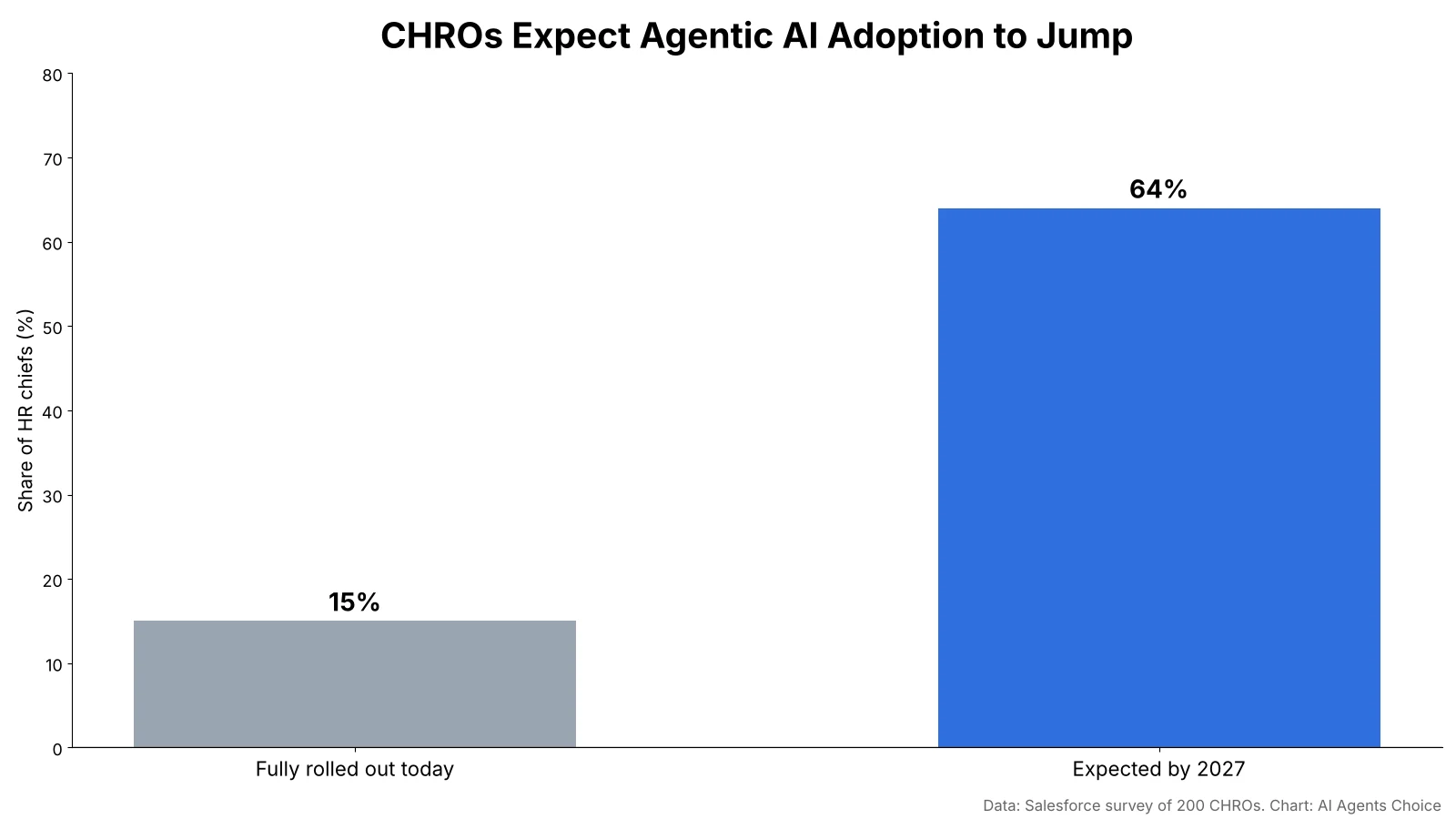
Agentic AI in HR means AI agents that do HR work on their own. They screen job seekers, book interviews and answer policy questions. Only 15% of HR chiefs had fully rolled out agentic AI in a Salesforce study of 200 CHROs released in May of last year. Yet the same leaders expect that share to reach 64% by 2027. That is a rise of 327% in about two years.
Most HR teams still sit at the AI stage, a step short of agents. In SHRM research from April 2026, 39% of companies had put AI to work inside HR, while 31% had no plans to do so. Recruiting comes first in almost every survey. It is also where agents save the most time today, with early users of LinkedIn Hiring Assistant saving more than four hours per role.
Control lags behind use, though. In a July 2026 Gartner survey of 297 CHROs, only 24% of leadership teams agreed on who should be accountable for AI agents. The rest of this page covers use rates, the HR tasks agents take on, live results, hiring and the gaps in rules.
Share of HR Teams Running AI Agents Today
Between 15% and 34% of HR teams run AI agents today. The rate depends on how a survey defines an agent. The low figure counts full rollout only. The high figure counts any agent-style help in HR workflows.
In the Salesforce CHRO study, 85% of companies had not yet put agentic AI in place. By contrast, the Culture Amp AI in HR study from May 2026 puts agent workflow help at 34%. That study asked 264 HR staff. In that group, 39% had moved AI into HR operations work, and 24% felt comfortable deploying agentic AI systems.
Each survey asks a different group a different question. So the rates spread out, as this table shows.
| Survey and timing | Who answered | Headline figure |
|---|---|---|
| Salesforce CHRO study, May of last year | 200 HR chiefs | 15% fully rolled out agentic AI |
| Gartner, fourth quarter of last year | 110 heads of HR | 95% adopted AI in some form |
| SHRM State of AI in HR, April 2026 | 1,900+ HR staff | 39% use AI inside HR |
| Culture Amp, May 2026 | 264 HR staff | 34% use agentic workflow support |
| LinkedIn, survey of November last year | 6,554 HR staff | 93% of recruiters plan more AI use in 2026 |
Plain AI use is far ahead of agent use. For example, the Gartner group put AI adoption at 95%, yet only one in five of those firms had gained major value from it. Likewise, 62% of companies in the SHRM data use AI somewhere in the business, which is well above the 39% that use it inside HR.
Job level also changes the picture. In the Culture Amp study, only 16% of staff without a team felt at ease with agentic AI. For C-suite HR leaders, the rate was 37%. In fact, 54% of those top leaders already use AI for agent workflows, more than twice the rate at any other level.

To see how other teams use agents, read our enterprise AI agent adoption statistics.
Which HR Tasks AI Agents Handle First
Recruiting is the HR task AI agents handle first, followed by HR tech and learning. In the April 2026 SHRM data, 27% of companies used AI in recruiting, 21% in HR tech and 17% in learning and development.
Recruiters plan to go further. In LinkedIn research published in January 2026, 93% of recruiters planned to raise their AI use this year. Also, 66% planned to use more AI for pre-screening interviews. For 59%, AI already surfaces people with skills they would have missed. You can compare tools for this work in our recruiting and HR agents list.
Pay work trails far behind. In a Mercer QuickPulse survey of just under 450 US companies in February 2026, more than half were exploring AI for pay planning or design. However, only 16% were using it.
Most daily HR use is still writing and research. In the Culture Amp study, 86% of HR staff used AI to create content and 83% used it to brainstorm. Another 81% used it to pull facts together from many places.
Agentic AI in HR Statistics From Live Agents
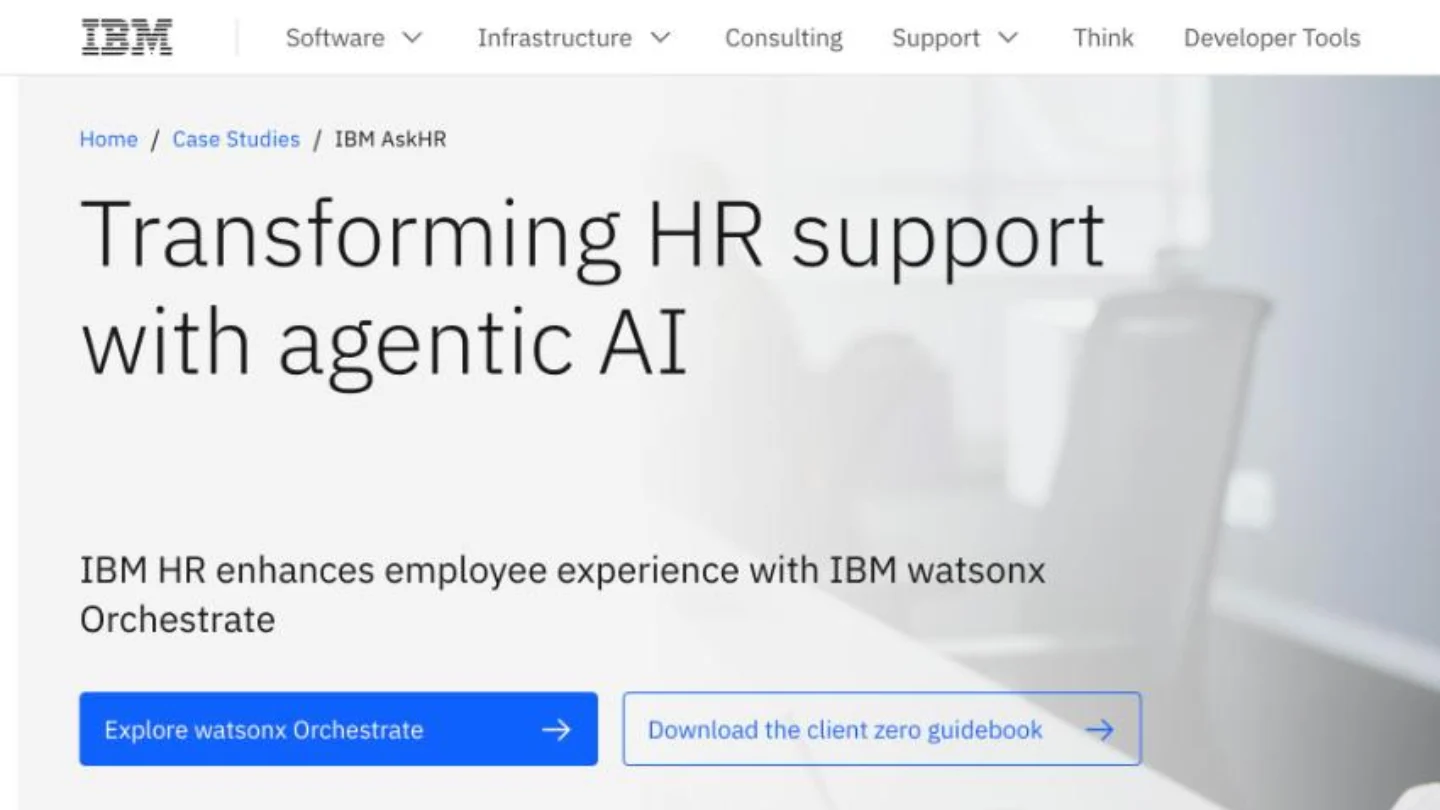
The best agentic AI in HR results on record come from IBM AskHR and LinkedIn Hiring Assistant. AskHR answers 94% of common staff questions without a person and runs about 80 HR tasks on its own. In 2024, it handled more than 11.5 million staff chats and processed over 1 million HR transactions.
Adoption among IBM managers has reached 99%. Over the past four years, the HR team has also cut its operating costs by 40%, and support tickets have dropped 75% since 2016. AskHR is built on IBM watsonx Orchestrate, which has its own agent catalog page.
Recruiting agents show the same kind of gains. Early users of LinkedIn Hiring Assistant save more than 4 hours per role. They also review 62% fewer profiles. And 69% more of their InMail notes get accepted. Hiring Pro, the LinkedIn agent for smaller firms, helps nearly 60% of hirers find someone to interview in week one.
| Agent | What was measured | Result | Period |
|---|---|---|---|
| IBM AskHR | Common questions solved without a person | 94% | Latest case study |
| IBM AskHR | Staff chats | 11.5 million+ | 2024 |
| IBM AskHR | HR transactions processed | 1 million+ | 2024 |
| IBM AskHR | HR operating costs | Down 40% | Past four years |
| LinkedIn Hiring Assistant | Time saved by early users | 4+ hours per role | January 2026 |
| LinkedIn Hiring Assistant | Profiles reviewed | 62% fewer | January 2026 |
| LinkedIn Hiring Assistant | InMail acceptance | Up 69% | January 2026 |
| LinkedIn Hiring Pro | Hirers with an interview in week one | Nearly 60% | January 2026 |
| LinkedIn Hiring Pro | Weekly time saved by users who save time | 6+ hours | January 2026 |
Read also: Agentic AI Statistics: Adoption, ROI, Jobs and Pricing Data
What CHROs Expect AI Agents to Change by 2027
CHROs expect AI agents to lift output by 30% and cut labor costs by 19% once fully in place. In the Salesforce study, that 19% works out to $11,064 per employee, based on the 2023 OECD average salary of $58,232.
HR chiefs also expect agents to reshape teams. In that study, 80% believe most workforces will have people and AI agents working side by side within five years. And 77% expect agents to change their company structure.
Few expect mass layoffs, however. On average, they plan to keep 61% of staff in their current roles and move 23% to new roles or teams. For 88%, moving people inside the company costs less than hiring from outside.
- Reskilling: 81% of CHROs are reskilling staff or plan to, with 20% already doing it and 61% planning to start.
- Soft skills: 75% expect AI agents to raise the need for soft skills such as judgment and teamwork.
- Awareness gap: 73% report that staff do not yet know how agents will change their work.
Pressure from the top is already rising. In the July 2026 Gartner CHRO survey, 67% of CHROs faced higher demands for staff output. And in a May 2026 Gartner poll of 203 CEOs and top leaders, 63% were fully redesigning how the business runs to get faster gains from AI.
How AI Agents Affect Hiring and HR Jobs
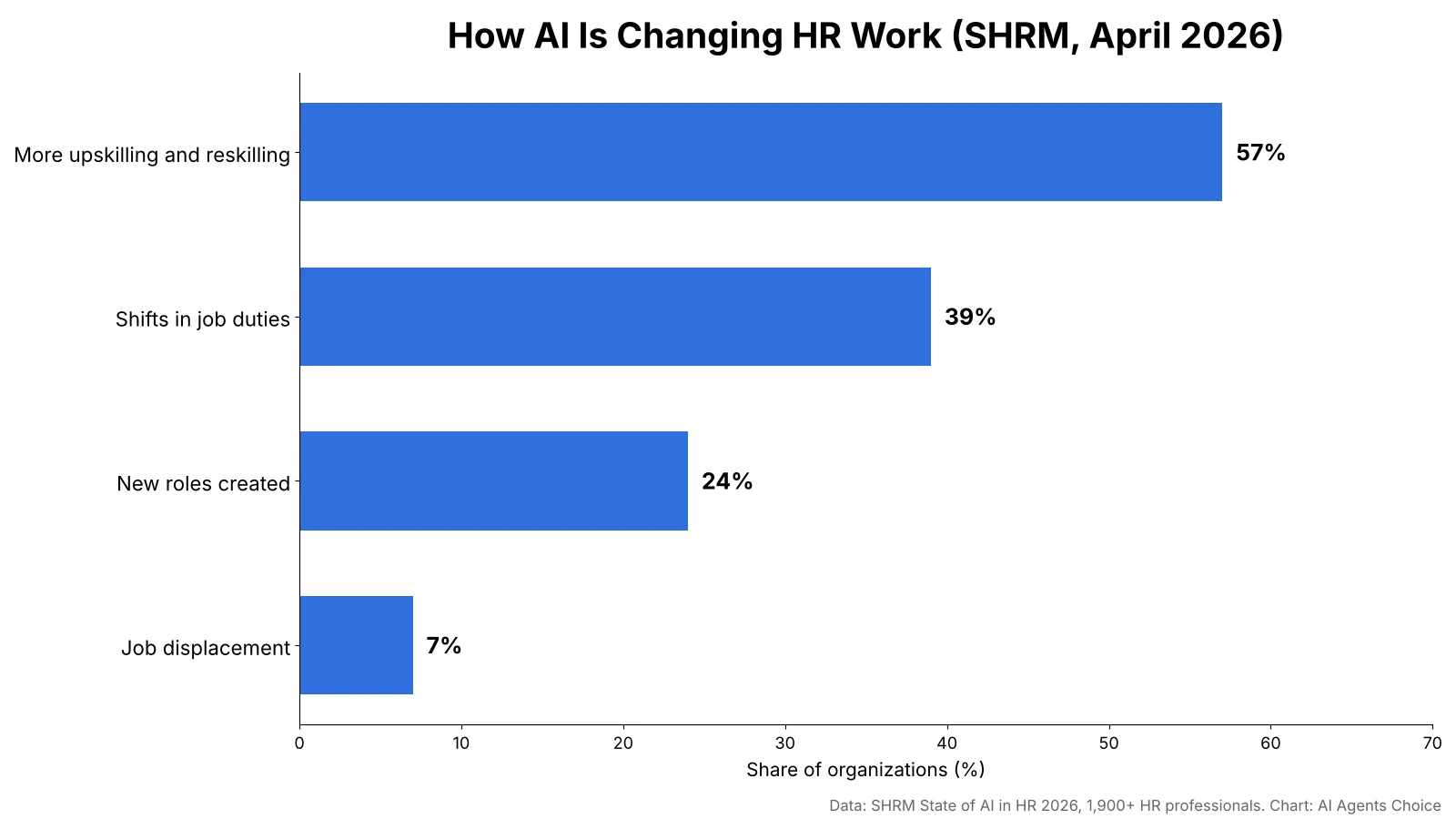
AI agents are changing HR jobs more than removing them so far. Only 7% of companies in the April 2026 SHRM data reported job displacement from AI. By contrast, 57% saw more upskilling and reskilling, 39% saw shifts in job duties and 24% created new roles.
HR staff mostly feel the gains. In the same SHRM data, 87% of HR staff reported better efficiency from AI, and 75% reported better work quality.
Entry-level hiring is where cuts show up first. In a Gartner survey of 110 heads of HR late last year, 22% of CHROs had at least one leader who stopped hiring for entry-level roles due to AI. In the Mercer February 2026 survey, 32% were replacing tasks with automation. Yet only 10% had cut hiring because of it, while 11% had added roles for new technology.
Over a longer span, the outlook is mixed. In a Gartner survey released in May 2026, 40% of companies had already removed outdated roles. Even so, Gartner expects AI to create more jobs than it removes starting in 2028.
Job seekers now use AI too, which adds load for HR teams. The Workday Global Workforce Report from October 2026 puts the median number of applicants per filled job at 69, up from 58 a year earlier. In its August 2026 pulse survey, 84% of job seekers used AI during their search. Workday also builds HR agents of its own, which you can review on our Workday Marketplace Agents page.
Skill demand is moving fast as well. In job data from more than 550 Workday clients, demand for hands-on AI skills rose 51% from September of last year to July 2026. Meanwhile, demand for basic prompting skills peaked in January 2026 and then fell 25%.
Gaps in How HR Runs and Tracks AI Agents
Most HR teams cannot yet prove what AI returns or agree on how to run it. In Gartner research from October 2026, 78% of leaders had no shared view of where AI creates value. And only 3% of companies beat their cost-savings goals through output alone.
Freed-up time is often lost as well. In a Gartner survey of 1,865 employees in the second quarter of 2026, only 21% of the time AI saved went into more creative work.
| Gap | Figure | Survey and date |
|---|---|---|
| HR does not formally measure AI success | 56% | SHRM, April 2026 |
| HR uses ROI as a success metric | 16% | SHRM, April 2026 |
| HR left out of AI strategy | 52% | SHRM, April 2026 |
| Have policies for employee AI use | 49% | SHRM, April 2026 |
| HR leaders who own AI strategy | 47%, up 10 points | Culture Amp, May 2026 |
| Leaders making progress on human and AI work design | 6% | Deloitte, March 2026 |
Rules are another weak spot. In the SHRM data, 57% of HR staff in places with workforce AI rules did not know those rules existed. Among those who did know, only 12% had taken steps to comply.
Design is the last gap. In the March 2026 Deloitte Global Human Capital Trends report, only 6% of leaders were making headway on how people and AI work together. Also, 42% of workers reported that their employer was not checking how AI affects people. Our HR management agents list shows which tools now offer audit logs and approval steps.
Time Saved, Rework and Manager Views on HR AI
AI agents and tools in HR save time, but rework eats a large share of it. In a Workday study of 3,200 employees fielded in November of last year, 85% saved one to seven hours a week with AI. However, nearly 40% of that time went to fixing AI output, and only 14% got positive net results every time.
Managers are less sure. AI has lived up to what fewer than half of them hoped. In a Gartner release from March 2026, 45% of managers reported that AI improved their teams’ work as much as they had hoped. Only 14% of managers in a Gartner survey from July of last year faced no problems in driving AI use across their teams.
Top leaders show the same gap. In the March 2026 Deloitte report, 60% of top leaders used AI when making decisions. Only 5% felt they managed it well. For more numbers on agents across all business functions, see our agentic AI statistics.
Related AI Agents


Read also: 10 Best Agentic AI Courses for Beginners
Explore Agent Categories
Related Articles
 GuidesAgentic Commerce Statistics: Latest Data
 GuidesAgentic AI Statistics: Adoption, ROI, Jobs and Pricing Data
 GuidesThe Research Before the Draft: Which AI Agent Should Find Your Next Topic?
 Guides10 Best Agentic AI Courses for Beginners
 Guides10 Best Agentic AI Tools for Coding
 GuidesAmazon Bedrock AI Statistics
