


AI customer support agents now cost a fraction of a human reply. In our research, published AI prices run from $0.99 to $2 per conversation. By contrast, an 11-minute human chat costs about $3.95 in US wages alone.
We compiled 45 statistics on AI support costs from Gartner, the US Bureau of Labor Statistics (BLS), Klarna and five vendors. Then we ran our own math on cost per resolution and on published resolution rates. You know what the real question is, though? It is how much of your queue an agent can close without a person. So we also gathered the published resolution rates we could open on vendor sites.
What an AI Resolution Costs Against a Human Chat
Vendors now price AI agents per outcome or per conversation. That makes the comparison with human cost far easier than it was with seat licenses. Also, Intercom and Salesforce publish their prices openly.
Published Prices Per AI Outcome or Conversation
- Intercom Fin charges $0.99 per outcome, with a 50-outcome monthly minimum, on its pricing page. A resolution or a successful handoff counts as one outcome, and Fin bills at most one per conversation.
- Salesforce lists Agentforce at $2 per conversation on its pricing page.
- Salesforce also sells Flex Credits at $500 per 100,000 credits. A standard action uses 20 credits, which comes to $0.10.
- On its original billing setup, Zendesk includes 5, 10 or 15 automated resolutions per agent each month on its Team, Professional and Enterprise plans. Accounts cap out at 10,000 allocated resolutions a year.
| Platform | Billing unit | Published price | What is included |
|---|---|---|---|
| Intercom Fin | Per outcome | $0.99 | 50 outcomes per month minimum |
| Salesforce Agentforce | Per conversation | $2.00 | Pay as you go |
| Salesforce Flex Credits | Per standard action | $0.10 (20 credits) | $500 buys 100,000 credits |
| Zendesk AI agents | Per automated resolution | Not listed in its help center | 5 to 15 per agent per month, by plan |
Zendesk changed its rules on May 18, 2026. Since then it sorts AI conversations into three tiers. For example, an assisted escalation is a chat the AI started and a human finished. That tier does not count against the resolution allowance. However, contained and verified resolutions do. A large language model checks each one before Zendesk bills it. For instance, a 20-agent team on the Professional plan gets 200 included resolutions a month.
The US Wage Baseline for Support Reps
- Customer service representatives earn a median $21.53 an hour, or $44,770 a year. That figure comes from the latest BLS Occupational Outlook Handbook.
- The US has 2,666,000 customer service representative jobs.
- The BLS expects that job count to fall 5% over the decade to 2035.
- Even so, the BLS projects about 289,500 openings a year over that decade.
Our Math on Minutes of Pay per AI Price
We divided each AI price by the median rep wage. At $21.53 an hour, one minute of a rep’s time costs about $0.36. So a $0.99 Fin outcome buys 2.76 minutes of human time. Likewise, a $2 Agentforce conversation buys 5.57 minutes.
Next, we priced a typical human chat. Klarna reported that customer errands took 11 minutes before its AI assistant arrived. At the median wage, that chat costs $3.95. Note that these are wages only. Benefits and overhead sit on top, so the real human figure runs higher.

Gartner adds a warning to this picture. In January 2026 it predicted that the cost per resolution for generative AI will pass $3 by 2030. As a result, Gartner expects AI to cost more than many offshore human agents in business-to-consumer support. Still, $3 equals about 8.4 minutes of median US rep pay. So even at that forecast price, an AI resolution costs less than our 11-minute US chat. Offshore teams are where Gartner sees the crossover. For more on pricing models like these, see our guide to AI agent subscription pricing strategies.
Running 10,000 Chats Through Our Cost Model
We built a small model to see how the prices play out. First, we took 10,000 monthly chats. Then we set the AI resolution rate at 68%, which is the median of the seven published rates we compiled. Every chat the AI does not resolve goes to a human for 11 minutes at the median wage.
| Scenario | AI cost | Human wage cost | Total | Change against all-human |
|---|---|---|---|---|
| All 10,000 chats handled by humans | $0 | $39,472 | $39,472 | Baseline |
| Fin resolves 6,800 at $0.99 each | $6,732 | $12,631 | $19,363 | 51% lower |
| Agentforce bills all 10,000 at $2 each | $20,000 | $12,631 | $32,631 | 17% lower |
The billing unit makes a large difference here. Fin charges for outcomes, so failed chats cost nothing extra. In contrast, our Agentforce row assumes every conversation is billed, including the 3,200 that reach a human. If only resolved chats were billed, the Agentforce total would fall to $26,231, or 34% lower than the baseline.
To adapt the model, first replace 11 minutes with your own average handle time. Next, use your loaded hourly cost in place of the median wage. Then test the resolution rate at both ends of our range.
Still, treat these as wage-only floors. Your own inputs will move the result a lot. For example, at a 55% resolution rate the Fin total rises to $23,207, which is 41% lower than the baseline. At 79%, it falls to $16,110, or 59% lower. Our guide on how to control AI agent costs covers usage caps and budget alerts for this kind of model.
Gartner’s Forecasts on AI Support Spending and Staffing
We opened five Gartner customer service press releases from 2026 that bear on cost. Taken together, they show spending on AI rising faster than savings from staff cuts. Also, most leaders are keeping their people.
| Gartner release | Sample | Statistic |
|---|---|---|
| January 2026 | Prediction | Generative AI cost per resolution will exceed $3 by 2030 |
| January 2026 | Prediction | AI rules will raise assisted service volume 30% by 2028 |
| February 2026 | 321 service leaders | 50% of firms that cut staff due to AI will rehire for similar work by 2027 |
| March 2026 | 321 service leaders | Over 50% of service teams will double technology spend by 2028 |
| March 2026 | 321 service leaders | 20% have reduced agent headcount due to AI |
| April 2026 | 321 service leaders | 31% have made or plan AI-driven frontline layoffs through early 2027 |
| August 2026 | 199 service leaders | AI spending rose 38%, while total service budgets grew 2% |
Also, 84% of leaders in the March 2026 release planned to add new skills to frontline roles.
So the budget story is more complex than the vendor pitch. The August 2026 survey covered 199 leaders between April and May 2026. In it, AI spending grew 19 times faster than the overall budget. That is why we read the “doubling tech spend” forecast as a cost shift. In fact, Gartner said that doubling will come without an equal cut in talent.
The headcount numbers point the same way. In the March 2026 release, only 20% of leaders had cut agents due to AI. In the same survey, published again in April, 31% had made or planned layoffs through early 2027. Yet 63% were cutting headcount slowly through attrition.
Klarna’s First Month With Its AI Assistant
Klarna published its AI assistant numbers on February 28, 2024. By then, the assistant, powered by OpenAI, had run for one month.
- The assistant handled 2.3 million conversations in its first month.
- That was two-thirds of all Klarna customer service chats.
- Klarna said the work equaled 700 full-time agents.
- Customers finished their errands in under 2 minutes, against 11 minutes before.
- Repeat inquiries dropped 25%.
- Customer satisfaction scores matched those of human agents.
- The assistant ran in 23 markets around the clock and in more than 35 languages.
- Klarna estimated a $40 million profit improvement in 2024 from the assistant.
We ran one extra number. Nine minutes saved on each of 2.3 million chats equals 345,000 hours of customer time in a single month. However, Klarna’s $40 million was an estimate made at launch. It was a forecast for the year ahead, so read it as a target figure.
We also priced the 700-agent claim. If those agents earned the US median of $44,770, their wages would total about $31.3 million a year. Klarna serves 23 markets with different wage levels, so treat this only as a scale check. Even so, it sits close to the $40 million Klarna projected.
Read also: Wonderful AI Alternatives for Enterprise Customer Service Agents
Savings Intercom Fin Customers Have Published
Intercom lists dozens of named customer results on its Fin site. We went through its customer stories page and kept the ones with dollar or cost figures. For instance, Intercom also reports results from its own support team.
| Company | Published result | Metric type |
|---|---|---|
| Intercom (own support team) | About $9 million | Annualized cost avoidance |
| Intercom (own support team) | 83% | Fin automation rate |
| solidcore | $569k | Costs saved each year |
| Nuuly | $359k | Salary savings in six months |
| Rocket Money | About $1 million | Annual ROI from Fin |
| ParkBee | About 50% | Reduction in cost per call |
| Synthesia | Over 275k | Extra monthly queries handled with the same headcount |
These are self-reported results that Intercom chose to publish. Even so, the dollar amounts are specific and tied to named firms. Anthropic posts the highest resolution rate in the set, at 79%. Rocket Money sits at 68%, and Lightspeed reports 65%. Synthesia, at 55%, is the lowest of the four. You can read our full profile of Intercom Fin for plans and features. If you run an online store, we also wrote a Fin vs Gorgias AI Agent comparison.
Next, we turned the dollar savings into rep salaries at the US median. Intercom’s own $9 million equals about 201 full-time reps. By comparison, solidcore’s $569k equals about 13 reps. Nuuly’s $359k covered six months. So a full year at that pace would come to about $718k, or 16 reps.
Decagon and Sierra Results Reported by Brands
Decagon and Sierra both publish customer case studies on their own sites. As with Fin, the numbers come from the vendors themselves.
Decagon Case Study Numbers
- ClassPass cut costs by 95% with Decagon, in Decagon’s case study.
- Duolingo has an 80% deflection rate with Decagon.
- Chime reports 70% resolution across chat and voice.
- Tremendous reports 90% deflection and 92% customer satisfaction.
- A Stripe customer story says Decagon cut support operations costs by 65% for one unnamed business.

The ClassPass figure is the largest single cost cut we found on any vendor page. So use it as a ceiling for what a booking-heavy queue can reach. Our Decagon profile covers its channels and setup.
Sierra and WeightWatchers
Sierra published its WeightWatchers story on February 13, 2024. In it, the agent contained nearly 70% of all cases within its first week. Also, customer satisfaction stayed above 4.5 out of 5.
Salesforce Help as Agentforce’s First Customer
Salesforce runs Agentforce on its own Help site first. It then reports the results on a page it calls Customer Zero.
- Agentforce has passed five million customer conversations on Salesforce Help.
- It resolves more than 63% of them instantly.
- Even so, the support team still gets around two million support requests each year.
The two-million figure matters for cost planning. Even at Salesforce, a large human queue remains after the agent goes live. Also, we did the math on the resolved share. Five million conversations at 63% means at least 3.15 million chats closed without a person. Our Agentforce listing covers editions and use cases beyond support.
How Resolution Rates Compare Across Seven Companies
Resolution rate drives every cost model in this article. So we pulled the seven published rates that use resolution or containment as the metric. We left out deflection and involvement rates, because those count different things.
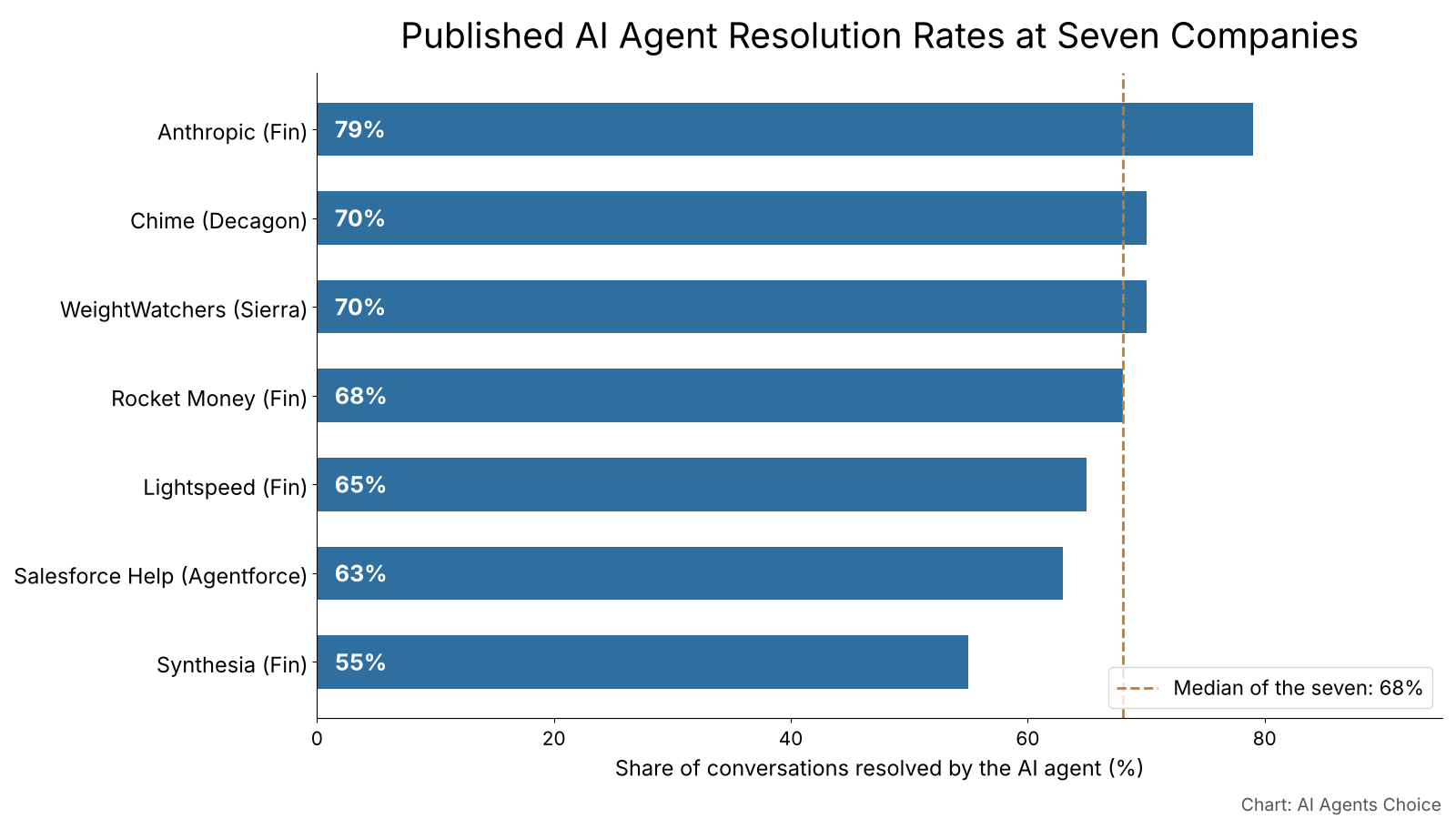
In our original research we found that the median of the seven is 68%, and the mean is 67%. Also, Klarna’s two-thirds share of chats lands in the same range. As a result, we used 68% in our 10,000-chat model. For a wider set of agents in this field, browse our customer support AI agents category.
Why Vendors Count a Resolution Differently
Each vendor defines a resolution in its own way, so read the rates with care. For example, Fin counts a chat as resolved when the customer confirms the fix. It also counts a chat where the customer leaves without asking for more help. In fact, 24 hours of silence after Fin’s last answer counts as a resolution.
Zendesk works differently. Since May 18, 2026, it splits AI outcomes into contained and verified resolutions. A verified one must pass a check by a language model. By contrast, Decagon’s Duolingo story reports deflection, which counts chats kept away from humans. So a 70% resolution rate and an 80% deflection rate do not measure the same thing.
Smaller teams can also compare Lyro by Tidio and the Gorgias AI Agent in our directory.
When Cutting Support Staff Backfires
However, several 2026 statistics point the other way. Gartner predicted in February 2026 that half of the companies that cut service staff due to AI will rehire by 2027. Those hires will do similar work under new job titles.
- In a survey of 5,801 US customers, Gartner found that 54% trust human agents more than AI for product or service advice. Only 32% trust AI more.
- Gartner also expects AI rules to raise assisted service volume by 30% by 2028.
So the savings in the vendor case studies may shrink over time. First, AI prices per resolution are forecast to rise. Second, new rules may push more chats back to humans. That is why we suggest modeling a range of prices. Our agentic AI statistics page tracks wider trends in ROI and failure rates.
Productivity Gains for Human Agents Using AI
Cost cuts also come from making human agents faster. For this, we used “Generative AI at Work,” an NBER working paper from April 2023. Its authors are Erik Brynjolfsson, Danielle Li and Lindsey Raymond.
- The study tracked 5,179 customer support agents.
- Access to an AI assistant raised issues resolved per hour by 14% on average.
- For novice and low-skilled agents, the gain was 34%.
We applied the 14% figure to our wage math. An agent who resolves 14% more issues per hour lowers the wage cost of each issue by about 12%. Then again, that gain applies only to chats humans still handle. For example, a $3.95 human chat would drop to about $3.46.
Next, we added that gain to our 10,000-chat Fin scenario. There, humans still handle 3,200 chats. With a 14% speed gain, their wage cost falls from $12,631 to about $11,080. As a result, the monthly total drops to about $17,812, which is 55% lower than the all-human baseline. Our explainer on AI agents vs AI chatbots covers how assist tools differ from agents that act alone.
Support Leaders’ Questions on AI Cost Savings
How Much Does an AI Customer Support Agent Cost per Resolution?
Published prices run from $0.99 per outcome for Intercom Fin to $2 per conversation for Salesforce Agentforce. However, Gartner expects generative AI cost per resolution to pass $3 by 2030.
How Much Did Klarna Save With AI Customer Service?
In February 2024, Klarna estimated a $40 million profit improvement from its assistant that year. Also, the assistant did the work of 700 full-time agents in its first month.
What Resolution Rate Should a Support Team Expect From an AI Agent?
The seven published rates we compiled range from 55% to 79%. Their median is 68%, so we use that figure as a planning base.
Are Companies Cutting Support Staff Because of AI?
Some are. In Gartner’s March 2026 release, 20% of service leaders had reduced headcount due to AI. Yet 63% are cutting headcount slowly through attrition instead. Gartner also expects half of the firms that cut staff to rehire by 2027.
Is AI Support Cheaper Than Offshore Agents?
Gartner’s January 2026 forecast implies that it often is today. That is because Gartner says AI cost per resolution will pass many offshore consumer agent costs only by 2030. Also, see our AI agent market size statistics for how fast vendor revenue is growing.
Related AI Agents


Read also: Enterprise AI Agent Adoption Statistics by Size, Stage and Region
Explore Agent Categories
Related Articles
 GuidesWonderful AI Alternatives for Enterprise Customer Service Agents
 ComparisonsFin vs Gorgias AI Agent: Which Support Agent Fits Your Store
 Guides100 AI Agent Statistics for Retail Companies
 GuidesNewest AI Agent Statistics for Small Businesses
 GuidesEnterprise AI Agent Adoption Statistics by Size, Stage and Region
 GuidesAgentic AI Statistics: Adoption, ROI, Jobs and Pricing Data
