

Agentic AI is the shift from chatbots that answer to software that plans, uses tools and finishes a task on its own. You do not need a degree to learn it, and several of the best courses for beginners are free, and two of them give you a certificate at no cost.
For most people, the best place to start is the free Hugging Face AI Agents Course or Microsoft’s AI Agents for Beginners on GitHub. If you want the clearest teaching on how agents think, Andrew Ng’s Agentic AI course from DeepLearning.AI is the strongest pick, while non-coders should look at Vanderbilt’s course for leaders on Coursera. Once the basics click, short courses on LangGraph, crewAI and MCP teach the tools that real teams use.
TL;DR: Start with the Hugging Face AI Agents Course if you want a free certificate, or Microsoft AI Agents for Beginners if you learn best from code and short videos. Take DeepLearning.AI’s Agentic AI course to learn the design patterns behind every agent, with Pro needed for the labs and certificate. Pick Vanderbilt’s leaders course on Coursera if you do not code. Add LangGraph, crewAI or MCP courses once you are ready to build with a real framework.
Which Agentic AI Course to Start With
- The Hugging Face AI Agents Course is free, and its certificates are free too. You earn a fundamentals certificate after Unit 1, with no deadline.
- Andrew Ng’s Agentic AI course runs 9 hours and 55 minutes. You can watch the videos for free, but labs, graded work and the certificate need DeepLearning.AI Pro at $25 a month billed yearly or $30 billed monthly.
- Microsoft’s AI Agents for Beginners is a free GitHub course with a short video per lesson and code that runs on the free GitHub Models tier.
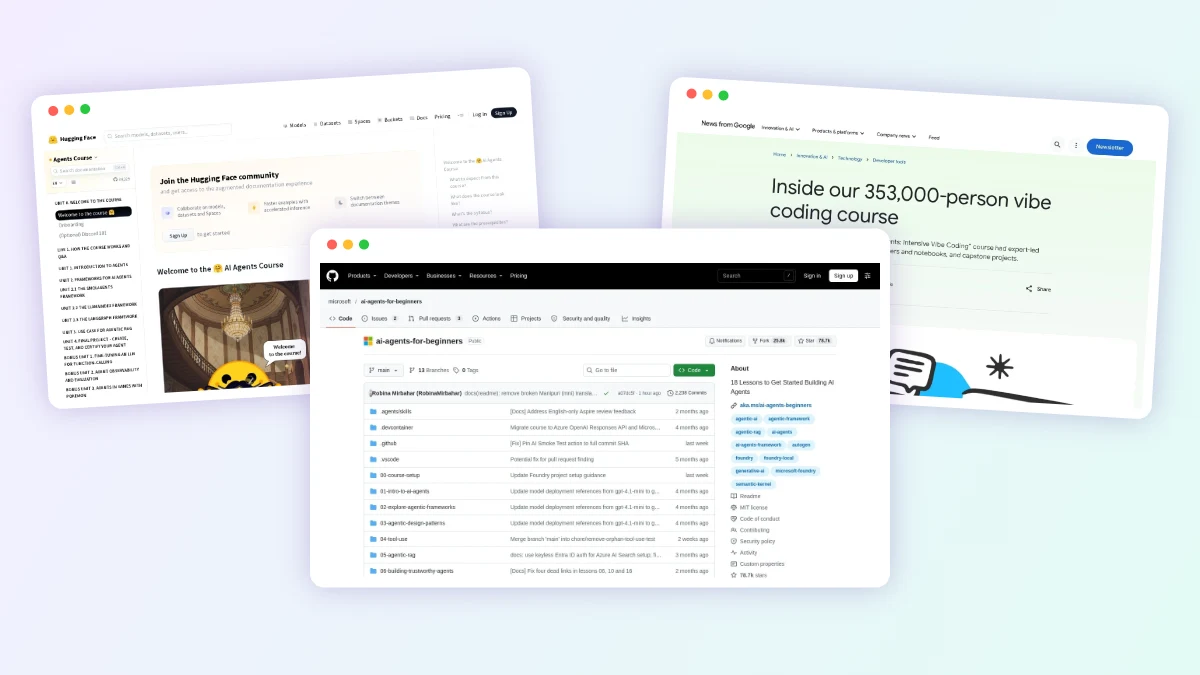
- Google and Kaggle’s five-day agents course drew more than 353,000 registrations in June 2026, and the material stays online as a self-paced Kaggle Learn guide.
- LangChain Academy’s Introduction to LangGraph is free, with 55 lessons and 6 hours of video.
- Most good agent courses expect basic Python. Vanderbilt’s leaders course is the main option here built around custom GPTs and prompting instead.
Quick Comparison of the Best Agentic AI Courses
Prices and formats below come from each provider’s own course page at the time of writing (November 2026). Coursera programs can be previewed for free, but a certificate needs paid enrollment or a Coursera Plus plan.
| Course | Provider | Level | Format/Length | Price | Certificate |
|---|---|---|---|---|---|
| Hugging Face AI Agents Course | Hugging Face | Basic Python | Self-paced units, about 3 to 4 hours a week | Free | Free |
| AI Agents for Beginners | Microsoft | Beginner | GitHub lessons with short videos and code | Free | No |
| Agentic AI | DeepLearning.AI | Intermediate | Video course, 9h 55m, 5 modules | Free to watch; Pro $25/month billed yearly | With Pro |
| 5-Day AI Agents Intensive | Google and Kaggle | Vibe coding focus | Five-day course, now a self-paced guide | Free | None listed |
| AI Agent Developer Specialization | Vanderbilt University (Coursera) | Beginner | 6 courses, about 2 months at 10 hours a week | Paid enrollment or Coursera Plus | Yes |
| Agentic AI and AI Agents for Leaders | Vanderbilt University (Coursera) | Beginner | 3 courses, about 4 weeks at 3 hours a week | Paid enrollment or Coursera Plus | Yes |
| Multi AI Agent Systems with crewAI | DeepLearning.AI | Beginner | Short course, 3h 6m | Free during platform beta | With Pro |
| Introduction to LangGraph | LangChain Academy | Python | 6 modules, 55 lessons, 6 hours of video | Free | None listed |
| Introduction to Model Context Protocol | Anthropic Academy | Working Python | Self-paced lessons with a final assessment | Free | Yes |
| RAG and Agentic AI Professional Certificate | IBM (Coursera) | Advanced | 10 courses | Paid enrollment or Coursera Plus | Yes |
The 10 Best Agentic AI Courses for Beginners, Ranked by Goal
We ranked these courses by how well they serve someone starting from zero. The list moves from free, broad foundations to framework courses and, last, a longer career program. We did not take every course end to end, so each summary is based on the provider’s published syllabus, pricing and requirements.
1. Hugging Face AI Agents Course: Best Free Course With a Certificate
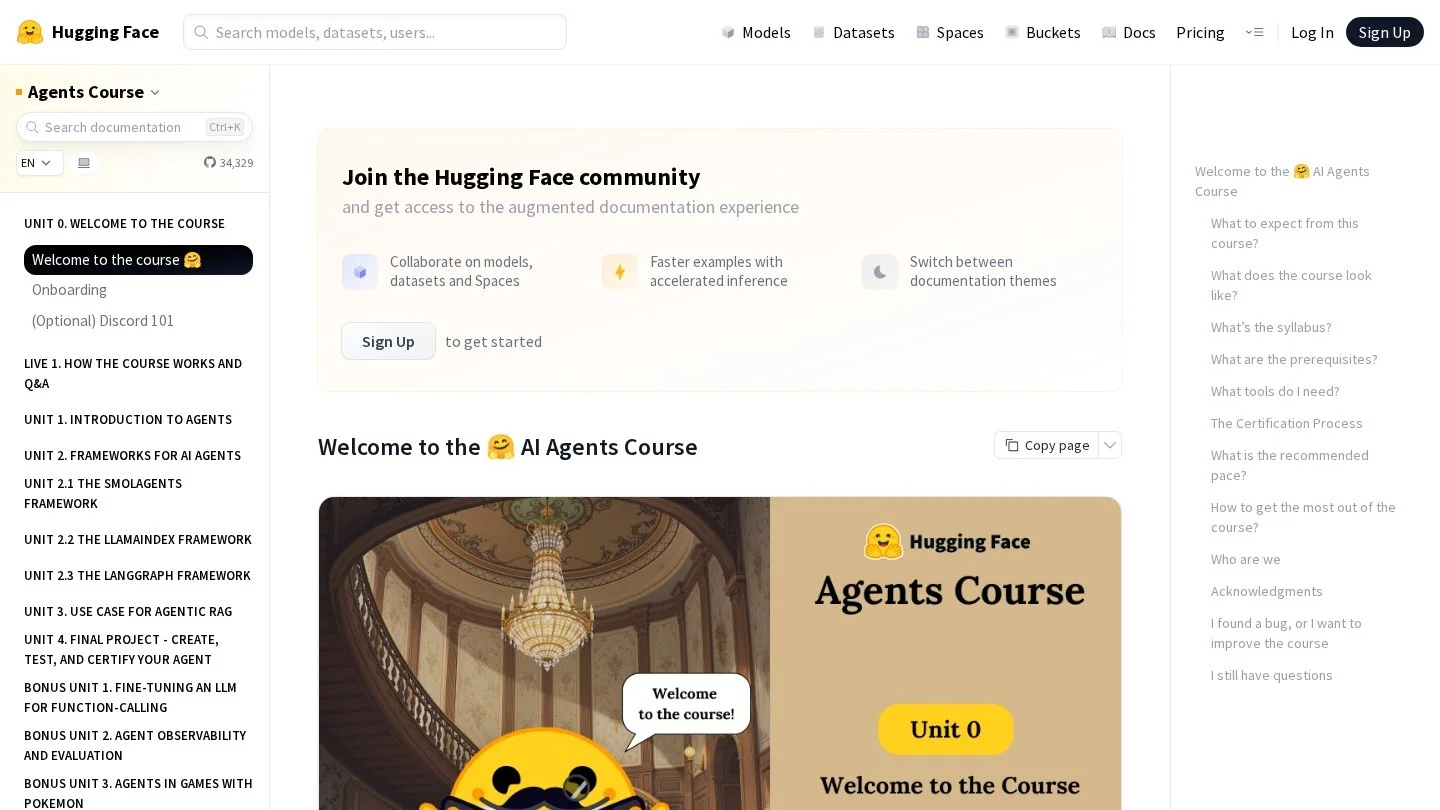
Hugging Face built this course to take you from “what is an agent” to a working one you submit for grading. It has four main chapters (agent fundamentals, frameworks, use cases and a final assignment), and each chapter is planned as about one week of work at 3 to 4 hours a week, so the core path fits into a month of evenings.
The framework chapter is the part most beginners will value, because instead of betting on one library, it walks through three of them: smolagents, LlamaIndex and LangGraph. Seeing the same ideas in three styles teaches you what is common to all agents and what is just one library’s habit. Bonus units cover fine-tuning a model for function calling, agent observability and evaluation, and agents that play Pokemon.
The certificate rules are simple: finish Unit 1 and you earn a Certificate of Fundamentals. Finish Unit 1, one use case assignment and the final challenge and you earn the full certificate of completion. There is no deadline, and you can also audit without signing up for certification. You need basic Python, a basic idea of how LLMs work and a free Hugging Face account.
Pricing: Free, including both certificates.
Pros
- Completely free, with two levels of certificate
- Covers three frameworks, so you can compare them early
- No deadline, so you can move at your own pace
- Bonus units on evaluation and observability go beyond the basics
Cons
- Assumes some Python, so true beginners may need a short Python primer first
- Mostly text and notebooks, with less video teaching than DeepLearning.AI
Best for: Self-starters who want a free, recognized certificate and hands-on practice with more than one framework.
2. Microsoft AI Agents for Beginners: Best Free Code-First Curriculum

Microsoft’s course lives in a public GitHub repository, where each lesson pairs a written guide with Python code samples and a short video. You fork the repo and run the code yourself, which is the fastest way to see an agent call a tool and change its plan.
The lessons follow a sensible order and start with what agents are and when to use them, then move through agent frameworks, design patterns, tool use, agentic RAG and how to build trustworthy agents. Later lessons cover planning, multi-agent systems, metacognition and running agents in production. Newer lessons add agent protocols such as MCP and A2A, plus context engineering. The original code samples use Microsoft’s Semantic Kernel and AutoGen. Once you finish, the Microsoft Agent Framework is the natural next step.
Cost is close to zero, since the samples work with GitHub Models, which has a free tier, or with Azure AI Foundry if you already use Azure. The course has been translated into more than 40 languages, and if you are brand new to generative AI, Microsoft suggests its 21-lesson Generative AI for Beginners course first.
Pricing: Free. Code samples run on the free GitHub Models tier or on Azure AI Foundry.
Pros
- Free, open and easy to fork
- Short videos plus runnable code for each lesson
- Covers production topics like trust, safety and deployment
- Available in dozens of languages
Cons
- No certificate
- Leans toward Microsoft tools and Azure services
- You need to be comfortable with Git and a code editor
Best for: Hands-on learners who want a free, structured path and do not need a certificate.
3. DeepLearning.AI Agentic AI: Best for Learning How Agents Think
Andrew Ng teaches this course himself, and it is one of the clearest introductions to agent design you can take. It runs 9 hours and 55 minutes across 31 video lessons and five modules, which cover agentic workflows, the reflection pattern, tool use, practical tips for building agents and patterns for highly autonomous agents.
What sets it apart is the method: Ng builds each pattern in plain Python from first principles before looking at frameworks. That means you learn why an agent reflects on its own output, or how it picks a tool, without a library hiding the logic. The examples are practical: a research agent, chart generation with reflection, better SQL generation, an email assistant, a customer service agent and a multi-agent market research team. A later module also adds evals so you can measure whether changes help.
DeepLearning.AI labels the course intermediate and asks for intermediate Python plus a basic grasp of LLMs and APIs. A motivated beginner can still follow the videos, and the same course is also listed on Coursera, where DeepLearning.AI marks it as intermediate with five modules.
Pricing: Free to audit the videos and forum. Labs, quizzes, 8 graded assignments and the certificate need DeepLearning.AI Pro, at $25 a month billed yearly or $30 billed monthly.
Pros
- Taught by Andrew Ng, with very clear explanations
- Builds patterns from scratch, so the ideas transfer to any framework
- Covers evals and error analysis, which many beginner courses skip
- Realistic example projects you can copy
Cons
- Hands-on labs and the certificate are behind Pro
- Rated intermediate, so complete beginners may need to rewatch parts
Best for: Anyone who wants to understand agent design deeply before choosing a framework.
4. Google and Kaggle 5-Day AI Agents Intensive: Best Short Crash Course

Google and Kaggle first ran a five-day agents course in November 2025, and Google says more than 1.5 million people took part. The June 2026 edition, called the 5-Day AI Agents: Intensive Vibe Coding Course with Google, drew more than 353,000 registrations. It focused on building with natural language prompts and on the full life cycle of designing, securing and deploying agents in the cloud.
Each day mixes expert-led sessions, technical whitepapers, notebooks and codelabs, and during the live run, learners worked together on Discord, and over 6,000 capstone projects were submitted. The live event is over, but Google says all the course content remains available as a self-paced Kaggle Learn guide.
This is a good choice if you learn best under a little time pressure, because you can treat it as a five-day sprint, read one whitepaper and finish one notebook each day. If you enjoy the Google stack, the natural next step is Google’s own Agent Development Kit.
Pricing: Free.
Pros
- Free and short enough to finish in a week
- Whitepapers give solid theory alongside notebooks
- Covers security and deployment, not only prototypes
Cons
- Live sessions and community events only happen during the scheduled run
- Built around Google tools and models
Best for: Busy learners who want a fast, free overview with real code.
5. Vanderbilt AI Agent Developer Specialization: Best Structured Path on Coursera

Dr. Jules White of Vanderbilt University runs this six-course program on Coursera, and Coursera marks it as beginner level. It needs basic Python but no prior AI or machine learning knowledge, which makes it one of the few agent programs built for people who can code a little but have never trained a model.
The first two courses are the agent core: AI Agents and Agentic AI with Python and Generative AI, then AI Agents and Agentic AI Architecture in Python. The rest round out the skills you need around agents: building custom GPTs, prompt engineering for ChatGPT, advanced data analysis and trustworthy generative AI. Coursera estimates about two months at 10 hours a week.
Learners rate the program well, and Coursera shows a 4.8 average from 10,658 reviews of courses in the program, and more than 52,000 people have enrolled. You get a shareable career certificate when you finish.
Pricing: Included with Coursera Plus, or paid enrollment. Coursera offers financial aid for eligible learners.
Pros
- Clear beginner level with a Python on-ramp
- Strong reviews across a large number of learners
- Shareable certificate from a university
Cons
- Half the program covers prompting and ChatGPT rather than agents
- Not free to complete
Best for: Learners who want a guided, university-backed path with deadlines and a certificate.
6. Vanderbilt Agentic AI and AI Agents for Leaders: Best for Non-Coders

Not everyone who needs to understand agents will write code, so this three-course program, also taught by Jules White, is aimed at managers and business owners. It starts with a primer on agentic AI for leaders, then teaches you to build custom AI assistants with OpenAI GPTs and to write better prompts for ChatGPT.
The goal is better decision-making, so you learn how to plan where agents fit in a team, how to deploy them as internal chatbots and how to automate work safely. Coursera estimates about four weeks at three hours a week. The program shows a 4.8 average from more than 10,000 reviews and over 58,000 enrollments.
Pair it with our guide to AI agents versus AI chatbots so you can tell the difference when vendors pitch you. When you want to build something yourself, look at no-code AI agent builders such as n8n.
Pricing: Included with Coursera Plus, or paid enrollment, with financial aid available.
Pros
- No programming focus, so anyone can follow it
- Built around strategy and safe rollout
- Short enough to finish in about a month
Cons
- Does not teach you to code an agent
- Relies on OpenAI products for the hands-on parts
Best for: Managers, founders and non-technical staff who need to lead agent projects.
7. Multi AI Agent Systems with crewAI: Best First Multi-Agent Project
João Moura, the founder of CrewAI, teaches this short course on DeepLearning.AI. It is marked beginner and runs 3 hours and 6 minutes, with 18 video lessons and 7 code examples. You only need a basic familiarity with coding and prompting.
The course teaches the idea of a “crew”: several agents, each with a role, that hand work to one another. You learn about roles, short-term and long-term memory, tools, guardrails against loops and errors, and ways to organize agents in sequence, in parallel or under a manager agent. Each lesson ends with a crew for a real business task, such as tailoring a resume, writing a research article, handling support tickets, planning an event or doing a financial analysis.
This is the most business-friendly introduction to multi-agent systems on the list, and seeing six working crews makes it easier to spot where a team of agents could help in your own company.
Pricing: Free to take during the DeepLearning.AI platform beta, which the provider says is for a limited time. The graded assignment and certificate need Pro.
Pros
- Taught by the framework’s founder
- Short and beginner level
- Six business projects you can adapt
Cons
- Focused on one framework
- Free access is limited to the platform beta period
Best for: Beginners who want to build a team of agents for a business task in an afternoon.
8. LangChain Academy Introduction to LangGraph: Best Free Framework Deep Dive

LangGraph is a framework for building agents that need control, memory and human review. LangChain, the company behind it, offers this free course in Python with six modules, 55 lessons and about six hours of video.
The modules build on each other: you start with the basics, then add state and memory, human-in-the-loop steps and user experience, then build a full assistant. The last two modules cover long-term memory and deployment. By the end, you have seen the parts that make an agent dependable in production, not just a demo.
Take this after one of the broad courses above, since it assumes you know what tool use and reflection are. Our LangGraph profile and guide to the best AI agent frameworks explain where it fits next to other options.
Pricing: Free.
Pros
- Free and made by the framework’s own team
- Covers memory, human review and deployment
- Long enough to go beyond toy examples
Cons
- Not a first course on agent ideas
- Python only
Best for: Learners who have the basics and want to master one serious framework for free.
9. Anthropic Academy Introduction to Model Context Protocol: Best for Connecting Agents to Tools

Agents become useful when they can reach your files, applications and data. Model Context Protocol, or MCP, is the open standard many agent tools now use for that connection. This free course from Anthropic teaches you to build MCP servers and clients in Python.
You learn the three core parts of MCP: tools, resources and prompts. You define tools, test them with the MCP Server Inspector, write a client, and then add resources and prompts. The course ends with a final assessment, and Anthropic asks for working Python and a basic grasp of JSON and HTTP requests.
MCP shows up in many other courses on this list, including Microsoft’s lessons on agent protocols and IBM’s certificate. Learning it on its own makes the rest much easier to follow.
Pricing: Free.
Pros
- Free and focused on one high-value skill
- Hands-on, with a real server and client
- Skills carry over to many agent platforms
Cons
- Narrow by design, so it will not teach agent design
- Needs some Python and API experience
Best for: Developers who want their agents to use real tools and data.
10. IBM RAG and Agentic AI Professional Certificate: Best Career Certificate

This is the longest program here and the one aimed most at jobs, with 10 courses, and the listed course times add up to about 101 hours. It covers building generative AI apps, retrieval-augmented generation, vector databases, multimodal apps, AI agents, MCP and a capstone project.
The framework coverage is wide, and you work with LangChain, LangGraph, CrewAI, AG2 (AutoGen) and BeeAI, plus tools such as Chroma, FAISS, LlamaIndex, Gradio and Flask. The program shows a 4.6 average from 1,174 reviews and more than 120,000 enrollments.
Be honest with yourself about the level, because Coursera rates the full certificate as advanced and asks for working Python plus basic web development. A good bridge is its sixth course, Fundamentals of Building AI Agents, which IBM lists at intermediate level with three modules and six hands-on labs. If it feels comfortable, the rest of the program will too.
Pricing: Included with Coursera Plus, or paid enrollment. You can enroll for free to preview the content.
Pros
- The broadest framework coverage on the list
- Ends with a capstone you can show employers
- Shareable professional certificate from IBM
Cons
- Rated advanced, so it is a second step for most beginners
- Long, at about 101 hours of listed course time
Best for: Career changers who already know some Python and want a portfolio-ready certificate.
Read also: 10 Best Agentic AI Tools for Coding
A Simple Learning Path for Your First Two Months
Many beginners lose time by starting with a framework, and a better order is ideas first, then one framework, then connections to real tools. This plan uses only free or low-cost courses from the list.
In weeks one and two, watch the free videos in DeepLearning.AI’s Agentic AI course, or take the Google and Kaggle intensive as a five-day sprint. Your aim is to understand four patterns: reflection, tool use, planning and multi-agent work. Keep notes on the specific problem each pattern solves.
In weeks three to six, do the Hugging Face AI Agents Course or Microsoft AI Agents for Beginners. Both make you write and run code, so earn the Hugging Face fundamentals certificate after Unit 1 if you want proof of progress. Our guide to building an AI agent from scratch is a good companion here.
In weeks seven and eight, pick one framework course, such as LangGraph or crewAI, and add the MCP course. Then build one small project for your own business, like a research helper or a support triage agent. Browse real AI agent examples for ideas you can copy.
How To Choose the Right Agentic AI Course
The best course is the one you will actually finish, and these five questions will narrow the list quickly.
Can You Write Basic Python?
Almost every course here assumes some Python, so if you have never coded, start with Vanderbilt’s leaders program or a short Python primer. If you can write a loop and call a function, the Hugging Face, Microsoft and crewAI courses are within reach.
Do You Need a Certificate?
If a certificate matters for your resume, Hugging Face offers the strongest free one on this list. DeepLearning.AI certificates need Pro, and Coursera certificates need paid enrollment or Coursera Plus. If you only want the skills, Microsoft’s GitHub course and LangChain Academy are free and thorough.
Concepts or a Specific Framework
Learn concepts first, because Andrew Ng’s course and the Microsoft lessons teach ideas that work in any tool. After that, choose one framework your team or target employer uses. Our agent frameworks category lists the main options.
How Much Time You Really Have
Be realistic about your schedule: the crewAI course takes about three hours, while the Vanderbilt developer program runs about two months at 10 hours a week. If you only have evenings, a short course you finish beats a long one you abandon.
Who Pays for the Model
Agents call language models, and those calls can cost money. Microsoft’s samples run on the free GitHub Models tier, and Hugging Face needs only a free account. Courses built on paid APIs may need a small budget, so check the setup page before you start.
Questions Beginners Ask About Agentic AI Courses
What Is Agentic AI in Simple Terms?
Agentic AI is AI that can plan steps, use tools and act toward a goal with little help. A chatbot answers one question, while an agent can search, write code, call an API, check its own work and keep going until the job is done.
Can I Learn Agentic AI Without Coding?
Yes, at the level of understanding and planning. Vanderbilt’s Agentic AI and AI Agents for Leaders program focuses on custom GPTs, prompting and strategy. To build your own agents, you will want basic Python or a no-code agent builder.
Which Agentic AI Course Is Free With a Certificate?
The Hugging Face AI Agents Course is free, and so are its certificates. You get a fundamentals certificate after Unit 1 and a full certificate after the use case assignment and final challenge.
How Long Does It Take To Learn Agentic AI?
You can learn the core ideas in a week with the Google and Kaggle intensive or Andrew Ng’s 10-hour course. Building agents with confidence usually takes a few months of practice, which matches the two-month estimate for Vanderbilt’s developer program.
Should I Learn LangGraph or CrewAI First?
CrewAI is quicker to start with because it uses roles and tasks that feel like a human team. LangGraph gives you more control over state, memory and human review. Many people try crewAI first and move to LangGraph for production work.
Want to see what agents can do once you have learned the basics? Browse our list of free AI agents and try a few in your own work.
Related AI Agents




Read also: AI Agent Human Intervention Rates
Explore Agent Categories
Related Articles
 GuidesAgentic AI Statistics: Adoption, ROI, Jobs and Pricing Data
 Guides10 Best Agentic AI Tools for Coding
 GuidesSynthesia AI Video Usage Among Corporate Training Teams
 GuidesBest CAMEL AI Alternatives and What They Cost
 Guides100 AI Agent Statistics for Retail Companies
 GuidesLLM or AI Agent? AI Search Engines and What They Actually Are
