Asking if your AI agent is solving the right problem means testing the task before you trust the tool. An AI agent is the right pick when a task needs judgment, has no fixed path and ends in a result you can check. When a task fails those tests, a plain workflow or a single model call does the job for less money. That is the core advice in Anthropic’s Building Effective Agents and in OpenAI’s practical guide to building agents.
The cost of a poor pick shows up in the survey data. In October 2026, Gartner found that only 13% of 2,002 CIOs had seen major or transformational value from AI. The same survey put the odds of any one AI use case working at about one in five. In customer service, just 4% of leaders had reached the return they expected from AI by August 2026.
What follows is a ten-question fit test, six cases where an agent is the wrong tool, and a scored example from a support team. After that come the numbers to track and the stop rules to set before a pilot starts.
What Solving the Right Problem Means for an AI Agent
An AI agent solves the right problem when the task needs the model to choose its own next step and the result can be checked. Anthropic draws a line between two kinds of systems. Workflows run models and tools through code paths you write in advance. Agents let the model direct its own process and pick its own tools as it goes.
So the real test is how much of the path you can write down before the work starts. If you can write the whole path, you want a workflow. If the number of steps changes from case to case, an agent starts to make sense. Anthropic places agents in open-ended problems where it is hard or impossible to predict how many steps a job will take.
OpenAI’s guide adds three signs that a task needs an agent:
- Complex decisions. The work turns on judgment, exceptions or context, as when a support team decides if a refund should go through.
- Rules that are hard to keep up. The rule set has grown so large that each change is risky, as in vendor security reviews.
- Lots of unstructured data. The task means reading documents or plain language, such as a home insurance claim.
When a use case cannot meet these tests, a fixed, rule-based system may be enough. Payment fraud is the classic contrast. A rules engine flags a payment by ticking through a checklist. An agent can spot a suspect payment even when no single rule breaks. So fraud review is one of the jobs where the extra cost can pay back.
Why So Many AI Agent Projects Miss the Mark
Many AI agent projects miss because teams pick tasks with unclear value, high running costs or weak risk controls. Gartner named those three causes in June of last year. At the time, it predicted that over 40% of agentic AI projects will be canceled by the end of 2027. Gartner also put the number of vendors with real agent products at about 130 out of thousands. It calls the rest agent washing, where old chatbots and RPA tools get a new label.
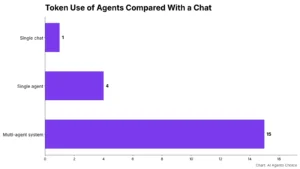
Cost is the second trap. In the October 2026 Gartner survey, 58% of CIOs faced more pressure to show AI cost savings. Also, 51% expected AI to raise the total cost of their tech stack. Agents make this harder because they read and write far more text than a chat. In June of last year, Anthropic put the token use of agents at about 4 times that of a chat. Multi-agent systems used about 15 times as many.
The third trap is aiming the agent at head count. In a Gartner survey of 321 service leaders in October of last year, only 20% had cut agent staff because of AI. Gartner now predicts that half of the firms that cut service staff due to AI will hire for the same work again by 2027.
Few firms have moved past the pilot stage either. In McKinsey’s State of AI survey from August 2026, about two in ten respondents were scaling agents across their firm. At firms with over $1 billion in revenue, the share was 40%, up from 27% a year before. About one in ten named cost as a limit on their use of agents.
AI Agent Problem Fit Checklist
The AI agent problem fit checklist has ten questions, and a task that fails any of the first four belongs in a workflow. Run each candidate task through the table before anyone writes a prompt.
| Question | Pass sign | Fail sign |
|---|---|---|
| 1. Does the path change from case to case? | Steps differ each time | Same steps every time |
| 2. Does the task need judgment on exceptions? | Odd cases are common | A lookup table covers it |
| 3. Is the input messy text, files or speech? | Emails, PDFs, calls | Clean form fields |
| 4. Can you check the result? | A test, ledger or reply proves it | Nobody can tell if it was right |
| 5. Is there enough volume? | Hundreds of cases a week | A few cases a month |
| 6. Is a mistake cheap to undo? | A draft or a small refund | A wire transfer or deleted data |
| 7. Can the agent reach the data and tools? | APIs or MCP servers exist | Data lives in inboxes or heads |
| 8. Do you know the current numbers? | Time, cost and error rate per case | No baseline yet |
| 9. Does one person own the outcome? | A named owner with a budget | Owned by the AI team in general |
| 10. Is each case worth the token cost? | Each case is worth dollars | Each case is worth cents |
Question 4 does the most work. Anthropic points to coding as a natural agent task because tests can prove the code runs. The agent then uses the test results to try again. Support passes for a similar reason, since each case ends as resolved or not.
Question 8 is the one teams skip. OpenAI advises building the first version with the most capable model to set a baseline, then trying smaller models where accuracy holds. You also need the baseline for the human process. Without it, no one can prove the agent helped.

Read also: What Is an AI Agent Playbook?
When Not to Use an AI Agent
Skip the AI agent when the steps are fixed, the task takes one step, the action can’t be undone or nobody can check the output. Each case has a cheaper build that does the job better.
Fixed Steps Belong in a Workflow
A task with fixed steps runs cheaper and more reliably as a workflow. Matching an invoice to a purchase order, or routing a ticket by product name, follows the same path every time. A tool from our workflow automation list handles it with no model at all, or with one model call for a single step. The full trade-off sits in our guide to autonomous AI agents vs workflow automation.
One-Step Tasks Need One Model Call
A one-step task needs a single model call, often with retrieval and a few examples. Anthropic’s advice is to find the simplest solution and add parts only when they improve results. That may mean building no agent at all. Summing up a call, tagging a ticket and drafting a reply are all one-step jobs.
Actions That Cannot Be Undone
Actions that cannot be undone should never run on an agent without a person in the loop. OpenAI puts canceling orders, approving large refunds and making payments in the group of actions that need human sign-off until the agent has proved itself. If all the value of a task sits in that one risky action, the agent saves little time once you add the approval step.
Results Nobody Can Check
A task with no way to check the result makes a poor agent task, because errors pile up unseen. Anthropic warns that agent autonomy brings higher costs and the risk of compounding errors. A strategy memo or a market summary has no right answer to check against. So a reviewer has to redo much of the work just to judge it.
Long Chains With No Checkpoints
Long chains of steps with no check in between are where agents break most often. In a study of agents in production posted to arXiv in February 2026, 68% of deployed agents ran fewer than 10 steps. After that, a person stepped in. Nearly half, 47%, ran fewer than 5. Teams that ship agents keep each run short and add checks between stages.
Multi-Agent Setups for Simple Jobs
Splitting a simple job across several agents usually costs more than it returns. Anthropic’s January 2026 guide to multi-agent systems puts their token use at 3 to 10 times that of a single agent for the same task. It also tells of a team that spent months on a multi-agent design, then got the same results by improving the prompt of one agent. Extra agents pay off in three cases. One agent’s context gets cluttered, parts of a task can run side by side, or specialist agents pick tools better.
Agent, Workflow or Single Model Call: Picking the Build
The right build depends on how many steps a task has and who decides them. Use the cheapest row that can do the job.
| Build | Who picks the next step | Cost per task | Use it for | Example |
|---|---|---|---|---|
| Single model call | No one, there is one step | Lowest | Drafts, tags, summaries | Tag a ticket by topic |
| Workflow | Your code | Low and steady | Fixed multi-step jobs | Match an invoice, then post it |
| Single agent with tools | The model | Higher, varies per run | Open tasks with a check at the end | Fix a failing test |
| Multi-agent system | Several models | 3 to 10 times a single agent | Broad research that splits into parts | Scan 20 sources on one market |
OpenAI’s advice for the two agent rows is to get the most out of one agent before adding more. Frameworks such as the OpenAI Agents SDK let you begin with one agent and add handoffs later. Many tools sold as agents sit in the workflow row. That is fine, as long as you pay workflow prices for them.
Three Support Tasks Scored Against the Checklist
Scored against the checklist, only refund requests pass the fit test, while order status checks and password resets work better as workflows. A typical online store’s support team handles all three every day.
| Task | Path changes? | Needs judgment? | Messy input? | Result can be checked? | Cost of a mistake | Best build |
|---|---|---|---|---|---|---|
| Order status | No | No | A little | Yes | Low | Workflow with one model call |
| Password reset | No | No | No | Yes | High, account takeover | Workflow with an ID check |
| Refund with exceptions | Yes | Yes | Yes, photos and emails | Yes, in the refund ledger | Low under a cap | Agent with a refund cap |
The refund task scores well because each case looks different. One customer sends a photo of a broken mug. Another sends a late tracking number, and a third has one missing item in a large order. An agent can read the message, check the order, apply the policy and draft the refund. Refunds under a set cap go through on their own. Above the cap, a person approves, in line with OpenAI’s advice on large refunds.
Order status fails because there is no judgment. A customer asks where a parcel is, and the answer comes from one lookup. One model call to read the message, plus a tracking API, does the job for a fraction of the cost. Password resets fail for a different reason, since the risk sits in proving who the customer is, and that belongs to a fixed identity check.
Klarna shows what the right kind of support task can return. Its AI assistant handled 2.3 million conversations in its first month, two-thirds of all its service chats, in February 2024. It did the work of about 700 full-time staff and cut repeat questions by 25%. Time to resolve a case fell from 11 minutes to under 2, and Klarna expected a $40 million profit gain for 2024.
Metrics That Show an AI Agent Is Solving the Right Problem
The metrics that show an AI agent is solving the right problem are resolution rate, escalation rate and cost per resolved task. Time to resolution, repeat contacts and how often people edit its work round out the set. Track each one against the human baseline from question 8.
| Metric | How to measure it | Warning sign |
|---|---|---|
| Resolution rate | Share of cases closed with no human help | Flat or falling after the first month |
| Escalation rate | Share of cases passed to a person | Rising week over week |
| Cost per resolved task | Model, tool and review costs divided by resolved cases | Higher than the human cost per case |
| Time to resolution | Minutes from first message to close | No faster than the human team |
| Repeat contact rate | Customers who come back on the same issue within 7 days | Higher than before launch |
| Human edit rate | Share of agent drafts a person changes | Most drafts get rewritten |
Quality is the main reason agents stall. In LangChain’s State of Agent Engineering survey of 1,340 people in late November and early December of last year, 57.3% had agents in production. Even so, 32% named quality as the biggest barrier, and latency came second at 20%. Only 52.4% ran offline evals, and 62% had detailed tracing.
Most teams still lean on people to judge output. In the February 2026 arXiv study, 74% of deployed agents relied on human review to rate their work. That review time belongs in the cost per task. Our page on AI agent human intervention rates has rates by vendor and benchmark. For test sets, see our guide to AI agent evaluation datasets.
Measure value to the customer as well as cost. In Gartner’s November 2026 survey of 275 service leaders, the advice was to run fewer, linked use cases with higher value. AI-forward service teams also spend about 1.8 times as much on data and knowledge work as on the use cases themselves. For ways to cut the token side of the bill, read our guide to controlling AI agent costs.
Set Stop Rules Before the Pilot Starts
Stop rules are limits you set before a pilot that end the project if the agent misses them. Typical ones are a cost per task and a minimum resolution rate. Most firms skip this step. In the October 2026 Gartner survey, only 31% of CIOs had rules for when a pilot should not move to production. Just 17% had rules for shutting down AI that already runs in production but brings little value.

The CIOs with the best results are far more likely to have stop rules. Gartner’s top group was 2.3 times as likely to have rules for halting pilots and 2.6 times as likely to have rules for retiring live AI. These five rules give a pilot a clean exit:
- A fixed end date. If the agent has not beaten the human baseline on cost or speed by that date, the pilot ends.
- A cost cap per task. Set the most you will pay for one resolved case, including review time, and track it weekly.
- A quality floor. Pick a minimum resolution rate and a maximum repeat contact rate before launch.
- A risk trigger. Any action that cannot be undone and ran without approval stops the agent until the cause is fixed.
- A review for live agents. Every quarter, compare each live agent with its first-month numbers and retire the ones that slipped.
Common Questions on Picking an AI Agent Task
Should I Buy an AI Agent or Build One?
Buy an AI agent when a vendor already covers your task and your data. Build one when the task depends on your own systems and rules. Building has become easier. In McKinsey’s 2026 survey, 32% of respondents had dropped at least one software purchase because agent coding tools let them build it in-house.
Can One AI Agent Handle Several Problems at Once?
One AI agent can handle several related tasks if they share the same tools and data. Problems start when the tool list grows long. Anthropic’s January 2026 guide flags tool overload once an agent has 15 to 20 or more tools, and notes that specialist agents pick tools better.
Who Should Own an AI Agent After Launch?
The team that owns the business process should own the agent after launch, with IT running the platform under it. Few firms have planned for this. In the October 2026 Gartner survey, only 4% of CIOs had plans to redesign roles for a workforce of people and agents.
How Long Should an AI Agent Pilot Run?
An AI agent pilot should run until it has handled enough real cases to compare with the baseline, and through at least one full business cycle. For a billing agent that means a full month-end run. For a support agent it means a normal week plus a busy one, such as a sale or a product launch.
Related AI Agents


Read also: Best Outreach AI Alternatives: Platforms, AI SDRs and Stacks