


A customer opens a support chat run by an AI agent. Roughly one time in four, that chat still ends without an AI resolution. AI agent human intervention rates climb on harder work. Claude Code users interrupt the agent in 5% to 9% of turns. On hard open-ended tasks, agents still fail about one attempt in three.
Each source counts intervention a little differently. Intercom, Salesforce, Sierra and Klarna publish vendor numbers. Anthropic’s study of agent autonomy and the Stanford AI Index 2026 cover harder work. So every figure here sits next to its definition.
Intervention Figures We Compiled From Vendors and Labs
We also added what each number actually counts, because a resolution rate and an escalation rate are not the same thing.
| Agent or study | Published figure | What it counts | Original source |
|---|---|---|---|
| Fin AI Agent (Intercom) | 76% average resolution rate | Conversations Fin resolved, across all conversations Fin joined | Fin AI instructions page and Intercom blog |
| Agentforce on Salesforce Help | About 76% resolved without a human | Customer queries on the Salesforce Help site | Salesforce customer story |
| Agentforce on Salesforce Help | 5% escalated to a human | Inquiries passed to a Support Engineer | Salesforce customer story |
| Homebase on Sierra | 70% of inquiries | Resolved fully and autonomously | Sierra customer story |
| Chime on Sierra | From 50% to over 70% | Resolution rate after the rollout | Sierra customer story |
| Klarna AI assistant | Two-thirds of chats | Share of customer service chats handled in month one | Klarna press release, February 2024 |
| Claude Code, new users | 5% of turns | Turns the user interrupted | Anthropic, Measuring AI agent autonomy in practice |
| Claude Code, experienced users | About 9% of turns | Turns the user interrupted | Same Anthropic study |
| Claude Code permission prompts | 93% approved | Manual permission prompts users accepted | Anthropic engineering post on auto mode |
| Claude API tool calls | 73% with a human in the loop | Tool calls with some human involvement, likely an upper bound | Same Anthropic study |
| Claude API tool calls | 0.8% irreversible | Actions that appeared impossible to undo | Same Anthropic study |
| Agents on structured benchmarks | About 1 in 3 attempts fail | Failure rate across agent benchmarks | Stanford AI Index 2026 |
We saw a clear split. Support agents now close most routine chats on their own. During open-ended work such as coding, people still step in often. For instance, experienced Claude Code users interrupt more often than new users, even though they approve more actions automatically.
Support Agents Leave About One Chat in Four Unresolved
Support is where vendors publish the most. So it gives the clearest view of real intervention rates. Still, each vendor defines a resolution its own way.
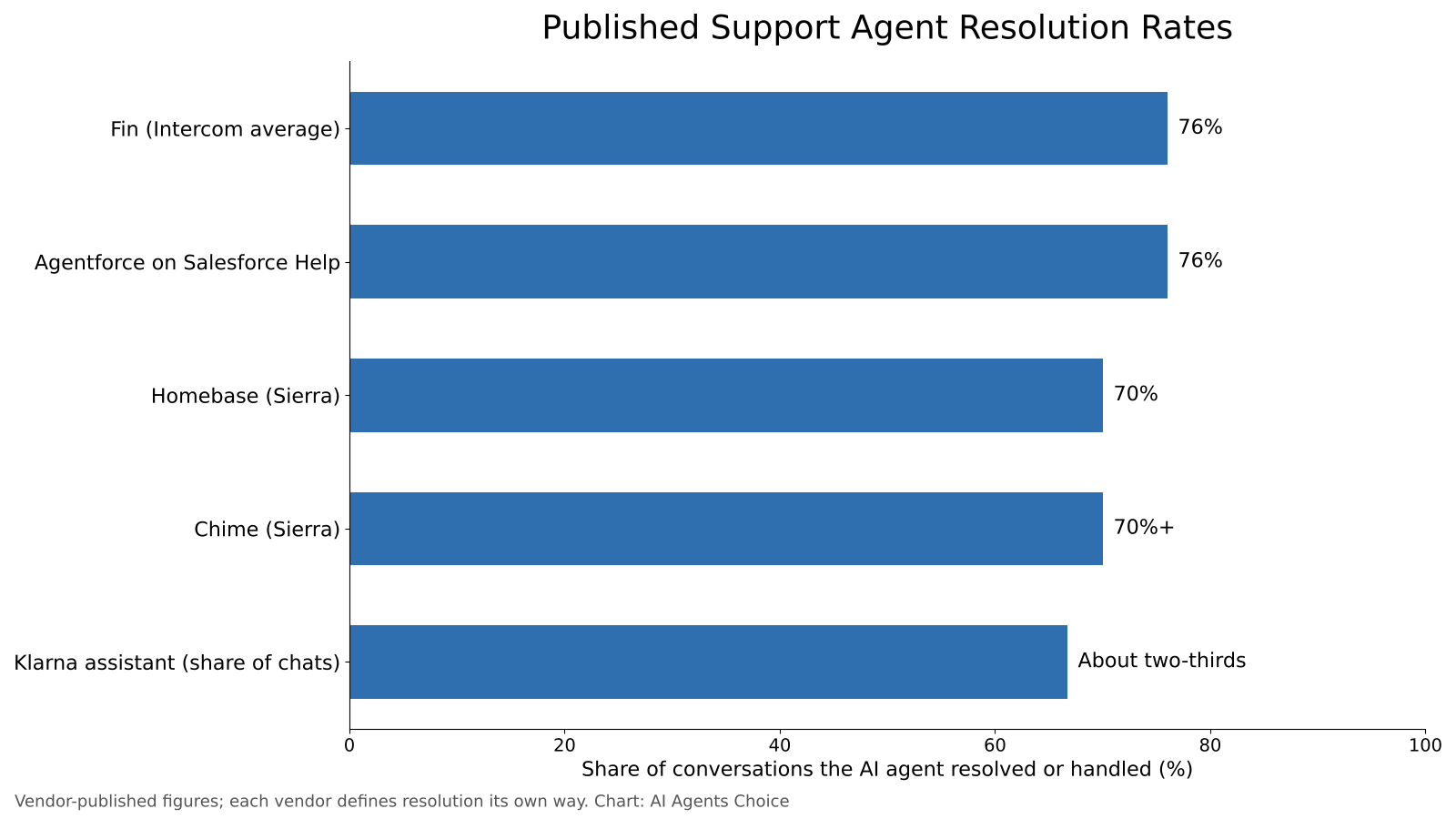
Fin Resolves 76% on Average
Intercom says Fin has an average resolution rate of 76%. The Fin AI Agent is used by more than 12,000 customers, and it handles over 2 million resolutions every week. Also, Intercom said in March 2026 that the rate has gone up every month.

The definition matters here. A Fin resolution counts when the customer confirms the answer helped, such as replying “That helped”. It also counts when the customer leaves for 24 hours after Fin’s last answer. However, a request for a person or a follow-up question marks the chat as unresolved. So the remaining 24% is a mix of human handoffs and open questions. You can compare Fin with its rivals on our Fin AI Agent page and in our Fin vs Gorgias comparison.
Agentforce Escalates 5% on Salesforce Help
Salesforce runs its own agent on its Help site. There, Agentforce resolves about 76% of customer queries without a human, and it has handled more than 1.7 million conversations. Also, it escalates only 5% of inquiries to a human Support Engineer.
Those two numbers do not add up to 100%, and that is useful to know. An escalation rate counts only formal handoffs. On the other hand, a resolution rate leaves out chats where the customer simply gave up or asked again later. So track both. More detail on the product sits on our Agentforce page.
Sierra Customers Report About 70%
Sierra publishes named customer stories. For example, Homebase says its agent now resolves 70% of all inquiries fully and autonomously, usually within minutes. Homebase also says tickets per support person fell by over two-thirds.

Chime tells a similar story. Its resolution rate rose from 50% to over 70%, and more than two-thirds of member questions are now resolved instantly. In both cases, the rest still reach a person.
Klarna Handled Two-Thirds of Chats in Month One
Klarna’s assistant was an early public case. In its first month, it had 2.3 million conversations, which was two-thirds of Klarna’s customer service chats. Klarna said that equaled the work of 700 full-time agents.
Klarna also reported a 25% drop in repeat inquiries. That figure is a good reminder to watch callbacks. After all, a chat that ends without a handoff can still come back as a new ticket. We cover more support numbers in our AI customer support cost reduction statistics. Also, the customer support agents category lists products such as Decagon.
How Often People Interrupt Coding Agents
Anthropic published the most detailed study we found on this. It looked at about 500,000 interactive Claude Code sessions and about 1 million public API tool calls. Then it measured when people stepped in and when Claude stopped on its own.

New users interrupt Claude in 5% of turns. By contrast, experienced users interrupt in about 9% of turns. At the same time, the share of sessions on full auto-approve grows from about 20% to over 40% with experience. So experienced users give the agent more room but correct it more readily.
Why People Step In
The study also listed reasons. When humans interrupted, 32% of the time they were adding missing technical context or corrections. Another 17% came because Claude was slow, hanging or doing too much. Also, 5% were mid-task changes to the requirements.
The agent stops itself too. In 35% of its own stops, Claude was offering a choice between approaches. Then 13% were to clarify a vague request, and 11% were to get approval before acting. In fact, on the most complex tasks Claude asked for clarification more than twice as often as on the least complex ones.
Permission Prompts Get Approved 93% of the Time
Anthropic’s engineering team found that users accept 93% of Claude Code’s manual permission prompts. That rate is part of why it built auto mode, where a classifier decides instead. In its tests, the full classifier had a 0.4% false positive rate on real traffic. However, it still missed 17% of real overeager actions.
Inside Anthropic, the trend points one way. Average human interventions per session fell from 5.4 to 3.3 over four months. Meanwhile, the success rate on the hardest internal tasks doubled.
Read also: AI ISA vs Human ISA: What Each Really Costs a Real Estate Team
What Agents on the Public API Do Without a Person
The same study classified about 1 million tool calls on Anthropic’s public API. Of these, 73% had a human in the loop in some way. Anthropic calls that an upper bound, since its classifier sometimes saw human involvement that was not there.
Risk was low in most calls. Only 0.8% of actions appeared to be irreversible. Also, 80% of tool calls came from agents with at least one safeguard. Human involvement also dropped as tasks got harder, from 87% of tool calls on minimal-complexity tasks to 67% on high-complexity ones.
Software engineering made up nearly 50% of tool calls. So these rates mostly describe coding work. For how to put approval gates in the right places, read our guide to human-in-the-loop orchestration.
Benchmark Failure Rates Show the Other Side
Vendor rates show what happens on routine work. Benchmarks, by contrast, show how often agents fail when the task is open-ended. In the Stanford AI Index 2026, agents still fail roughly one in three attempts on structured benchmarks.
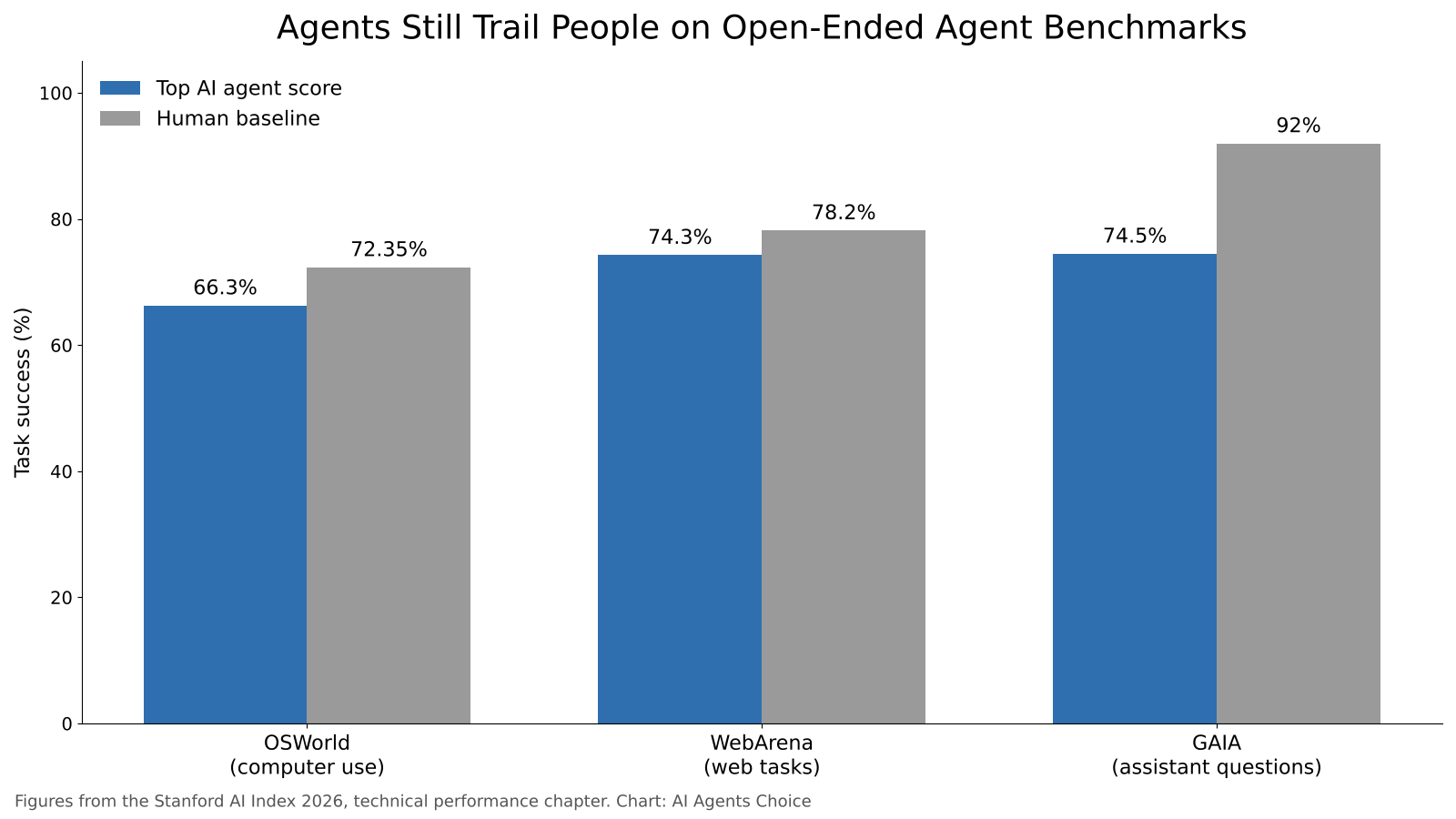
- OSWorld: Claude Opus 4.5 led at 66.3%, against a human baseline of 72.35%.
- WebArena: Success rose to 74.3% in early 2026. The human baseline is 78.2%.
- GAIA: The top score reached 74.5% last September, against a human baseline of 92%.
- τ-bench: Claude Opus 4.5 led at 70.2% pass@1 on the original benchmark.
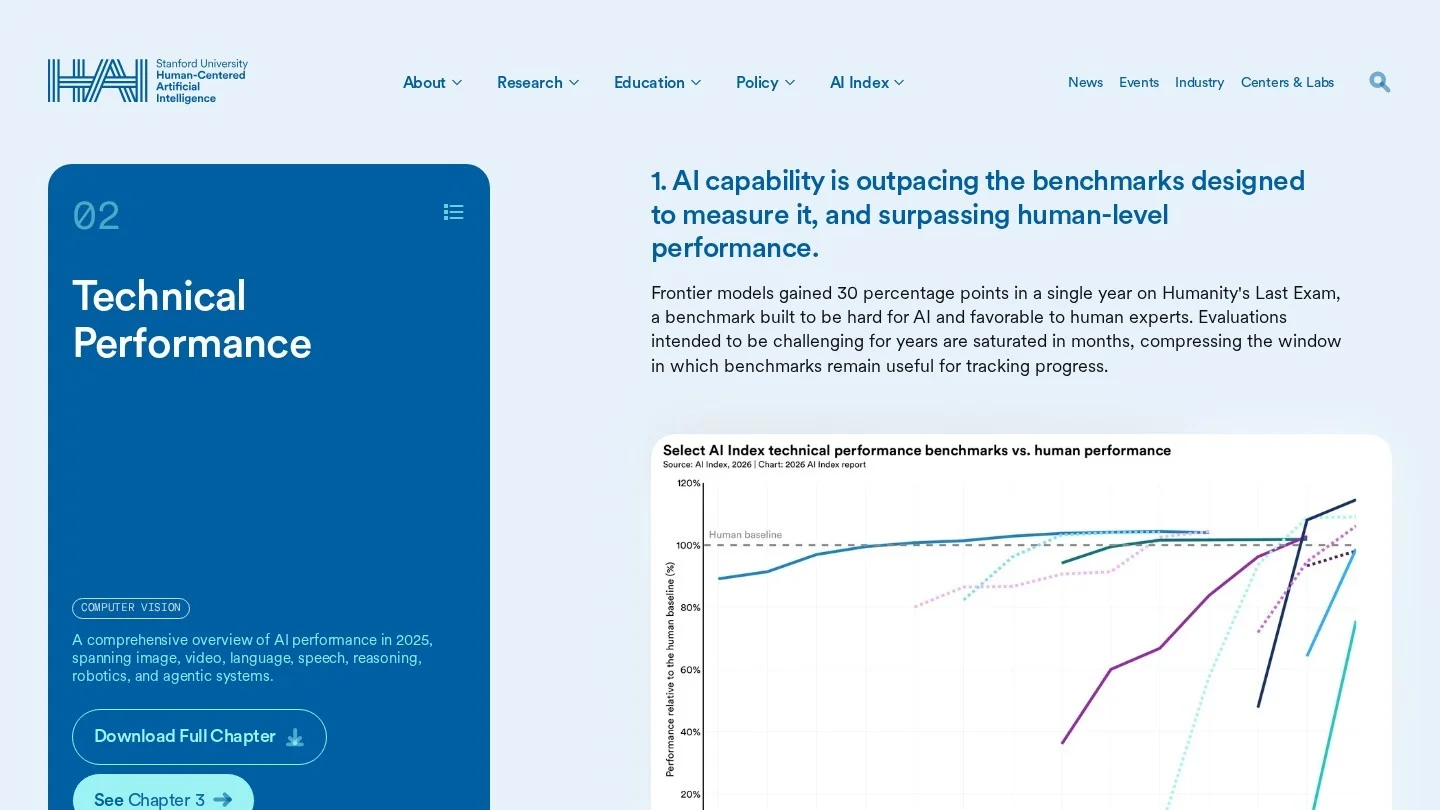
Repeat runs matter as much as single scores. When Sierra launched τ-bench, the best GPT-4o agent averaged under 50% across retail and airline tasks. Then it dropped to about 25% when it had to succeed on the same retail task eight times. In production, each of those misses becomes a handoff or a bad answer. Our post on AI model accuracy by task category has the full benchmark tables.
Why Vendor Rates Look Better Than Benchmarks
The gap is real, and it has clear causes. First, support agents answer a narrow set of questions from a known help center. Benchmarks, on the other hand, are built to be hard and broad.
Second, vendors choose the metric. For example, Fin counts a silent customer as resolved after 24 hours. A benchmark would mark the same case as unknown. Also, published customer stories are picked by the vendor, so they show the better rollouts.
Third, scope keeps changing. Intercom now prices some work as outcomes, such as a Procedure where Fin gathers context and takes action before a handoff. So a handoff can still include useful agent work.
How to Measure Your Own Intervention Rate
First, pick one unit of work. For support, use the conversation. With coding or back-office agents, use the task or the agent turn.
Next, count every way a person can step in. We use four buckets.
- Escalations: the agent or the customer hands the case to a person.
- Interruptions: a person stops the agent mid-task to correct it.
- Approvals: a person must click yes before an action runs.
- Reopens: the same customer or issue comes back within a set window, such as seven days.
Then divide the sum by total units. For example, take 10,000 conversations with 900 escalations and 400 reopens. That gives 1,300 interventions, or a 13% intervention rate. We made up these inputs to show the method, so use your own counts.
Finally, track the rate weekly and split it by reason. Anthropic’s reason list is a good template. For instance, if most interruptions add missing context, fix the knowledge base or the prompt first. Also, watch cost per resolved task, since retries and longer loops raise token bills. Our posts on AI agent token consumption and agentic AI statistics add more numbers for that business case.
Handoff Questions From Support and Engineering Leads
What Is a Good Resolution Rate for an AI Support Agent?
Published averages sit near 70% to 76%. Fin reports 76% on average, and Salesforce reports about 76% on its own Help site. Still, a new rollout often starts lower, as Chime’s move from 50% to over 70% shows.
What Is the Difference Between Resolution Rate and Escalation Rate?
Resolution rate counts chats the agent closed. Escalation rate counts chats passed to a person. For example, Agentforce on Salesforce Help resolves about 76% but escalates only 5%. So the rest end in other ways.
How Often Do Developers Interrupt AI Coding Agents?
In Anthropic’s data, new Claude Code users interrupt in 5% of turns and experienced users in about 9%. Also, users approve 93% of permission prompts.
Will AI Agents Stop Needing Humans Soon?
Agents still need people on hard tasks. They trail people on OSWorld, WebArena and GAIA. However, internal Anthropic data shows interventions per session falling from 5.4 to 3.3 in four months. So the rate is dropping, but a human check still belongs on risky steps. Agent frameworks with approval support, such as LangGraph, let you add that check in code.
Related AI Agents

Read also: Enterprise AI Agent Adoption Statistics by Size, Stage and Region
Explore Agent Categories
Related Articles
 GuidesHuman-in-the-Loop Orchestration: How to Add Approval Gates to AI Agents
 GuidesAI ISA vs Human ISA: What Each Really Costs a Real Estate Team
 GuidesSynthesia AI Video Usage Among Corporate Training Teams
 GuidesBest CAMEL AI Alternatives and What They Cost
 Guides100 AI Agent Statistics for Retail Companies
 GuidesLLM or AI Agent? AI Search Engines and What They Actually Are
