


Pick MCP first. Among multi-agent communication protocols, it is the one that connects an agent to its tools and data. A2A comes in once your agents must hand work to agents that other teams or vendors run.
We read the specs, docs and launch posts for five protocols. They compete less than the headlines say, because each one covers a different link in the chain. MCP plugs an agent into tools, while A2A passes jobs between agents. AG-UI feeds the person watching on screen. Then there is ANP, which aims at an open network of agents, and FIPA-ACL, the older standard that tried this first.
So the right pick depends on the connection you are building today. Our guide to agent-to-agent communication covers A2A in depth. Here, we compare the whole set side by side.
Five Protocols Mapped to the Link Each One Covers
Every row comes from the protocol’s own spec or launch material. So it covers only what each project documents itself.
| Protocol | Started by | Home today | Connects | Message format | How agents find each other |
|---|---|---|---|---|---|
| MCP (Model Context Protocol) | Anthropic | Agentic AI Foundation (Linux Foundation) | Agent to tools and data | JSON-RPC 2.0 | Client asks the server for its tools |
| A2A (Agent2Agent) | Agentic AI Foundation (Linux Foundation) | Agent to agent | JSON-RPC, gRPC or HTTP+JSON | Agent Card at /.well-known/agent-card.json | |
| ACP (Agent Communication Protocol) | IBM | Merged into A2A | Agent to agent | Folded into A2A | Folded into A2A |
| AG-UI (Agent-User Interaction) | CopilotKit | Open-source project | Agent to user interface | Stream of JSON events | The app points at an agent backend |
| ANP (Agent Network Protocol) | ANP open-source community | Open-source community | Agent to agent across the open web | JSON-LD descriptions, DID identity | Manifest at /.well-known/agent-descriptions |
| FIPA-ACL | Foundation for Intelligent Physical Agents | Published standard since 2002 | Agent to agent | Messages with a performative and parameters | Left to the agent platform |
Also, two of these now share one home. The Agentic AI Foundation hosts MCP and A2A, next to goose, AGENTS.md and agentgateway. As a result, MCP and A2A now sit under one neutral group at the Linux Foundation.
MCP Gives One Agent Its Tools
Anthropic started MCP, and its first spec revision is dated November 5, 2024. It lets an AI app connect to a server that exposes tools, files and prompts. For example, a coding agent can call a GitHub server to open a pull request. The model decides when to call a tool. Then the server runs it and sends back the result.
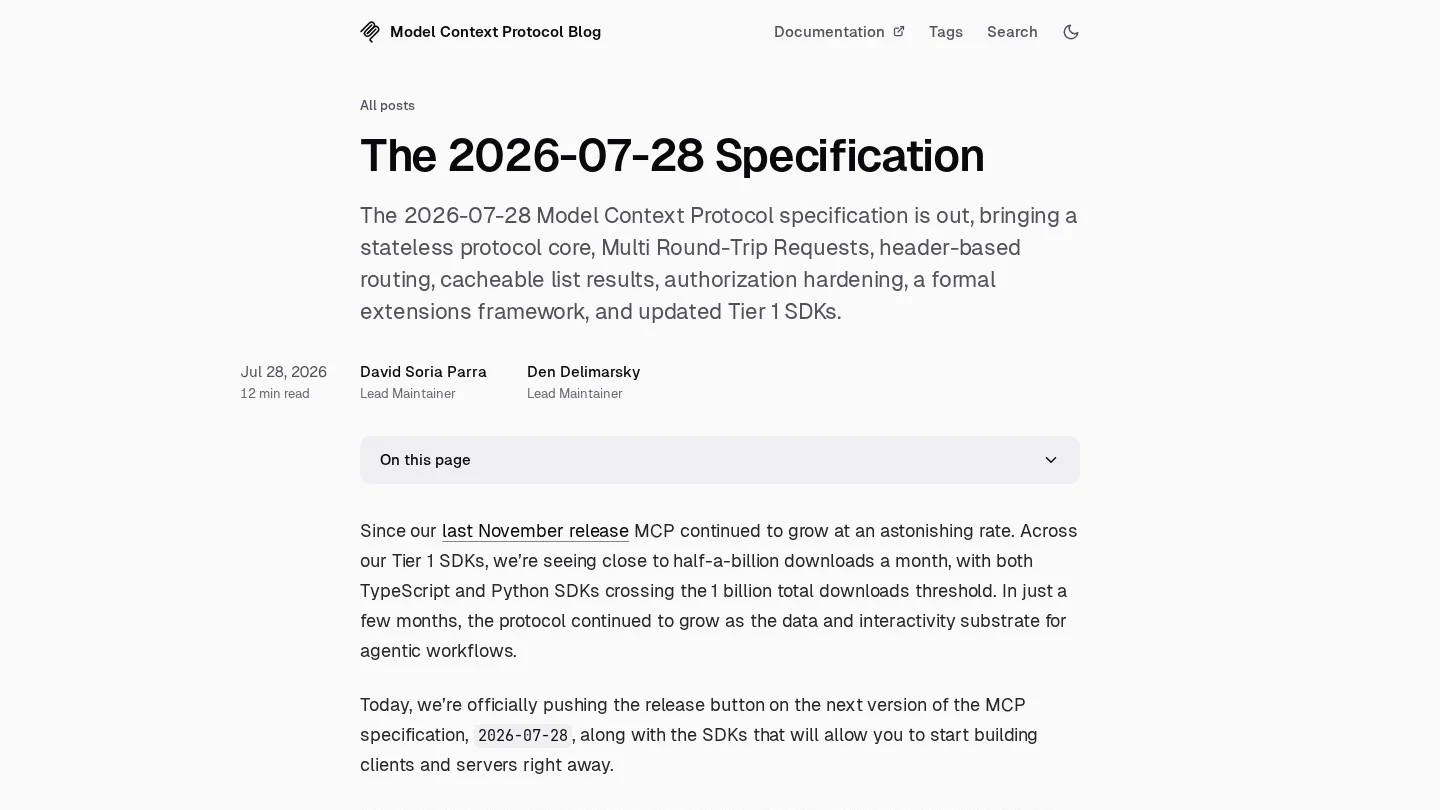
The newest revision shipped on July 28, 2026, and it changed the protocol a lot. MCP is now stateless. Each request carries its own protocol version, client details and capabilities, so the old start-up handshake and session IDs are gone. Also, a server that needs input from the user now returns an input-required result, and the client retries the call with the answer.
Next, tasks moved out of the core into an official extension. MCP Apps and Enterprise Managed Authorization sit in that same extension framework. In addition, Roots, Sampling and Logging are now deprecated, and the old HTTP plus SSE transport has a year-long exit path.
Adoption is large. The MCP team counts close to half a billion monthly downloads across its main SDKs. Besides, the TypeScript and Python SDKs have each passed one billion downloads in total. For the wire format underneath, read our explainer on JSON-RPC in AI agent communication.
A2A Moves Tasks Between Agents
Google launched A2A in April last year and later gave it to the Linux Foundation. Then version 1.0, the first stable spec, followed in March 2026. On August 17, 2026, A2A became a hosted project of the Agentic AI Foundation. At that point, more than 150 organizations backed it.
In A2A, the remote side is a full agent with its own model and tools. So you hand it a goal, and it returns a task you can track. Version 1.0 names its calls SendMessage, SendStreamingMessage, GetTask, ListTasks, CancelTask and SubscribeToTask. It also adds CreateTaskPushNotificationConfig and GetExtendedAgentCard.
Security got tighter in 1.0 as well. For instance, a provider can sign its Agent Card with JSON Web Signature. In addition, a task ID alone should not grant access, and ListTasks returns only tasks the caller may see. Pages are capped at 100 tasks.

Where IBM’s ACP Went
IBM built the Agent Communication Protocol for much the same job as A2A. However, ACP merged into A2A in August last year. So a team that built on ACP now has one path forward, and that path is A2A.
AG-UI Streams the Agent’s Work to the Screen
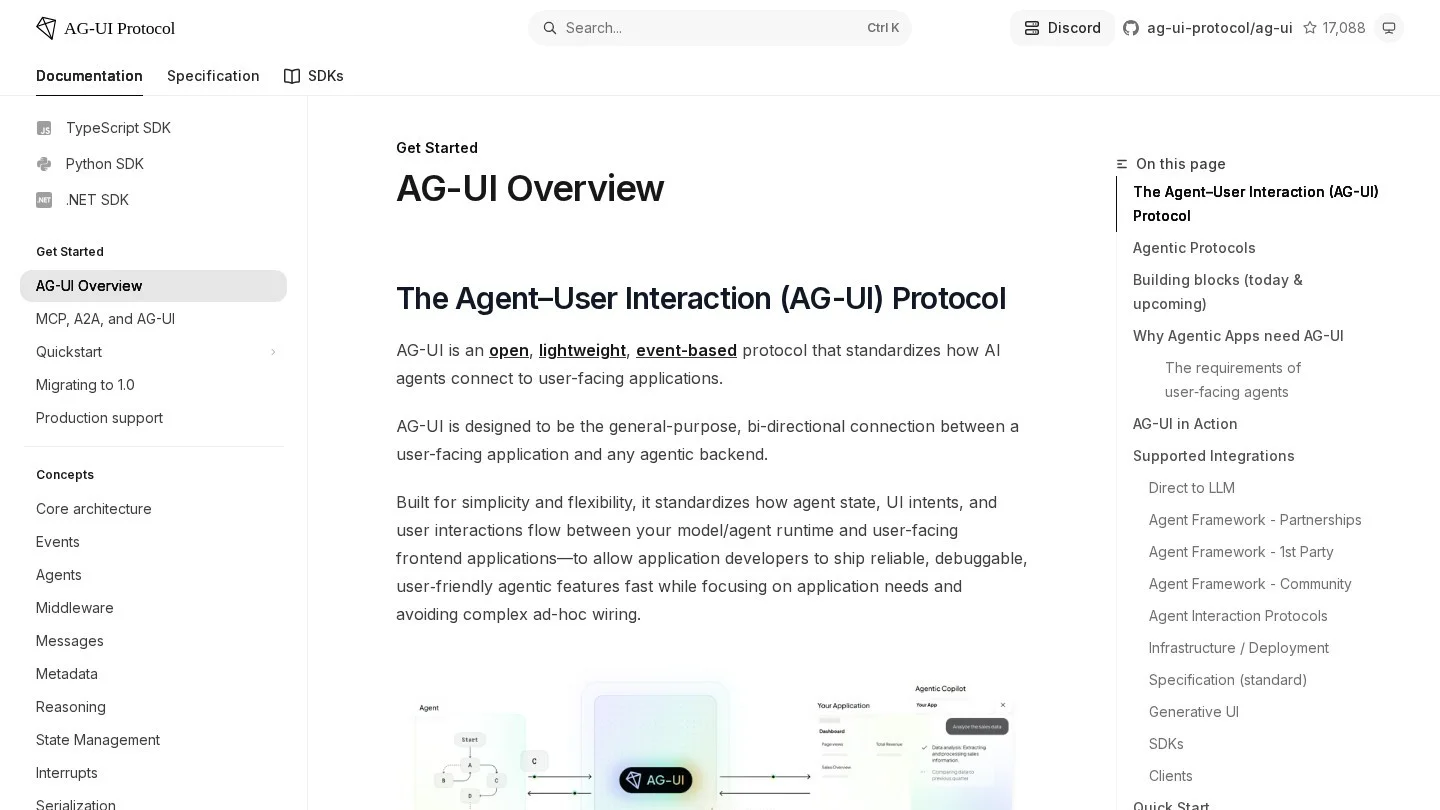
CopilotKit launched AG-UI on May 12 last year. It is an open, event-based protocol between an agent backend and a user-facing app. For example, the agent streams events such as TEXT_MESSAGE_CONTENT, TOOL_CALL_START and STATE_DELTA. The front end reads one ordered stream and draws the chat, the tool progress and the shared state.
At launch, the stream ran over standard HTTP, with an optional binary channel. AG-UI now has first-party support in Microsoft Agent Framework, Google ADK, AWS Strands Agents, Amazon Bedrock AgentCore, Mastra, Pydantic AI, LlamaIndex and AG2. Also, LangChain and CrewAI are partners. Meanwhile, community connectors cover the OpenAI Agents SDK and the Claude Agent SDK.
AG-UI calls itself the third leg next to MCP and A2A. In fact, its contributors added handshakes so AG-UI apps can talk to agents that support MCP and A2A. Still, keep A2UI apart in your head. Despite the name, A2UI is a generative UI spec, alongside MCP-UI and Open JSON UI. AG-UI can carry widgets built with any of them.
Read also: JSON-RPC in AI Agent Communication: How MCP and A2A Use It
ANP Plans for an Open Network of Agents
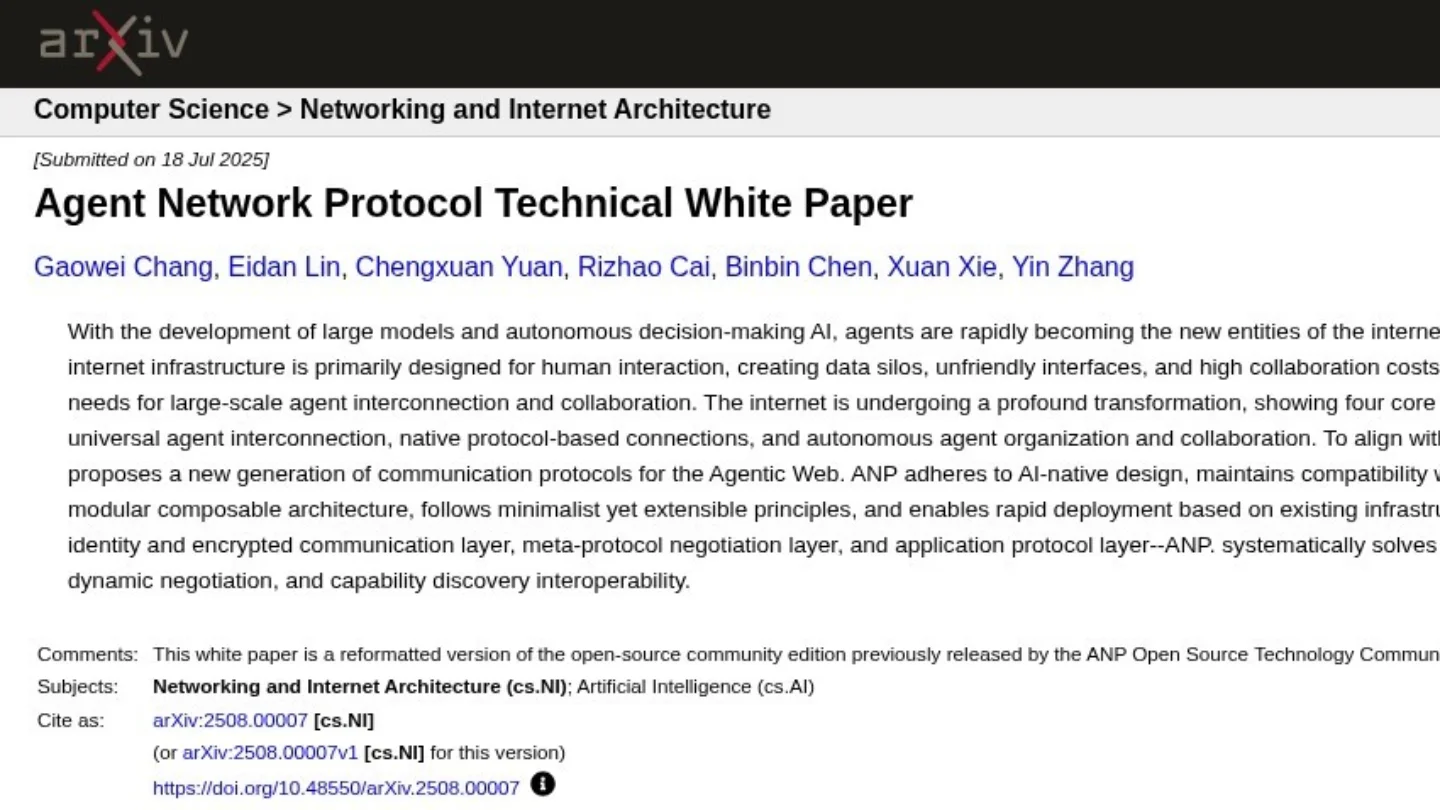
The Agent Network Protocol comes from an open-source community, and its technical white paper sets out three layers. First, an identity layer uses the W3C DID standard with a method called did:wba. It also uses ECDHE key exchange, so relay platforms cannot read messages in transit.
Second, a meta-protocol layer lets two agents agree on a protocol in natural language. Then they generate and test the code to handle it, and they can cache it for next time. Finally, an application layer holds the Agent Description Protocol and the Agent Discovery Protocol.
Agent descriptions are JSON-LD documents that use schema.org terms. For discovery, a domain can publish a manifest at /.well-known/agent-descriptions. Search agents can also crawl and index descriptions. So ANP aims at agents that find strangers on the open web, much like search engines find pages.
FIPA-ACL Shows What Agents Needed Before LLMs
FIPA-ACL is the Agent Communication Language from the Foundation for Intelligent Physical Agents. Its message structure spec reached Standard status in December 2002. Each message can carry 13 parameters, such as sender, receiver, content, ontology, protocol and conversation-id.
Only one parameter is mandatory, and that is the performative. The performative names the kind of act, such as a request or an inform. Then reply-with and in-reply-to tie a reply to the message it answers. Modern protocols solve the same matching problem with message IDs and task IDs.
A FIPA message can also name its content language and its ontology. LLM agents, by contrast, read plain text. So A2A and MCP wrap loose language in a thin JSON envelope and let the model work out the meaning.
One Support Desk Wired With Three Protocols
Picture a refund agent for an online store. A customer opens the help widget and asks for a refund. The widget talks to the agent over AG-UI, so the customer sees each step as it streams in.
From there, the agent reads the order through an MCP server on the order database. The refund needs approval from finance, and finance runs its own agent. So the support agent sends the case over A2A and gets back a task ID. When the finance agent asks for a receipt, the task moves to an input-required state. Then the support agent asks the customer through the widget.
Real platforms already ship these pieces. Amazon Bedrock AgentCore runs A2A servers with JSON-RPC 2.0 over HTTP, and it is a first-party AG-UI integration. Also, Microsoft Agent Framework can serve an agent over A2A and call remote A2A agents, and it has first-party AG-UI support too. Google ADK covers A2A and AG-UI as well.
Before a design like this goes live, add approval steps for refunds. Our guide to human-in-the-loop orchestration shows where those gates sit.
Matching the Protocol to Your Next Build
Use MCP when one agent needs tools or data. For example, a sales agent that reads a CRM and writes notes needs only MCP. Our list of AI agent frameworks compares the toolkits you can build on.
Add A2A when another team or company owns the other agent. It also earns its place when work runs for minutes or hours and needs status updates. On the other hand, two agents in one codebase can share state directly. LangGraph and CrewAI handle that inside one process.
Pick AG-UI when people watch the agent work in your app. Besides, it saves you from writing a custom socket format for every framework. Keep an eye on ANP if your agents must meet unknown agents on the open web.
Finally, plan for memory and context on top of any protocol. Our guides on agent state across sessions and context engineering cover that layer.
Security Gaps Each Protocol Leaves Open
No protocol makes an agent safe by itself. For instance, MCP HTTP servers should check the Origin header to block DNS rebinding. Local MCP servers should bind to 127.0.0.1. However, prompt injection through tool results is still your problem.
A2A signs cards and scopes tasks to the caller. Even so, a remote agent’s reply lands in your model’s context as text. So treat every reply as untrusted input, and log each message with its task ID. ANP pushes identity down to DIDs and end-to-end encryption. Then trust comes down to which identities you accept.
Also, agents that call each other can loop and burn tokens. Set step limits and budget caps, as our guide on controlling AI agent costs explains.
Specs and Launch Posts Behind This Comparison
We read the MCP base protocol and transport pages for the July 28, 2026 revision. Then we read the MCP release post. For A2A, we read the Agentic AI Foundation’s announcement and its version 1.0 builder’s guide. After that, we read the AG-UI introduction and its agentic protocols page, plus CopilotKit’s launch post.
ANP details come from the technical white paper by its core authors. For FIPA-ACL, we read the message structure standard. Finally, we checked Amazon’s AgentCore A2A contract for a real deployment. We left out adoption figures that the projects do not publish themselves.
Quick Answers on MCP, A2A and AG-UI
Is MCP a Multi-Agent Protocol?
Mostly no. MCP connects one agent to tools and data. Still, a tool behind an MCP server can itself be an agent. For agent-to-agent hand-offs with tracked tasks, A2A is the protocol built for that job.
Does A2A Replace MCP?
No. They cover different links, and many systems use both. An agent uses MCP to reach its own tools. Then it uses A2A to pass work to agents it does not control.
Is IBM’s ACP Still Worth Building On?
ACP merged into A2A in August last year. So new work should target A2A, which now sits at the Agentic AI Foundation.
Do I Need AG-UI if My App Already Has a Chat Window?
Not always. A plain chat that shows final answers works without it. But AG-UI pays off when users must see tool calls, progress and shared state live. It also lets you swap agent frameworks without rewriting the front end.
Which Frameworks Support These Protocols Today?
Microsoft Agent Framework and Google ADK document A2A and AG-UI support. Also, Amazon Bedrock AgentCore runs A2A servers and appears in the AG-UI list. Besides, Mastra and the OpenAI Agents SDK appear in the AG-UI integration list. Browse our multi-agent systems page for more.
Related AI Agents



Read also: Gemini CLI vs Claude Code: Access, Pricing and MCP Compared
Explore Agent Categories
Related Articles
 GuidesJSON-RPC in AI Agent Communication: How MCP and A2A Use It
 GuidesWhat Is Agent-to-Agent Communication? How A2A Lets AI Agents Work Together
 GuidesHierarchical Multi-Agent Systems Explained
 GuidesGemini CLI vs Claude Code: Access, Pricing and MCP Compared
 GuidesBest MCP Servers for Autonomous AI Workflows: 13 Picks With Safe Settings
 GuidesSynthesia AI Video Usage Among Corporate Training Teams
