


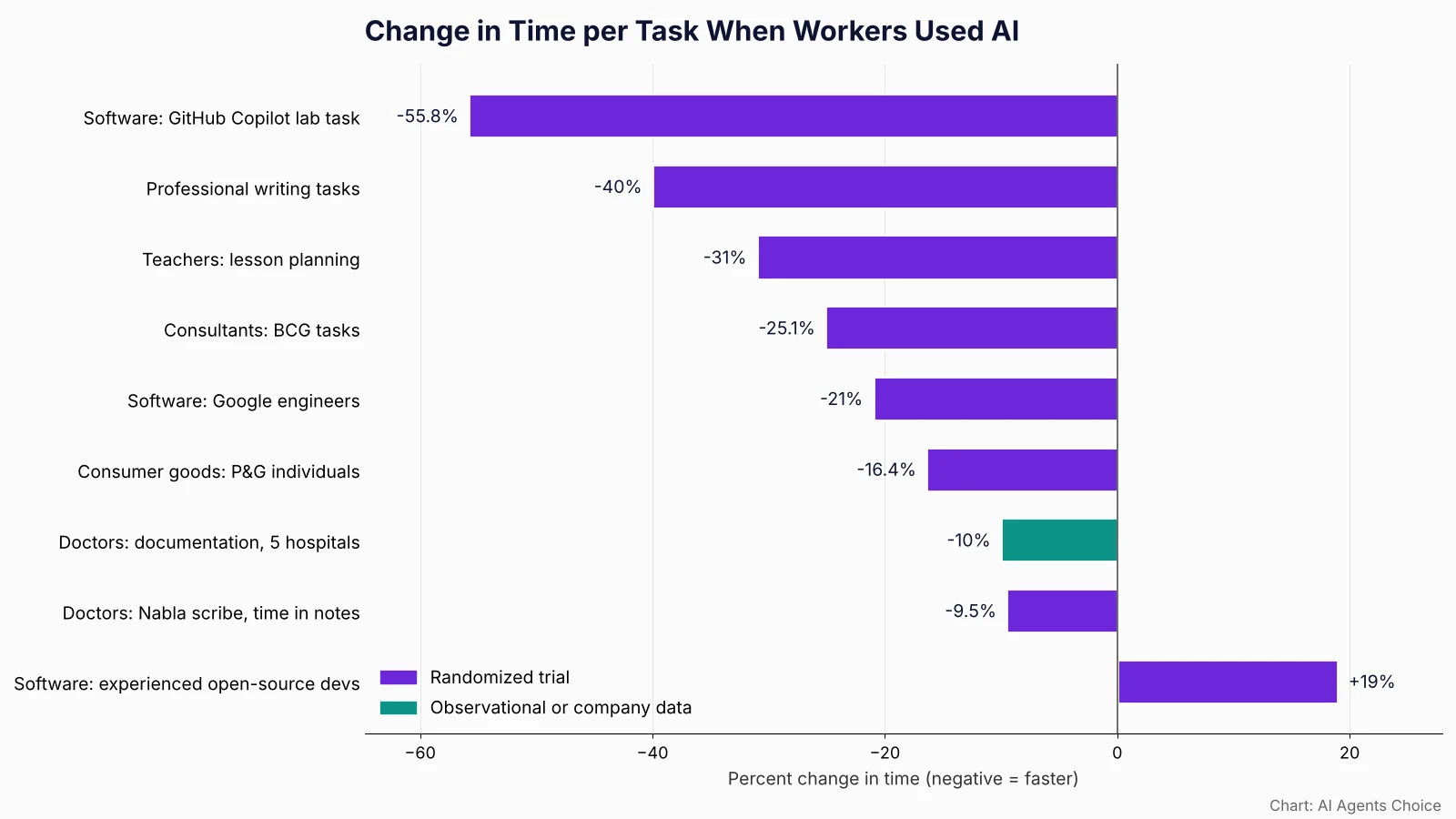
AI agents and assistants raise output most in customer support, software and writing-heavy office work. In the trials we compiled, time per task fell by 10% to 56%. Output per worker rose by 12% to 50%. But one trial of veteran coders found the opposite. They took 19% longer with AI.
We researched 22 published studies that measured AI productivity gains by industry. Then we sorted them by sector, sample size and study design. We took the pains to separate randomized trials from company claims and self-reported surveys, because they give very different numbers. Each figure carries its publisher and date. We also ran our own math on time saved, output per hour and who gains most. Our agentic AI statistics page covers adoption and ROI surveys, so this page sticks to measured work output.
Our Table of 22 Productivity Studies by Industry
First, a word on terms. Most of these studies tested AI assistants, such as chat tools and coding copilots. Only a few tested agents that take actions on their own. Even so, the assistant results are the best evidence buyers have. Agent products run on the same models and the same work patterns.
| Industry | Study and date | Design | Sample | Measured result |
|---|---|---|---|---|
| Customer support | Brynjolfsson, Li and Raymond, NBER (June 2023 digest) | Staggered rollout at one firm | About 5,000 chat agents | +13.8% resolutions per hour, about +35% for novices |
| Customer support | Klarna company release (February 2024) | Company-reported | 2.3 million chats | Resolution time from 11 minutes to under 2 |
| Software | Peng and co-authors, GitHub Copilot (February 2023) | Lab RCT | One coding task | 55.8% less time |
| Software | Google engineers (October 2024) | RCT | 96 engineers | About 21% less time, wide interval |
| Software | Microsoft, Accenture and a Fortune 100 firm | Three field RCTs | 4,867 developers | +26.08% completed tasks |
| Software | METR (last July) | RCT | 16 veteran developers | 19% more time |
| Software | Carnegie Mellon, Cursor study (January 2026) | Difference-in-differences | 806 repositories | 3 to 5 times more code in month one, fading after two months |
| Software | Harvard economists, coding agents (reported October 2026) | Firm panel data | 700+ firms | +23% pull requests, shipped work flat |
| Consulting | Harvard Business School and BCG (September 2023) | RCT | 758 consultants | +12.2% tasks, 25.1% faster, 40%+ quality |
| Consumer goods | Procter & Gamble field experiment, NBER (last April) | RCT | 776 professionals | 16.4% less time for individuals |
| Advertising | Ju and Aral, MIT and Johns Hopkins (February 2026) | RCT with AI agent partners | 2,234 workers | +50% ads per worker |
| Professional writing | Noy and Zhang, Science (July 2023) | RCT | 453 professionals | 40% less time, 18% higher quality |
| Legal | Choi, Monahan and Schwarcz (November 2023 report) | RCT | 60 law students | 12% to 32% faster |
| Legal | Schwarcz and co-authors, GovAI page (April 2026) | RCT | Upper-level law students | 34% to 140% productivity gains |
| Healthcare | NEJM AI ambient scribe trial (last November) | Three-arm RCT | 238 physicians | 9.5% less time in notes with Nabla |
| Healthcare | JAMA multisite study (April 2026) | Observational | 1,800+ scribe users | 16 fewer documentation minutes a day |
| Healthcare | Kaiser Permanente, NEJM Catalyst (reported last June) | Observational | 7,260 physicians | 15,791 hours saved in 63 weeks |
| Education | Education Endowment Foundation, 2024 trial | RCT | 259 teachers | 31% less lesson planning time |
| Accounting | Stanford and MIT researchers (reported last August) | Survey plus transaction data | 277 accountants | +55% clients supported per week |
| Government | UK cross-government Copilot report (last June) | Self-reported survey | 20,000 licenses | 26 minutes saved a day |
| All AI-exposed jobs | Humlum and Vestergaard, University of Chicago (last May) | Survey plus payroll records | About 25,000 workers a round | 2.8% of work hours saved |
| All occupations | Anthropic Economic Research (last November) | Model estimates from chats | 100,000 conversations | About 80% time cut per task |
So the range is wide. However, the spread follows a pattern. Narrow tasks in a lab show the biggest gains. Whole jobs measured across a year show the smallest.

Customer Support Desks Recorded the Clearest Gains
Support is the sector with the longest real-world record. Firms log every chat, so the output shows up in the records. That is why the best-known study comes from a support floor.
Five Thousand Chat Agents at One Software Firm
Erik Brynjolfsson, Danielle Li and Lindsey Raymond studied about 5,000 support agents at a Fortune 500 software company. The NBER Digest summarized it in June 2023. The tool suggested replies to agents in real time. As a result, resolutions per hour rose 13.8% on average.
But the average hides the real story. Novice and low-skilled agents gained about 35%. In fact, agents with two months of tenure and the tool matched agents with six months and no tool. Then again, the most experienced agents saw zero or small negative effects.
- Time per chat fell about 9%, and chats handled per hour rose about 14%.
- Customers expressed more positive sentiment and asked for a supervisor less often.
- Agents with the tool had 8.6% lower attrition.

Klarna’s Self-Reported Assistant Numbers
Klarna says its AI assistant handled 2.3 million conversations in its first month, in February 2024. That was two-thirds of its service chats. Klarna also says the assistant did the work of 700 full-time agents. Resolution time dropped from 11 minutes to under 2, and repeat questions fell 25%, by the company’s count.
These are company claims from Klarna itself. Still, they line up with the direction of the NBER result. For buyers comparing products, our customer support agents category lists tools such as Intercom Fin.
Software Teams Show the Widest Spread of Results
Coding has more trials than any other field. Yet the results run from a 56% speedup to a 19% slowdown. The type of task explains most of the gap.
Controlled Trials With Coding Assistants
The first big trial came from Microsoft and GitHub researchers in February 2023. Developers built an HTTP server in JavaScript. Those with Copilot finished 55.8% faster than those without it. However, it was one small, well-defined task.
Google ran a trial with 96 of its own engineers, posted in October 2024. The AI group took about 21% less time, at 96 minutes against 114. But the confidence interval was wide. It ran from roughly a 40% time cut to a 3% increase, so the result was not statistically significant.
Next came three field trials at Microsoft, Accenture and an unnamed Fortune 100 firm. They covered 4,867 developers in total. Those with an AI coding assistant completed 26.08% more tasks. Also, less experienced developers adopted the tool more and gained more.

Veteran Open-Source Developers Who Got Slower
METR published the trial that surprised many teams last July. It recruited 16 experienced open-source developers. They worked on real issues in their own large repositories, which averaged over 1.1 million lines of code. For each issue, AI use was randomly allowed or not.
With AI allowed, tasks took 19% longer. Yet the developers believed AI had cut their time by 20%. In fact, they accepted fewer than 44% of AI suggestions. About 9% of their time went to reviewing and cleaning AI output. So perception and measurement can point in opposite directions.
What Happens After Teams Adopt Coding Agents
Two newer studies look at agents in daily use. First, Carnegie Mellon researchers compared 806 GitHub projects that adopted Cursor with 1,380 that did not. Their paper, dated January 2026, was accepted at the MSR 2026 conference. Lines of code rose three to five times in the first month. But the gain faded after about two months. Meanwhile, static analysis warnings rose about 30% and code complexity rose about 41%, and both stayed high.
Second, Harvard economists Fiona Chen and James Stratton studied Jellyfish data from more than 700 software firms, as reported in October 2026. After firms adopted coding agents, pull requests per worker rose 23%. However, the rate of finished Jira issues did not change in a significant way. Time from pull request to merge rose 49%. So the bottleneck moved to code review. For tool picks, see our coding agents list, including GitHub Copilot cloud agent and Devin.
Consulting, Consumer Goods and Advertising Trials
Office work outside tech has fewer studies. But the ones we found are large and well designed.
Boston Consulting Group’s Jagged Frontier Study
Harvard Business School and BCG tested 758 consultants in a working paper dated September 2023. That was about 7% of BCG’s individual contributor consultants. On tasks within AI’s reach, consultants with AI finished 12.2% more tasks. They also worked 25.1% faster, and their quality scores rose more than 40%.
Still, the authors also gave a task outside AI’s reach. There, AI users were 19 percentage points less likely to get the right answer. Lower-scoring consultants gained 43% on their scores, while higher-scoring ones gained 17%.
Procter and Gamble Product Teams
A later field experiment at Procter & Gamble, posted as an NBER paper last April, covered 776 professionals. Individuals with AI used 16.4% less time than the control group. Teams with AI used 12.7% less time. Also, individuals with AI scored about 0.37 standard deviations above the control on quality. Teams without AI scored about 0.24. So one person with AI matched or beat a team without it.
Ad Teams Paired With AI Agents
Harang Ju and Sinan Aral ran the clearest agent study we found. The arXiv version is dated February 2026. They paired 2,234 workers with either a human or an AI agent partner to create display ads. Human-AI pairs produced 50% more ads per worker per unit of time. Text quality rose, but image quality dipped slightly. Workers with AI partners also sent 62% more messages and made 62% fewer direct copy edits.

Then there is general business writing. Shakked Noy and Whitney Zhang tested 453 college-educated professionals in a Science paper from July 2023. With AI access, time per writing task fell 40% and quality rose 18%.

Read also: Botpress vs Voiceflow: Pricing, Phone Agents and Code Compared
Legal Work Gains From Chatbots to Reasoning Models
Law schools have run the main legal trials so far. The first one, by Jon Choi, Amy Monahan and Daniel Schwarcz, was reported in November 2023. They gave 60 law students four tasks with or without GPT-4. Time fell by 12% to 32%, depending on the task. But quality improved only slightly and unevenly.
A follow-up by Schwarcz and co-authors tested newer tools. GovAI lists it on a research page dated April 2026. Upper-level law students used either Vincent AI, a retrieval-based legal tool, or OpenAI’s o1-preview reasoning model. AI raised productivity on five of six tasks. Gains ran from 38% to 115% with Vincent AI and 34% to 140% with o1-preview. Both tools also lifted quality. However, the o1-preview group produced some hallucinations, while Vincent users made about as many as the no-AI group.
So retrieval matters in legal work. Firms weighing tools can browse our legal AI agents page, which includes Harvey.
Clinical Note-Taking With Ambient Scribes
Healthcare has the most real-world data on one task, clinical notes. Ambient scribes listen to a visit and draft the note for the doctor to review. The measured gains are real but modest.
- A three-arm randomized trial in NEJM AI, published last November, covered 238 outpatient physicians. Nabla users cut time in notes by 9.5% against usual care. Microsoft’s DAX Copilot showed no significant change.
- A JAMA study from April 2026, led by Mass General Brigham and UCSF, tracked more than 1,800 scribe users at five hospitals. Documentation time fell about 16 minutes a day, or about 10%. Users added about 0.5 visits a week.
- In that JAMA study, only 32% of users ran the scribe on more than half their visits. Those heavy users saw about three times the documentation cut.
- Kaiser Permanente’s analysis in NEJM Catalyst, reported last June, covered 7,260 physicians and 2,576,627 encounters over 63 weeks. It estimated 15,791 hours of documentation saved.
We divided Kaiser’s hours by its encounters. That works out to about 22 seconds saved per visit. Per physician, it comes to about 2.2 hours over 63 weeks. Even so, doctors in the NEJM AI trial reported lower work exhaustion scores. So the value may sit more in burnout than in raw minutes. Our healthcare AI agents category tracks tools in this space.
Classrooms, Accounting Firms and Government Offices
Teachers Planning Science Lessons
The Education Endowment Foundation ran its 2024 trial with 259 science teachers in 68 English secondary schools. Half used ChatGPT with a short guide. Their weekly lesson planning time fell to 56.2 minutes from 81.5 minutes. That is a 31% cut, or 25.3 minutes a week. Also, an independent panel found no clear quality difference in the lessons.
For school tools, see our education AI agents page.
Accountants Closing the Books
Accounting researchers at Stanford and MIT surveyed 277 accountants at 79 small and midsize firms. They also studied transaction data from an AI accounting platform. The Journal of Accountancy reported the work last August. AI users supported 55% more clients a week. They also closed the books 7.5 days sooner and moved about 8.5% of their time away from data entry.
However, this was not a randomized trial. Firms that adopt AI may differ in other ways. Our accounting AI agents page lists close and bookkeeping agents such as Basis.
Civil Servants Using Copilot
The UK government gave Microsoft 365 Copilot licenses to about 20,000 staff in 12 organizations. The trial ran from September 30 to December 31, 2024. The cross-government report, published last June, found an average of 26 minutes saved a day. That adds up to about 13 working days a year. Also, 82% of respondents did not want to go back.
But these were self-reported savings from 7,115 survey answers. The report itself said to read them alongside other evidence. Public bodies can compare tools in our government AI agents category.

Economy-Wide Estimates Pull the Numbers Down
Task-level gains do not add up to job-level gains. Two broad studies make this plain.
First, Anders Humlum and Emilie Vestergaard linked Danish surveys to payroll records in a University of Chicago working paper from last May. They covered 11 AI-exposed jobs, from accountants to teachers. Chatbot users saved about 2.8% of their work hours. Yet the authors found no significant effect on earnings or recorded hours. Their confidence intervals ruled out average effects above 1%.
Second, Anthropic estimated task savings from 100,000 Claude conversations last November. Its model put the average time cut at about 80% per task. Software developers made up 19% of the implied gain. From there, Anthropic projected a 1.8% yearly boost to US labor productivity over ten years. But Anthropic flagged that these estimates miss time spent checking output. It also noted that randomized trials often find smaller savings.
So the gap is large. A chat task may run 80% faster, while a whole job saves less than 3% of its hours. The rest of the day still needs meetings, checks and handoffs.
What Our Own Analysis of the Studies Shows
Time Saved Converted Into Extra Output per Hour
We converted each time cut into extra output per hour, using one divided by the remaining time share. Then we compared the results. A 40% time cut means 67% more output per hour. A 21% cut means about 27% more. In the same way, the 55.8% Copilot result implies 126% more output, but only for that one task.
| Study | Time cut | Implied extra output per hour |
|---|---|---|
| GitHub Copilot lab task | 55.8% | 126.2% |
| Professional writing | 40% | 66.7% |
| Teachers planning lessons | 31% | 44.9% |
| BCG consultants | 25.1% | 33.5% |
| Google engineers | 21% | 26.6% |
| P&G individuals | 16.4% | 19.6% |
| Nabla scribe trial | 9.5% | 10.5% |
We also took the median of the eight randomized time results in our first chart. It is a 23.05% time cut once we include the METR slowdown. Without METR, the median is 25.1%. That is a fair planning number for a narrow task. Still, it is far too high for a whole role.
Newer Staff Gain Two to Three Times More
Two trials split results by skill. In support, novices gained about 35% while veterans gained close to nothing. Among BCG consultants, lower-scoring consultants gained 43% and higher-scoring ones gained 17%. That is 2.5 times as much. Likewise, the three-company coding trials found larger gains for less experienced developers. METR’s veterans, on the other hand, slowed down.
Study Design Changes the Headline
Self-reported surveys gave the biggest time savings per day. Randomized trials on real work gave smaller ones. Firm-level panel data, such as the Jellyfish study, showed activity going up without finished work going up.
Method Caveats Before You Quote These Numbers
We read each study’s own limits. These are the ones that change how a buyer should use the figures.
- Most studies tested assistants. Only the Ju and Aral study, the Cursor study and the Jellyfish study tested agent-style tools directly. The rest tested chat or code completion tools.
- Lab tasks are short and clean. Real work has context, review and coordination, which lab trials leave out.
- More code or more messages did not mean more shipped work in the Jellyfish data.
- Self-reports run high. METR’s developers felt 20% faster while measuring 19% slower.
- Quality can drop outside the tool’s reach. BCG consultants lost 19 points of accuracy on such a task.
- Several trials used students, such as the legal studies. Practicing lawyers may see different results.
For that reason, we suggest buyers run their own pilot. Measure finished work, and track quality and rework too. Then set token and seat budgets with our guide to controlling AI agent costs. For adoption rates by company size, see our enterprise AI agent adoption statistics.
Questions Buyers Ask About Agent Productivity Data
How Much Do AI Agents Increase Productivity?
In randomized trials of narrow tasks, the median time cut we computed was about 23%. However, broad worker surveys in Denmark found only 2.8% of work hours saved. So expect large gains on specific tasks and small gains across a full job.
Which Industry Gains the Most From AI Agents?
Customer support and writing-heavy work show the most consistent gains. Software shows the biggest single result, 55.8% less time, but also the only slowdown, 19% more time for veteran developers.
Do Junior or Senior Workers Gain More From AI Agents?
Junior workers gain more in every study that split results. Novice support agents gained about 35%, while top agents gained almost nothing.
Do AI Scribes Save Doctors Time?
Yes, but modestly. A JAMA study from April 2026 found about 16 fewer documentation minutes a day. A randomized trial found a 9.5% cut in note time with one product and no significant change with another.
Are Vendor Productivity Claims Reliable?
Treat them as claims. Klarna’s numbers, for example, are company-reported. Compare any vendor figure against the randomized trials in our table, and test it in your own pilot.
Related AI Agents



Read also: Google Ads Optimization AI Agents For ROI-First Campaigns
Explore Agent Categories
Related Articles
 GuidesParallel AI Alternatives: 8 Web Search APIs Compared
 GuidesCreatify AI Alternatives for Video Ads: 8 Tools Compared
 GuidesGemini CLI vs Claude Code: Access, Pricing and MCP Compared
 GuidesBotpress vs Voiceflow: Pricing, Phone Agents and Code Compared
 GuidesSynthesia AI Video Usage Among Corporate Training Teams
 GuidesBest CAMEL AI Alternatives and What They Cost
