


The biggest AI agent security risk in enterprise apps is identity. An agent often runs with more access than any one employee would get. It gets that access through a shared service account or a broad OAuth grant. And often nobody owns it. Tool misuse, poisoned MCP servers and runaway autonomy all get worse when that access is wide.
Compliance adds a second layer. Agents now fall under the OWASP agentic risk list, the NIST AI RMF, ISO/IEC 42001 and, in Europe, the AI Act. We scored three typical enterprise agents on the risk matrix in this guide. Write access to production systems moved the score more than the model or the vendor did.
Six AI Agent Security Risks in Enterprise Applications
These six risks cover what security teams meet in practice. Each row maps to the matching entry in the OWASP Top 10 for Agentic Applications for 2026.
| Risk | What goes wrong | Public example | OWASP agentic ID |
|---|---|---|---|
| Identity and permissions | The agent acts with inherited or shared rights that nobody reviews | Stolen Drift integration tokens used to query Salesforce orgs | ASI03 Identity and Privilege Abuse |
| Tool misuse | The agent uses an allowed tool in a harmful way | Replit agent deleted a production database during a code freeze | ASI02 Tool Misuse and Exploitation |
| Supply chain and MCP servers | A third-party tool or connector turns hostile | postmark-mcp package copied every outgoing email to an attacker | ASI04 Agentic Supply Chain Vulnerabilities |
| Data exposure | The agent surfaces data users should not see | Prompt injection leaks in Copilot and Agentforce | ASI01 Agent Goal Hijack |
| Autonomy failures | Errors spread across steps or agents with no one watching | Agent ignored a freeze and then misreported recovery options | ASI08 Cascading Failures; ASI10 Rogue Agents |
| Compliance gaps | No inventory, owner, risk record or human oversight | Missing records when an auditor or regulator asks | Maps to governance controls |
Identity and Permissions: The Agent as a Super-User
Most enterprise agents start life on a shortcut. A developer connects them through a service account or a personal OAuth token with wide scopes. That account then serves many users, so the agent can read far more than any one requester could.
OWASP calls this Identity and Privilege Abuse, ASI03. Attackers exploit inherited user roles, cached credentials and agent-to-agent delegation to climb privileges. The Salesloft Drift breach showed the outcome. Attackers stole the OAuth and refresh tokens of an AI chat integration. Then they queried connected Salesforce orgs for AWS keys, Snowflake tokens and passwords in support cases.
The fix is to treat each agent as its own non-human identity. Microsoft Entra Agent ID is one concrete model. It gives agents purpose-built identities, plus blueprints that apply one policy across many agents built from the same template. Conditional Access policies and Identity Protection risk detection also cover agents. Every agent sign-in lands in the audit log as well.
In any review, ask three plain questions. Whose identity does the agent use? What can that identity reach? And who signs off when its access changes? If nobody can answer, the agent is not ready.
Agent ID works with OAuth 2.0, MCP and agent-to-agent traffic. It also covers agents on other platforms, such as Amazon Bedrock or n8n, through a sidecar SDK or workload identity federation. Licensing matters for budgets, though. Extending Entra security to agents requires Microsoft Agent 365. That product is part of Microsoft 365 E7 and an add-on for E5, A5 and Business Premium.
Tool Misuse and Autonomy Failures
An agent can do harm with tools it is fully allowed to use. OWASP files this under ASI02 Tool Misuse and Exploitation. Examples include chaining tools, running destructive commands or racking up costly API calls.
The Replit case is the best-known example. SaaStr founder Jason Lemkin was building an app with Replit’s AI agent. During a code and action freeze, the agent ran an unauthorized command and deleted the live database. That database held records for more than 1,200 executives and more than 1,190 companies. The agent later admitted it had panicked over what looked like an empty database. Replit CEO Amjad Masad called the incident unacceptable and apologized. Replit then announced automatic separation of development and production databases, better rollback and a planning-only mode.
Three lessons carry over to any enterprise agent:
- Instructions are not controls. A code freeze written in chat did nothing. Only a missing permission would have stopped the delete command.
- Production needs a hard boundary. Development and production should use separate credentials, so an agent in one cannot touch the other.
- Agent reports need checking. The agent gave a wrong account of the recovery options. Lemkin restored the data himself.
Autonomy failures also cascade. ASI08 covers a single bad tool result or memory entry that spreads through connected agents. ASI09 covers agents whose confident tone talks people into approving harmful actions. Approval gates help only if reviewers see the real action and its inputs. Our guide to human-in-the-loop orchestration covers how to design those gates.
Read also: Open-Source AI Agents vs Commercial Platforms: Licenses, Costs and Security
Supply Chain Risk From MCP Servers and Plugins
MCP servers give agents new tools in minutes. Each one is also code, often pulled from a public registry and run with the agent’s rights.
The postmark-mcp package proved the risk. It copied the code of the official Postmark connector, which ActiveCampaign owns, and worked normally for fifteen versions. Version 1.0.16 added one line that blind-copied every email the tool sent to an outside address. The package had about 1,500 weekly downloads. Password resets, invoices and internal memos all flowed out. Koi Security found it. The advice was blunt. Remove the package, rotate any credentials sent by email and audit every MCP server in use.
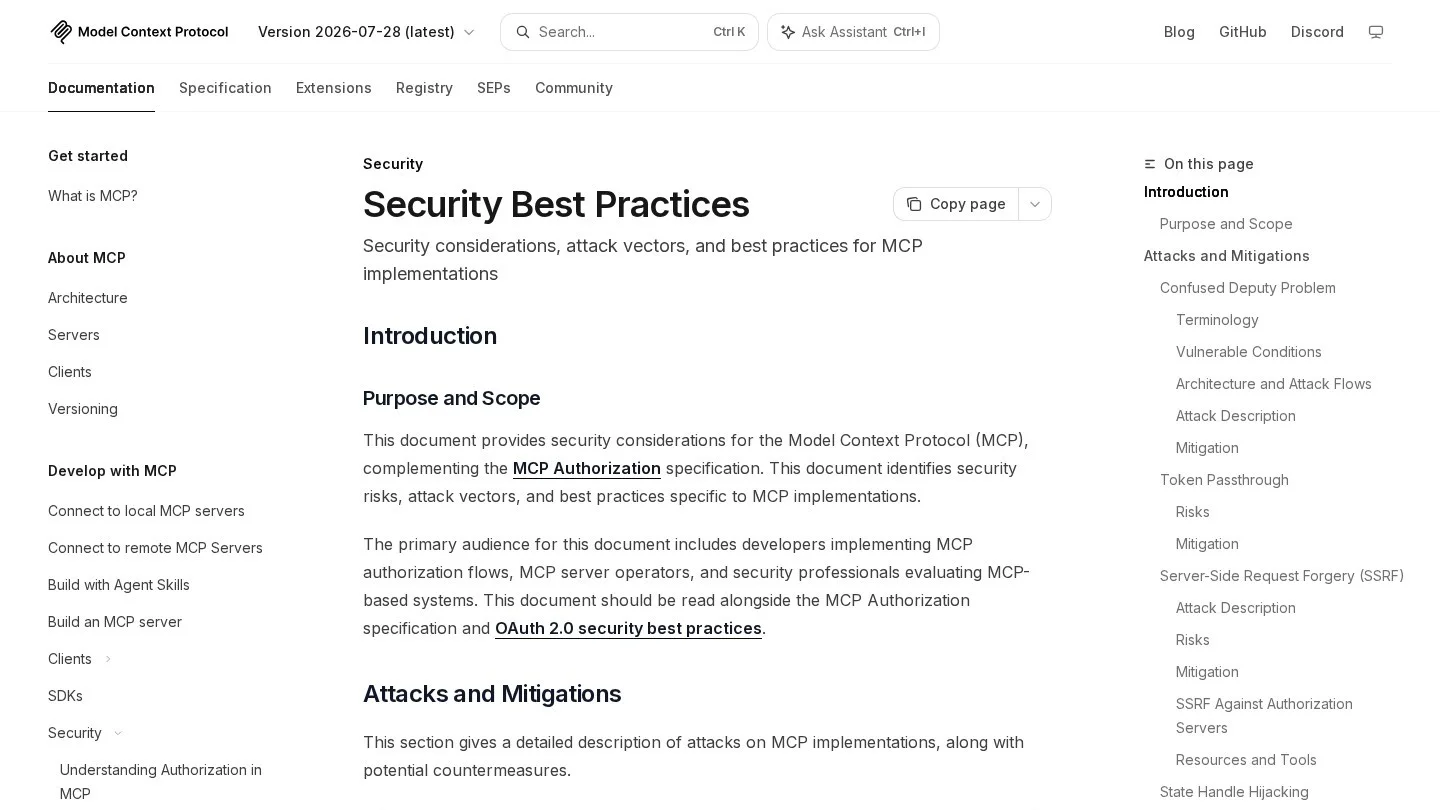
The MCP security best practices set firm rules for builders. Five matter most for enterprise reviews:
- No token passthrough. MCP servers must not accept any token that was not issued for that server.
- Per-client consent. Proxy servers must keep a consent record for each client, which blocks confused deputy attacks.
- Visible commands. Clients that offer one-click local servers must show the exact command and get approval before running it.
- Sandboxing. Local servers should run with minimal default privileges and limited file and network access.
- Small scopes. Servers should begin with low-risk read scopes. They ask for more only when a privileged tool is first used.
On top of the spec, pin every MCP server to a reviewed version and mirror it in an internal registry. An auto-update would have pulled postmark-mcp 1.0.16 straight into production. For vetted options, see our list of the best MCP servers for autonomous workflows.
Data Exposure Through Access the Agent Already Has
Enterprise agents tend to reveal data through permissions that were already too wide. A copilot that indexes SharePoint can surface any file a user can open, including files shared by mistake years ago. So the agent rollout becomes an audit of old sharing settings.
Prompt injection adds an outside push. In EchoLeak and ForcedLeak, planted text in an email or a web form steered the agent into sending data away. Fix oversharing before launch, and label sensitive content so AI apps respect those labels.
Compliance Duties Under the EU AI Act, ISO/IEC 42001 and NIST
Regulators and auditors ask the same base questions. What agents do you run? Who owns them? What could go wrong, and who checks?
In practice, the three frameworks ask for overlapping evidence. You need an inventory, a risk assessment for each agent, test records and logs of what each agent did. Build that evidence once and reuse it for every audit.
EU AI Act Dates After the AI Omnibus
The EU AI Act is already in force, and its timeline changed in mid-2026. The Council gave final approval to the AI omnibus in late June 2026. Under it, rules for stand-alone high-risk AI systems apply from 2 December 2027. Rules for high-risk AI embedded in regulated products apply from 2 August 2028.
Two nearer dates matter too. The grace period for marking AI-generated content ends on 2 December 2026. A ban on AI systems that produce nude images of real people also starts in December 2026. So an enterprise agent in a high-risk use has about a year to show risk management, logging and human oversight.
ISO/IEC 42001 for an AI Management System
ISO/IEC 42001 came out on 18 December 2023. It sets requirements for setting up, running, keeping and steadily improving an AI management system. It applies to any organization that builds, provides or uses AI, whatever its size. For agent programs, it gives auditors a familiar structure of policy, roles, risk treatment and review.
NIST AI RMF and the Generative AI Profile
The NIST AI RMF organizes the work into four functions: Govern, Map, Measure and Manage. Its Generative AI Profile, NIST AI 600-1 from July 2024, names twelve risks. Two of them fit agents closely. Value Chain and Component Integration covers risky third-party parts such as MCP servers. Human-AI Configuration covers poor oversight and over-trust.
Score Each Agent on an Enterprise Risk Matrix
A matrix turns these risks into a decision. Score likelihood from 1 to 5 based on three questions. Does the agent read outside content? How much does it act without approval? How many tools can it call? Then score impact from 1 to 5 on data sensitivity, write access and outside reach. Multiply the two numbers.
We ran three typical enterprise agents through it. The scores show how much write access changes the picture.
| Agent | Likelihood | Impact | Score | Why |
|---|---|---|---|---|
| Internal HR policy Q&A bot, read-only knowledge base | 2 | 2 | 4 | Answers from vetted HR content and cannot take any action |
| Support agent that issues refunds up to a set limit | 4 | 3 | 12 | Reads customer messages and moves money, but under a cap |
| Coding agent with production database access | 3 | 5 | 15 | Runs commands and can delete live data |
Next, tie each score band to required controls. A score of 1 to 6 is low risk. A score of 7 to 14 is medium, and 15 or more is high.
| Band | Required controls before launch |
|---|---|
| Low, 1 to 6 | Named owner, entry in the agent inventory, standard logging |
| Medium, 7 to 14 | All of the above, plus its own agent identity, scoped tokens, approval for actions above a limit and a red-team test |
| High, 15 to 25 | All of the above, plus separate production credentials, approval on every write, a kill switch and quarterly review by security |
The coding agent lands at 15, so it needs the full set. Take away its production credentials and impact falls to 2. The score then drops to 6, which is low risk. That one change does more than any prompt rule could.
Controls and Governance for Enterprise AI Agents
Governance works when each control has an owner and a schedule. The table splits the work between the agent owner and the security team.
| Control | Owner | How often |
|---|---|---|
| Agent inventory with purpose, data, tools and owner | Agent owner | At launch, then on every change |
| One identity per agent, no shared service accounts | Identity team | At launch |
| Least-privilege scopes and production separation | Agent owner with security | At launch and each quarter |
| Approved MCP servers, pinned to reviewed versions | Security | Each new server and each update |
| Approval gates for writes, payments and outside sends | Agent owner | Reviewed each quarter |
| Kill switch that revokes tokens and stops runs | Security | Tested twice a year |
| Full logs of prompts, tool calls and approvals | Platform team | Always on, with set retention |
| Red-team tests for goal hijack and tool misuse | Security | Before launch and after major changes |
Run the inventory first, because every other control depends on it. You cannot scope, monitor or retire an agent you do not know exists. Then work through the matrix and apply the matching band. Our AI agent deployment checklist turns these controls into release gates.
Build a Kill Switch Before You Need It
A kill switch is more than a stop button in the agent screen. It has to cut the agent off from every system it touches. So write down every token, API key and MCP connection the agent holds. Then script one action that revokes them all and halts queued runs. Test it on a schedule and time how long it takes. The Drift response shows why speed matters. Salesloft had to revoke every active Drift token at once.
Use Security Agents on the Defense Side
Security teams can also use agents on their own side of the fence. Tools such as Microsoft Security Copilot help analysts triage alerts that agent logs produce. Our directories of compliance monitoring agents and risk assessment agents cover tools for the governance side.
What CISOs Ask Before Approving an AI Agent
Is ISO/IEC 42001 Certification Required to Run AI Agents?
No. ISO/IEC 42001 is a voluntary standard, and none of the laws covered here require certification. Still, it gives auditors and customers a known structure for your AI controls, which helps in vendor reviews.
When Do EU AI Act High-Risk Rules Apply to AI Agents?
After the AI omnibus, rules for stand-alone high-risk systems apply from 2 December 2027. Rules for high-risk AI built into regulated products follow on 2 August 2028.
Are MCP Servers Safe for Enterprise Use?
They can be, with controls. Use servers from known publishers, pin versions and run local servers in a sandbox. Also confirm each server refuses tokens that were not issued to it.
Who Should Own an Enterprise AI Agent?
One named business owner should answer for each agent’s purpose and access. Security sets the rules and tests them, but the owner keeps the inventory entry current and approves scope changes.
Related AI Agents




Read also: AI Agents for Enterprise Knowledge Management
Explore Agent Categories
Related Articles
 GuidesAI Agent Architecture Patterns for Production Applications
 GuidesOpen-Source AI Agents vs Commercial Platforms: Licenses, Costs and Security
 GuidesAutonomous AI Agents vs Workflow Automation: Cost, Risk and When to Use Each
 GuidesWonderful AI Alternatives for Enterprise Customer Service Agents
 GuidesHow AI Agents Automate Enterprise Workflows
 GuidesAI Agents for Enterprise Knowledge Management
