


Prosper AI Leads Our List of AI Agents for GI Clinics
The best AI agent for a gastroenterology clinic is Prosper AI. Its GI offering books colonoscopies and sends prep instructions. It also chases prior authorizations by phone. Also, it states that it is HIPAA compliant, holds SOC 2 Type 2 and signs BAAs.
We researched GI-focused agents on vendor product and security pages. We also read their published case studies. Then we kept only tools that do a real clinic job and state HIPAA terms on their own pages. In our original research we found five that pass both tests.
So this list is short on purpose. Each pick covers a different part of the GI day. Two work the phones, one runs prep outreach, and two help with notes. For a broader view, our healthcare AI agents page lists every medical tool in our directory.
Five HIPAA-Ready Agents Mapped to GI Clinic Jobs
We compiled this table from each vendor’s official pages. All five sell on custom quotes after a demo.
| Agent | Main GI job | Channels | Security terms stated by the vendor | Best for |
|---|---|---|---|---|
| Prosper AI | Scheduling, prep, recall, benefits and prior auth calls | Phone, SMS, email | HIPAA compliant, SOC 2 Type 2, signs BAAs | GI groups with heavy phone volume |
| Assort Health | Inbound and outbound calls, intake, referrals, payments | Phone, online booking | SOC 2 Type II, HIPAA, BAA on every engagement | Multi-specialty groups with a GI line |
| Luma Health | Colonoscopy prep calls, reminders, recalls, waitlist | Voice agent, text, chatbot | HIPAA compliant, SOC 2 and HITRUST certified | GI groups on Epic |
| Suki | Ambient visit notes and coding suggestions | Ambient capture on any device | Complies with HIPAA, signs BAAs | One scribe for every clinician |
| Sully.ai | Agents for front desk, notes and coding | Phone and clinic workflow | HIPAA compliant, signs BAAs, SOC 2 Type II on request | Small practices wanting one vendor |
Because pricing is quote-based, plan your budget around time saved at the front desk. Our guide to AI tool pricing models explains the per-seat and usage deals you are likely to see.
GI Phone Lines and Procedure Booking
Phones are where most GI groups feel the strain first. So both tools in this group pick up every call and book straight into the schedule.
Prosper AI, Built Around the GI Front Desk
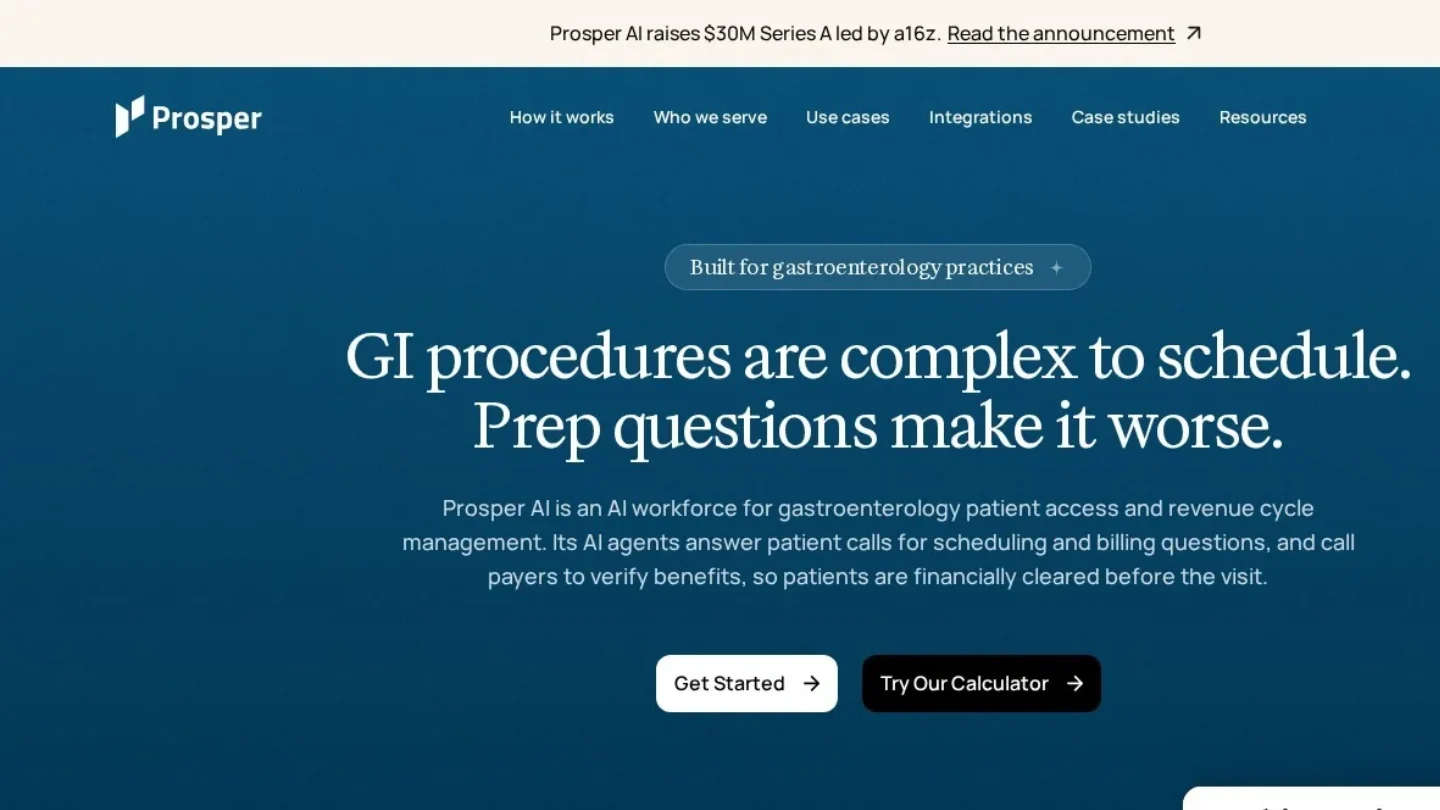
Prosper AI is our best overall pick because its GI page covers more front-desk work than any other tool we found. Its agents book and reschedule across providers and locations at any hour. They also handle cancellations. Colonoscopy scheduling is a named use case.
Next, the waitlist agent backfills same-day cancellations. Then the prep agent sends instructions by text or email at booking and again the day before. Your practice writes the prep rules, and clinical decisions stay with your staff.
The back-office side matters just as much. The agent checks eligibility by API and calls the payer when the API cannot answer. For prior authorization, it calls payers, waits on hold and records the outcome in the EHR.
Also, Prosper places outbound colonoscopy recall calls and takes referral intake. If a patient mentions severe abdominal pain or rectal bleeding, the call goes to staff. The agent gives no clinical advice or triage.
Prosper lists integrations with ModMed, Epic, athenahealth, NextGen and more than 80 EHRs in total. It says initial go-live takes about three weeks, with full coverage in 10 to 12 weeks. Prosper also says one Northeast GI group with more than 100 providers now routes over half its scheduling and waitlist calls to the agents.
We would pick Prosper for a GI group whose phone queue drives its no-show and backlog problems. As a next step, Prosper could add GI case studies to its GI page, since the ones there now come from OB/GYN practices.
Assort Health for Multi-Specialty Groups With a GI Service Line
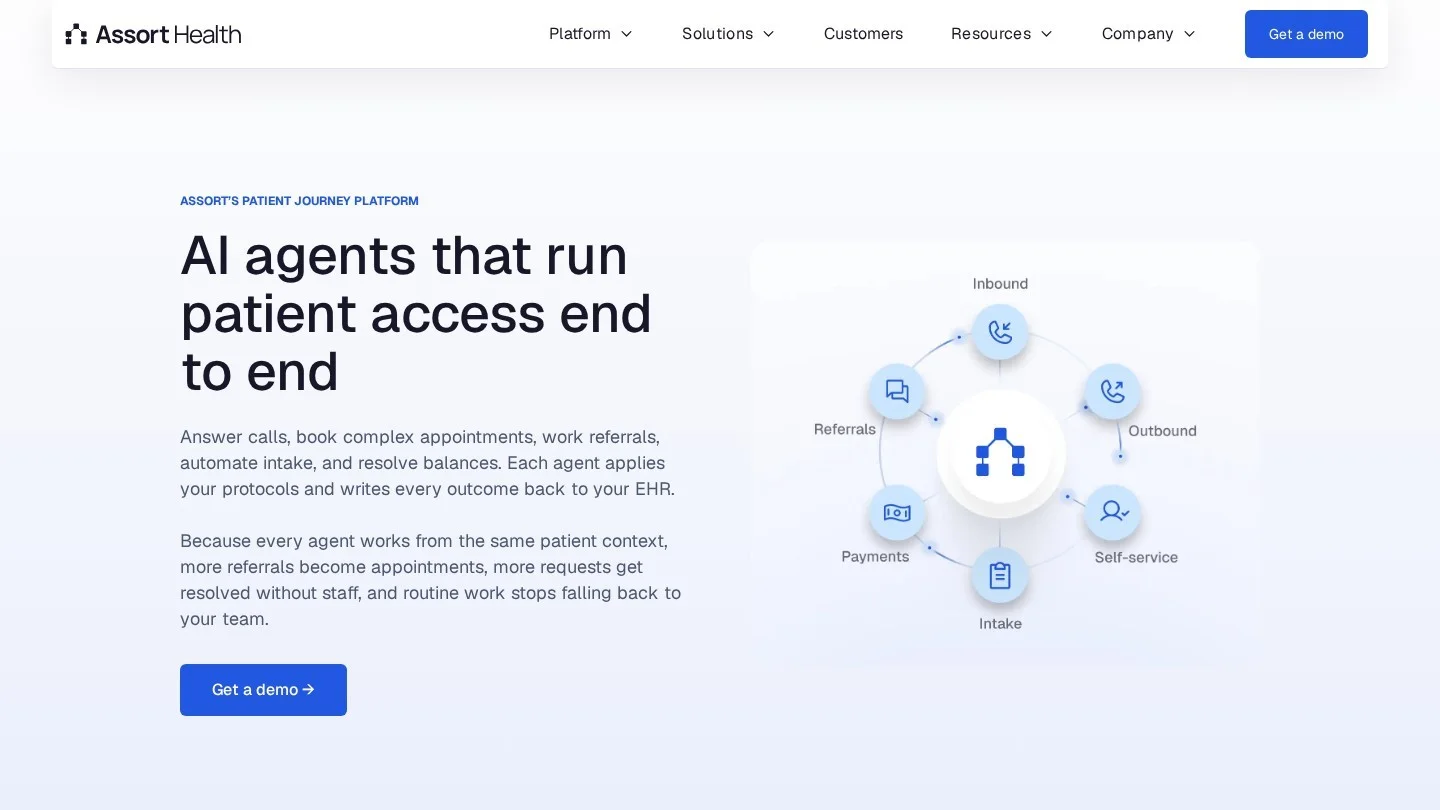
Assort Health builds voice agents for specialty care, and gastroenterology is one of its listed specialties. Its platform covers six agents. They handle inbound calls, outbound outreach, self-service booking, intake, referrals and payments.
For example, the inbound agent answers every call and books on your protocols. Meanwhile, the intake agent gets forms done and into the EHR before the patient arrives. A separate refill use case routes medication requests through your own workflow.
On security, Assort says SOC 2 Type II, HIPAA and a BAA on every engagement are the floor. It also says patient data never trains a foundation model, and clinical matters route to a person.
Assort reports more than 200 provider organizations and bidirectional links to more than 20 EHR and practice systems. So it works well for a group where GI is one service line among several. On the other hand, a GI-only practice may want a vendor whose page goes deeper on prep and recall.
Both picks are voice agents first. If you are weighing a scripted phone tree against an agent, our explainer on AI agents vs AI chatbots covers the difference. Also, the voice AI agents category lists more phone tools.
Colonoscopy Prep Calls and Recall Lists
Poor prep and no-shows cost GI groups real money. In fact, no-show and poor bowel prep rates can reach 25% at some facilities. So prep outreach is the most GI-specific job an agent can take on.
Luma Health for Epic-Based Prep Calls and Recalls

Luma Health has a colonoscopy prep workflow that runs inside Epic. It reads the procedure order, the date and the prep protocol from the chart. Then an AI voice agent calls the patient to confirm prep, fasting, insurance and timing.
If an answer falls outside the script, the call becomes an In Basket message for a nurse. Also, every confirmation goes back into Epic as discrete data. Luma publishes the compliance guidelines, call scripts and configuration templates under Apache 2.0, so your team can read them before go-live.
Luma says the rollout runs through a 100-patient sandbox test and goes live in about 15 days. It also says it does not train its AI models on customer data. Its GI materials state that Luma is HIPAA compliant and certified for SOC 2 and HITRUST.
The case studies are specific. Digestive Health Specialists used Luma to send prep instructions across more than 20 care paths and to build recall lists from Epic. The practice reports 7.5 hours of staff call time saved each day and about 95% of patients reached on the first attempt.
Luma also lists GastroHealth as a customer with three times more appointment confirmations. Beyond prep, the platform offers self-scheduling, a waitlist and referral tools. Its messages go out in more than 30 languages. We would pick Luma for any GI group on Epic that wants prep calls handled with a nurse in the loop.
Text outreach alone also moves the needle. For instance, Mount Sinai sent digital prep and navigation content by text to patients booked for colonoscopy. Patients who engaged heavily were about four times as likely to complete the procedure. So even a tool that only texts can earn its cost.
Read also: Best AI Agents for Healthcare Call Centers: 6 HIPAA-Ready Picks
Ambient Scribes for GI Visit Notes
GI notes pull in prior scopes and pathology results, so documentation eats clinic time. Ambient scribes listen to the visit and draft the note for the physician to sign.
Suki for Ambient Notes Across GI and Other Specialties
Suki supports clinicians across 99 specialties, and gastroenterology is on the list. It drafts notes from the visit conversation and also takes dictation. In addition, it suggests codes, prepares pre-charting and builds the assessment and plan by problem.
Finished notes go back to the EHR. On security, Suki says it complies with HIPAA requirements and signs BAAs with customers. Its developer docs add that visit audio and transcripts are deleted after 30 days, while the note stays for the length of the contract.
We would pick Suki for a GI group that wants one scribe for every clinician, including any non-GI providers in the building. Suki could make the choice easier by publishing GI-specific examples on its main site.
Sully.ai for a Bundle of Clinic Agents

Sully.ai sells a team of AI agents in place of a single tool. The roster includes an AI receptionist, an AI scribe and an AI medical coder. It also lists an AI nurse and an AI medical assistant.
Sully states that it is HIPAA compliant and will sign a BAA before you use it with patient data. Its SOC 2 Type II and ISO 27001 reports are available on request through its trust portal.
We would pick Sully for a smaller GI practice that wants one vendor for the phone and the note. However, its pages are not GI-specific, so ask for a GI demo with your own prep and recall rules.
Check your EHR before adding a scribe. For instance, ModMed sells an AI scribe built into its GI EHR that turns the visit dialogue into suggested notes and orders. If you already run that system, compare it with the picks here and ask for BAA terms in writing.
Where GI Genius Sits Next to These Agents
GI Genius belongs in a different category from every agent on this list. It is a medical device that Medtronic distributes and Cosmo Pharmaceuticals built. The FDA granted it De Novo clearance on April 9, 2021.
During a colonoscopy, it reads the scope’s video feed in real time. Then it marks suspected polyps on the screen as a second observer for the endoscopist.
So it is cleared clinical software inside the procedure room. The agents on our list work on the phone and in the note. That is why we evaluate them separately. A device goes through clinical review, while an admin agent goes through IT and privacy review.

Get These Answers in Writing Before Signing a BAA
Every vendor here states HIPAA terms. Even so, your compliance officer should see the details in writing. We would bring these questions to the first demo.
- Will you sign our BAA, or only your own form?
- How long do you keep call audio, transcripts and notes?
- Does any patient data train your models or a third party’s models?
- Which symptoms trigger a hand-off to staff, and who sets that list?
- Do answers write back to our EHR as discrete fields or as free text?
- Can we see the prep script and change it ourselves?
Also, ask how the vendor handles state rules on call recording and consent. Then ask for a reference from a GI group of your size. For more on budgeting, our guide to controlling AI agent costs covers usage caps and contract terms.
Roll Out One GI Agent at a Time
Pick the single job that costs your group the most staff hours. For most GI groups, that is either inbound scheduling calls or colonoscopy prep outreach. So buy for that job first and leave the rest for later.
Then plan a short pilot. For example, Luma tests its prep workflow on 100 patients in a sandbox before production calls begin. Prosper says initial go-live takes about three weeks. Ask any other vendor for a pilot of the same size.
Next, choose two numbers to track before you switch anything on. Good choices are same-day cancellations you refilled and patients reached before their prep day. Also track how many calls the agent hands to staff, because a high hand-off rate means the scripts need work.
After that, review a sample of calls or notes every week. Your nurses should hear how the agent explains your prep rules and fasting. Your physicians should read the scribe’s drafts before they trust its coding suggestions.
Finally, add the second agent only when the first one holds steady for a month. A practice that stacks a phone agent and a scribe in the same week will struggle to tell which one caused a problem. For more phone and chat tools, our page of customer support AI agents lists other options.
How We Screened GI Clinic Agents
We began with agents that GI groups use for phones, prep, prior authorization and notes. Then we opened each vendor’s product, security and case study pages.
Next, we kept only tools that state HIPAA terms on their own site. We also dropped tools with no healthcare focus at all.
Finally, we ranked the five by how much GI clinic work each one covers. We used only vendor-reported results, and we name the practice each time. For more real deployments, see our roundup of AI agent examples and our support cost reduction statistics.
Gastroenterology Practice Questions About AI Agents
Can an AI Agent Send Colonoscopy Prep Instructions?
Yes. Prosper sends prep instructions by text or email at booking and the day before. Also, Luma’s voice agent calls patients inside Epic to confirm prep and fasting.
Can AI Agents Handle Prior Authorization for a GI Practice?
Partly. Prosper’s agent calls payers, waits on hold and records the outcome in your EHR. Still, your staff keep the clinical decisions and sign off on each request.
Is an AI Phone Agent Allowed to Give Medical Advice?
The phone agents on this list send clinical questions to people. For example, Prosper routes callers with severe abdominal pain or rectal bleeding to staff. Assort also routes clinical matters to a person.
Is GI Genius an AI Agent?
No. GI Genius is an FDA-cleared device that flags possible polyps during colonoscopy. It does not book visits or talk to patients. For tools that do, see our AI scheduling agents page.
Related AI Agents


Read also: Hiring an AI Copywriter? Pick It by the Copy You Need Written
Explore Agent Categories
Related Articles
 GuidesBest AI Agents for Healthcare Call Centers: 6 HIPAA-Ready Picks
 GuidesAI Cardiology Practice Automation: Where Agents Help a Heart Clinic
 GuidesHiring an AI Copywriter? Pick It by the Copy You Need Written
 GuidesBest MCP Servers for Autonomous AI Workflows: 13 Picks With Safe Settings
 GuidesBest No-Code AI Agent Builders: 10 Picks by Team and Budget
 GuidesSynthesia AI Video Usage Among Corporate Training Teams
