


Very few SEO agencies say they use AI agents. We read the websites of 69 SEO agencies listed in New York, London, Toronto and Sydney, and only 4 mentioned AI agents or “agentic” work at all. Just 2 said they run an AI agent themselves, and only 1 described agents doing SEO tasks such as research, drafting and technical checks.
AI itself is everywhere on these sites. Of the 69 agencies, 53 (77%) sell some form of AI search work, sold as GEO, AEO or “AI SEO”. Only 22 (32%) say they use AI in their own work, and 7 of those name the tool. We kept one row per agency with the page we read and a quoted line for every finding, and every figure on this page comes from that file.
Four Agency Sites in 69 Talk About AI Agents
We searched each page for the words “AI agent”, “agentic” and “autonomous agent”. Four agencies used them, and they used them for different things.
- A New York agency says its strategists “use specialist AI agents for research, drafting and technical checks.” The page lists four agent roles (research, writing, review and publishing) with a human approval step, though it names no model or vendor behind them.
- A Toronto agency runs a 24/7 AI phone agent that books consultations and routes callers to staff. It also builds AI receptionists, chatbots and workflow automation for clients.
- A second Toronto agency lists “AI Chatbots & Agents” as a service in its main menu, beside its GEO offer.
- A Sydney agency sells an “agentic commerce optimisation service” that prepares product feeds, product pages and checkout for AI shopping agents.
Only the first of these uses agents inside SEO delivery. The second uses one for its own front desk, and the last two sell agent-related work to clients. Put as shares of the 69 sites, 6% mention agents, 3% use one themselves and 1% describe agents doing SEO work. The 95% confidence interval for “uses an AI agent itself” runs from 1% to 10%, so even with a larger sample the true share among listed agencies is unlikely to be high.
Our SEO agents category lists products such as Search Atlas OTTO and Alli AI, which push on-page fixes live across sites. Agencies in our sample did not name either one.
How We Built the Sample and Read Each Site
Where the Agency Names Came From
We started from four public “top SEO agencies” lists for New York, London, Toronto and Sydney, each with 50 entries and a staff count per agency. We removed duplicates across lists, the list publisher itself and three firms based outside the four countries. That left a frame of 190 agencies, 47 or 48 per city list.
The Six Things We Coded on Every Page
For each agency we opened one page on its own website and read the full text, including the navigation menus. We then coded six yes or no fields and kept a short quote as evidence for every “yes”.
| Field | Coded “yes” when the page |
|---|---|
| Mentions AI agents | uses “AI agent”, “agentic” or “autonomous agent” |
| Sells AI search work | offers GEO, AEO, AI SEO, LLM visibility or AI Overviews work, including as a menu item |
| Uses AI in own work | describes its own process or service as AI-powered, AI-driven or using AI |
| Names an in-house AI tool | names its own AI platform, dashboard or agent set |
| Names a third-party AI model | says which outside model or product its staff use |
| AI-related client result | shows a case study or award tied to AI search or AI tools |
AI platforms named only as places a client should appear, such as ChatGPT or Perplexity in a GEO pitch, did not count as tools the agency uses. A client logo of an AI company did not count either. Where a page was ambiguous we coded “no” and wrote the reason in the notes column.
How We Coded the Borderline Pages
Several pages needed a judgement call, and we recorded each one in the notes column so the coding can be checked. A London agency’s portfolio image described a client’s “AI agent page design” in its alt text. We coded that page “no” for AI agents, because the words described a client project and nothing the agency does or sells.
A Toronto page carried a news headline promising “autonomous AI intelligence” for SEO campaigns, but the article itself was not on the page and nothing else on it mentioned AI, so we did not count it as a claim about the agency’s own process. Another Toronto agency wrote about “GEO and AI driven strategies” as a market trend, which we also left out of the own-work count.
In the other direction, a menu item reading “AI Chatbots & Agents” counted as an agent mention even without supporting copy, since a service listed in the main navigation is something the agency offers for sale. The same rule applied to AI search, which is why a GEO label in a menu counts as selling AI search work.
Why the Final Count Is 69
Our plan was to read 150 agency sites. Our fetch tool could only open web addresses that had already appeared in search results, so each agency first had to surface in a search restricted to its own domain. Searches returned results for some domains and not others, and that capped what we could reach within our research budget. In the end we read 69 agencies, which is 36% of the 190-agency frame.
Because of this route, 52 of the 69 pages are the agency’s main SEO service page, 15 are homepages and 2 are about pages. Service pages are where AI search offers usually sit, which may lift that share a little against a homepage-only reading.
Three in Four Sell AI Search, One in Three Describe Their Own AI
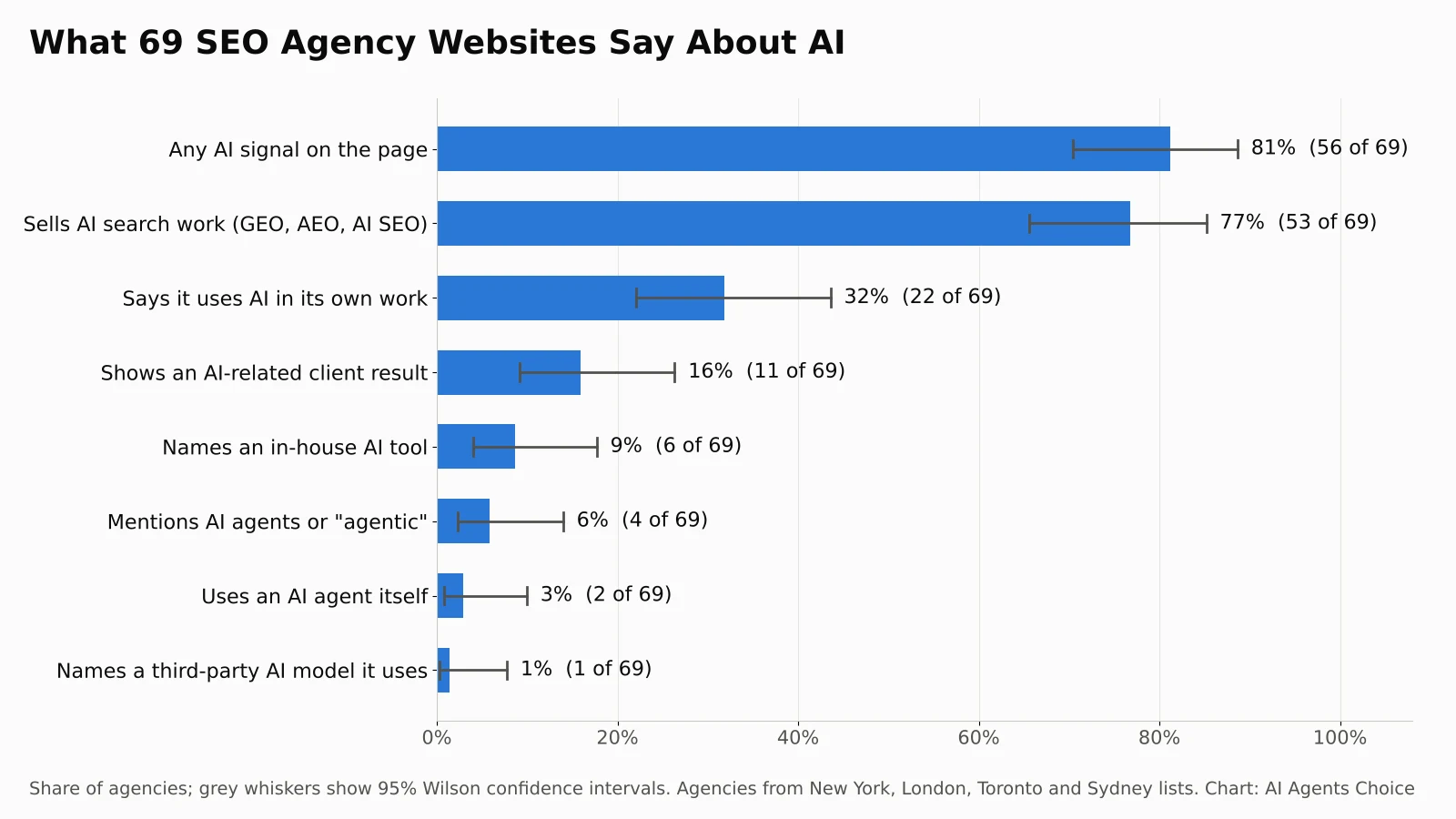
The gap between what agencies sell and what they say about their own methods is the main finding. Most pages now pitch help with getting a brand into AI answers, while far fewer explain how the agency itself works with AI, and very few name a specific tool.
| Signal on the agency page | Agencies | Share | 95% confidence interval |
|---|---|---|---|
| Any AI signal | 56 of 69 | 81% | 70% to 89% |
| Sells AI search work (GEO, AEO, AI SEO) | 53 of 69 | 77% | 66% to 85% |
| Says it uses AI in its own work | 22 of 69 | 32% | 22% to 44% |
| Shows an AI-related client result | 11 of 69 | 16% | 9% to 26% |
| Names an in-house AI tool | 6 of 69 | 9% | 4% to 18% |
| Mentions AI agents or “agentic” | 4 of 69 | 6% | 2% to 14% |
| Sells an agent or agentic service | 3 of 69 | 4% | 2% to 12% |
| Uses an AI agent itself | 2 of 69 | 3% | 1% to 10% |
| Names a third-party AI model it uses | 1 of 69 | 1% | 0.3% to 8% |
| No AI signal at all | 13 of 69 | 19% | 11% to 30% |
We used the Wilson score method for the intervals because several shares are close to zero, where the standard normal method gives negative lower bounds. All of the arithmetic, including the intervals, was run in Python on the research file.
GEO and AEO Have Become a Standard Menu Item
Of the 53 agencies selling AI search work, 12 (23%) list it only as a menu label, such as “GEO”, “AEO” or “AI SEO”, with no description on the page we read. The other 41 explain the offer in body copy on the page itself. Typical wording promises that a client will be “cited” or “recommended” in ChatGPT, Gemini, Perplexity and Google AI Overviews.
The labels vary much more than the services behind them. We counted GEO, AEO, AIO, LLMO, “AI Search Optimisation”, “AI SEO”, “ChatGPT SEO” and “Search Everywhere Optimization” across the sample, often two or three on the same page. One London agency lists “AI SEO & LLMs Optimisation”, “Generative Engine Optimisation” and “AIO Optimisation” under a single AI Search menu.
Only 3 agencies claim AI in their own work without selling AI search. Every one of the 11 AI-related client results came from an agency that also sells AI search, which fits the pattern of AI search being the commercial hook. Software that tracks brand mentions in AI answers, such as Profound, is the kind of product these offers depend on, though few pages say which tracker they use.

Read also: What Can an AI Agent Fix in Your Store’s SEO?
AI Claims Rarely Name the Tool Behind Them
Twenty-two agencies say they use AI in their own work. Fifteen of them stop at a phrase such as “AI-powered”, “AI-driven strategy” or “AI-accelerated workflows”. The other seven name something, and six of those seven name their own product.
- In-house AI products named on the pages included an “AI brand intelligence” platform, a branded suite of AI tools, a proprietary AI reporting dashboard and a framework that “merges AI, LLM, SEO, and PR”.
- Two of the in-house items are agents, the New York agent set for SEO tasks and the Toronto phone agent.
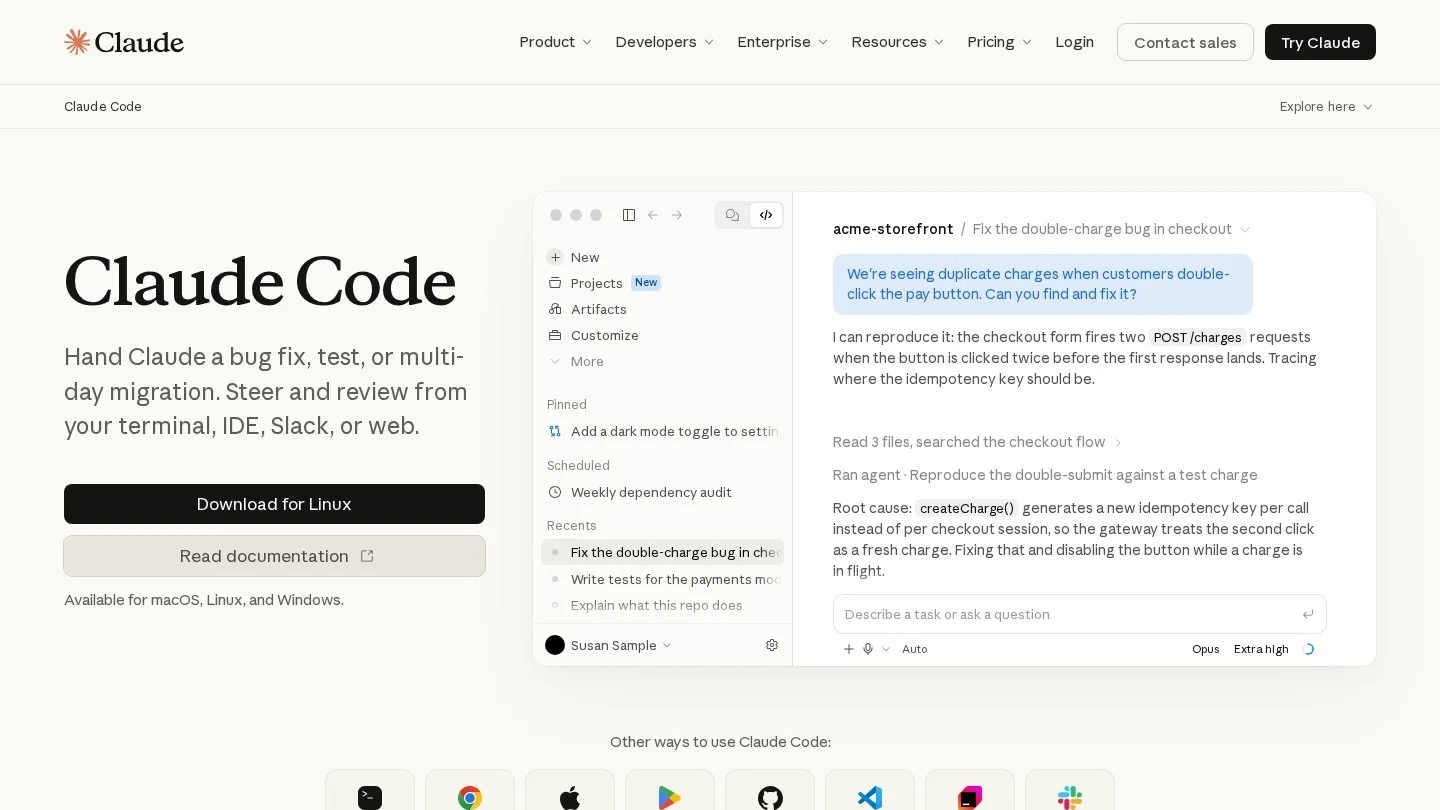
- One Sydney agency was the only site in the sample to name an outside model. Its resources menu links to a write-up on how it uses Claude for SEO across more than 1,000 client audits, and it also names Claude Code.
One Australian agency says it used AI, scrapers and its own tools to audit the pricing of more than 220 competitors. Several agencies frame AI as an assistant to staff. A Sydney agency writes that its “specialists use AI across content, technical audits and keyword research,” and a Melbourne page says its copywriters “balance the use of AI and human expertise.” One Australian service page goes the other way and states that no AI was used to create the page.
Client Results Tied to AI Search
Eleven agencies (16%) show a client result linked to AI. These are the agencies’ own figures, with no method given on the page we read.
- A US agency says a multi-specialty medical group gained 2,658% more Google AI Overview citations.
- A Sydney agency says a jewellery client grew ChatGPT-attributed revenue by 762%.
- Another Sydney agency says one client’s AI referral traffic rose 931% year on year.
- A London agency says it helped a client raise AI visibility by 61.3%.
- A Sydney agency says one client’s AI search visibility grew 41%.
- A UK agency says it took a 60% share of voice in AI Overviews for a seating manufacturer.
- An Australian agency cites a 2026 industry award for “Best AI Search Optimisation Campaign”.
None of these pages gives a baseline period or the tool used to measure AI citations. Ask for both before you treat one of these numbers as a forecast for your own site.
Thirteen Agencies Made No AI Claim at All
Thirteen agencies (19%) showed no AI signal on the page we read. Their median listed headcount is 33 staff, a little above the 25.5 median for agencies that did mention AI, so silence on AI is not only a small-firm habit. One of them employs 157 people.
Most of these pages describe classic SEO work such as technical audits, content, local SEO and link building. A Sydney page says “SEO is all we do.” Three of the thirteen still carry AI items in their menus for unrelated services, named “AI Transformation”, “AI Assisted Development” and “Gravity AI”, with no link to search work on the page.
Five of the thirteen came from the London list, four from New York, three from Sydney and one from Toronto. Agencies with no AI search line may still offer it on request. A buyer who wants GEO from one of these firms should ask directly, because the website gives no hint either way.
Differences by City List and Team Size

| City list | Agencies read | Sell AI search | Claim AI in own work | Show AI client result |
|---|---|---|---|---|
| New York | 22 | 77% (57% to 90%) | 23% (10% to 43%) | 14% (5% to 33%) |
| London | 19 | 68% (46% to 85%) | 37% (19% to 59%) | 21% (9% to 43%) |
| Toronto | 11 | 91% (62% to 98%) | 36% (15% to 65%) | 0% (0% to 26%) |
| Sydney | 17 | 76% (53% to 90%) | 35% (17% to 59%) | 24% (10% to 47%) |
The city lists look different at first glance. Toronto has the highest share selling AI search and no AI client results, and New York has the lowest share claiming AI in its own work. Every interval overlaps with every other, though, so the sample cannot show a real difference between markets. A group of 11 agencies moves 9 points with each agency.

Headcount shows a steadier pattern, using the staff count printed in the source lists. Among the 12 agencies with 1 to 10 staff, 67% sell AI search, 17% claim AI in their own work and none show an AI client result. Among the 16 with 51 or more staff, those figures are 88%, 44% and 38%. The 41 agencies with 11 to 50 staff sit in between at 76%, 32% and 12%.
The direction is the same on all three measures, rising with team size each time. Larger agencies have more pages, more case studies to publish and more reason to package AI search as a product. The groups are still small. Even the widest gap, 0% against 38% for client results, has intervals that touch, so a larger sample is needed to confirm it.
A Survey of 371 SEO Professionals Points the Same Way
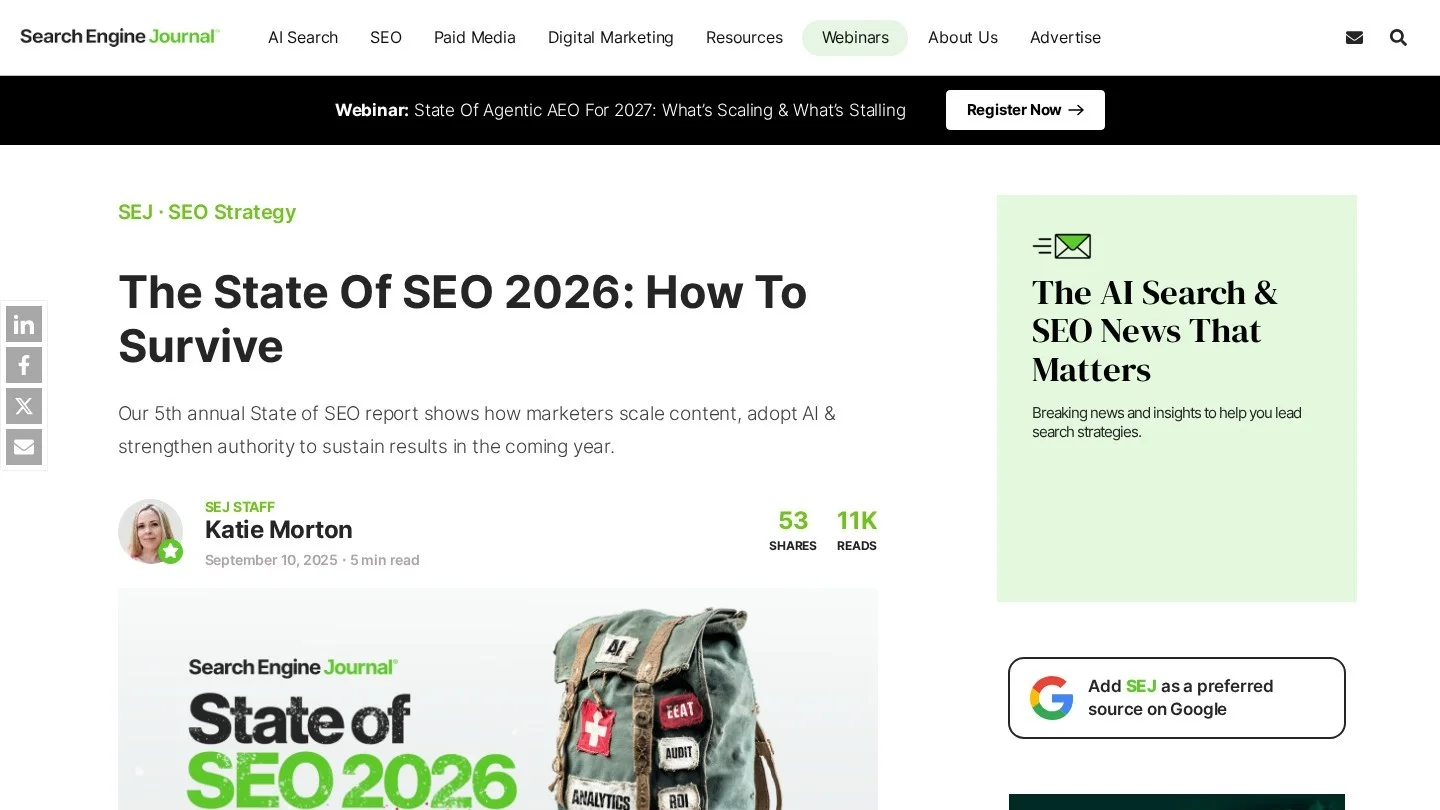
Search Engine Journal published its State of SEO 2026 report on September 10, 2025, based on 371 SEO professionals in 52 countries. Its numbers measure what practitioners report in a survey, while ours measure what agencies publish on their own websites. The two methods answer different questions, so we keep them apart.
- 22% of respondents fell into a group the report calls “AI-Heavy Adopters”, betting on scale through automation.
- 58% were “Hybrid Strategists” who use AI to improve content written by people.
- 77% worried that AI answers will reduce clicks to websites.
- About 42% of companies were training staff on AI.
A 22% heavy-adopter share and our 32% of agencies claiming AI in their own work are close in size, which suggests public claims are not wildly ahead of practice. The 77% worry figure sits beside our 77% selling AI search. The matching figure is a coincidence, but both numbers show AI answers have become the main commercial concern in SEO.
Limits That Shape How to Read These Numbers
A website shows what an agency chooses to say. Some agencies surely use ChatGPT, Claude or agent tools without writing about it, and some pages claim more than happens in client work. Every share here should be read as public positioning by the agency.
Our sample is 69 agencies, below the 100 we set as a floor, and it was not drawn purely at random. Agencies entered the sample when a search on their own domain returned a page we could open, which favours sites with more indexed pages. The sample median staff count is 26 against 20 in the full frame of 190, so mid-sized firms are slightly overrepresented. The source lists also rank agencies that market themselves well, so small local firms with thin websites are underrepresented.
We also read only one page per agency. An agency that offers GEO on a separate page and leaves it out of its menu would be coded “no”. Margins of error on the overall shares run up to 11 points either way, and on the city and size splits up to about 25 points.
Questions to Put to an Agency That Says It Uses AI
The gap between AI claims and named tools gives buyers a practical test. Ask which models or products the team uses, for which tasks and with what review step. The one agency in our sample that described its agent workflow listed research, drafting and technical checks with a human approval step, and that level of detail is what to expect.
For an AI search offer, ask how citations are measured, which AI platforms are tracked and what the baseline was before the work started. Ask whether AI search is priced as a separate line or folded into the SEO retainer, since both models appeared in our sample. Agencies building their own agent setups face the running-cost questions covered in our guide to controlling AI agent costs.
Agency owners looking at agent products for content and AI search work can compare AirOps and Frase, both listed in our agents for agencies category. For a wider view of how businesses outside SEO adopt agents, our agentic AI statistics collects published survey figures, and AI agents vs AI chatbots explains where a chatbot ends and an agent begins.
Reader Questions on SEO Agencies and AI Agents
What Percentage of SEO Agencies Use AI Agents?
In our sample of 69 agency websites, 3% said they use an AI agent themselves and 6% mentioned AI agents or agentic work in any way. Only one agency described agents doing SEO tasks.
How Many SEO Agencies Offer GEO or AEO?
53 of 69 (77%) offered some form of AI search optimisation. Twelve of those listed it only as a menu item with no description on the page we read.
Do Bigger SEO Agencies Use More AI?
They make more AI claims on their websites. Agencies with 51 or more staff were more likely than those with 1 to 10 staff to claim AI in their own work (44% against 17%) and to show an AI client result (38% against 0%).
Which AI Tools Do SEO Agencies Say They Use?
Almost none of them name a specific tool. Only 1 of 69 agencies named an outside model (Claude), and 6 named their own AI products. Fifteen agencies claimed AI use with no tool named at all. Agency owners planning to package agent work as a service will find pricing ideas in our list of profitable AI agent business ideas.
Read also: JSON-RPC in AI Agent Communication: How MCP and A2A Use It
Related AI Agents




Explore Agent Categories
Related Articles
 Guides1,000 Pages From One Spreadsheet: Programmatic SEO With AI Agents
 GuidesWhat Can an AI Agent Fix in Your Store’s SEO?
 GuidesAI Agents vs AI Assistants: Technical Differences and Use Cases
 GuidesAI Agent Middleware: Architecture and Use Cases
 GuidesJSON-RPC in AI Agent Communication: How MCP and A2A Use It
 GuidesBrowser Use vs Playwright: AI Agent or Scripted Automation
