


When WebArena launched, the best GPT-4 agent finished 14.41% of its web tasks. Human testers finished 78.24% of the same tasks. That gap is why AI agent benchmarking exists. A demo can look flawless while the agent still fails most real jobs.
So how do you benchmark an AI agent? Measure four things on tasks that look like your real work. They are task success, cost per task, latency and tool-call accuracy. Then run each task more than once, because agents are not consistent.
We read the original papers behind SWE-bench, τ-bench, GAIA, WebArena and OSWorld, and we noted how each one checks success. In our research, one pattern stood out to us. Four of the five never ask a model to grade the work. Instead, they check the end state, such as passing tests, a matching database or a script that inspects the finished task.
Four Metrics for AI Agent Benchmarking
A single accuracy score hides too much. For example, two agents can both pass 80% of tasks while one costs ten times more per run. So we track these four numbers side by side.
Task Success Rate and Pass^k
Task success rate is the share of tasks the agent fully completes. Partial credit can help you debug, but the headline number should be pass or fail.
Then add pass^k. The τ-bench paper defines it as the chance that all k tries at the same task succeed. It differs from pass@k, which counts a task as solved if any one try works. Pass^k is the harsher test, and it matches what a customer sees. A support agent that solves a refund on Monday and fails it on Tuesday is not reliable.
Cost per Completed Task
Divide total spend by the number of tasks the agent finished. Count model tokens, tool fees and any per-run platform charge. Failed runs still cost money, so they belong in the total.
This number moves fast with settings. For instance, a higher reasoning effort may lift success by a few points and double the bill. Our study of AI agent token consumption shows why agents burn far more tokens than chat.
Latency per Task
Time the whole task, from the first request to the final result. Step latency matters less than end-to-end time. A phone agent has a few seconds per turn, while a research agent can take minutes. So set the limit by channel before you compare agents.
Tool-Call Accuracy
A bad tool call is one of the most common ways an agent fails. The agent picks the wrong tool, passes a wrong argument or calls the right tool at the wrong time. So score each call in a test run on three checks: right tool, right arguments and right order.
Also log calls that should never happen, such as a refund the policy does not allow. τ-bench catches these by comparing the final database with the expected one. As a result, a wrong write fails the task even when the chat sounds fine.
Five Public Benchmarks Used to Test AI Agents
We pulled these details from each benchmark’s original paper. The last column shows the best AI result the authors reported at launch, which shows how hard each test was on day one.
| Benchmark | What the agent does | Size | How success is checked | Best result at launch |
|---|---|---|---|---|
| SWE-bench | Fixes real GitHub issues in a code base | 2,294 problems from 12 Python repositories | The patch must resolve the issue, checked against the project’s tests | Claude 2 resolved 1.96% |
| τ-bench | Serves a simulated customer in retail and airline support | Two domains with set policies | The final database must match the expected outcome, and the reply must hold the required facts | gpt-4o averaged 48.2% pass^1 |
| GAIA | Answers real-world questions that need browsing, files and tools | 466 questions | Each answer is checked against a known correct answer | GPT-4 with plugins scored 15%; humans 92% |
| WebArena | Completes tasks on four working websites | Shopping, forums, code collaboration and content management sites | Functional correctness of the finished task | GPT-4 agent 14.41%; humans 78.24% |
| OSWorld | Uses a real computer across apps | 369 tasks on Ubuntu, Windows and macOS | A custom execution-based script for every task | 12.24%; humans over 72.36% |

Chart: AI Agents Choice, built from the original WebArena, OSWorld and GAIA papers. The early gaps were huge. Still, every one of these tests has since moved, which we cover after the benchmark notes.
SWE-bench for Coding Agents

SWE-bench gives the agent a code base and an issue written by a real user. The agent must edit the code so the matching pull request’s tests pass. Because the check runs real tests, a patch that only looks right still fails.
Most vendors now quote SWE-bench Verified. It holds 500 tasks that people screened by hand, and it was built with OpenAI. Coding agents such as OpenHands and Devin are judged on these sets.
τ-bench for Customer Service Agents

τ-bench puts the agent between a customer and a set of company tools. A language model plays the customer and follows a hidden goal. The agent must follow a written policy, such as the airline’s rules on cabin class and membership.
Then the benchmark checks the database. If the agent changed the wrong order or skipped a rule, the task fails. In the paper, gpt-4o’s pass^8 in retail fell under 25%. In other words, it rarely solved the same task eight times in a row.
GAIA for Research Assistants
GAIA asks questions that people answer without much trouble. Still, each one needs browsing, files or tools, so a model cannot answer from memory alone. That makes it a good proxy for research assistants and deep-research agents.
WebArena for Browser Agents

WebArena runs four real, self-hosted websites. They cover online shopping, forum discussions, software collaboration and content management. The tasks are long and mimic everyday web chores. Browser agents such as Browser Use work on this kind of task.
OSWorld for Computer-Use Agents
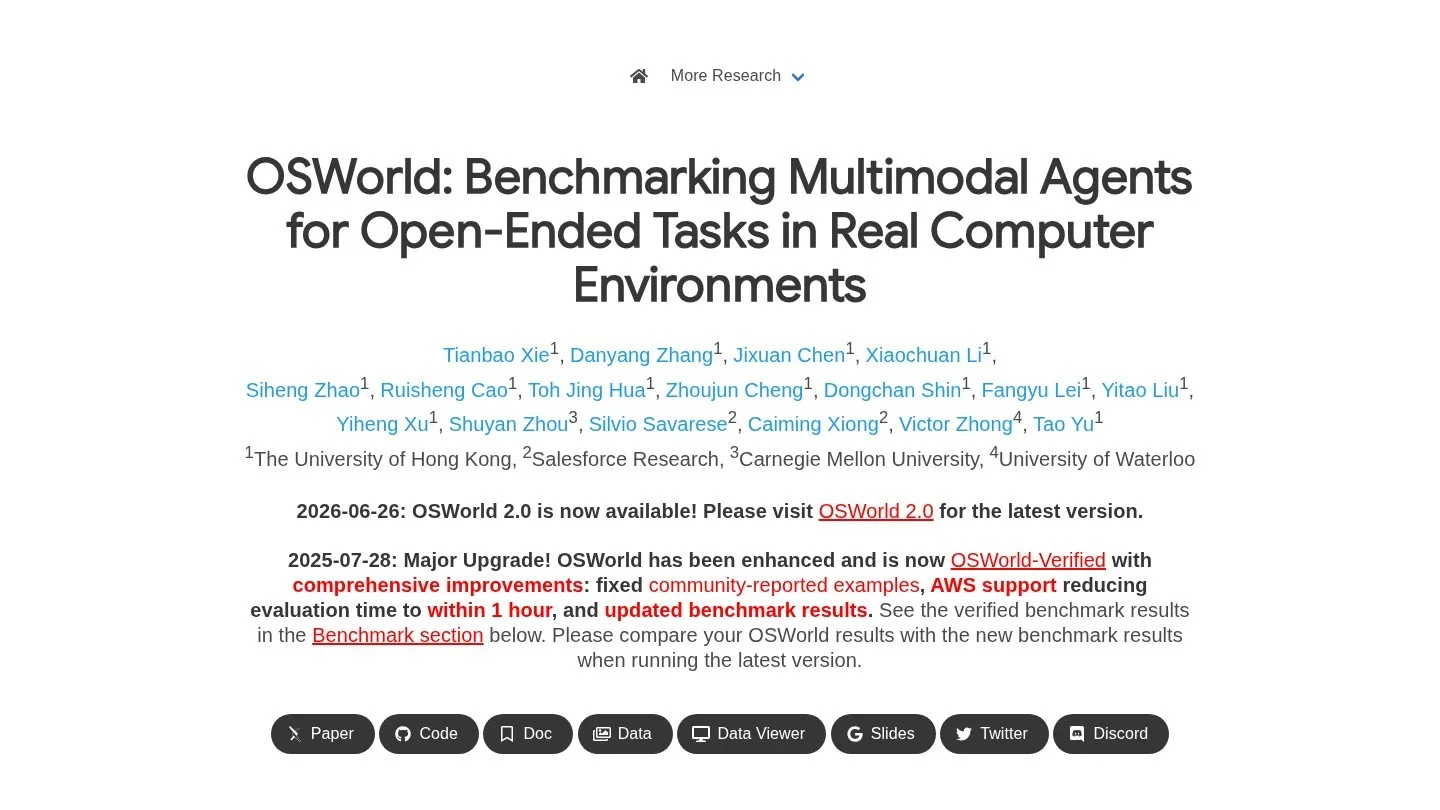
OSWorld goes beyond the browser. It gives the agent a full desktop with web and desktop apps on Ubuntu, Windows or macOS. Every task ships with its own script that checks the end state, such as a saved file or a changed setting.
How Far AI Agent Benchmark Scores Have Moved
Launch scores age fast. On the original OSWorld, the Stanford AI Index reports a top score of 66.3% for Claude Opus 4.5, close to the human mark. The same report puts the top GAIA score at 74.5%. Meanwhile, the best SWE-bench Verified scores sit near 80% when labs use their own agent setups.
So builders keep making harder tests. OSWorld 2.0 has 108 long tasks on a live Ubuntu machine. There, Claude Opus 5.5 scored 81.8% on partial credit but 48.7% on the strict pass rate. That spread is the lesson. An agent often gets most of the way and then misses the last step. Our post on AI model accuracy by task category lists the latest scores in full.
Read also: Klarent AI Alternatives for Autonomous Web and Mobile Testing
How to Benchmark Your Own AI Agent
Public scores rank models. However, they cannot tell you how an agent handles your refund policy or your CRM. For that, you need a private benchmark, built the same way the papers build theirs.
- Collect real tasks. Pull 30 to 50 finished tasks from your queue, tickets or logs. Keep the hard ones and the odd ones, since easy tasks inflate the score.
- Write a check for each task. Copy the papers here. Define the end state that counts as success, such as a record updated, a test passing or a refund amount. Avoid scoring by how the reply reads.
- Run every task several times. Use at least three runs and report pass^k next to the average. A big gap between the two means the agent is unstable.
- Log cost, time and tool calls per run. Then work out cost per completed task, end-to-end latency and tool-call accuracy from those logs.
- Compare against today’s process. Time a person doing the same tasks, or use your current resolution data. Our numbers on AI agent human intervention rates give a reference point for support work.
- Re-run on every change. A new model, prompt or tool can break tasks that used to pass. So treat the test set like a regression suite.
Tracing tools make the logging part easy. For example, Langfuse records each agent step with cost and latency, and it supports datasets, experiments and human labeling queues. Its Hobby cloud plan is free for 50,000 units a month, and Core costs $29 a month. Five Sigma, which builds the Clive claims agent, says it uses LangSmith evaluation datasets to check for hallucinations.
Your test set is the part of this work worth the most care. Our guide to AI agent evaluation datasets covers how to build and grow one.
Mistakes That Skew AI Agent Benchmark Results
We kept running into the same traps while comparing published scores. Each one can move a result by several points.
- Different harnesses. The same model scores lower on SWE-bench’s shared bash-only setup than in each lab’s own agent loop. So compare scores only when the harness matches.
- Buggy tasks. Google noted that three SWE-bench Verified tasks had harness bugs, and it adjusted its own score after fixing them. Also, the Stanford AI Index found invalid-question rates from 2% to 42% across nine common benchmarks.
- One run per task. A single pass hides the drop that τ-bench found on repeated tries. Report pass^k, or at least the spread across runs.
- Ignoring cost. A top score at maximum effort may cost far more per task. Put cost per completed task next to every success rate. Our guide to controlling AI agent costs covers budget caps.
- Mixing benchmark versions. τ-bench and τ2-bench give very different numbers for the same model. For instance, two models tied at 99.3% on τ2-bench Telecom. So always check the version and domain a vendor quotes.
Quick Answers on AI Agent Benchmarks
What Is the Most Important Metric for Benchmarking an AI Agent?
Task success rate comes first, measured as pass or fail on the end state. Next, add pass^k for reliability and cost per completed task for budget.
Which Benchmark Fits a Customer Service Agent?
τ-bench and τ2-bench are closest, because they test policy-following with tool calls and a simulated customer. Still, build a private set from your own tickets before you buy.
How Many Tasks Do I Need for an Internal Benchmark?
Thirty to fifty real tasks is a workable first set. Then run each one at least three times and add new failures from production as you find them.
What Is the Difference Between Pass@k and Pass^k?
Pass@k counts a task as solved if any of k tries works. Pass^k needs all k tries to work. So pass^k is the better guide for agents that customers rely on.
Related AI Agents



Read also: Hierarchical Multi-Agent Systems Explained
Explore Agent Categories
Related Articles
 GuidesKlarent AI Alternatives for Autonomous Web and Mobile Testing
 GuidesSynthesia AI Video Usage Among Corporate Training Teams
 GuidesBest CAMEL AI Alternatives and What They Cost
 Guides100 AI Agent Statistics for Retail Companies
 GuidesLLM or AI Agent? AI Search Engines and What They Actually Are
 GuidesCan You Trust an AI Agent?
