

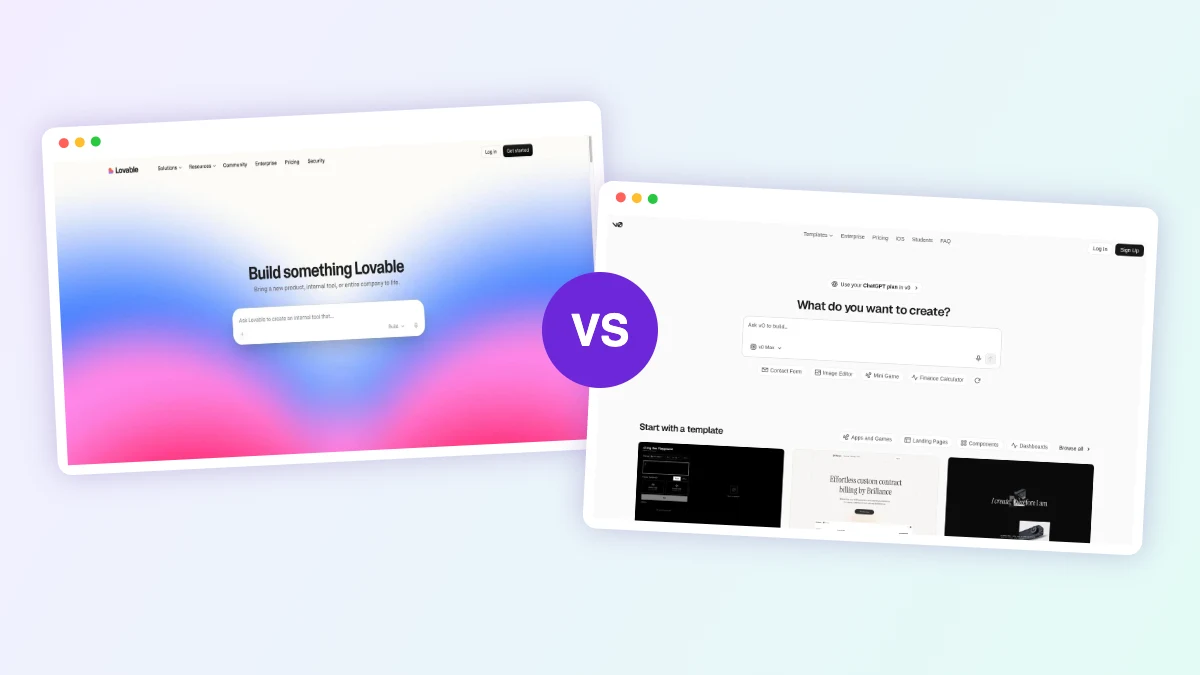
Lovable and v0 both turn a written prompt into a working web app, but they are built for different people. Lovable is the better choice if nobody on your team writes code and you want the database, login and hosting handled for you in one place. v0 is the better choice if you care most about polished interfaces and want real code that drops into GitHub and deploys on Vercel, where your engineers already work.
Pricing also follows that split. Lovable charges per workspace, so a whole team can share one credit pool, while v0 charges per user and meters usage by tokens. That difference matters more than the headline prices of $25 and $30 a month. This comparison is based on each vendor’s published pricing pages, documentation and announcements, plus an independent pricing tracker. We did not test either tool hands-on.
Lovable or v0 for Your Next App
- Lovable starts free with 5 build credits a day, and Pro costs $25 a month for 100 credits, or $21 a month on annual billing, priced per workspace rather than per seat.
- v0 starts free with a cap of seven messages a day, and Plus costs $30 per user a month with $30 of credits per user plus $2 of daily login credits.
- Lovable includes its own backend, called Lovable Cloud, with a database, file storage and login, so non-developers rarely need another service.
- v0 produces Next.js-style front-end code with a visual Design Mode, Git branches per chat and one-click deploys to Vercel.
- For a five-person team, Lovable’s shared pool is usually cheaper, while v0’s training opt-out by default requires the $100 Business seat.
- Both meter usage, so a busy build week costs more than a quiet one on either tool.
Lovable and v0 by Pricing, Stack and Deployment
Both tools are AI app builders, a newer cousin of the classic no-code platforms covered in our guide to no-code AI agent builders. The table compares them on the points that usually decide a purchase.
| Lovable | v0 by Vercel | |
|---|---|---|
| Maker | Lovable (Stockholm) | Vercel |
| Built for | Non-developers building full apps | Designers and front-end teams shipping interfaces |
| Free plan | 5 build credits a day, capped at 30 a month | 7 messages a day; new users get a one-time $5 credit |
| Entry paid plan | Pro, $25 a month for 100 credits | Plus, $30 per user a month with $30 of credits |
| How you are billed | Per workspace, shared credit pool | Per user, plus token-metered usage |
| Business tier | $50 a month for 100 credits | $100 per user a month |
| Backend included | Lovable Cloud database, storage and auth | Connects to outside databases and services |
| Code access | Two-way Git sync on every plan; editing on Pro and up | GitHub sync on every plan, plus a Git panel for branches and pull requests |
| Hosting | lovable.app address, custom domains on Pro | One-click deploys to Vercel |
| Training opt-out by default | Business and Enterprise | Business and Enterprise |
| Security and admin | SOC 2 Type 2 and ISO 27001:2022; SSO on Business | SAML SSO and role-based access on Enterprise |
How Lovable Works and Who It Suits
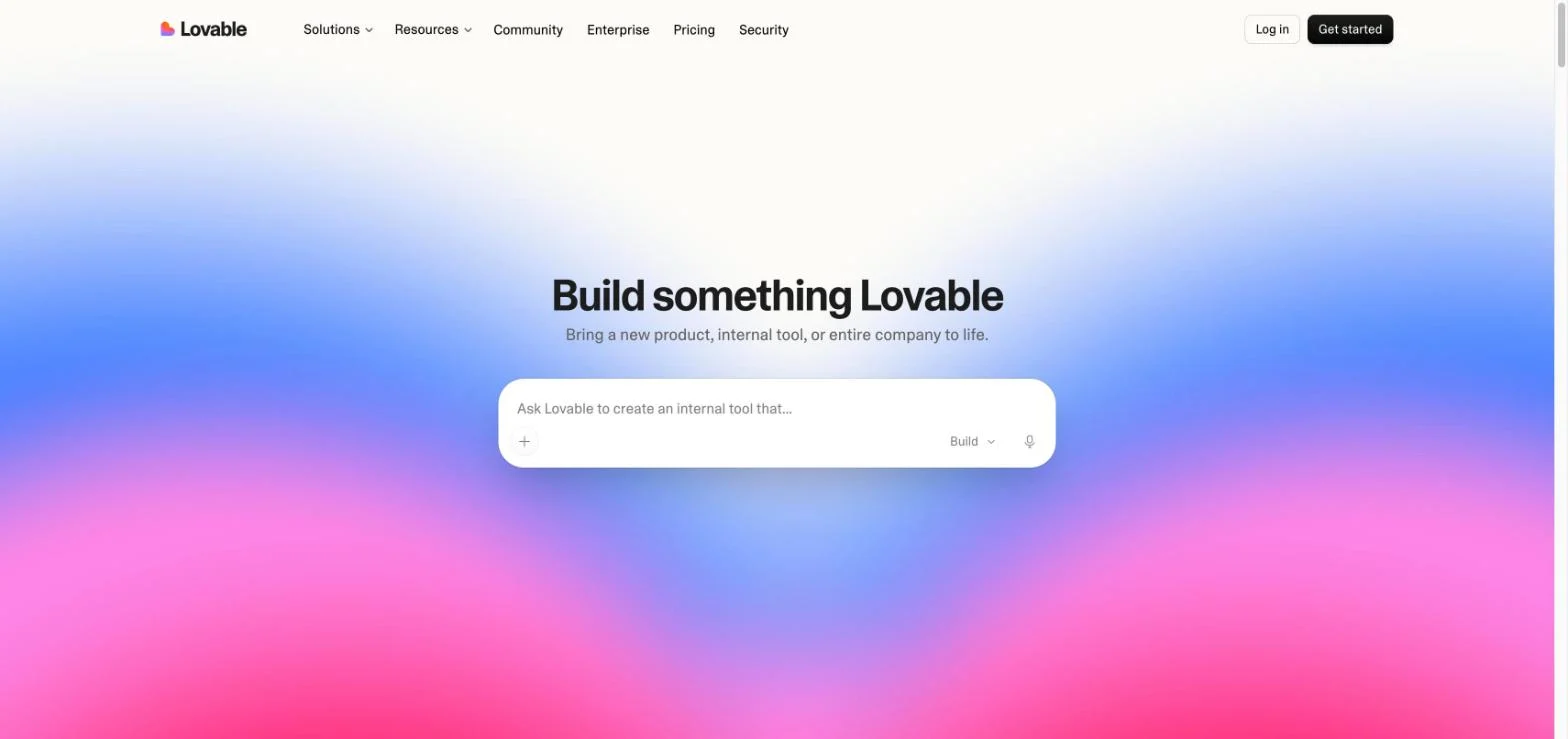
Lovable is a chat window attached to a live preview. You describe what you want, and the agent plans and writes both the front end and the back end while the preview updates, and you keep chatting to request changes. An optional Plan mode lets you agree on an approach before any code is written, at a cost of about one credit per message.
The feature that sets Lovable apart is Lovable Cloud. It gives every app a database, file storage and user login without any setup, with hosting regions in the EU, the US and Asia Pacific. An AI gateway lets your app call text, image, music and voice models without its own API keys. On October 20, 2026, Lovable also added the option to create Supabase projects straight from the chat, for teams that prefer to own their backend account.
What a Typical Build Looks Like
- Describe the app. Write a plain-English prompt, or start from an image or a design reference.
- Let the agent build. Lovable’s own examples price a button color change at 0.50 credits, removing a footer at 0.90 and adding sign-up and login at 1.20. A landing page with images costs about 2 credits.
- Connect services. Built-in connectors cover tools such as Klaviyo, n8n, Cube, Scrive and LlamaParse.
- Publish. Apps go live on a lovable.app address, and Pro adds custom domains and removes the Lovable badge.
- Hand off the code. Two-way Git sync works on every plan, so an engineer can take over later.
A basic security scan runs every time you publish, checking database rules and common setup mistakes. A deeper AI scan is available on demand. Treat both as a safety net rather than a full code review.
Scale and Team Controls
Lovable has grown very quickly. It confirmed to TechCrunch that annual recurring revenue passed $400 million in February 2026, and in August it raised $400 million at a $13.3 billion valuation. It says more than 60 million projects have been built on the platform and that apps made with it draw over 900 million visits a month.
October 2026 brought a wave of team features. Admins on paid plans can now set credit limits and alerts per member, group or project, and email warnings arrive before credits run out. Enterprise admins gained scheduled audit log exports and policies that require approval before an app is published. Lovable states SOC 2 Type 2 and ISO 27001:2022 certification, and Business adds SSO, a security center and a data processing agreement.
How v0 Works and Who It Suits

v0 is Vercel’s AI agent for building web interfaces and apps. Vercel says it is agentic by default: it plans the build, creates tasks, connects to databases and writes the code while you watch a live preview. You refine by chatting or switch to Design Mode, which gives you visual controls for spacing, colors and type. Saved design systems apply the same colors, fonts and styles across every project, which keeps a team’s pages consistent.
The February 2026 rebuild moved v0 closer to how engineering teams already work. It can import an existing GitHub repository, pull environment variables from Vercel and build in a sandbox that mirrors a real deployment. A Git panel lets non-engineers open a branch for each chat, raise a pull request and deploy when it merges. That is the biggest practical difference from Lovable: v0 is designed to work on code your company already owns, not only on projects it started itself.
Connections and Models
v0 connects directly to Snowflake and AWS databases. In September 2026, Vercel brought marketplace integrations into v0, including Resend for email, Clerk for login, Algolia and Amazon OpenSearch for search, and MongoDB Atlas for data. When a prompt needs one of these services, v0 shows a connect card and sets up the configuration for you.
Paid plans include access to all of v0’s models, named Mini, Pro, Max and Max Fast. Since October 2026, eligible responses from OpenAI models can also draw on a ChatGPT subscription, though v0 still charges a small platform fee in credits for each request.
Scale and Backing
v0 had more than 4 million users by March 2026, according to SaaStr, and people created 9.6 million projects with it during 2025. Teams and Enterprise accounts bring in more than half of v0’s revenue, which tells you companies buy it for shared work. Vercel itself was valued at $9.3 billion after a $300 million funding round in September 2025.
Read also: Perplexity Comet vs Opera Neon: Which AI Browser Should You Use?
Pricing Compared: Workspace Credits vs Per-User Tokens
The two pricing models work very differently, so it helps to compare their structure before running any numbers. Lovable figures come from its published subscription documentation, while v0 figures come from its pricing page and from an independent tracker that records every change to it.
| Plan | Lovable | v0 |
|---|---|---|
| Free | $0, 5 daily build credits (max 30 a month), small Cloud and AI grants | $0, 7 messages a day, one-time $5 credit for new users |
| Entry | Pro: $25 a month for 100 credits ($21 on annual billing), plus 5 daily credits | Plus: $30 per user a month, $30 of credits per user, $2 of credits per daily login |
| Larger tiers | Pro scales to 10,000 credits for $2,250 a month | Extra usage billed by tokens at each model’s rate |
| Business | $50 a month for 100 credits ($42 on annual billing), SSO, API, training excluded by default | $100 per user a month, training opt-out by default, API access |
| Enterprise | Custom, with SCIM, audit logs and publishing controls | Custom, with SAML SSO, role-based access and support SLAs |
| Unused credits | Roll over while subscribed; top-ups last 12 months | Monthly credits roll over and expire after 65 days |
| Usage on top | Lovable Cloud hosting and in-app AI billed by use | Hosting on Vercel; token rates per model |
v0’s token rates decide how fast its credits go. v0 Mini costs $0.20 per million input tokens and $1.20 per million output tokens, v0 Pro costs $2 and $10, v0 Max costs $5 and $25, and v0 Max Fast costs $10 and $50. Chat history and source files count as input tokens, so a long project gets more expensive per message. When credits run out, v0 pauses generation rather than charging overage automatically.
Three Worked Examples
A solo founder building a first product. On Lovable Pro at $25 a month, 100 credits buys roughly 50 to 200 prompts, using Lovable’s own sample costs of 0.50 to 2 credits each. The 5 daily credits add up to 150 more in a 30-day month if you use them every day. On v0 Plus at $30, a v0 Pro request that reads 100,000 tokens of context and writes 10,000 tokens costs about $0.30, so the included $30 covers about 100 such requests. Daily login credits can add up to $40 more over 20 working days. The same request costs about $0.03 on v0 Mini, so model choice matters a lot.
A five-person product team. Because Lovable bills per workspace, five people can share one Pro subscription and its credit pool. At Lovable’s published tiers, 800 shared credits cost $200 a month on Pro or $400 a month on Business. On v0, five Plus seats cost $150 a month with $150 of pooled credits. If everyone logs in on 22 working days, daily credits add up to $220 more, for as much as $370 of usage before top-ups. Moving the same five people to v0 Business costs $500 a month, which is $350 more than Plus, mainly for training opt-out by default and API access.
A ten-person company that needs data protection. On v0, ten Business seats cost $12,000 a year against $3,600 for ten Plus seats. On Lovable, Business is priced by credits rather than people, so ten people on a 100-credit Business workspace pay $504 a year on annual billing, though a team that size will likely need a larger credit tier. For teams that handle client data, this gap is often the deciding factor.
Lovable’s subscription only covers building. Once an app has real users, Lovable Cloud charges for database size, storage, network and compute, and the AI gateway bills by tokens and seconds of voice or video. Budget for both before launch.
Code Ownership, Security and Lock-In
Both tools let you keep your code, but in different ways. Lovable offers two-way Git sync on every plan, including Free, though editing and downloading code directly needs Pro or above. The app is easiest to run on Lovable Cloud, so moving it elsewhere takes some engineering work. v0 works in your own GitHub repository from the start, with branches and pull requests. The smoothest path is Vercel hosting, but because the code lives in GitHub, an engineer can deploy it elsewhere.
On data, the two are closer than they look. Both exclude your data from model training by default only on Business and Enterprise. Lovable’s Free and Pro users can opt out in settings. Lovable lists SOC 2 Type 2 and ISO 27001:2022 and runs a security scan on every publish. v0 puts SAML SSO and role-based access on Enterprise, and the rebuilt v0 adds deployment protection and a web application firewall through Vercel. On both, a person still needs to check access rules, payments and private data before real customers arrive.
Which One Should You Pick
The decision mostly comes down to who will do the building and where the finished application will live. These scenarios describe the buyers who most often compare these two products.
- You are a non-technical founder testing an idea. Pick Lovable, because it handles the database, login and hosting in one place, and the Free plan is enough to see whether it fits before you pay.
- You are a designer who wants to ship real pages. Pick v0, because Design Mode and saved design systems let you adjust a working page and publish it, rather than handing off a static mockup.
- Your engineers already use GitHub and Vercel. Pick v0, since it imports existing repositories, opens pull requests and deploys on merge, which fits a workflow your team already trusts.
- You run operations and need internal tools quickly. Pick Lovable, since dashboards, intake forms and approval flows are well within its range, and one shared workspace keeps costs predictable for a small team.
- You are an agency producing client sites. Either works. Lovable’s shared credits suit several projects on one plan, while v0’s design systems suit agencies with strict brand rules.
- You want to explore layouts before writing any code. Look at Google Stitch for free UI exploration, or the Figma Design Agent if your source of truth is a Figma file.
- You need changes inside a large, existing codebase. Neither is the best fit. A coding agent such as Devin works inside repositories and handles tickets, and our Devin vs OpenHands comparison covers that choice.
For a wider view, our roundup of the best agentic AI coding tools covers more builders and coding agents. You can also browse our pages on AI coding agents, design agents and agents for startups. If you are weighing general agents that can also build simple sites, see Manus vs Genspark.
Limits Both Share
Neither tool gives you a fixed monthly bill. Lovable’s cost per prompt varies with the request, and hosting is usage-based. v0’s cost depends on the model, the length of your chat history and the size of your files. For Lovable, the most common complaint in public reviews is credits running out faster than expected, and v0’s token meter makes spending just as hard to predict, so set limits from the first day.
Both also change quickly. v0 moved from message counts to tokens in 2025, roughly doubled its model rates in February 2026 and then cut some rates in August. Lovable shipped more than 20 releases in October 2026 alone and retired Gemini 2.5 models that some apps used for their AI features. Check the pricing page before each renewal, and test any app that depends on a specific AI model after a provider update.
Questions About Lovable and v0
Is Lovable Better Than v0?
Lovable is better for non-developers who want a complete app with a database, login and hosting from one chat. v0 is better for designers and front-end teams who want polished interfaces as real code in GitHub. The simplest test is to build the same small app on both free plans before choosing.
Which Is Cheaper, Lovable or v0?
For one person, Lovable Pro starts at $25 a month against $30 for v0 Plus. For teams, Lovable is usually cheaper because it bills per workspace, while v0 charges each user. v0’s cheapest model can make individual requests very inexpensive, so heavy users should compare actual usage.
Can v0 Build a Backend and Database?
v0 can connect to databases and services as it builds, including Snowflake, AWS databases and MongoDB Atlas, and it sets up services such as Clerk for login and Resend for email. Lovable differs by bundling its own backend, Lovable Cloud, so a beginner never has to set one up.
Can I Export My Code From Lovable?
Yes. Two-way Git sync with GitHub works on every plan, including Free. Editing and downloading code directly inside Lovable requires Pro or above.
Does v0 Only Work With Vercel?
One-click deployment targets Vercel, and the smoothest path runs through it. Because v0 also syncs to GitHub, engineers can take the code and host it elsewhere if they need to.
Related AI Agents




Read also: Manus vs Genspark: Which General AI Agent Fits Your Work?
Explore Agent Categories
Related Articles
 ComparisonsPerplexity Comet vs Opera Neon: Which AI Browser Should You Use?
 GuidesDuplicates, Typos and Broken Dates: Which AI Agent Should Clean Your Data?
 GuidesThe Research Before the Draft: Which AI Agent Should Find Your Next Topic?
 GuidesBest Voiceflow Alternatives: 8 Chat and Voice Agent Builders
 GuidesAI Tools Pricing Models Explained: A Guide for Buyers and Builders
 GuidesBest No-Code AI Agent Builders: 10 Picks by Team and Budget
