


AI agents are changing travel booking by finishing the purchase inside the chat, so the traveler no longer jumps across five tabs to pay. Hotels moved first, and Google now lets US users book a room inside AI Mode with partners such as Marriott and Hilton. Flights are a step behind on the big platforms, but startups like Mindtrip already sell airline tickets inside a chat window.
We researched ten companies that put agents into the booking flow, from search engines to an airline. For each one, we opened the company’s own announcement or product page and noted what the agent can do on its own. After that, we compiled where a human still has to step in and what can go wrong when software holds your card.
Booking Agents Sorted by How Far They Go
The picture is uneven, so we put it in one table first. Some agents plan and compare but hand you off to a website to pay. Others take payment in the chat and then fix the trip later when plans change. You can see more travel agents side by side on our AI agents for travel page.
| Company | What the agent does | Pays inside the chat? |
|---|---|---|
| Google AI Mode | Books hotels with partner brands in the US and tracks flight prices | Hotels yes, through Google Pay; flights no |
| Kayak Ask AI | Answers travel questions in plain words and compares live prices | Yes, Kayak says you can compare and book in one place |
| Expedia | Activity Planner books tours and activities after a trip is set | Yes, for bookable activities in the US |
| Booking.com | AI Trip Support answers service questions and hands off to staff | No, it serves trips already booked |
| Trip.com TripGenie | Plans trips and helps with booking choices in the app | Booking stays inside the Trip.com app |
| Priceline Penny | Recommends hotels and flights through more than 10 linked agents | Runs inside Priceline’s own site and app |
| Mindtrip | Searches and sells airline tickets in the chat | Yes, with PayPal checkout |
| Otto | Books and changes business trips by chat | Yes, and it modifies or cancels in the same chat |
| Navan Ava | Resolves business travel support requests | Works on trips booked in Navan |
| Perk | Lets staff search flights and cancel hotels from Claude or ChatGPT | Out-of-policy trips go to approval first |
So the real split is between agents that sell and agents that serve. The selling agents are newer and narrower. The serving agents, which handle changes and support, already carry a large share of the work at some firms.
The Plumbing Behind a Chat That Books a Room
You know what the real question is? It is how a chat window gets hold of a live seat or room at all. In our research, every agent that completes a sale leans on four pieces of plumbing that already existed before the AI arrived.
Live Supply From a Booking System
First, the agent needs live prices and stock. Mindtrip gets live airline inventory from Sabre. Google’s hotel booking works only with partner brands such as Hilton and Marriott. Without that link, an agent can only suggest, and you finish the job yourself.
A Payment Rail the Traveler Already Trusts
Next comes payment. Google uses Google Pay for AI Mode hotel bookings, and Mindtrip uses PayPal. In both cases, the traveler pays through a wallet brand they already know.
A Merchant Who Owns the Booking
Then someone has to own the booking after payment. In Google’s setup, the hotel or booking site is the merchant of record and handles service. As a result, the AI company stays out of refunds and changes, and the travel brand keeps the customer.
Connectors and Teams of Smaller Agents
Finally, the newest piece is a connector that lets outside assistants act on a booking platform. Perk uses an MCP server so Claude or ChatGPT can search flights inside Perk’s rules. Priceline goes the other way and splits Penny into more than 10 smaller agents with one coordinating core. If you want to see how these parts fit in other fields, our list of AI agent examples shows the same pattern outside travel.
Search Engines and Big Booking Sites Turning Into Agents
The largest booking sites have the most to lose if travelers plan elsewhere. That is why each one now runs its own agent inside its own app or site.
Google Puts Hotel Checkout Inside AI Mode
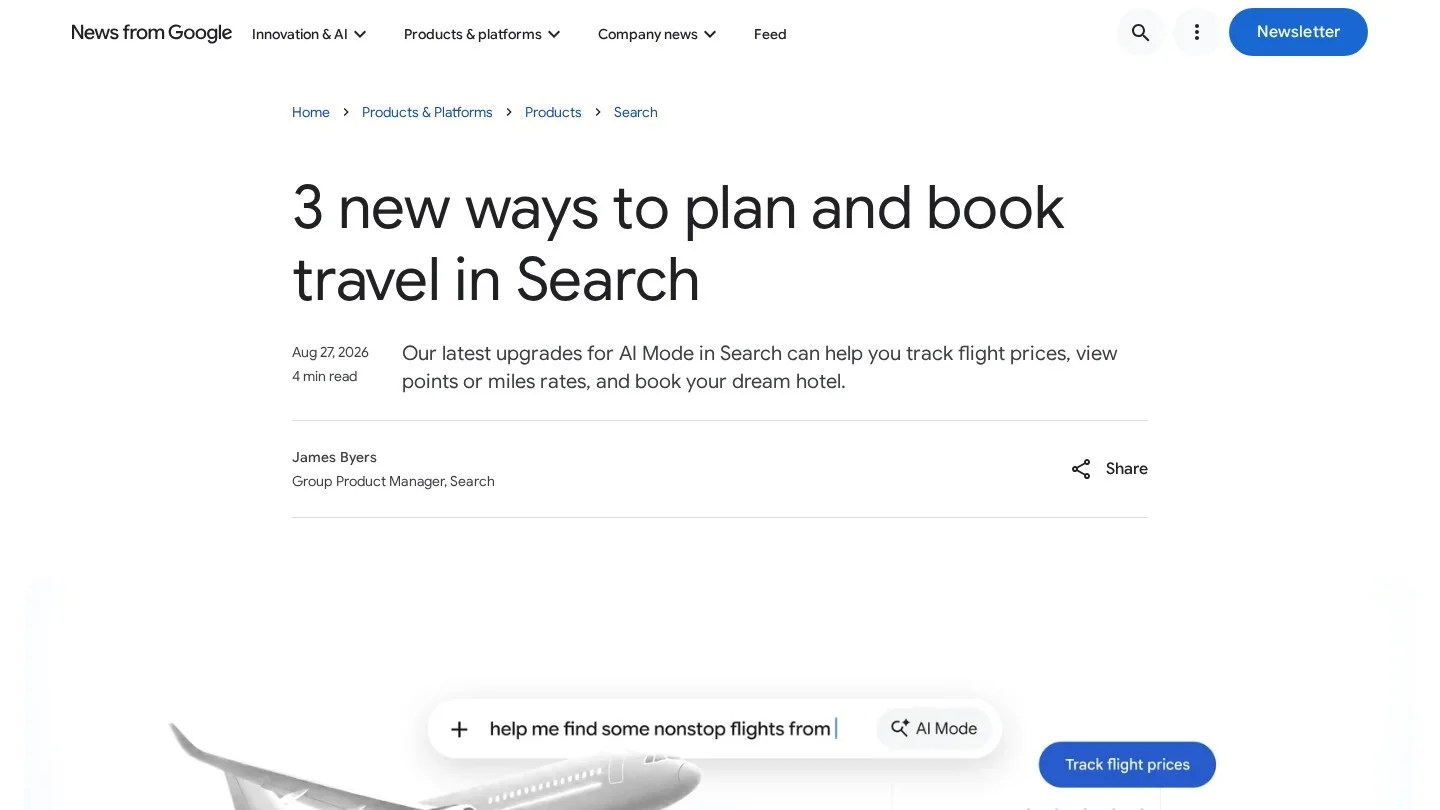
Google announced on August 27, 2026 that US users can book hotels directly in AI Mode, in English. A “Continue on Google” button appears next to partner hotels, and payment runs through Google Pay. Named partners include Booking.com, Expedia, Hilton, IHG, Marriott and Trip.com, among others.
Still, Google does not take over the booking itself. The hotel or booking site stays the merchant of record and handles customer service. For flights, AI Mode tracks prices across more than 300 airlines and travel sites. But you still buy the ticket on the airline’s site or another booking platform.
Before that, Google rolled out agentic restaurant booking in AI Mode in the US. It works with reservation partners such as OpenTable and Resy. So dinner and the hotel can now sit in one planning session.
Kayak Swaps Search Boxes for Plain Questions
Kayak launched AI Mode, built on ChatGPT and Kayak’s own price data, for US users on desktop and mobile web. In April 2026 the feature became Ask AI, which sits on the Kayak homepage. You type a request the way you would say it to a friend, and the agent compares current prices from hundreds of providers.
However, Ask AI is mainly a smarter front door to Kayak’s search. The value is speed, since one sentence replaces a dozen filters and date pickers.

Expedia Buys Layla and Adds Agents Across Three Brands
Expedia Group bought Layla on July 31, 2026. Layla is a Berlin startup whose chat agent builds full trips with flights, stays, food and transport. You can read our notes on Layla too. Expedia plans to plug Layla’s planning tools into its own supply and booking technology.
Then, on October 28, 2026, Expedia released more than 30 features across its three consumer brands. The Activity Planner is the part that books, since it can reserve tours and activities once a trip is set. Property Expert answers questions about a hotel from its details and reviews. Meanwhile, Vrbo’s AI Voice Agent handles common calls and passes the full context to a person when needed.
Booking.com Uses Agents on Both Sides of the Stay
Booking.com runs AI Trip Support as the first point of contact for travelers in ten countries, including the US, UK, Germany and Singapore. It answers service questions at any hour and passes harder cases to a human. Its AI Voice Support pulls up booking details on English and German phone lines.
On the hotel side, Booking.com calls Smart Messenger and Auto-Reply its first agentic tools. Smart Messenger reads property and reservation data, then suggests what to tell a guest and when. Booking.com says early tests raised partner satisfaction by 73% over its older messaging tools.
Trip.com Sees Chats Turning Into Purchases
Trip.com built TripGenie into its app as a free planning and booking assistant. At ITB Berlin in March 2026, Trip.com said about 60% of TripGenie chats now relate to booking decisions. So people now use the agent to choose what to buy, and planning is only part of its job. Our profile of TripGenie by Trip.com covers its in-trip features too.
Priceline Runs Penny on More Than Ten Agents
Priceline describes Penny as a team of more than 10 specialized agents working together. It added Anthropic’s Claude to Penny’s core for long, multi-step reasoning, while Google Cloud and OpenAI supply search and voice. Penny recommends hotels and flights based on the conversation, and it covers rental cars too. Also, Priceline says Penny users convert at a higher rate than shoppers who skip it. See our page on Penny by Priceline.
Startups That Sell the Trip Inside a Chat Window
Smaller companies move faster because they have no old booking flow to protect. Two of them show how far a chat-only purchase has come.
Mindtrip Sells Airline Tickets With PayPal
On May 6, 2026, Mindtrip launched flight booking inside its chat. Sabre supplies live airline inventory, and PayPal handles checkout, so the traveler never leaves the conversation. Mindtrip and Sabre said hotel booking would follow later. Our Mindtrip profile lists its price alerts and group trip features.

Otto Books and Fixes Business Trips by Chat
Otto has booked flights and hotels for business travelers since its public launch. In July 2026 it added rental cars at no extra cost, using each company’s negotiated rates. Travelers can modify or cancel a booking in the same chat, and human agents stay on call around the clock. Otto also learns loyalty numbers and car preferences, so the traveler stops typing them in. Read more on our Otto page.
Read also: Smart AI Agents for Travel Expense Auditing
Corporate Travel Platforms Where Agents Already Carry Support
Business travel has rules that leisure travel lacks, such as spend limits and approvals. Even so, business travel is where vendors publish the clearest workload numbers.
Navan Ava Resolves Most Support Requests
Navan says its AI agent, Ava, resolves 60% of support requests, with a customer satisfaction score of 78. Ava handles anything from policy questions to trip disruptions. A separate Waiver Agent watches airline waivers and alerts travelers to rebook before they get stuck. Navan also uses voice agents that call hotels to hold rooms for late arrivals. Our notes on Navan Ava go deeper.
Perk Lets Staff Book Travel From Claude or ChatGPT
Perk, the company formerly called TravelPerk, expanded its connection for AI assistants on August 19, 2026. Through its MCP server, employees can search flights and cancel hotel bookings from Claude or ChatGPT. Any out-of-policy booking goes straight into the company’s existing approval flow. Managers can also approve or reject those requests from their own assistant. That setup is a live case of one agent handing work to another system, and our Perk page has the details.
An Airline That Takes Bookings by Text or Voice
Air India built eZ Booking for members of its Maharaja Club loyalty program. A member types or says their travel plans, and the agent builds an itinerary. The member can then edit it or accept it and pay. Changes work the same way, by text or voice, with no screen-by-screen menus.
The feature grew out of AI.g, Air India’s virtual agent for customer questions. When eZ Booking launched, Air India said AI.g had answered over 7 million queries and handled 97% of them without a human. So the airline had real service data before it let an agent touch bookings.
Trips That Still Need a Human on the Phone
Agents do well on single, clear requests. But in our research, most companies we studied keep people in the loop for the messy cases. Booking.com and Otto both pass hard cases to staff, and so does Vrbo’s voice agent. Navan’s own number tells the same story, because 60% resolved by AI also means 40% still need a person.
These are the trips where we would still call someone.
- Mass disruptions, such as a storm grounding a hub, when seats run out fast and someone has to make trade-offs.
- Group bookings with split payments, room blocks or special contracts.
- Multi-country trips where visa or entry rules change the route.
- Refund disputes, where a human can bend a rule and an agent usually cannot.
Even so, Perk now shows eVisa and ETA entry requirements inside its MCP connection. That moves one of these jobs part of the way toward software.
Travelers Still Hesitate to Hand Over the Card
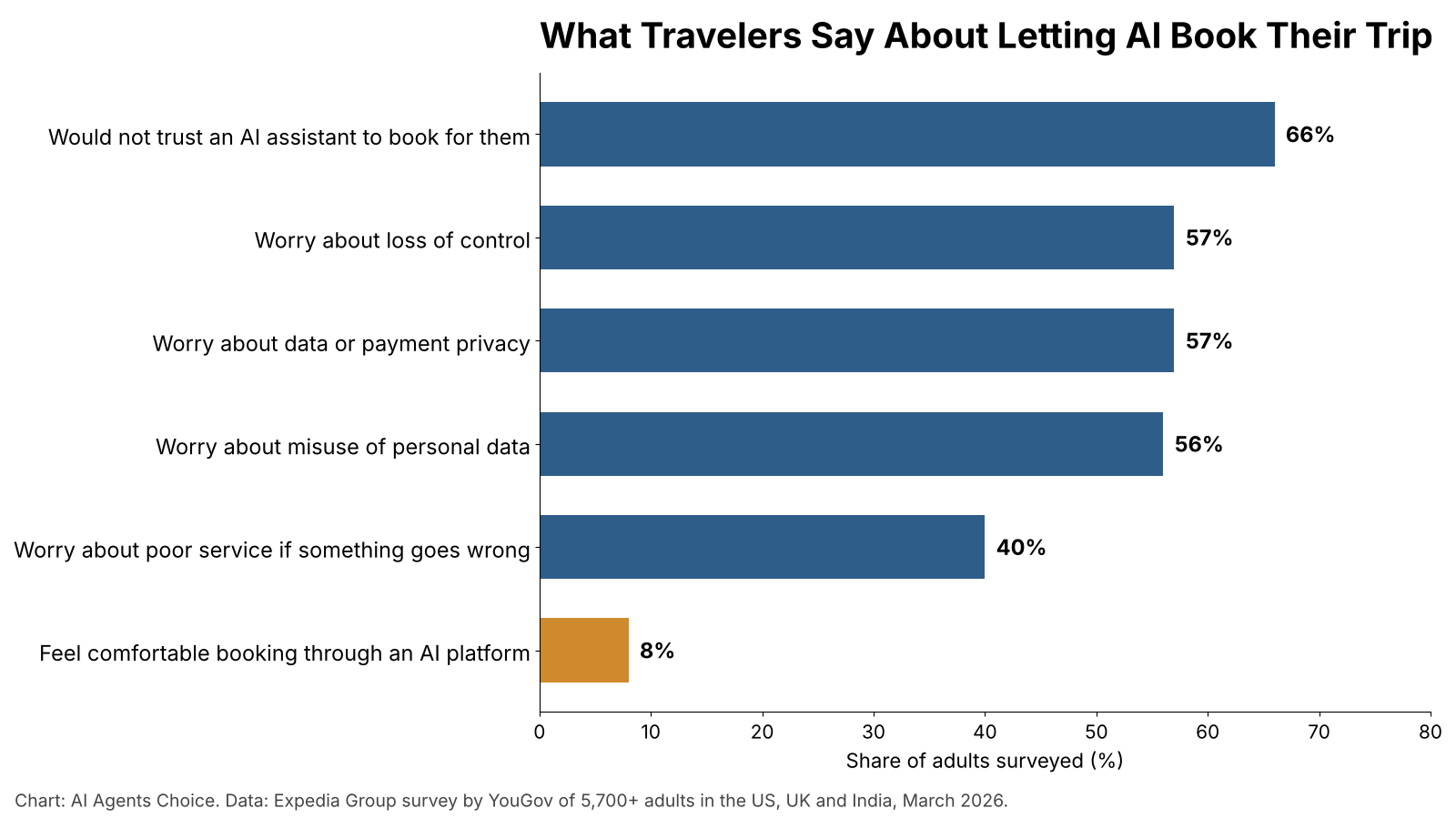
Trust is the slowest part of this shift. In April 2026, Expedia Group published a YouGov survey of more than 5,700 adults in the US, UK and India. Only 8% said they felt comfortable booking through an AI platform. Meanwhile, 66% said they would not trust an AI assistant to buy or book on their behalf.
Still, the same survey shows people like AI for the early steps. For example, 53% were comfortable letting AI suggest travel options, and 40% used it to build itineraries. So the gap sits right at the payment step.
What Can Go Wrong When Software Holds Your Card
Most risks come from one question. Who fixes the trip when the agent gets it wrong? Google’s answer is clear, since the hotel or booking site stays the merchant of record and owns customer service. You should find the same answer for any agent before you let it pay.
Confirm Who Holds the Booking
First, check whether the agent books on its own platform or passes you to a partner. A partner booking means the partner’s change and refund rules apply. As a result, your support path may run through a company you never visited.
Read the Summary Before You Approve
Next, read every date and name the agent shows before you confirm. A wrong airport code or an extra night costs real money, and fixing it later may carry a fee. In the Expedia survey, 57% of adults named loss of control as a worry, which is exactly this risk.
Limit What Personal Data the Agent Keeps
Also, agents that remember loyalty numbers and passport data save time. But they also hold more of your data in one place. In the same survey, 57% worried about data or payment privacy and 56% about misuse of personal data.
Keep Company Policy in Charge
For business trips, the agent should obey the company’s travel policy, the way Perk routes out-of-policy bookings to approval. Then finance can audit every claim after the trip, which we cover in our guide to AI agents for travel expense auditing.
Traveler Doubts About AI Booking, Answered
Can an AI Agent Book a Flight for Me Today?
Yes, but only on some services. Mindtrip sells flights inside its chat with PayPal checkout, and Otto books flights for business travelers. Google AI Mode tracks fares, but you still buy the ticket on another site.
Is Booking Through an AI Agent Safe?
It is as safe as the company behind it. Check who is the merchant of record and who handles changes. Also, check whether a human team backs up the agent when things go wrong.
Will AI Agents Replace Human Travel Agents?
Not for complex trips yet. Most services we researched still hand hard cases to people. However, routine support is moving to agents quickly, as Navan’s 60% figure shows.
How Is a Travel Agent Different From a Travel Chatbot?
A chatbot answers questions, while an agent takes actions such as booking or cancelling. Our explainer on AI agents versus AI chatbots covers the difference in more depth. For the bigger picture of assistants that act across apps, see our piece on personal AI operating systems.
Related AI Agents




Read also: AI Agents for Enterprise Knowledge Management
Explore Agent Categories
Related Articles
 GuidesSmart AI Agents for Travel Expense Auditing
 GuidesSynthesia AI Video Usage Among Corporate Training Teams
 GuidesBest CAMEL AI Alternatives and What They Cost
 Guides100 AI Agent Statistics for Retail Companies
 GuidesLLM or AI Agent? AI Search Engines and What They Actually Are
 GuidesCan You Trust an AI Agent?
